How to Choose an Accounting System? A Roadmap for SMEs from Bookkeeping to Reporting|Accounting System Recommendations

A comprehensive guide for Taiwanese SMEs on selecting an accounting system: from compliance with business accounting laws, electronic invoicing integration, OCR recognition, automatic generation of the three key financial statements, to comparing cloud vs on-premises options, a seven-step implementation process, and cost evaluation; this article helps you understand how to select the right accounting system.
An accounting system is the core tool for SMEs to digitize their daily bookkeeping, invoice management, and financial reporting. It upgrades the traditional model of manual Excel or outsourced accounting firms to a modern process that automatically classifies vouchers, recognizes invoices with OCR, and generates the three major financial statements in real-time. According to Taiwan's "Business Accounting Law," every transaction must have a voucher, and the income statement, balance sheet, and cash flow statement are legally required documents, with account books needing to be retained for 10 years and vouchers for 5 years; selecting a compliant accounting system that integrates electronic invoicing is the most straightforward and labor-saving way for SME owners to ensure compliance. The Ministry of Finance in Taiwan has fully promoted electronic invoices; businesses still relying on manual bookkeeping not only suffer from low efficiency but also have a higher risk of regulatory gaps during audits. This article starts from the question of "why do we need an accounting system" and introduces the core functions, key purchasing considerations, implementation steps, and cost evaluations, helping SME owners in Taiwan understand bookkeeping to financial reporting in one go.
Why Do SMEs Need an Accounting System?
Article 14 of Taiwan's "Business Accounting Law" states that every transaction by a business must be recorded with a voucher; Article 65 requires that annual financial statements must be completed within two months after the end of the accounting year; Article 38 mandates that account books must be retained for at least 10 years and vouchers for 5 years. For an SME with fewer than 30 employees, it is nearly impossible for accounting staff to manually input all data and meet deadlines without errors, and long-term data retention needs a systematic digitization solution.
The accounting system addresses three core pain points:
- Time Costs: Manually entering each invoice traditionally occupies accounting personnel for three to five days during month-end closing; an automated system with OCR recognition can significantly reduce this time.
- Error Risks: Manual input inevitably leads to typos and misclassifications; the system’s automatic matching and anomaly detection can alert before problems escalate and are easier to handle during audits by regulatory authorities.
- Information Timeliness: Business owners only know whether they made a profit or loss last month after the month-end closing; the system allows for the three major financial statements to be generated at any time, providing clear cash flow visibility, beneficial for making timely business decisions.
In a nutshell
The accounting system transforms "knowing at month-end" into "knowing every day," upgrading accountants from data entry workers to financial analysts.
Essential Features of Accounting Systems in Taiwan
A good accounting system is not just accounting software; below are the key core functions that Taiwanese SMEs should confirm when purchasing:
Table: Core Function Features of Accounting Systems for Taiwanese SMEs
| Function Item | Description | Corresponding Taiwan Regulations |
|---|---|---|
| Voucher Management | Online issuance and classification of receipts, transfer orders, and allowances | Article 14 of the Business Accounting Law |
| Invoice OCR | Photo or PDF upload, automatically identifying buyer, seller, amount, and uniform invoice number | Key points of electronic invoicing implementation |
| Electronic Invoice Integration | Supports three-part, two-part, and cloud invoices, transferring to the Ministry of Finance platform | Article 32-1 of the Value-Added and Non-Value-Added Business Tax Law |
| Three Major Financial Statements | Automatic generation of income statement, balance sheet, and cash flow statement | Article 28 of the Business Accounting Law |
| Bank Reconciliation | Import bank statement, automatically match entries | — |
| Accounts Receivable and Payable Management | Accounts receivable tracking, accounts payable reminders | — |
| Multi-Company / Cost Center | Account separation for multiple companies or branches and consolidated statements | — |
| Accounting Firm Export Format | Compatible with mainstream formats like Dingxin, Yongyou, and Zhenghang | — |
| Account Book Preservation | Preserve and back up accounts for 10 years and vouchers for 5 years | Article 38 of the Business Accounting Law |
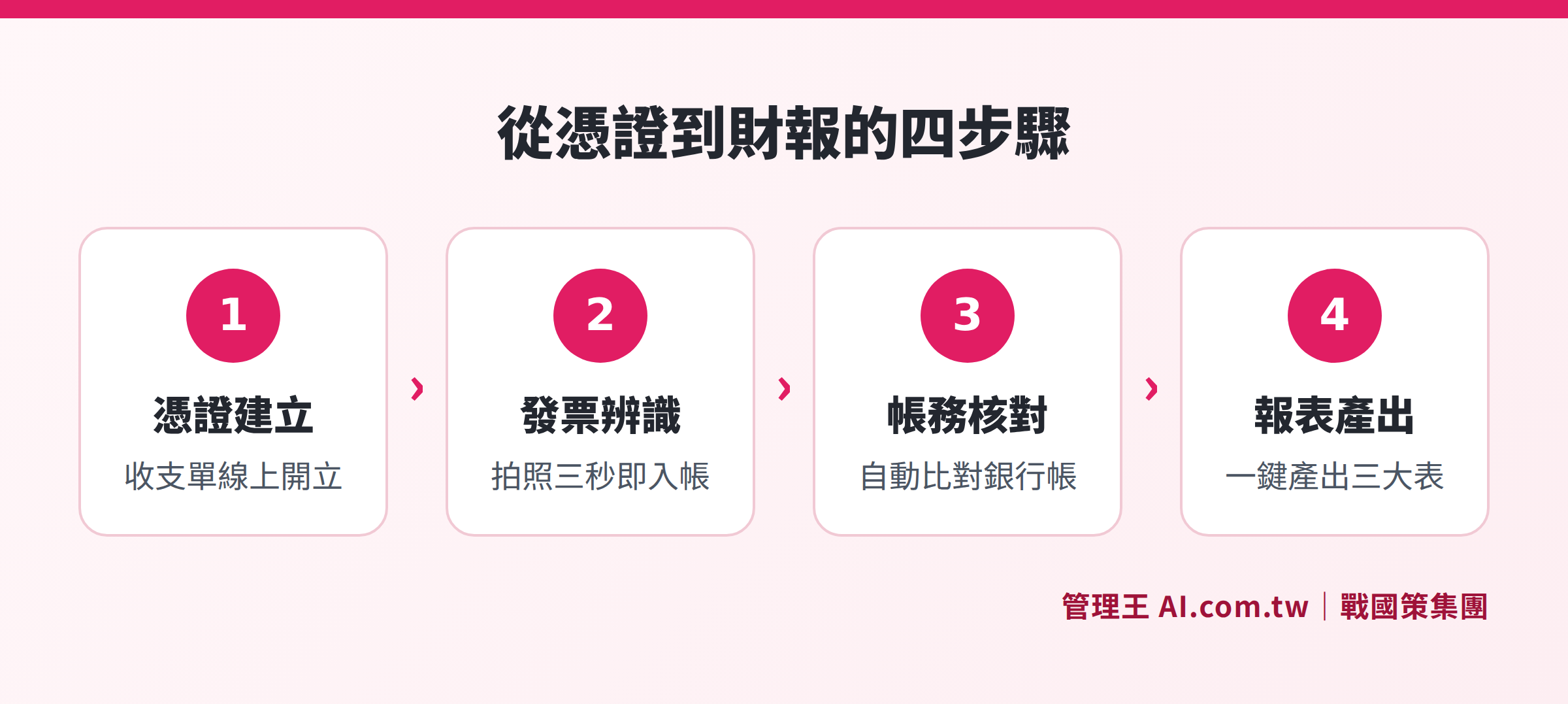
Six-step process from voucher input to automatic generation of three major financial statements
Electronic Invoice Regulations: Key Points of the New Regulations for 2025
The Ministry of Finance continues to promote the widespread adoption of electronic invoices. According to Article 32-1 of the Value-Added and Non-Value-Added Business Tax Law, businesses must comply with the electronic requirements announced by the competent authority when issuing invoices and transfer data through the Ministry of Finance's electronic invoicing integration service platform.
Three Common Types of Invoices:
- Three-part Uniform Invoice: Mainstream for B2B transactions, both buyer and seller retain one copy; the system must support uniform invoice number verification and input tax offsets.
- Two-part Uniform Invoice: Commonly used in B2C retail, allowing the issuance of cloud invoices for consumers to redeem rewards via mobile devices.
- Cloud Invoice (Electronic Carrier): A paperless trend where consumers store invoices on mobile barcodes, personal certificates, or credit cards.
When purchasing an accounting system, be sure to confirm "whether it has integrated with the Ministry of Finance's electronic invoicing integration service platform" to avoid the problem of purchasing a third-party invoice server, which incurs dual costs and data fragmentation.
How to Choose the Right Accounting System? Five Key Assessment Indicators
1. Compliance with Taiwanese Regulations
Does the system design comply with the "Business Accounting Law," support electronic invoice transmission, and can it export in formats familiar to accounting firms (Dingxin, Yongyou, Zhenghang)? The tax logic in Taiwan is significantly different from Western systems; directly bringing in QuickBooks or Xero will require extensive customization.
2. Invoice OCR Accuracy Rate
Given the variety of invoice formats in Taiwan (three-part, two-part, cash register type, electronic carriers), the OCR recognition rate of Taiwanese formats directly affects the manual correction workload of accountants. It is advisable to request vendors to provide real OCR recognition results using "Taiwan invoice test samples" during evaluation.
3. Integration Depth with Other Business Systems
If the accounting system is independent of CRM, procurement, inventory, and payroll, it will still require significant manual reconciliation every month. A system with native integration allows sales quotes to automatically trigger accounts receivable and payable without redundant data entry, only needing the accountant to review.
4. Support for Multiple Companies and Cost Centers
Group or multi-brand enterprises need to account separately by legal entity and also require consolidated statements. Evaluate whether the system supports "simultaneous logins for multiple companies," "inter-company offsets," and "automated generation of consolidated income statements."
5. Implementation Support and After-Sales Service
Implementing an accounting system requires aligning existing chart of accounts, importing historical data, and training accounting personnel; whether the vendor offers implementation consultation and has a local service team in Taiwan directly affects the stability after going live.
Cloud Accounting System vs. On-Premises Software: How Should SMEs Choose?
Taiwanese SMEs often face the choice between "cloud subscription" or "one-time purchase of on-premises software." Each has applicable scenarios:
Table: Comparison of Cloud vs. On-Premises Accounting Systems
| Comparison Item | Cloud Subscription | On-Premises Purchase |
|---|---|---|
| Initial Costs | Low (monthly or yearly payment) | High (one-time licensing fee) |
| Maintenance and Updates | Automatically pushed by vendor | Must upgrade manually or pay maintenance fees |
| Data Access | Any device, anywhere | Limited to installed machines |
| IT Resource Requirements | Almost zero | Requires servers and IT staff |
| Regulation Updates | Immediate updates by vendor (including electronic invoices) | Based on versions, requires manual upgrades |
| Scalability | Flexible adjustments based on the plan | Limited by authorized quantity |
| Target Audience | 10-100 people, multi-point, no IT department | Special information security requirements, no network environment |
For most Taiwanese SMEs, a cloud subscription is the more pragmatic choice: it saves on server procurement and IT maintenance costs, and when there are updates in regulations (like new electronic invoice regulations), the vendor will push those directly without requiring manual tracking. On-premises software is suitable for industries with special security regulations (like government contract vendors needing to keep data from leaving) or unstable network environments in manufacturing sites.
Complete Cost Analysis of Accounting Systems: How to Evaluate Subscription Plans?
Many SME owners hesitate at the "monthly subscription fee of a few thousand" but often find that when all costs are itemized, the total cost of ownership (TCO) for the subscription can actually be lower.
Invisible costs to consider during evaluation:
- Accounting Staff Overtime Pay: Overtime hours for manual reconciliation at month-end, according to Article 24 of Taiwan's Labor Standards Act, overtime pay must be 1.34 times regular wages (for the first two hours) and 1.67 times (beyond two hours).
- Error Correction Costs: Hours spent re-auditing and correcting mistakes from manual entry and misclassifications.
- Outsourcing Bookkeeping Fees: Monthly fees charged by external bookkeeping offices based on transaction volumes, which increase with complexity.
- Compliance Risks: Potential fines for underreporting, late reporting, or unclear accounts; according to Article 71 of the Business Accounting Law, inaccurate bookkeeping may incur fines up to NT$150,000.
For an SME with 15 employees, if subscribing to a complete cloud accounting system can reduce the accountant's monthly overtime by 10 to 15 hours, the costs saved often exceed the monthly fee. Furthermore, an All-in-One platform that integrates CRM, procurement, and payroll can further save on multiple software subscription fees.
Steps to Implement an Accounting System for SMEs
Many owners worry that "switching systems is a big project," but a clearly structured implementation process can actually be completed within a month:
Table: Seven Steps to Implement an Accounting System for SMEs
| Step | Tasks | Estimated Time |
|---|---|---|
| 1. Requirement Inventory | Identify company organization structure, existing accounting processes, invoice types | 3–5 days |
| 2. Chart of Accounts Creation | Set according to the standard chart of accounts defined by the Business Accounting Law and confirm with the accountant | 3–5 days |
| 3. Importing Historical Data | Import customer, supplier, and product files from Excel or old systems | 1–3 days |
| 4. Integration Settings | Connect to the electronic invoicing platform and the bank reconciliation statement import format | 1–2 days |
| 5. Staff Training | Training for accounting personnel on operating the system (basic + advanced) | 1–2 days |
| 6. Parallel Run | Run old and new systems concurrently for one month to confirm consistent numbers | 1 month |
| 7. Official Switch | Close the old system and fully switch to the new system | — |
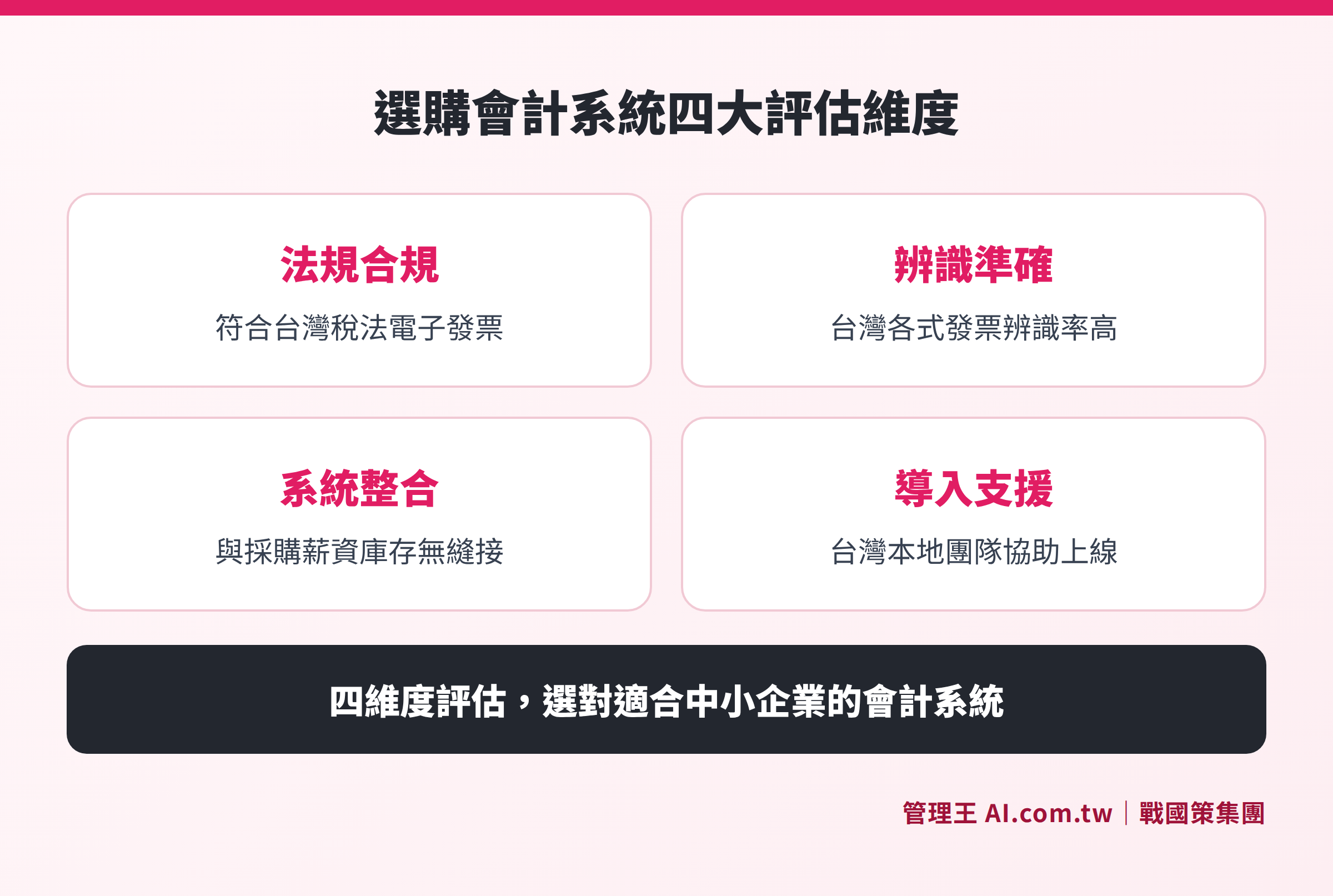
Evaluating accounting systems from the four dimensions of compliance, OCR accuracy, integration depth, and implementation services
The Integration Benefits of Accounting Systems with Payroll, Procurement, and Inventory
Many businesses procure "accounting systems" and "payroll systems" separately, but this creates data silos—after payroll is issued, the HR department needs to manually inform the accounting department to record it, repeating the same manual interfacing steps every month.
Actual benefits after integration:
- Automatic Payroll Entry: After the monthly settlement is completed, the costs of payroll, income withholding, and employer burdens for labor and health insurance are automatically converted into entries without repeated input from accounting personnel.
- Automatic Payables for Procurement: After procurement systems receive goods, they automatically create accounts payable and schedule payment dates; after payment, it automatically enters the account and matches with the bank reconciliation statement.
- Real-time Inventory Cost Updates: The inventory system automatically drives changes in the inventory account with every in-out transaction, eliminating the need for manual adjustments at month-end counts.
- Quotes to Accounts Receivable: After a quote system issues a quote and the deal is made, the system automatically establishes accounts receivable and tracks payment progress, automatically reminding when overdue amounts have not been collected.
This "native integration" model differs fundamentally from "each independently connecting APIs": the data in native integration circulates automatically within the same database, without needing extra integration or maintenance fees, and no issues arise from API disconnections that create accounting gaps.
How to Operate with 管理王: Practical Use of Accounting System
管理王 AI.com.tw Accounting System is a one-stop bookkeeping and reporting tool specially designed for Taiwanese SMEs, completing the process from voucher creation to three major financial statements without needing to switch systems.
Daily Bookkeeping Process:
- When receiving a paper invoice, take a photo with your mobile phone and upload it; the OCR recognizes the buyer, seller, amount, uniform invoice number, and item name in about three seconds, suggesting accounting classifications.
- Incoming invoices can be automatically fetched from the email (supporting electronic invoice notification emails from the Ministry of Finance) or batch-uploaded as PDFs, with a one-click import into accounting based on corresponding categories.
- Online issuance of income and expenditure statements and transfer orders, with the system automatically suggesting accounts, making it easy for administrative staff unfamiliar with accounting.
Monthly Closing Reports:
The income statement, balance sheet, and cash flow statement can be generated at any time with a single click; after importing bank reconciliation statements, the system automatically matches transactions, making differences clear; reminders for the due dates of accounts receivable and payable allow the finance personnel to process in advance.
Integration with Business Processes:
管理王’s accounting system is natively integrated with the quotation system, the procurement system, the inventory system, and the payroll system—after sales issue a quote and close the deal, the system automatically establishes accounts receivable; after procurement payment, it automatically enters the account, needing no repeat input by the accountant. Multi-company and cost center functions support account separation and consolidated statements for group enterprises.
The free plan can be used permanently, suitable for teams just starting out to first try the basic bookkeeping functions, with the option to upgrade to advanced plans as needed, without needing to link a credit card. To understand the full pricing plans, or to explore report analysis systems that visualize financial data, allowing owners to grasp the company’s financial status at a glance.
Let a consultant help you evaluate the most suitable accounting system solution
The 戰國策 Group consultants offer free interviews to assist with inventorying existing accounting processes, establishing charts of accounts, ensuring your accounting system goes live smoothly within a month.
Free consultation hotline: 0800-003-191
LINE official account: @119m
Official website: app.AI.com.tw
Free trial: Apply for 管理王 now
Frequently Asked Questions
Do SMEs Have to Use an Accounting System?
According to Taiwan's "Business Accounting Law", every transaction by a business must have voucher records, and annual financial statements must be completed within two months after the end of the accounting year, with account books preserved for at least 10 years. While the law does not mandate the use of specific software, a digital system can ensure compliance and reduce human errors, especially in today's context where electronic invoicing is fully implemented, systematic management is practically essential.
What is the Difference Between Accounting Systems and ERP?
Accounting systems focus on bookkeeping, invoicing, and financial statements; ERP (Enterprise Resource Planning) integrates cross-departmental processes like procurement, inventory, production, and sales, with the accounting module being one part of ERP. If an SME only needs bookkeeping and reporting, a standalone accounting system suffices; if cross-departmental process automation is needed, consider an integrated report analysis system or All-in-One platform.
What Are the Mainstream Accounting Systems Available in Taiwan?
Common choices for Taiwanese SMEs include: Dingxin Computer, Yongyou, Zhenghang Information (domestic old brands), QuickBooks (international brand, requires customization to fit Taiwanese tax logic), and 管理王 AI.com.tw (including AI assistance and cross-module integration). Priority should be given to checking electronic invoicing integration, Chinese interface, and local service support as three basic conditions.
Do You Need Professional Accounting Background to Operate an Accounting System?
Modern cloud accounting systems are often designed with "guided input,” where the system automatically suggests account classifications, enabling administrative staff without an accounting background to complete daily bookkeeping tasks. It is advisable to choose vendors that provide implementation training, initially assisted by an accountant to establish the chart of accounts and operational logic, with ongoing daily use managed by administrative personnel.
Can Old Data Be Transferred When Switching Accounting Systems?
Most mainstream accounting systems support importing historical entries, customer files, and supplier files from Excel or competing systems (Dingxin, Yongyou, etc.). It is recommended to adopt a "parallel running" strategy during implementation: operate both old and new systems concurrently for a full month to confirm consistent numbers before officially switching, greatly reducing transfer risks. Additionally, using an electronic signature system can fully digitize the approval process, and a third-party management system can centralize supplier information management. Once data transfer is complete, use the report analysis system to visualize financial data, helping owners quickly grasp operational conditions, and through the approval center digitalizing the financial expenditure review process to eliminate issues of paper loss and approval delays.
Data Sources
- National Regulatory Database, "Business Accounting Law", Ministry of Justice, https://law.moj.gov.tw/LawClass/LawAll.aspx?pcode=J0080009
- Ministry of Finance, "Value-Added and Non-Value-Added Business Tax Law", National Regulatory Database, https://law.moj.gov.tw/LawClass/LawAll.aspx?pcode=G0340003
- Ministry of Finance, Regulations Related to Electronic Invoice Integration Service Platform, https://www.etax.nat.gov.tw/etwmain/tax-info/innotative-tax-e-reference/startup/invoice/VOpWrNx
- 管理王 AI.com.tw Accounting System Features Page, https://app.ai.com.tw/features/accounting
This article is for general information only and does not constitute legal or tax advice; real situations are subject to the latest announcements from competent authorities.