How to Manage Advertising? FB, Google, LINE Multi-Platform Effect Tracking|Recommended Advertising Management Tools

An article to understand advertising management: from the characteristics of the three major platforms FB, Google, LINE, to a unified dashboard for multi-platform tracking, intelligent budget reallocation, UTM attribution tracking, CRM integration, helping Taiwan's SMEs marketing teams see clearly where every advertising dollar is spent.
Advertising management integrates multiple advertising platforms like Facebook, Google, LINE into a single interface, allowing marketing teams to compare spending, performance, and ROAS on one screen, eliminating the need to log into five different backends daily and manually input numbers into Excel tools and processes. In simple terms, advertising management helps you "see clearly where the money is spent, where to invest more, and where to stop immediately." One of the most common pitfalls for SMEs in Taiwan is the isolation of data across platforms — FB reports 50 conversions, Google reports 40 conversions, but the order system only shows 35 completions, leading to attribution discrepancies. The correct advertising management approach includes unified attribution, intelligent budget reallocation, and integrating CRM to calculate true ROI, forming the core infrastructure for modern marketing teams to save time and enhance advertising effectiveness.
Analysis of the Characteristics of Taiwan's Three Major Advertising Platforms
Before choosing advertising channels, it is essential to understand the audience logic and billing mechanisms of each platform to allocate resources properly based on product nature and marketing goals.
Google Ads: Precision Advertising Capturing Search Intent
Google Ads is an advertising platform centered on search intent. When users actively search for "ERP system recommendations" or "which accounting software is best" on Google, ads appear prominently at the top of the search results, with click rates significantly higher than other formats. According to Google Ads' official explanation, the main types of advertising campaigns include:
- Search Ads: Text ads appear at the top of Google search results, bidding based on keywords, suitable for consumers with high intent to purchase.
- Display Ads: Image or banner ads delivered through the Google Display Network (GDN) on thousands of partner websites.
- YouTube Ads: Six or fifteen-second ads played before or after YouTube videos, enhancing brand visual impressions.
- Performance Max Ads: Covers all Google properties such as search, display, YouTube, Gmail, Discovery, with AI automatically optimizing bids.
The advantage of Google Ads lies in its high purchase intent; consumers actively searching indicates they are already in the decision funnel, resulting in conversion efficiencies that typically surpass passive display ads.
Meta (Facebook/Instagram) Ads: Social Ads Reaching Interest-Based Audiences
The Meta advertising platform accurately targets users based on their interests, behaviors, and demographics, with a core logic of "finding the right people and showing the right ads"; even when individuals aren’t actively searching, ads can appear accurately in the feeds of target audiences.
Meta's strengths include:
- Custom Audiences: Upload existing customer lists to re-engage on Meta.
- Lookalike Audiences: Automatically expands similar groups based on the characteristics of the best customers.
- Retargeting: Uses Meta pixels to track and deliver ads to visitors who browsed the website but did not make a purchase.
It is important to note that starting January 6, 2025, Meta, in accordance with Taiwan's Fraud Prevention Act, will require all advertisers targeting Taiwanese audiences to complete identity verification for "individuals/organizations" and "beneficiaries and investors"; unverified advertisers will be unable to run ads.
LINE LAP: A Local Advertising Channel in Taiwan Not to Be Overlooked
The LINE Ads Platform (LAP) is a system designed for brands to place paid ads within the LINE ecosystem. With over 21 million monthly active LINE users in Taiwan, approximately 27% of LAP's unique audience cannot be reached on other platforms, making it crucial for marketers targeting consumers aged 35 and older, brick-and-mortar stores, and service sectors.
The main advertising placements in LINE LAP include:
- Smart Channel: At the top of the chat list, ensuring high exposure.
- LINE TODAY: News page, suitable for brand awareness ads.
- LINE VOOM: Short video feed, ideal for video content.
- LINE Wallet and POINTS Task Wall: Precisely reaching paid and points pages.
LINE LAP's billing methods include CPC (Cost Per Click), CPM (Cost Per Mille), and CPF (Cost Per Friend Added), with a low entry threshold; testing budgets start at around NT$100 per day.
Table: Comparison of Taiwan's Three Major Advertising Platforms
| Platform | Audience Logic | Main Billing | Taiwan's Greatest Advantage |
|---|---|---|---|
| Facebook/IG | Interest and behavior targeting | CPM, CPC | Precise audience, retargeting, Lookalike |
| Google Ads | Search keyword intent | CPC, CPM | High purchase intent, covers all Google properties |
| LINE LAP | Daily usage habits | CPC, CPM, CPF | 21 million users in Taiwan, 27% unique reach |
The Current State of Taiwan's Digital Advertising Market: Why Systematic Management is More Needed Now
According to the "2025 Taiwan Annual Digital Advertising Statistics Report" released by the Digital Media Application and Marketing Association (DMA) in August 2026, Taiwan's digital advertising market reached a total size of NT$66.177 billion for the year, with a year-on-year growth rate of 3.92%; digital advertising now accounts for 73.43% of total media investment.
Several key turns in the report are worth noting for marketers:
- Video Advertising Tops for the First Time: Video advertising reached NT$19.964 billion (30.17% of the total), surpassing display ads (NT$19.509 billion) for the first time, becoming the most popular ad type.
- Social Media Accounts for 37.56%: Social media ad spending hit NT$24.856 billion, indicating that FB, IG, and LINE remain the main battlegrounds.
- Mobile Dominates the Advertising Market: Mobile ad spending reached NT$51.75 billion, accounting for 78.2%.
- Emerging Media Explodes: Retail media and programmatic outdoor advertising have a year-on-year growth rate of 30.98%.
The data above conveys a clear signal: advertising budgets are being distributed across more platforms, and marketers face a situation of "simultaneously fighting on multiple battlefields." Relying on manual dashboard switching and data consolidation is no longer enough to keep up with the competitive pace of Taiwan’s digital advertising market.
In a nutshell
Taiwan's digital advertising reached NT$66.177 billion, of which 78.2% is on mobile and 37.56% on social media - multi-platform distribution is now the norm, making advertising management systems a present necessity, not a future concept.
Five Major Pain Points of Multi-Platform Advertising
Why do more and more SMEs in Taiwan require advertising management systems? Below are the real dilemmas most frequently reflected by marketing teams:
Pain Point 1: Switching Between Platforms Consumes Time
Running ads on FB, IG, Google, and LINE means marketers have to switch between four to five different ad backends daily; each backend has different interface logics, metric names, and reporting time zones, consuming half the morning just to copy numbers.
Pain Point 2: ROAS Numbers Cannot Be Consolidated
Each platform claims its ads lead to conversions, but the total numbers often exceed actual orders due to cross-platform attribution overlaps — the same customer may be counted once by FB and once by Google, making true cross-platform ROAS difficult to calculate.
Pain Point 3: Budget Allocation Relies on Intuition, Difficult to Optimize
Without a unified view, it's hard to judge in real-time which platform has the lowest CPA and which ad has the highest ROAS; budget adjustments are often only made during the end-of-month review, meaning it takes thirty days to discover money was spent incorrectly.
Pain Point 4: Confusion of Material Versions
The same promotional activity may have different sizes and copy versions on four different platforms, with materials scattered across various backends, Google Drive, and LINE groups; updating one version requires logging in one by one, prone to errors and inefficiency.
Pain Point 5: Leads from Ads Not Entered into CRM for Tracking
If leads from ads leave inquiries and there’s no CRM integration, follow-up by sales teams is inefficient, and it becomes impossible to identify which ads actually led to sales, leaving the final ROI of the ads always a mystery.
Six Essential Core Features of an Advertising Management System
A good advertising management system goes beyond simply "putting backends on the same screen"; it must resolve the five major pain points listed above and include the following six features:
Feature 1: Unified Multi-Platform Dashboard
Integrate Google Ads, Facebook/Instagram Ads, TikTok Ads, and LINE LAP into a single interface, allowing one-stop comparison of spending, clicks, conversions, ROAS, and CPA. Marketers no longer need to switch backends, instantly seeing which platform is profitable and which is burning money.
Feature 2: Intelligent Budget Reallocation
The system automatically detects low ROAS platforms, reallocating budgets to high ROAS platforms and setting alerts for budget overruns, preventing any single ad from burning money uncontrollably without detection.
Feature 3: A/B Material Testing and Centralized Management
Built-in multi-version ad material testing, managing images, videos, and copy centrally, with cross-platform synchronization to quickly identify the highest converting version and replicate it across platforms for enhanced results.
Feature 4: UTM Attribution Tracking
Automatically generate UTM links, paired with cross-platform conversion attribution analysis, to distinguish between first-touch, last-touch, and linear attribution models, clarifying each touchpoint's contribution proportion.
Feature 5: Deep CRM Integration
Leads generated from ads automatically enter the follow-up list for salespeople, with the system automatically calculating the true LTV (Customer Lifetime Value) and ROI for each ad after the sales follow-up, so that what the boss sees is not just click numbers, but actual revenue.
Feature 6: Automated Advertising Health Check Reports
Regularly send automated advertising health check PDFs to supervisors, summarizing performance, budget usage, and optimization recommendations, allowing decision-makers to grasp advertising status without needing to log into the system.
Table: Corresponding Pain Points of Advertising Management Functions
| Feature | Solves Pain Point | Benefit |
|---|---|---|
| Unified Multi-Platform Dashboard | Time-consuming backend switching | Manage all ads in one screen |
| Intelligent Budget Reallocation | Intuitive budget allocation | Automatic optimization, reducing waste |
| A/B Material Centralized Management | Confusion of material versions | Quickly replicate the best version |
| UTM Attribution Tracking | ROAS numbers cannot be merged | Real cross-platform attribution |
| Deep CRM Integration | Ads leads not tracked | Calculating the real ROI to the final sale |
| Advertising Health Check Report | Supervisors unable to grasp in real-time | Automatically send PDF summaries |
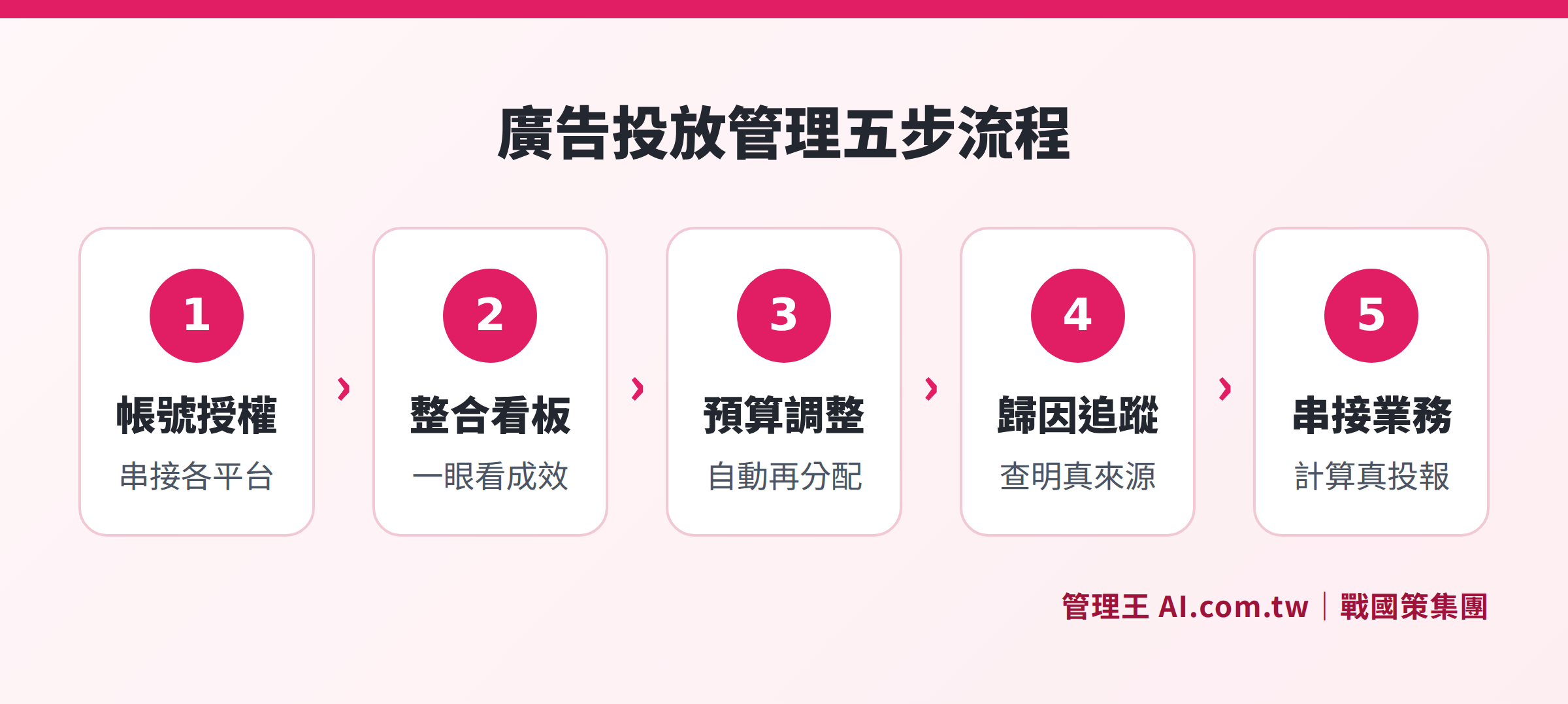
The complete advertising management process from multi-platform advertising to CRM integration, demonstrating how each function connects to solve pain points.
How to Correctly Track Advertising Effectiveness? Clarifying Key Metrics at Once
There are numerous advertising data points, but not every number is worth focusing on. Here are the core metrics that SMEs need to pay attention to the most:
Table: Key Metrics for Advertising Effectiveness Tracking
| Metric Name | Calculation Method | Description |
|---|---|---|
| ROAS (Return on Ad Spend) | Revenue from ads ÷ Ad spend | ROAS > 1 indicates a profit, the higher the better |
| CPA (Cost Per Acquisition) | Ad spend ÷ Number of conversions | Lower is better, used to compare efficiency of different ads |
| CTR (Click-Through Rate) | Number of clicks ÷ Number of impressions × 100% | Reflects the attractiveness of ad materials |
| CVR (Conversion Rate) | Number of conversions ÷ Number of clicks × 100% | Reflects consistency between landing page and ad promises |
| CPM (Cost Per Mille) | Ad spend ÷ Number of impressions × 1,000 | Commonly used for brand ads, measures reach efficiency |
| LTV (Customer Lifetime Value) | Average transaction value × Purchase frequency × Average customer lifespan | Used to assess whether ads can recoup long-term value |
UTM Parameter Structure
UTM is the standard parameter used by Google Analytics to track ad sources. The standard structure is:
`https://your-website/?utm_source=facebook&utm_medium=cpc&utm_campaign=campaign_name&utm_content=material_version`
A good advertising management system should automatically generate UTM links to avoid human input errors.
Choosing the Attribution Model
Different attribution models yield distinctly different conclusions about "who deserves the most credit":
- First-Touch: Allocates all credit for the sale to the first contact point, suitable for assessing brand awareness ads.
- Last-Touch: Allocates all credit for the sale to the last click, suitable for evaluating ads that facilitate purchases.
- Linear: Distributes credit equally across all touchpoints, suitable for long sales cycles with multiple touchpoints.
For most SMEs, it is advisable to use Data-Driven Attribution, dividing credit based on actual contribution ratios of each touchpoint; however, this requires a sufficient volume of conversion data for accuracy.
How to Choose an Advertising Management Tool? Five Evaluation Keys
When Taiwanese SMEs choose advertising management tools, in addition to functionality completeness, the following five dimensions must be carefully considered:
1. Support for Major Taiwanese Channels: Many foreign advertising management tools lack integration with LINE LAP and Xiaohongshu; if the target audience is in Taiwan, this is a significant drawback. Before selecting a tool, confirm that it fully supports FB/IG, Google, LINE, TikTok, and even Threads.
2. Does AI Functionality Incur Extra Costs?: Some tools require additional fees or subscriptions for AI text generation, budget recommendations, and audience expansion; when evaluating, consider the total cost of ownership (TCO).
3. Can It Integrate Deeply with CRM?: If the advertising tool cannot connect with the business CRM, it can only show "advertising-level ROI" without reflecting "customer transaction ROI," which often differs significantly.
4. Data Storage and Compliance: If potential customer data from ads (names, phone numbers, emails) is stored on overseas servers, caution is needed regarding the applicability of Taiwan's Personal Data Protection Act. Choose systems that store data in Taiwanese data centers for smoother auditing and compliance.
5. Language of Customer Service and Local Support: Advertising systems often encounter issues during peak activity periods; having customer support that speaks Chinese and responds instantly is much more crucial than English support tickets.
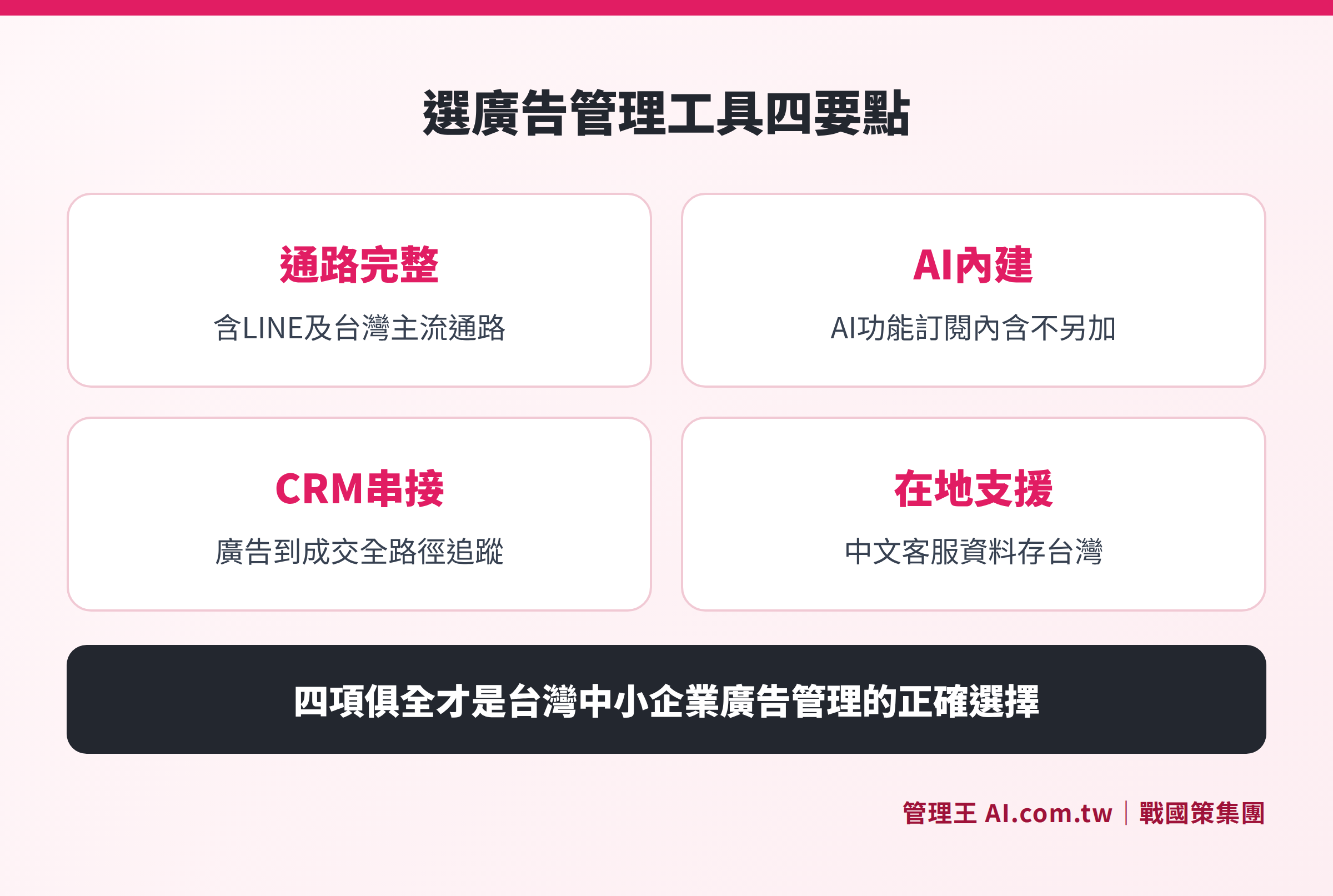
The five key evaluation factors for SMEs choosing advertising management tools, comprehensively considering channel support and data security.
Using 管理王 AI.com.tw for Advertising Management
管理王 Advertising Management System is the core module of marketing systems, natively integrated with over 70+ other 管理王 modules, requiring no API calls or integration fees. The actual operation process is as follows:
Step 1: Connect Advertising Accounts
In the 管理王 backend, authorize the connection of Google Ads, Facebook Ads, and LINE LAP advertising accounts at once; the system automatically begins syncing data across platforms.
Step 2: Set Up Unified Dashboard
In the CEO War Room or advertising dashboard, select the indicators to monitor (ROAS, CPA, spending, conversions), with numbers from each platform aggregating automatically on one screen, allowing for instant comparison of cross-platform performance.
Step 3: Set Budget Alerts and Automatic Reallocation
Set daily budget caps for each ad and ROAS targets; when the system detects low-performing ads, it automatically sends notifications and reallocates budgets to high-performing platforms, ensuring limited marketing expenses continue to flow to the best-performing channels.
Step 4: Centralized Material Management and A/B Testing
Upload images, videos, and copy to a centralized material library, creating multiple versions of ads, with the system automatically tracking the CTR and CVR of each version, identifying the best combinations for cross-platform promotion.
Step 5: Integrate CRM for True ROI Analysis
Leads generated by ads automatically enter the CRM system, with sales follow-ups and conversions automatically recorded by the system, calculating the true LTV and ROI for each ad and not just click numbers. The boss can also use the reporting analysis system for a comprehensive view of marketing effectiveness across the company.
Advertising management can be paired with social scheduling management, marketing automation, Landing Page creation, and AI SEO to form a complete marketing system, covering everything from traffic generation, conversion, to repurchase, all in one system.
The free plan can be used indefinitely, with a quick 30-second free registration and no credit card required. For advanced features, please refer to service plan pricing.
Try the Advertising Management System for Free
戰國策 Group serves 30,000 enterprises, with consultants assisting in connecting FB, Google, and LINE ads, providing a clear view of real ROI
Free consultation hotline: 0800-003-191
LINE official account: @119m
Official website: app.AI.com.tw
Free trial: Apply for 管理王 now
Frequently Asked Questions
What budget scale of companies is suitable for advertising management?
There are no scale limits for advertising management — companies with monthly ad budgets ranging from thousands to millions of NT dollars can use it. Companies with smaller budgets need systematic management more, as every penny cannot be wasted; while larger budget companies need automated tools to save labor and avoid management errors. The 管理王 free plan allows small companies to experience core functions before upgrading as needed.
How many advertising accounts can the advertising management system manage simultaneously?
This depends on the chosen plan. 管理王's advertising management under the business (NT$10,000/month) and flagship (NT$19,900/month) plans supports multiple advertising accounts and team collaborations, suitable for companies with multiple brands or markets. Please refer to the official pricing page for detailed account quantity limits.
How to solve cross-platform attribution issues in advertising?
The best practice is to adopt a unified UTM tracking structure combined with first-party data (GA4 or Pixels on the official website), along with the advertising management system's cross-platform attribution capabilities, selecting the attribution model suitable for the length of the sales cycle (use Last-touch for short cycles; use Linear or Data-driven for long cycles and multiple touchpoints). The 管理王 advertising management supports automatic UTM generation and multi-model attribution switching, allowing objective measurement of contributions from each platform.
What is the difference between LINE Ads (LAP) and FB Ads? Should both be advertised?
The logic of the two is different: FB proactively finds people based on "interest audiences," while LINE "naturally appears" in a frequently used messaging tool. In the Taiwan market, the two are highly complementary — FB is suitable for brand awareness and retargeting, while LINE is ideal for deepening engagement with the local older consumer or loyal customer groups. If advertising on both, it’s suggested to view the CPA of both platforms uniformly in the advertising management system, dynamically adjusting budget ratios based on performance rather than fixed proportions.
What is the difference between an advertising management system and a general advertising agency?
Advertising agencies provide human services, while advertising management systems offer automated tools; both can be used together. Using systems to manage data, automate budget allocation, and reporting combined with agency assistance for creative strategies and material production often represents the best combination for medium-sized enterprises. Solely relying on agencies can lead to low data transparency and loss of historical records due to personnel changes; building a management system ensures data sovereignty and allows bosses to independently verify agency performance reports.
Data Sources
- DMA Taiwan Digital Media Application and Marketing Association "2025 Taiwan Annual Digital Advertising Statistics Report" (Released August 2026)
- LINE Ads Platform Official Advertising Placements and Billing Introduction (Checked 2026)
- Google Ads Official Explanation: Available Ad Formats for Different Campaign Types (Google Ads Help)
- Meta Taiwan Advertising Delivery Verification Regulations (from January 2025) (According to Taiwan's Fraud Prevention Act)
- 管理王 AI.com.tw Advertising Management Functions Page (官方)