What is an AI Agent? 5 Scenarios Where Businesses Use AI as Employees|AI Agent Recommendations
An AI Agent is an AI system that can autonomously perceive, plan, and execute tasks. The core difference lies in its ability to "not just answer, but also take action." This article explains the definition of AI Agents, differences from chatbots, four core components, and the five most common scenarios for implementation in businesses: customer service automation, sales CRM, internal knowledge base, marketing content, and financial administration, assisting small and medium-sized enterprises in Taiwan to choose suitable AI Agent solutions.
An AI Agent is an AI system that can autonomously perceive its environment, plan, and execute tasks, with the core difference being its ability to "not just answer questions, but proactively take action." Unlike traditional AI chatbots that can only converse, AI Agents can call external tools, consult databases, create tasks, send notifications, and even link multiple steps to complete complex workflows. For small and medium-sized enterprises in Taiwan, the most direct meaning of AI Agents is that they can automate repetitive and rule-based tasks, freeing employees to focus on matters requiring judgment and creativity, effectively equivalent to hiring a digital employee on standby at an extremely low cost.
One Sentence Summary
An AI Agent is not just a "smarter ChatGPT," but a digital employee that can autonomously execute tasks, operate systems, and complete workflows, with the difference being "action" rather than just "answers."
What is an AI Agent? The Leap from Chatbots to Autonomous Action
According to IBM's definition, an AI Agent is "a system that can autonomously execute tasks and design workflows using available tools." In addition to natural language understanding, it possesses the ability to make decisions, solve problems, interact with external environments, and take actions (Source: IBM Think Topics, 2025).
Traditional large language models (LLMs, such as ChatGPT, Claude) operate by "input question → output answer," limited by training data and unable to proactively obtain the latest information or interact with external systems. AI Agents add four key capabilities on top of LLMs:
Table: Core Differences Between AI Chatbots and AI Agents
| Aspect | Traditional AI Chatbot | AI Agent |
|---|---|---|
| Execution Method | Passive Answering | Proactive Planning and Execution |
| Tool Usage | Cannot | Can Call APIs, Query Databases, Operate Systems |
| Memory Capability | Within Single Conversation | Can Retain Corporate Knowledge Across Conversations |
| Multi-Step Tasks | Needs Human Guidance | Can Independently Break Down and Complete |
| Integration Depth | Operates Independently | Can Be Embedded in CRM, ERP, Human Resources Workflows |
IBM's actual case studies show that an insurance company built a legal research assistant using an AI Agent, intelligently routing incoming legal inquiries, reducing contract review time from 90 minutes to 45 minutes, and maintaining an auditable complete record for each decision.
Four Core Components of an AI Agent
A complete AI Agent architecture includes the following four modules, understanding these components will help businesses assess and choose:
Perception Module
Receives input information, including text, documents, forms, database query results, etc., transforming unstructured information into a format understandable by the Agent.
Memory Module
Divided into short-term memory (current conversation context) and long-term memory (corporate knowledge base, historical data), allowing the AI to reference company policies, product specifications, customer records while answering, rather than relying solely on general training knowledge.
Reasoning & Planning Module
Breaks down complex tasks into executable steps, prioritizes, selects the most appropriate tools, and automatically adjusts strategies when encountering errors.
Action Module
Calls external tools (APIs, databases, system interfaces) to perform specific operations such as querying, creating records, sending notifications, updating statuses, which is the fundamental difference between AI Agents and simple chatbots.
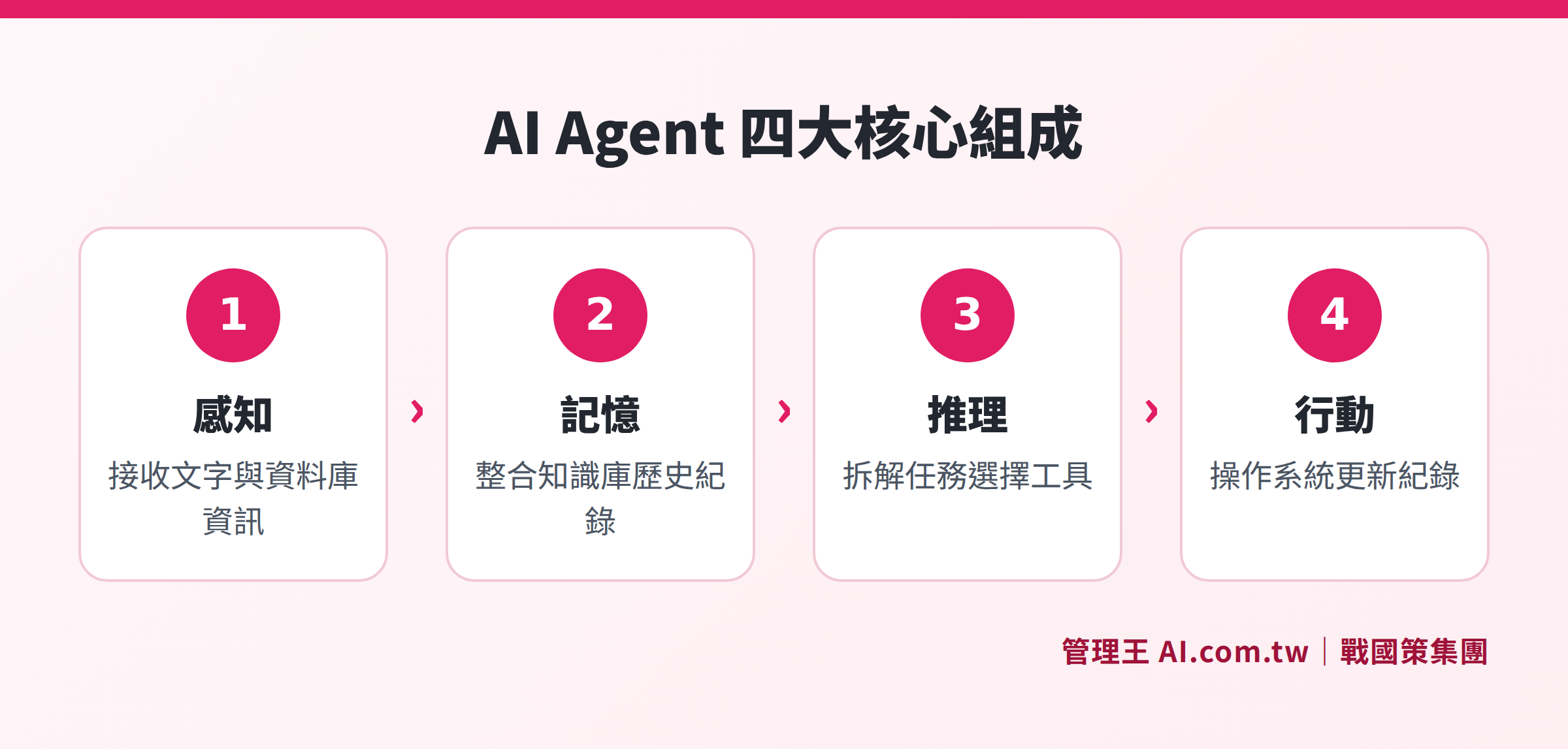
The four modules of AI Agent—Perception, Memory, Reasoning, and Action—operate in cycles, from input information to autonomous task completion
5 Core Scenarios for Enterprises Treating AI as Employees
The application of AI Agents in enterprises is not a single function but can be deployed across departments and contexts. Here are the five most common scenarios with the highest return on investment for small and medium-sized enterprises in Taiwan:
Scenario 1: Customer Service and After-Sales Automation
Traditional customer service requires employees to respond to repetitive questions one by one. An AI Agent can integrate order systems, frequently asked question (FAQ) databases, and customer data to automatically process return requests, order tracking, account issues, and service explanations within 24 hours, freeing employees from repetitive work to focus on complex complaints that require empathy.
Suitable Industries: E-commerce, Retail, Food Service, Software Services
Scenario 2: Business Development and CRM Management
An AI Agent can automate business development processes: scanning publicly available information to identify potential customers, generating personalized outreach emails based on client backgrounds, tracking follow-up statuses, and recording interactions in CRM. Sales personnel only need to review and send, significantly compressing the time from development to contact.
Suitable Industries: B2B Manufacturing, Consulting Firms, Agencies, Wholesalers
Scenario 3: Internal Knowledge Base and Employee Q&A
Standard operating procedures (SOP), regulations, and product specifications of small and medium-sized enterprises are often scattered across emails, cloud drives, and paper documents, making it time-consuming for new employees to find information. After integrating corporate documents, AI Agents allow employees to directly ask questions like "What are the payment terms for this customer's contract?" or "What is the application process for ISO certification?" with the AI providing immediate answers along with the source documents.
Suitable Industries: Manufacturing, Consulting, Medical Services, Educational Institutions
Scenario 4: Batch Generation of Marketing Content
The marketing department often needs to write copy for dozens of SKUs or hundreds of customers individually. An AI Agent can read product data and customer segmentation tags to batch-generate personalized emails, social media posts, and advertising materials with consistent quality and speed far exceeding manual writing.
Suitable Industries: E-commerce, Retail Brands, Agencies
Scenario 5: Financial and Administrative Automation
Expense reimbursements, travel requests, procurement invoicing, and payroll calculations are highly repetitive and follow clear rules, making them most suitable for automation by AI Agents. AI can read forms, compare rules, determine whether management approval is needed, and automatically route to the correct approver, significantly compressing manual reconciliation tasks at the end of the month.
Suitable Industries: Applicable across all sectors, especially for small and medium-sized enterprises with tight financial personnel.
Table: Comparison of 5 AI Agent Application Scenarios
| Scenario | Automation Focus | Labor Hours Freed | Recommended Initial Enterprise Size |
|---|---|---|---|
| Customer Service Automation | Repetitive Question Responses, Work Order Diversion | 30-50% Customer Service Personnel | 10+ People |
| Sales CRM | Outreach Emails, Follow-Up Reminders, Record Updates | 20-40% Sales Personnel | Has Sales Team |
| Internal Knowledge Base | SOP Q&A, Document Searches | 10-20% All Employees | 5+ People |
| Marketing Content | Batch Copy, Schedule Publishing | 40-60% Marketing Personnel | Has Marketing Needs |
| Financial Administration | Reimbursements, Procurement, Payroll Calculations | 30-50% Administrative Personnel | Applicable for All Sizes |
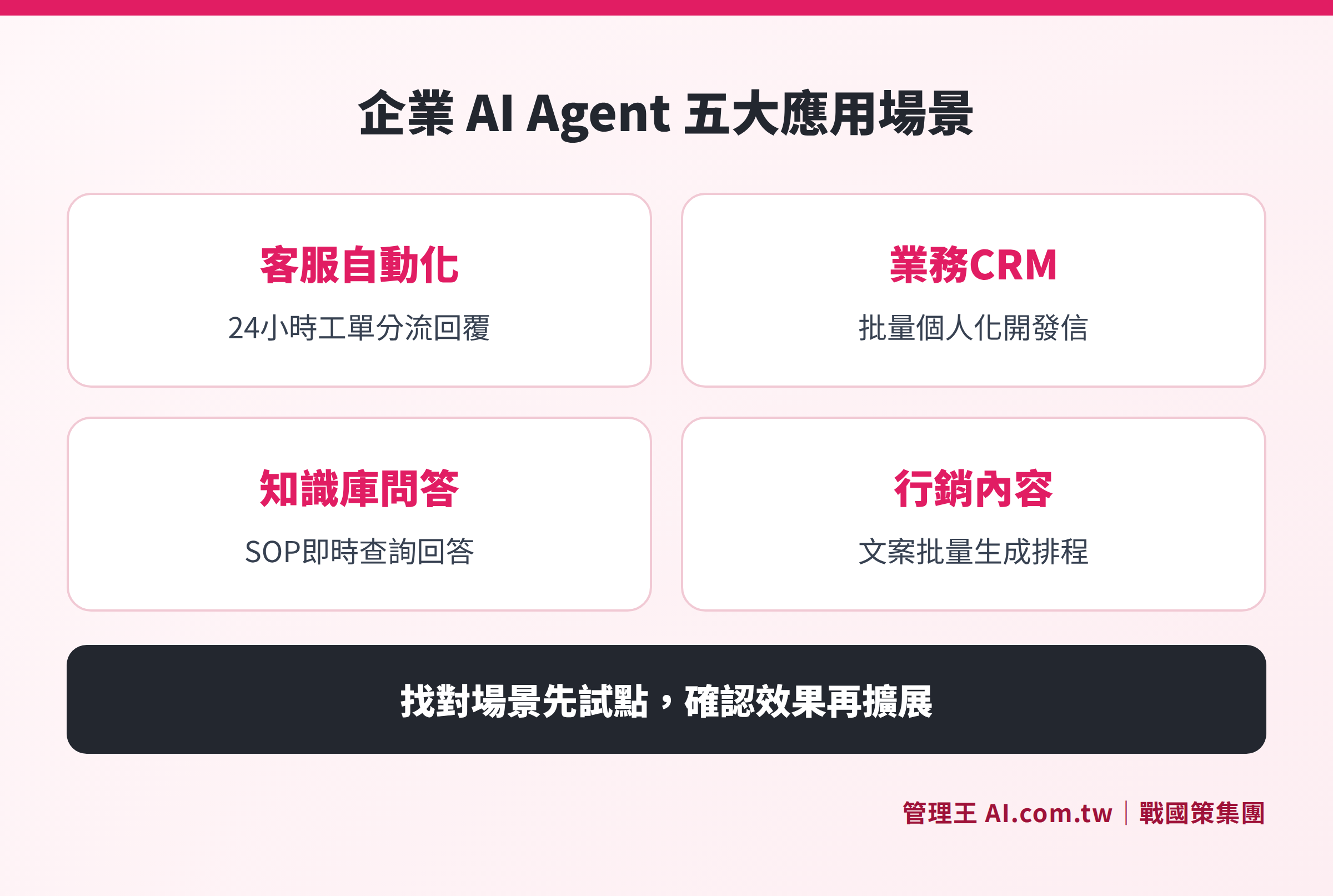
Descriptions and applicable enterprise types for the five core scenarios: Customer Service Automation, Sales CRM, Knowledge Base Q&A, Marketing Content, and Financial Administration
How to Choose an AI Agent? 5 Evaluation Points for SMEs
There are many tools on the market claiming to have AI Agent functionalities. When evaluating, small and medium-sized enterprises in Taiwan should grasp the following five core questions:
1. Can it access internal company data?
An AI that cannot read CRM, orders, or documents is just another ChatGPT, providing limited assistance to company operations. Confirm during evaluation whether the AI can natively integrate with existing systems or whether extra API development is required.
2. Does data protection comply with Taiwan regulations?
Confirm whether data is stored within Taiwan, whether it complies with personal data protection requirements, and whether conversations will be used for model training. Business secrets, customer lists, and financial data must have their privacy policies confirmed before upload.
3. Is the Chinese processing capability sufficient?
Foreign tools often have discrepancies in expressing themselves in Traditional Chinese, including wording habits (e.g., writing "影片" as "視頻") and Taiwan-specific business terminology (Unified Invoice, Labor and Health Insurance, Second Generation Health Insurance), which must be tested practically.
4. Can it take actions rather than just providing suggestions?
A true AI Agent goes beyond outputting suggestions; it can directly create tasks in systems, update client statuses, arrange meetings, and send notifications. If it can only "tell you what to do" instead of "help you do it," the automation benefits significantly diminish.
5. Is the pricing model transparent?
Usage-based, word-count-based, and subscription models have their pros and cons. For small and medium-sized enterprises, the most important aspect is that "there won't be sudden exorbitant bills"—confirm whether there are usage limits, whether overages are billed automatically, and whether point packages can be purchased.
How is AI Agent Pricing Determined? Plans and Usage Explanation
The charging methods for AI Agent tools are mainly divided into three models:
1. Pay-per-use: Suitable for businesses with unstable usage or just starting, but may result in unpredictable costs.
2. Subscription: A fixed monthly fee enjoying all features, controllable costs, currently the mainstream model for B2B enterprise AI tools.
3. Subscription + Point System (Hybrid): Basic functionalities are covered by the monthly fee, with AI usage calculated by points, allowing for purchase of excess points, balancing flexibility and control.
Taking 管理王 AI.com.tw as an example, it adopts a subscription + point system: a free plan is permanently usable, including 100 AI points per month; paid plans can be chosen according to demand without auto-debiting, allowing businesses to purchase additional points flexibly based on actual AI usage.
How to Implement Management King AI Employees?
Management King AI.com.tw's AI Employee is an AI Agent tool designed specifically for small and medium-sized enterprises in Taiwan, natively integrating with over 70 modules such as CRM, task management, accounting, and customer service without the need for additional API development.
Document and Communication Drafting: Enter the recipient and purpose, and the AI instantly generates drafts for Email or LINE messages, supporting various tones; meeting transcripts can be pasted in for summarizing key points and to-dos. Through the task management module, AI-generated to-dos can be directly assigned to members.
Knowledge Base Integration Q&A: The AI knowledge base feature allows employees to directly ask internal company questions, with AI querying uploaded SOPs, contracts, and product specifications to answer, preventing misinformation, and correct answers can be added to the knowledge base with one click for continuous optimization.
Batch Task Automation: In the marketing scenario, hundreds of similar tasks can be assigned at once, for example, generating personalized outreach emails for each client on the list; combined with the CRM system, the AI reads client backgrounds to complete each entry, requiring only review and sending by sales personnel.
Cross-Module Hands-On Operations: AI employees not only chat but can also directly query CRM customer data, create tasks in task management, and schedule meetings, truly integrating into workflows rather than being another app to switch to.
Reports and Analysis: Paired with the report analysis center, the AI automatically compiles sales, customer service, and marketing data, regularly generating operational reports, allowing managers to grasp overall company status in the shortest time.
AI Customer Service: Alongside AI employees, this customer service automation feature integrates FAQ databases and work order systems, automatically responding to common questions 24/7, with human customer service handling complex cases requiring judgment.
Marketing Automation: Combined with the batch generation capabilities of AI employees, it can automate email marketing sequences, social media copy, and advertising materials, scheduled for timely publication.
Free plans are permanently available, with a 30-second free registration to try all 100+ features without needing a credit card. For complete plan pricing, see https://app.ai.com.tw/pricing.
Three Main Types of AI Agents
Different business needs match different types of AI Agents, understanding the differences helps in selection:
Goal-based Agent: The most common form for enterprise deployment. Set clear goals (e.g., "complete customer service work order responses" or "generate this week's sales report"), the Agent plans steps autonomously, calling tools to achieve goals. Suitable for customer service automation, business processes, and financial reporting with clearly defined outcomes.
Reactive Agent: Responds immediately based on the current environmental state without long-term planning. Suitable for real-time alerts (e.g., automatically reordering when inventory falls below a threshold), rules triggering (e.g., auto-diverting work orders on specific keywords), with fast response but lower flexibility.
Multi-Agent System: Multiple specialized Agents perform their roles, coordinated by a central Agent. For example, a receiving Agent confirms an order, then notifies an inventory Agent to reduce stock, triggering a logistics Agent to arrange delivery, ultimately having a customer service Agent send shipment notifications to customers. Suitable for complex processes requiring cross-department collaboration in medium to large enterprises.
For small and medium-sized enterprises in Taiwan, starting with a "Goal-based Agent" is the most practical: focus on a single high-repetition scenario to quickly see results and then gradually expand.
Differences Between AI Agents and RPA (Robotic Process Automation)
Many enterprises have already adopted RPA tools. The main differences between AI Agents and RPA are:
RPA (Robotic Process Automation) automates fixed processes by recording operational steps, suitable for repetitive tasks with unchanged interfaces and fixed steps (e.g., importing monthly fixed-format reports), but it fails when encountering interface changes or exceptional circumstances and requires manual reconfiguration.
AI Agents understand natural language commands, judge exceptional circumstances, and automatically adjust strategies, still functioning normally in the face of unstructured data (email contents, customer messages) or situations requiring judgment (classification of complaint levels, reviewing contract terms). RPA performs fixed actions, while AI Agents handle tasks that require comprehension.
The two are not mutually exclusive; many enterprises adopt a hybrid structure of "AI Agent + RPA": AI Agents are responsible for understanding and judgment, while RPA executes specific system operations, leveraging their respective advantages.
Common Misconceptions Before Implementing AI Agents
Misconception 1: AI Agents can completely replace human labor.
AI Agents excel at handling tasks that are high in repetition and with clear rules; tasks requiring empathy, complex judgment, or creative thinking still need humans. The ideal deployment method is "AI handles the repetitive, while humans manage the exceptions."
Misconception 2: Using AI is always safe.
Data protection standards vary greatly among different vendors. Before use, it is essential to verify whether data is used for model training, the storage location of data (Taiwan or overseas), and compliance with Taiwan's personal data protection act. It is recommended to prioritize tools that retain data in Taiwan and have clear privacy policies.
Misconception 3: The more complex the AI, the better.
For small and medium-sized enterprises, tools with low learning difficulty and the ability to be quickly integrated into existing workflows often deliver higher ROI than solutions that are complex and require extensive customization.
Misconception 4: Implementing all at once.
It is recommended to pilot from a single high-repetition scenario, such as Q&A for customer service or generating outreach emails, then expand to other processes after confirming effectiveness, reducing implementation risks and allowing time for employee adaptation.
Find Professional Consultants to Assist with AI Agent Implementation
Free consultation with 管理王 consultants to learn how to integrate AI Agents into your CRM, customer service, and marketing processes, with a response within 30 minutes.
Free consultation hotline: 0800-003-191
LINE Official Account: @119m
Official Website: app.AI.com.tw
Free Trial: Apply for Management King Now
Frequently Asked Questions
What is the difference between AI Agents and ChatGPT?
ChatGPT is a general-purpose large language model that excels at answering questions and generating text, but it does not know your company's data and cannot operate your systems. An AI Agent adds tool usage, memory, and planning capabilities atop LLMs, able to read CRM customer data, create tasks, query orders, and send notifications— the difference lies in "actions" rather than just "answers." The core value of enterprises implementing AI Agents is exactly this ability to "do things for you."
How much budget is required for small and medium-sized enterprises in Taiwan to implement AI Agents?
The budget varies greatly depending on tool selection and implementation scope. For 管理王, for example, the free plan is permanently usable (including basic AI functionalities); paid plans start from NT$5,000/month (including 1,000 AI points), with a cap of NT$19,900/month (unlimited members, 10,000 AI points). The key is to assess the labor cost savings AI can provide; if saving 20 hours of labor per month, at NT$200/hour estimation, the cost can be recouped.
Will AI Agents take my company data to train models?
This depends on the privacy policy of the service provider. When selecting enterprise-level AI tools, be sure to confirm: (1) whether data is used for model training; (2) the data storage location (Taiwan or overseas); (3) whether it complies with Taiwan's personal data protection act. 管理王 has signed corporate agreements with OpenAI/Anthropic, ensuring conversations and documents are not used for model training and data is stored in Taiwan data centers, complying with local regulatory requirements.
Is it difficult to get started with AI Agents? Can regular employees use it?
There is a wide variation among tools. The ideal enterprise AI Agent tool should allow employees to use it directly in their workflows without needing to learn prompt engineering or switch systems. The design principle of 管理王 AI employees is: employees simply need to use "AI help me write" or "AI help me summarize" in their daily work, with the system-driven templates handling complex tasks without any technical background.
How many people should a company have to benefit from AI Agents?
Companies with 5 or more employees are worth evaluating. The fewer the people, the more severe the situation of each person taking multiple roles, making the benefits of AI Agents more pronounced—equivalent to hiring a tireless digital employee at an extremely low cost. Manufacturing, e-commerce, consultancy, and service industries, regardless of size, all have high-repetition workflows suitable for automation.
Sources
- IBM Think Topics — What are AI agents? (2025): Definition, architecture components, legal research case studies on AI Agents
- IBM Think Topics — AI agent use cases (2025): Classification of enterprise application scenarios
- Management King AI.com.tw AI Employee Features Page: AI Agent functions, plans, and pricing of Management King
- Management King AI.com.tw Service Plans: AI point quotas and costs for each plan