What is AI Customer Service? Features, Costs, and Steps for SMEs to Implement|AI Customer Service Recommendations
AI customer service integrates a three-tier structure of AI bot first responses, seamless human handovers, and data optimization, enabling small and medium enterprises in Taiwan to serve customers 24/7, manage messages from various channels like LINE, measure satisfaction automatically, and achieve service levels comparable to large enterprises with small teams.
AI customer service (AI Customer Service) is a customer service system centered around artificial intelligence technology, integrating natural language processing (NLP) and multi-channel communication interfaces, allowing businesses to automatically reply to customer inquiries, intelligently classify tickets, and seamlessly transfer to human agents through different channels such as LINE, Facebook Messenger, Email, and website chatboxes. Compared to traditional pure human customer services, AI customer service can operate 24/7 year-round, handle a large volume of conversations simultaneously, and seamlessly transfer full conversation context to a human agent if the bot cannot answer. For small and medium enterprise owners in Taiwan, the core value of AI customer service lies in enabling a small customer service team to produce service volumes comparable to that of large enterprises, handling repetitive inquiries (shipment inquiries, return exchanges, rate explanations) with AI, allowing humans to focus on complex cases that truly require judgment, ultimately enhancing customer satisfaction and reducing overall labor burdens. This article serves as a fundamental guide, covering the definition of AI customer service, six features, implementation steps, cost comparisons, and system selection criteria, helping small and medium enterprise owners in Taiwan make informed decisions.
What is AI Customer Service? Definition, Composition, and Operating Principles
Three Core Components
A complete AI customer service system typically operates in three collaborative layers:
First Layer: AI Bot (Automated First Response Layer)
Connecting to the enterprise knowledge base, when a customer sends a message, the AI first determines if it can automatically reply. Common inquiries (shipping schedules, return and exchange rules, product specifications) are answered by the bot in seconds, without human intervention. Modern AI customer service adopts large language models (LLMs) that understand meaning rather than merely matching keywords—"My item hasn’t arrived yet" and "Where is the package?" can be identified as the same type of inquiry, significantly enhancing automatic reply coverage.
Second Layer: Human Hand-off Layer (Human-Machine Collaboration Layer)
For issues that the bot cannot resolve, the complete conversation history is passed on to a human specialist. Customers do not need to repeat themselves, and the specialist can immediately grasp the full context upon takeover. High-value customers, complaint cases, and situations requiring personal judgment should be handled by humans, with AI blocking routine matters.
Third Layer: Data and Optimization Layer
At the end of each conversation, the system automatically records CSAT (Customer Satisfaction Scores), first response times, and resolution times, analyzing cases where AI answered incorrectly and regularly updating the knowledge base. The entire system becomes increasingly accurate over time, not relying on assumptions but accumulating real service volume continuously.
Differences Between AI Customer Service and Traditional Rule-based Chatbots
Early rule-based chatbots (FAQ bots) relied on pre-set keyword trees, often leading to irrelevant answers when customers changed their phrasing, resulting in a poor user experience. Modern AI customer service employs natural language understanding (NLU), capable of handling meaning, context, and complex inquiries, such as: "Can I exchange the blue item I ordered last week for red? How much extra do I owe?" These multi-layered questions are completely beyond the capabilities of rule-based bots, whereas AI customer service can break them down and respond progressively.
Understand it in one sentence
AI Customer Service = AI Bot (Automated First Response) + Human Handover (Complex Issues) + Data Analysis (Continuous Improvement). All three layers are essential for the system to function effectively.
AI Customer Service vs Traditional Human Customer Service: Seven Key Differences
Table: Comprehensive Comparison of AI Customer Service and Traditional Human Customer Service
| Comparison Item | Traditional Human Customer Service | AI Customer Service System |
|---|---|---|
| Service Hours | Fixed schedule (usually 9:00 AM – 6:00 PM) | 24/7 year-round service |
| Concurrent Handling Volume | One agent handles 1-2 inquiries at a time | Can handle a large volume of conversations simultaneously |
| Repetitive Questions | Require manual responses every time | AI automatically responds, freeing up manpower |
| Cross-Channel Integration | Must switch between multiple apps | Unified backend management for all channel messages |
| Conversation History | Relies on personal memory or notes | Automatically accumulates complete conversation records |
| Satisfaction Tracking | Manual surveys, difficult to sustain | Automatically sends CSAT after each conversation |
| Training Costs | New hires require weeks of training | Knowledge base updates allow for immediate operation |
Why Do Small and Medium Enterprises in Taiwan Need AI Customer Service? Analysis of Four Major Pain Points
Pain Point 1: Messages Lost Across Channels
Consumers in Taiwan are accustomed to contacting businesses through LINE, Facebook Messenger, and Instagram DM, resulting in messages being dispersed across multiple platforms. Customer service personnel switch between four to five apps daily, making it easy to miss messages during peak hours. AI customer service’s unified multi-channel inbox consolidates all messages into a single backend, ensuring no messages are missed from any channel, and automatically merges messages from the same customer coming from different channels into one customer file.
Pain Point 2: Customers Not Receiving Replies After Hours
Consumers in Taiwan are used to messaging at any time, expecting quick replies even late at night or on holidays. If customer service only responds the next day, customers may have already turned to competitors. The AI bot operates around the clock, providing instant answers to common questions, preventing customer drop-offs while they wait.
Pain Point 3: Repetitive Questions Consuming Customer Service Time
A significant percentage of customer queries are repetitive questions, such as "Has it shipped?" "How do I apply for a return or exchange?" "What specifications do you offer?" These questions require manual responses each time, which is tedious and wastes specialists' time, hindering service quality improvement. AI customer service automatically addresses repetitive inquiries through the knowledge base, allowing customer service specialists to focus on high-value cases.
Pain Point 4: Difficulty in Quantifying Service Quality
Traditional customer service relies on subjective assessments to evaluate performance, making it difficult for supervisors to articulate whether "service quality has improved this month." The AI customer service system automatically records data such as CSAT scores, response times, and resolution rates, enabling customer service supervisors to speak in numbers, allowing owners to clearly see the actual return on customer service investments.
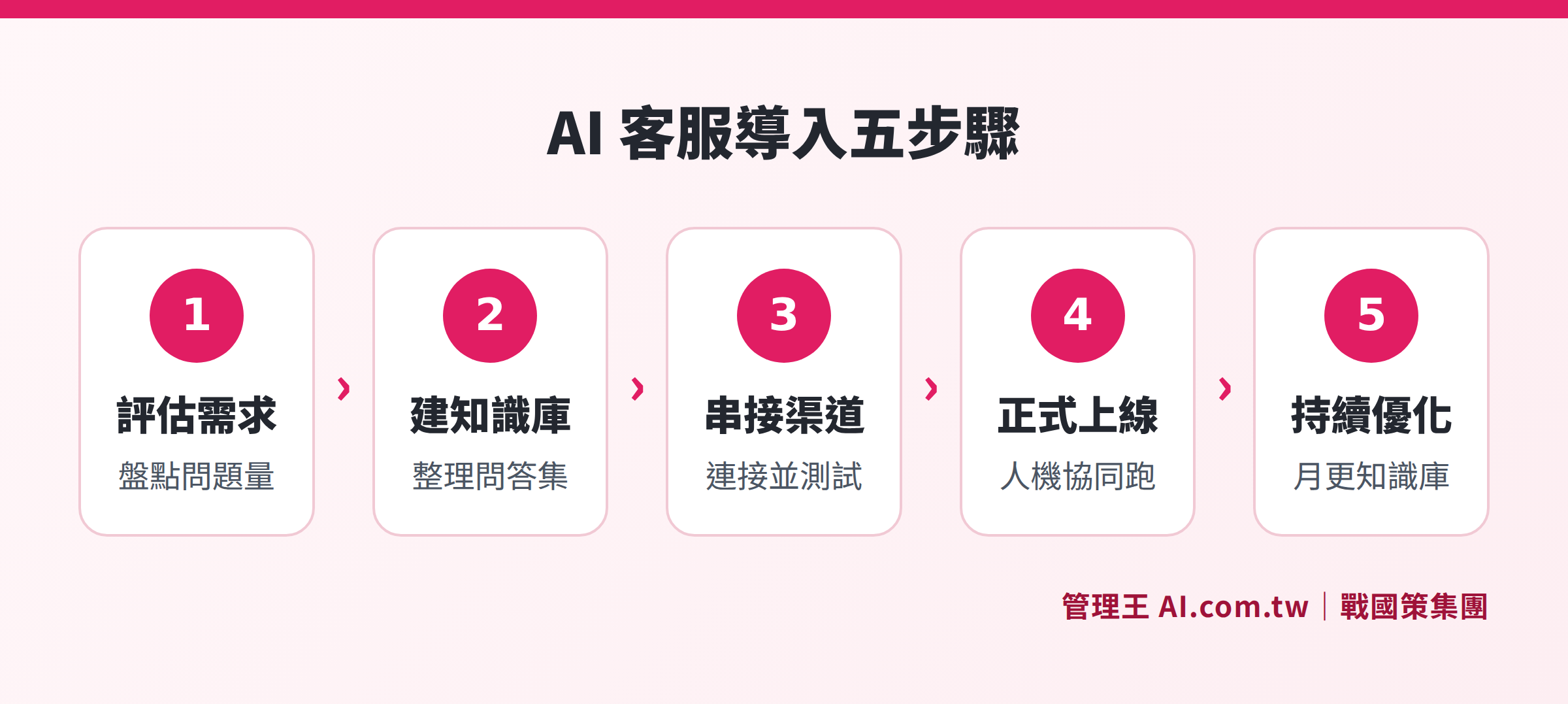
AI Customer Service implementation process: from assessing needs, building a knowledge base, connecting channels, testing launch to periodic optimization, five key steps in total
Six Core Functions of AI Customer Service Systems
1. Unified Multi-Channel Inbox
Consolidates all messages from LINE official accounts, Facebook Messenger, Instagram DM, website chatboxes, and Emails into a single backend. Customer service does not need to switch between multiple apps, ensuring no messages are missed from any channel, and automatically identifying and merging messages from the same customer coming through different channels, preventing service context loss due to channel differences.
2. AI Bot First Response
Connects to the enterprise knowledge base, with AI automatically answering common questions. For example, Management Wang AI Customer Service Center can automatically respond to about 80% of common inquiries, including business hours, return and exchange rules, shipping costs, and specifications, and remains available at night and on holidays, preventing repetitive questions from consuming human time.
3. Seamless Human Hand-off
When the bot cannot answer or the customer explicitly requests a human, the system automatically connects to a customer service specialist, bringing along the complete conversation history, allowing the agent to grasp the situation immediately, so the customer doesn’t have to repeat themselves. For VIP customers or highly emotional complaint cases, prioritizing a human transfer is crucial for maintaining customer relationships.
4. Intelligent Ticket Management
AI automatically categorizes conversations (inquiries, complaints, after-sales, returns, etc.) and opens tickets for complex cases to be assigned to corresponding personnel, setting SLA reply time limits to ensure every ticket has someone responsible for it, with time constraints for tracking. The customer service ticket system supports various distribution logics: by meaning, customer level, customer service skills, and evenly distributing based on workload.
5. Automatic Measurement of Satisfaction
Automatically sends CSAT (Customer Satisfaction Score, rated 1 to 5 stars) and NPS (Net Promoter Score) after each conversation. The customer satisfaction dashboard automatically calculates trends, with negative feedback promptly notifying supervisors for follow-up, providing specific numbers for service quality to help supervisors identify areas needing optimization.
6. AI Self-Learning
When customer service specialists modify AI responses, the system automatically learns the correct version and updates the knowledge base, with the accuracy rate increasing as service volume grows. This positive feedback loop makes the system more efficient as it gets busier— the larger the service volume, the richer the training data AI accumulates, increasing the rate of automatic handling.
Steps to Implement AI Customer Service: From Assessment to Launch
Many businesses believe that implementing AI customer service is complex and time-consuming; in fact, the basic setup of a SaaS-type AI customer service system can typically be completed within a few days. Here are the recommended five-step process:
Step 1: Assess Needs and Channels
Confirm the current main customer service channels (LINE? Email? Website?), tally the monthly inquiry volume and rate of repetitive questions, and list the top 20 to 30 most common inquiries as a basis for building the knowledge base later.
Step 2: Build the AI Knowledge Base
Organize the enterprise’s common FAQs into structured documents, including questions, standard answers, and handling of exceptions. The AI knowledge base module supports uploading Q&A pairs, PDF manuals, or web articles. Initially, it is recommended to organize 50 to 100 entries to cover the majority of inquiries.
Step 3: Connect Channels and Testing
After connecting channels like LINE and FB Messenger to the AI customer service backend, conduct internal testing to identify incorrect AI answers and correct the knowledge base. Management Wang’s AI customer service uses a training model tailored for Taiwan’s traditional Chinese, understanding vernacular Chinese and industry abbreviations, reducing instances of irrelevant answers.
Step 4: Official Launch (Concurrent Human-Machine Operation)
Initially, it is recommended that humans monitor all AI responses, confirming quality stability before gradually allowing AI to handle first replies. Set a confidence threshold (e.g., automatically transferring to a human when AI confidence is below 75%) to balance quality and efficiency.
Step 5: Regular Review and Optimization
Monthly reviews of CSAT data, AI to human transfer rates, and common failure cases, updating the knowledge base to continuously improve AI accuracy. Through the survey tool, further customer feedback can be collected for optimization purposes.
How is AI Customer Service Cost Calculated? Comparison Guide to Plans
The cost structure of AI customer service varies by vendor, with common billing methods as follows:
Subscription (SaaS): Fixed fees charged monthly or annually, based on member count or number of channels. Mainstream AI customer service SaaS plans in Taiwan range from thousands to tens of thousands of NTD per month, depending on the depth of features and level of integration.
Usage-Based Billing: Charges based on the number of AI conversation instances or API call counts, suitable for businesses with variable message volumes.
Custom Development: Charged hourly, suitable for enterprises with specific process integration needs, offering high flexibility but longer implementation times.
Be Aware of Hidden Costs: Some foreign SaaS (like Zendesk, Intercom) may require additional purchases of AI functionality modules or LINE integration plugins, and after adding exchange rates and annual fees, the total cost of ownership (TCO) is often much higher than the quoted monthly fees.
Table: Comparison of Management Wang AI Customer Service Center Plans
| Plan | Monthly Fee (NTD) | Member Limit | AI Points | Suitable For |
|---|---|---|---|---|
| Free Plan | Permanently Free | 10 People | One-time quota | Just getting started, want to try it out |
| Economy Plan | NT$5,000 | 30 People | 1,000 Points/Month | Small e-commerce, service industries |
| Business Plan | NT$10,000 | 60 People | 3,000 Points/Month | Growing enterprises, including remote training |
| Flagship Plan | NT$19,900 | Unlimited | 10,000 Points/Month | Heavy AI usage or large teams |
For complete pricing and annual payment discounts, please refer to the Management Wang pricing plans.
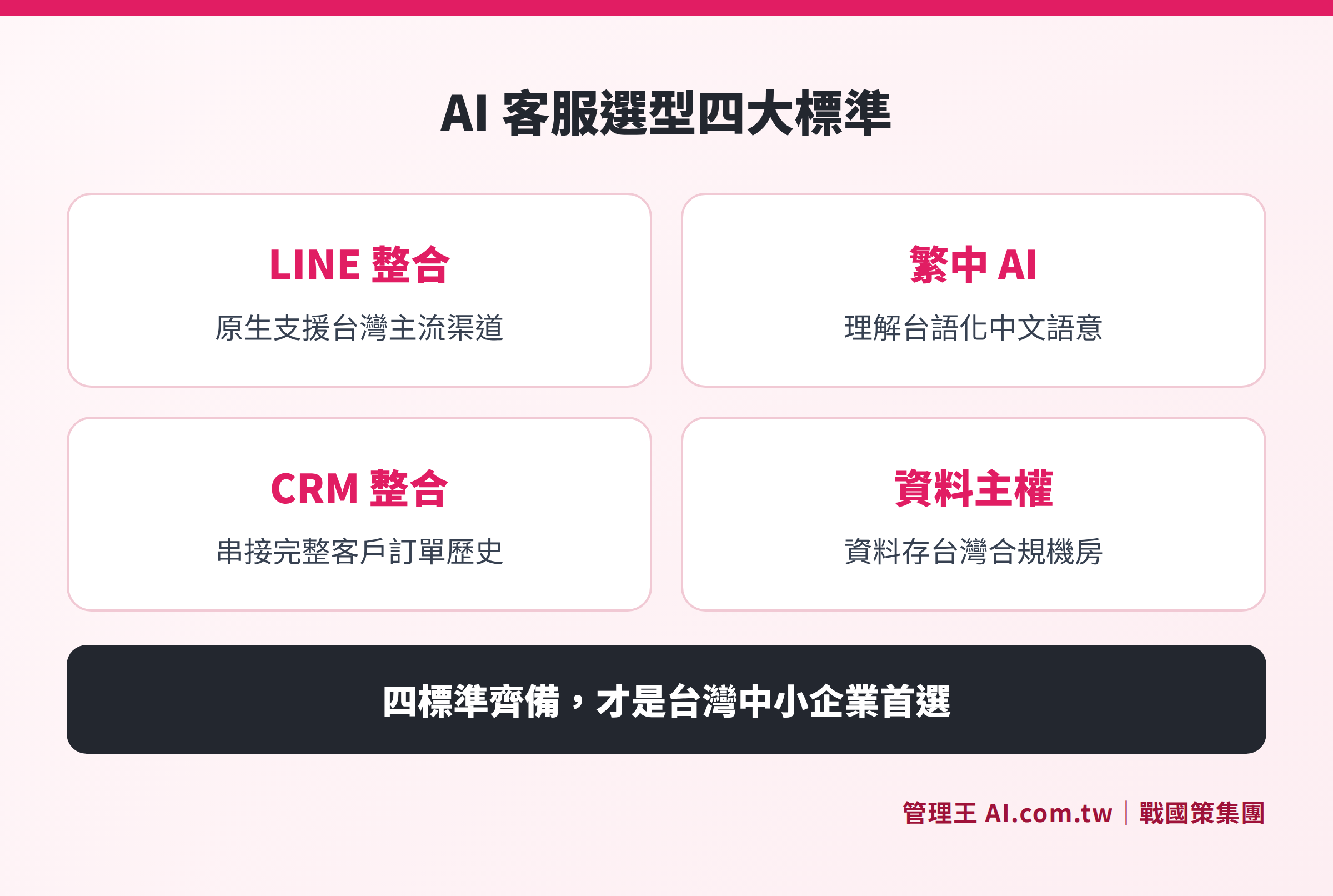
Four core standards for selecting AI customer service systems: Native integration with LINE, proficiency in traditional Chinese, depth of CRM integration, and data storage locations
How to Choose an AI Customer Service System Suitable for Small and Medium Enterprises? Five Evaluation Standards
Standard 1: Native Support for Mainstream Taiwanese Channels
LINE official accounts are the primary communication channels between businesses and consumers in Taiwan; if the AI customer service does not natively support LINE, it is essentially useless. Prioritize choosing plans that natively integrate LINE rather than relying on third-party plugins (plugins often have functional limitations and additional costs).
Standard 2: Understanding of Traditional Chinese and Taiwanese Context
Foreign AI customer service tools have varying levels of understanding of traditional Chinese; vernacular phrases ("group buying," "stepping on a landmine," "dream teammate") and industry abbreviations ("home delivery," "COD," "convenience pickup") frequently lead to misunderstandings. Select AI models trained on traditional Chinese in Taiwan to significantly reduce irrelevant responses.
Standard 3: Native Integration with CRM
If customer service can see a customer’s order history, past interaction records, and VIP level simultaneously while replying, service quality can be significantly enhanced. Choose AI customer service that can natively integrate with the CRM system, avoiding the need to pay extra for integration fees or to open APIs independently.
Standard 4: Flexibility in Ticket Distribution and SLA Tracking
Different cases require different specialists; prioritize systems that can automatically distribute tickets based on various dimensions such as meaning classification, customer grading, customer service skills, and workload, while supporting SLA time limit settings and breach alerts, ensuring numerical guarantees for service commitments.
Standard 5: Data Sovereignty and Personal Data Protection Compliance
According to Taiwan's Personal Data Protection Act, businesses using software to process personal data must ensure data security and obtain consent from the parties involved. Choose vendors that store customer data in data centers in Taiwan, ensuring compliance with regulations and being able to provide complete access audit logs during regulatory audits.
How to Use Management Wang AI Customer Service Center
The Management Wang AI Customer Service Center is the practical accumulation of services for over 30,000 enterprises by the 戰國策 group, designed as a one-stop intelligent customer service solution specifically for small and medium enterprises in Taiwan. Here is the actual operating process:
Set Up Multi-Channel Inbox: Access the backend to connect LINE official accounts, Facebook Messenger, and website chatboxes, automatically importing all messages into a unified inbox; customer service only needs to open one backend and no longer switch between multiple apps, ensuring no messages from any channels go unanswered.
Establish AI Knowledge Base: Upload the enterprise FAQs to the AI knowledge base module; the format can be Q&A pairs, PDF manuals, or web articles. Management Wang uses a Taiwanese traditional Chinese-trained model, allowing operation to begin with just 30 to 50 entries, paired with AI intelligent replies, setting confidence thresholds to ensure quality.
Configure Tickets and SLA: In the customer service ticket system, set SLA limits (for example, responding to general inquiries within 4 hours, responding to VIP clients within 15 minutes); AI automatically categorizes tickets and assigns them to the appropriate specialists, ensuring every ticket has a responsible party and a trackable time limit.
Monitor Satisfaction and Improve: The customer satisfaction dashboard automatically compiles CSAT and NPS scores, with negative feedback promptly notifying supervisors via LINE; coupled with the survey tool, it can conduct deeper customer feedback investigations to continuously optimize service.
Enhance with Full Channels: If phone service is needed, the AI phone service system can further enhance voice channels, allowing incoming calls to be initially answered by AI, automatically recording call highlights, achieving true omni-channel intelligent customer service.
Management Wang offers a free plan that can be used permanently; apply for free in 30 seconds to experience all 100+ features without needing a credit card. Annual payments enjoy additional discounts; for complete plans, see the pricing page.
Let AI help you with 24/7 customer service
Management Wang consultants assist in building knowledge bases and multi-channel integration, enabling small customer service teams to produce a service volume comparable to large enterprises.
Free consultation hotline: 0800-003-191
LINE official account: @119m
Official website: app.AI.com.tw
Free trial: Apply for Management Wang now
Frequently Asked Questions
What scale of enterprises is AI customer service suitable for?
AI customer service is suitable for enterprises of all sizes, especially small and medium enterprises that have a certain volume of customer inquiries daily but cannot afford to hire a large customer service team. As long as the enterprise has consistent repetitive questions (shipment inquiries, product descriptions, registration processes), it can effectively reduce labor burdens through AI customer service, allowing small teams to produce larger service volumes. The free plan is suitable for initial trials, and enterprises with basic needs can start with the economy plan of NT$5,000 per month.
How much time and technical capability are required to implement AI customer service?
Using Management Wang AI Customer Service Center as an example, basic setup (connecting channels, building a knowledge base, setting automatic replies) can be completed within 1 to 3 days, and staff usually need only half a day to learn how to use the system. No engineers or IT backgrounds are needed; the interface is designed in traditional Chinese. Business and flagship plans include remote implementation training, with consultants providing full assistance to speed up the launch process.
What if the AI customer service answers incorrectly? Will it make customers more dissatisfied?
The AI customer service system has a confidence threshold mechanism; when the AI is uncertain about an answer, it automatically transfers to human customer service, avoiding dissatisfaction from incorrect answers. The confidence threshold for Management Wang's AI customer service can be set yourself, with the default being to transfer to a human when AI confidence is below 75%. All AI responses are labeled "AI automatic reply" in the backend, allowing customer service to intervene and correct within 30 seconds, with incorrect answers easily added to the knowledge base for future accuracy.
Is customer data secure with AI customer service? Does it comply with personal data protection laws?
According to Taiwan's Personal Data Protection Act, enterprises using software to handle personal data must ensure data security and obtain consent from the parties involved. Management Wang’s data is stored in 戰國策 group's data center in Taiwan (with dual-room backup, ISO 27001 standards), transmitted entirely through HTTPS/TLS 1.3 encryption, and provides complete audit logs that record all operations, ensuring compliance with personal data laws and data sovereignty requirements.
Can AI customer service completely replace human customer service?
Currently, the best positioning for AI customer service is as an assistant rather than a replacement for human agents. AI excels at handling repetitive, standardized issues, but complex judgments, emotional appeasement, high-value negotiations, or legal responsibilities still require human intervention. The industry's best practice is a "AI first response, human handling of complex cases" collaborative model, allowing both to achieve maximum effectiveness, enabling a two-person customer service team to produce service volume comparable to that of large customer service teams.
Sources
- Taiwan's Personal Data Protection Act (PDPA), National Legislative Database: https://law.moj.gov.tw/LawClass/LawAll.aspx?pcode=I0050021
- Basic Law on Artificial Intelligence, National Legislative Database (Publicized on December 23, 2024): https://law.moj.gov.tw/LawClass/LawAll.aspx?pcode=A0030297
- Management Wang AI Customer Service Center Features Page, 戰國策 group AI.com.tw: https://app.ai.com.tw/features/ai-customer-service
- Management Wang Plans and Pricing: https://app.ai.com.tw/pricing