AI Customer Service System Recommendations: Key Considerations for LINE Integration and Human Handover Features|AI Customer Service Recommendations
作者:AI.com.tw
This article analyzes 7 key indicators for selecting an AI customer service system, emphasizing the essential native integration mechanism with LINE and the design points for human handover in Taiwanese enterprises. It compares the functional differences between international companies and local Taiwanese solutions, assisting small and medium-sized businesses in finding the most suitable AI customer service system recommendations.
An AI customer service system is a customer service platform that integrates multi-channel messaging, automated initial contact by bots, and seamless handovers to human agents. The two most crucial features when selecting a system are native integration with LINE Official Accounts (which has over 22 million monthly active users in Taiwan, accounting for over 93% of the population) and the fluidity of human handover—Gartner's 2026 survey shows that 87% of customers believe they should still be able to find a human when using AI customer service. If these two aspects are poorly executed, even the cheapest systems will just increase customer complaints. This article details the purchasing criteria, key functional comparisons, and how to quickly launch an AI customer service center using 管理王 AI.com.tw.
Why is LINE Integration Essential for AI Customer Service Systems?
Taiwanese people are accustomed to using LINE for communication, and corporate clients are no exception. There are over 3.6 million LINE Official Accounts in Taiwan (LY Corporation 2026 data), almost every small and medium business has an account, but most only use it to send broadcast messages, without linking it to an AI customer service backend.
What's the problem? Customer service personnel switch between LINE, Facebook Messenger, Instagram DM, Emails, and website chat boxes every day, which is not only time-consuming but also prone to missed messages. Each missed inquiry could mean a lost order or a negative review.
True LINE integration means not just forwarding LINE messages to email, but:
- Messages go directly into a unified inbox, with an AI bot responding first
- Customer service replies in the same backend while customers still see the conversations in the LINE chat window
- Supports native LINE formats such as rich menus, Flex Messages, and push notifications
- Knowledge base training and integration with LINE message context (Taiwanese phrases like "踩雷", "揪團", "貨到付款" are understood)
Before selecting a system, ask: Is LINE integration natively supported or does it require purchasing additional plugins?
Human Handover Feature: An Overlooked Yet Critical Indicator
According to Gartner's 2023 survey: 64% of consumers wish companies would not use AI in customer service; 53% said they would consider switching to competitors if a company only offered AI customer service. But this does not imply that AI customer service is ineffective—the issue lies in poorly designed human handover mechanisms.
Common human handover issues:
- Customers getting stuck in bot loops, stating "I want to talk to a human" numerous times without any results
- Once transferred to a human, the conversation history is not carried over, requiring customers to repeat themselves
- Confusion in multi-channel transfers: LINE messages forwarded to email, yet the customer service staff responsible for LINE are completely unaware
- No SLA tracking, leading to uncertainty about whether the forwarded inquiries have been picked up
Correct human handover designs should include:
- Confidence threshold: If AI confidence falls below a preset value (e.g., 75%), it automatically transitions to a human agent
- Keyword triggers: Customer phrases like "complaint", "refund", and "manager" immediately trigger a human transfer
- Complete conversation history carried over: Customer service can directly see the full context when taking over
- Post-transfer notifications: Instant LINE or system notifications to customer service indicating "new ticket available"
- SLA auto-timer: Warnings issued for unanswered tickets after a set period, and supervisors can intervene
In a nutshell
AI customer service handles repetitive issues, while human agents manage high-value matters; the seamless switch between the two is what completes a customer service system.
7 Essential Questions to Ask When Choosing an AI Customer Service System
Table: AI Customer Service System Evaluation Checklist
| Evaluation Item | Why It Matters | How to Confirm |
|---|---|---|
| Channel Coverage | Do they cover LINE, FB, IG, and Email? | Request an on-site demo |
| Native LINE Integration | Any additional fees or plugins required? | Review official pricing explanations |
| Human Handover Mechanism | Confidence thresholds, keyword triggers, history carryover | Test actual operations |
| Chinese AI Capabilities | Identification rates for Traditional Chinese and Taiwanese dialects | Test with real FAQs |
| Knowledge Base Training | How many entries reach 85% accuracy? | Inquire with the vendor |
| CRM Integration | Can customer service see customer data in real-time? | Conduct practical operation tests |
| Data Storage Location | Compliance with Taiwanese regulations and data privacy laws | Inquire about security terms |
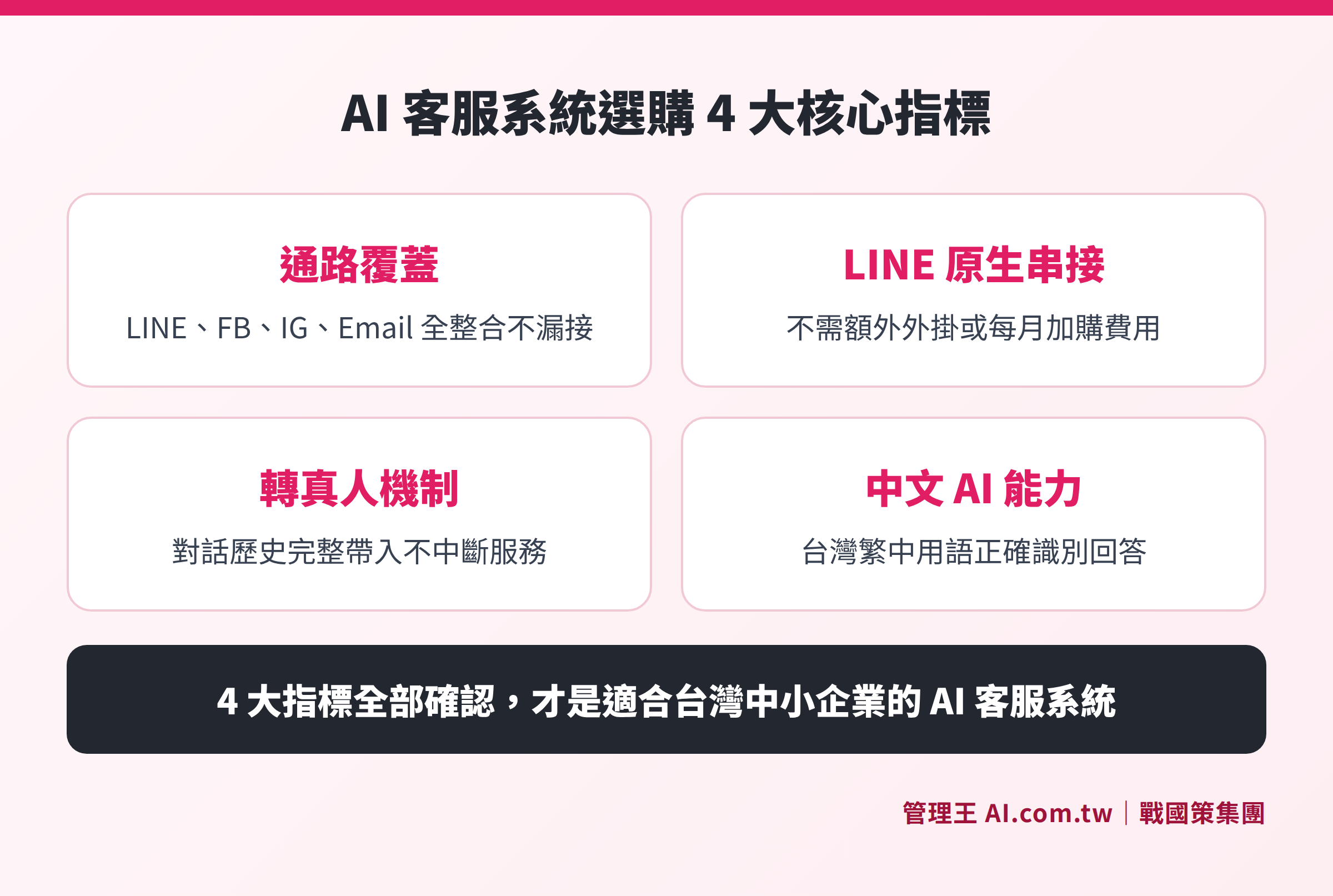
Seven key aspects to evaluate for an AI customer service system: channel coverage, LINE integration, human handover mechanisms, Chinese AI capabilities, knowledge base training, CRM integration, and data security.
In-depth Comparison of AI Customer Service System Functions
AI customer service systems on the market can be divided into three categories:
1. International Giants (Zendesk, Freshdesk, Intercom)
- Complete functionality, rich ecosystem
- High pricing: Zendesk starts at USD 55 per agent/month
- Additional purchases required for LINE integration; limited support for Traditional Chinese
- AI understanding in Chinese is primarily based on English, lacking localization for Taiwan
2. Local Taiwanese SaaS
- User-friendly Chinese interface, supports LINE
- Functional depth varies; must be verified one by one
- Usually does not include ERP/CRM/Human resource integrations
3. All-in-One management systems with built-in customer service modules (e.g., 管理王)
- AI customer service integrated with CRM, ticket system, and accounting—data sharing
- Single account management, no extra API integration fees required
- Designed for localization in Taiwan, with native LINE support
- Free plan available for perpetual use
Table: Functionality Comparison Among Three Types of AI Customer Service Systems
| Feature Item | International Giants | Local Taiwanese SaaS | All-in-One (管理王) |
|---|---|---|---|
| Native LINE Integration | Requires plugins | Usually supported | Natively supported |
| Traditional Chinese AI | Limited | Supported | Special training for Taiwan |
| CRM Integration | API integration | Partial support | Native integration |
| Ticket SLA Tracking | Complete | Partial | Complete |
| CSAT/NPS Measurement | Complete | Partial | Built-in |
| Data Stored in Taiwan | No (Singapore/USA) | Most do | Yes (ISO 27001) |
| Monthly Fee (Starting) | Approx. NT$1,700/person | Varied | NT$0 (free plan) |
Technical Details of LINE Customer Service Integration
LINE Official Accounts have three levels: General Account, Verified Account (blue badge), and Business Account (green badge). To connect an AI customer service bot, you must use the LINE Messaging API, which requires a LINE Official Account and activation of the Messaging API feature.
The core capabilities of the LINE Messaging API include:
- Webhook event handling: Every user action sends an HTTPS POST to the bot server
- Multiple message formats: text, stickers, images, videos, locations, rich menus (Rich Menu), Flex Messages
- Push messages: Actively sending messages to users
- Human takeover: Using Chat Control API's Acquire Control / Release Control endpoints, the bot can seamlessly hand over conversation control to human agents while preserving the conversation history
It is important to note that the LINE Pro plan (NT$800 to NT$4,000/month) is required to unlock the Messaging API and audience segmentation features. When choosing an AI customer service system, check whether the vendor assists in LINE API applications and setup or if you have to handle it yourself.
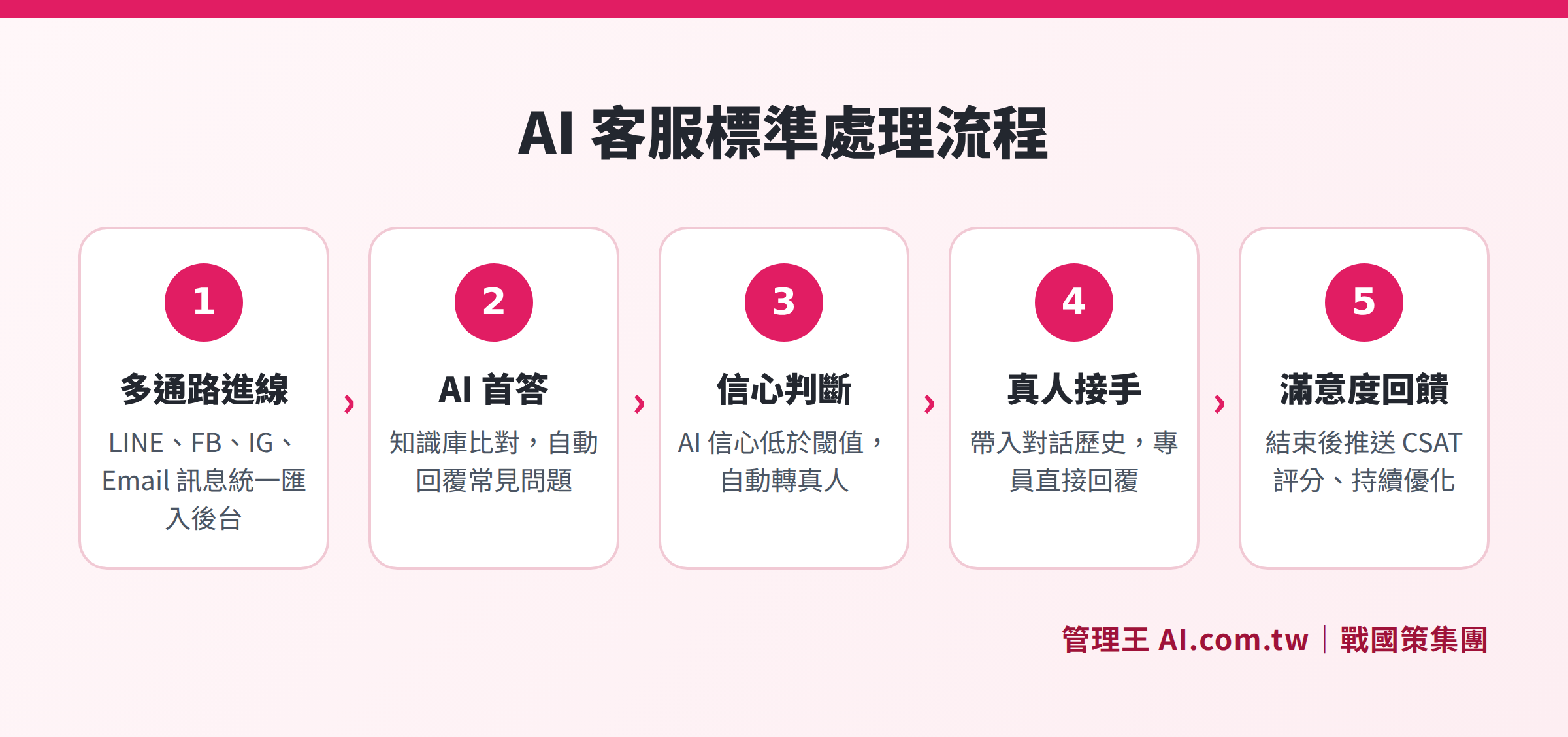
Standard AI customer service process: Multi-channel messages enter a unified inbox, the AI bot addresses common questions, and complex issues are handed off to human agents while retaining conversation history.
Before Implementing an AI Customer Service System, Organizing the Knowledge Base is Crucial
Many businesses buy an AI customer service system but are unable to utilize it after three months; the reasons are almost always the same: the knowledge base is not well organized.
The quality of responses from an AI bot depends 100% on the quality of the knowledge base. Establishing a knowledge base involves four steps:
Step 1: Collect Existing Data
Export all LINE messages, Emails, and FAQ documents that customer service replied to in the past three months. Identify the top 50 repeatedly occurring questions; these become the first batch of content for the knowledge base.
Step 2: Organize into Q&A Pairs
Each piece of knowledge base content should be formatted as: question (in customer terminology) + standard answer (using the best version from customer service). Avoid jargon or internal terms, adopting customer-friendly language—e.g. customers say "return" instead of "reverse logistics".
Step 3: Set Trigger Words for Human Handover
Define which keywords will always trigger a human handover; common trigger phrases include: "complaint", "refund", "legal", "media", "supervisor", "unreasonable". The occurrence of these keywords means the customer's emotions or needs exceed what the bot can manage.
Step 4: Continuous Training and Optimization
Once the first version of the knowledge base is online, staff should spend 10 to 15 minutes daily reviewing AI responses, correcting inaccuracies, and adding them to the knowledge base. Generally, after two to four weeks, the automatic resolution rate stabilizes at 70% to 80%.
Table: Knowledge Base Construction Progress Reference
| Knowledge Base Entries | Estimated Automatic Resolution Rate | Suggested Completion Time |
|---|---|---|
| 30 Entries | 60% to 70% | 1 week before implementation |
| 80 Entries | 75% to 85% | 1 month post-launch |
| Over 150 Entries | 85% to 90% | 3 months post-launch |
Data Protection: Key Compliance Points for AI Customer Service
According to Taiwan's Personal Data Protection Act, conversation records collected by customer service systems (including names, contact details, order information) are personal data, and businesses have a legal duty to protect them.
Main compliance requirements:
- Disclosure Duty: Before collecting personal data, purposes, usage methods, and retention periods must be disclosed (Article 8 of the Personal Data Protection Act)
- Security Maintenance: Appropriate security measures must be implemented to prevent data theft, alteration, or damage (Article 27 of the Personal Data Protection Act)
- Inquiry and Deletion: Customers have the right to request inquiries, corrections, or deletions of their personal data, and businesses must respond within 15 days
- Penalties: Violations of security maintenance obligations can incur fines ranging from NT$20,000 to NT$2,000,000; serious cases can reach NT$15,000,000
When choosing an AI customer service system, it is advisable to confirm whether data storage is located within Taiwan, whether it possesses ISO 27001 certification, and if it provides complete operation logs (Audit Log).
How to Implement with 管理王
管理王 AI Customer Service Center is an integrated AI customer service solution designed for small and medium enterprises in Taiwan, consolidating conversations from LINE, Facebook Messenger, Instagram DM, Email, and website chat boxes into a single backend, eliminating the need to switch between multiple apps.
Operational workflow:
- Add the LINE Official Account in 管理王's backend, authorize the Messaging API, and complete integration in about 15 minutes
- Upload FAQ documents or directly add Q&A pairs in the knowledge base interface, starting with at least 30 entries
- Set AI confidence thresholds (default 75%) and trigger keywords for human handover
- Enable CSAT automated surveys, pushing five-star ratings at the end of each conversation
- Monitor CSAT and NPS trends on the Customer Satisfaction Dashboard
When integrated with other functions, the customer service reply window can directly view customer order history and interaction records from the CRM system on the right side without screen switching. Complex cases can be transferred to the customer service ticketing system with one click, setting SLA time limits and task distribution logic to ensure every ticket is accounted for.
If voice customer service is needed, 管理王's AI Phone Customer Service System can integrate with the AI Customer Service Center, sharing the same CRM underlay, automatically merging customer records from phone and text services.
The free plan can be used perpetually and includes basic AI auto-reply features (AI credits are one-time use); if higher AI usage or a larger number of team members is required, it can be upgraded to the Economy plan (NT$5,000/month) or Business plan (NT$10,000/month). For a deeper understanding of the full implementation of AI customer service, refer to the comprehensive article What is AI Customer Service? Features, Costs, and Steps for SMEs to Implement.
Find the Right AI Customer Service System with Free Consultation
consultants assist you in evaluating LINE integration settings, knowledge base construction, and human handover processes, providing insights into how the 管理王 AI Customer Service Center can be tailored for your small or medium enterprise in just 30 minutes.
Free consultation hotline: 0800-003-191
LINE Official Account: @119m
Official website: app.AI.com.tw
Free trial: Apply for 管理王 now
Frequently Asked Questions
What is the difference between a LINE customer service bot and a LINE Official Account?
A LINE Official Account is a brand account for businesses on LINE used to broadcast messages. The LINE customer service bot is an automated response system integrated via the LINE Messaging API based on the official account. Most businesses have an official account but not a bot; once an AI customer service system is implemented, messages from the official account will be automatically handled by the AI bot, with human agents only addressing issues the AI cannot resolve.
What happens if the AI bot answers incorrectly?
Proper AI customer service systems include a confidence threshold mechanism: if the AI determines its confidence in a response falls below the set value (e.g., 75%), it will automatically switch to human customer service to avoid providing uncertain answers. Additionally, the customer service interface will indicate "AI Auto Reply", allowing agents to intervene and correct within 30 seconds; the corrected content can be added to the knowledge base for more accurate answers in future interactions.
What are the typical costs for AI customer service systems?
Costs can vary significantly based on functionality depth and scale. International giants like Zendesk start at USD 55 (approximately NT$1,700)/agent/month; local Taiwanese options have varied pricing based on functionality. The 管理王 AI Customer Service Center's free plan is available for perpetual use, with paid plans starting at NT$5,000/month, covering multiple features such as AI customer service, CRM, and ticketing without charging per agent. For detailed pricing plans, please refer to 管理王 service plans.
What size of businesses need AI customer service systems?
It is generally worthwhile to implement one if any of the following apply: daily customer service messages exceed 30, the same questions are repeatedly answered three times or more, customer service needs to be on duty across more than two channels (like LINE + Facebook), or there’s a need for automated replies outside of business hours. After implementing an AI customer service solution, even a team of two can handle the message volume that previously required five to ten people.
How long does it take to implement an AI customer service system?
Assuming a prepared FAQ knowledge base (30 to 50 entries), system integration typically takes one to three days. Achieving a stable automatic resolution rate of over 70% generally requires a stable running and adjustment period of two to four weeks. If you're using 管理王, consultants will assist with knowledge base imports for free, helping to shorten adjustment time.
Sources
- LY Corporation "LINE in Taiwan" (22 million monthly active users on LINE in Taiwan, penetration rate 93%): https://www.lycorp.co.jp/en/story/20250226/linetaiwan.html
- LY Corporation LINE CONVERGE 2026 (over 3.6 million LINE Official Accounts in Taiwan): https://www.lycorp.co.jp/en/story/20261113/converge_2026.html
- LINE Developers Messaging API Overview (Chat Control API, message formats): https://developers.line.biz/en/docs/messaging-api/overview/
- Gartner "Customers Still Want Human Agent Access" (87% of customers believe human transition is necessary, 2026): https://news.designrush.com/ai-customer-service-human-agent-access-gartner
- Taiwan's Personal Data Protection Act full text: https://law.moj.gov.tw/LawClass/LawAll.aspx?pcode=I0050021
- Qualtrics XM Institute 2024 NPS Industry Benchmark Report: https://loyaltyloop.com/blog/csat-vs-nps