How to Choose Meeting Recording AI? Accuracy, Privacy, and Key Points for Chinese Recognition|Recommended Meeting Recording Software

Three key points for selecting meeting recording AI tools: Chinese recognition accuracy, compliance with personal data laws (notification obligations and risks of overseas storage), and depth of integration with CRM task systems. 管理王 AI meeting recording supports multilingual recognition, voiceprint identification, and automated task linking, with data stored in Taiwan in compliance with personal data laws.
There are countless AI tools for meeting recording, how can you choose without regrets? The key lies in three dimensions: Chinese recognition capability, privacy compliance, and integration depth with enterprise systems. High accuracy but only supporting English is of limited help to Taiwanese companies; the ability to recognize Chinese but storing data on overseas servers brings personal data law risks; even if the first two points pass, if the recorded to-do items still need to be manually pasted into the task system, the time saved is lost again. This article dissects a comprehensive evaluation framework for selecting tools from the perspective of Taiwanese companies, explaining which features truly impact daily efficiency and how to avoid common purchasing pitfalls.
Why is "Chinese Recognition" the First Threshold?
The language environment of meetings in Taiwanese enterprises is quite complex: an internal meeting may simultaneously include Mandarin, English terms, and occasionally Taiwanese, while cross-department reports feature a large number of abbreviations and jargon; external client meetings may even present Japanese or Cantonese.
International AI speech recognition tools are primarily trained on English data, resulting in significant performance gaps in purely Chinese conversations. A 2026 real-world testing comparison (tinrec.com) indicated that certain tools still have high error rates in recognizing sentences and terms in mixed Chinese and English, leading to summaries that contain misinterpretations, even mistaking amounts.
When evaluating Chinese recognition capability, it is recommended to focus on confirming four aspects:
- Language Support Range: Does it support Traditional Chinese interface and recognition (not just Simplified conversion)?
- Mixed Language Capability: Can it separately recognize mixed Chinese and English, or simultaneous Mandarin and Japanese?
- Voiceprint Separation: Can it distinguish different speakers in a multi-person meeting and correspond them to their real names?
- Term Learning: Can it customize industry vocabulary and name lists to reduce the error rate of professional terms?
In Brief
Choosing meeting recording AI is not just about asking "Does it support Chinese?" It must be practically tested under multi-speaker, mixed language, and terminology situations.
Common terms used in Taiwan’s manufacturing, such as "JIT Material Preparation" and "ECN Engineering Changes," as well as technology industry terms like "POC Acceptance" and "SLA Contracts," can often pose challenges for tools not trained on Taiwanese data. It is recommended to conduct blind tests with three to five real meeting recordings from your company before officially implementing a solution and compare recognition results before making a decision.
How to Assess Accuracy? Three Practical Methods
Tool vendors all claim high accuracy, but under what conditions is the data measured? The following three methods can be used to verify in your own environment without requiring technical background.
Table: Self-Testing Accuracy in Three Steps
| Step | Method | Evaluation Focus |
|---|---|---|
| Record Test Clip | Take a 10-minute real internal meeting recording (ensure consent has been obtained) | Multiple speakers, including English abbreviations |
| Compare Transcript | Manually verify the number of critical term errors | Error rates for terms, amounts, and names |
| Test Summary Quality | Compare the summary content with actual resolutions | Check if action items are fully captured and if the responsible person is correct |
Among the types of recognition errors, the following four have distinctly varying degrees of impact:
Table: Common Speech Recognition Problem Types and Their Impact
| Problem Type | Example | Impact Level |
|---|---|---|
| Homophone Replacement | "Procurement" becomes "Step on Purchase" | Low (meaning is unaffected but impression is poor) |
| Term Error | Brand names and abbreviations misrecognized | Medium (may mislead decision-making) |
| Speaker Confusion | Incorrectly labeling speakers during multiple conversations | Medium-High (responsibility attribution is unclear) |
| Amount Number Error | "Five hundred thousand" mistaken as "50 Completed" | High (consequences are most severe) |
If errors occur with amounts or the responsible person for action items, the consequences can be severe. Therefore, AI-generated meeting summaries should still be confirmed manually by participants before being officially sent out. If the tool can indicate "Confidence Level" for recognition, it would significantly enhance efficiency by allowing employees to prioritize reviewing low-confidence entries.
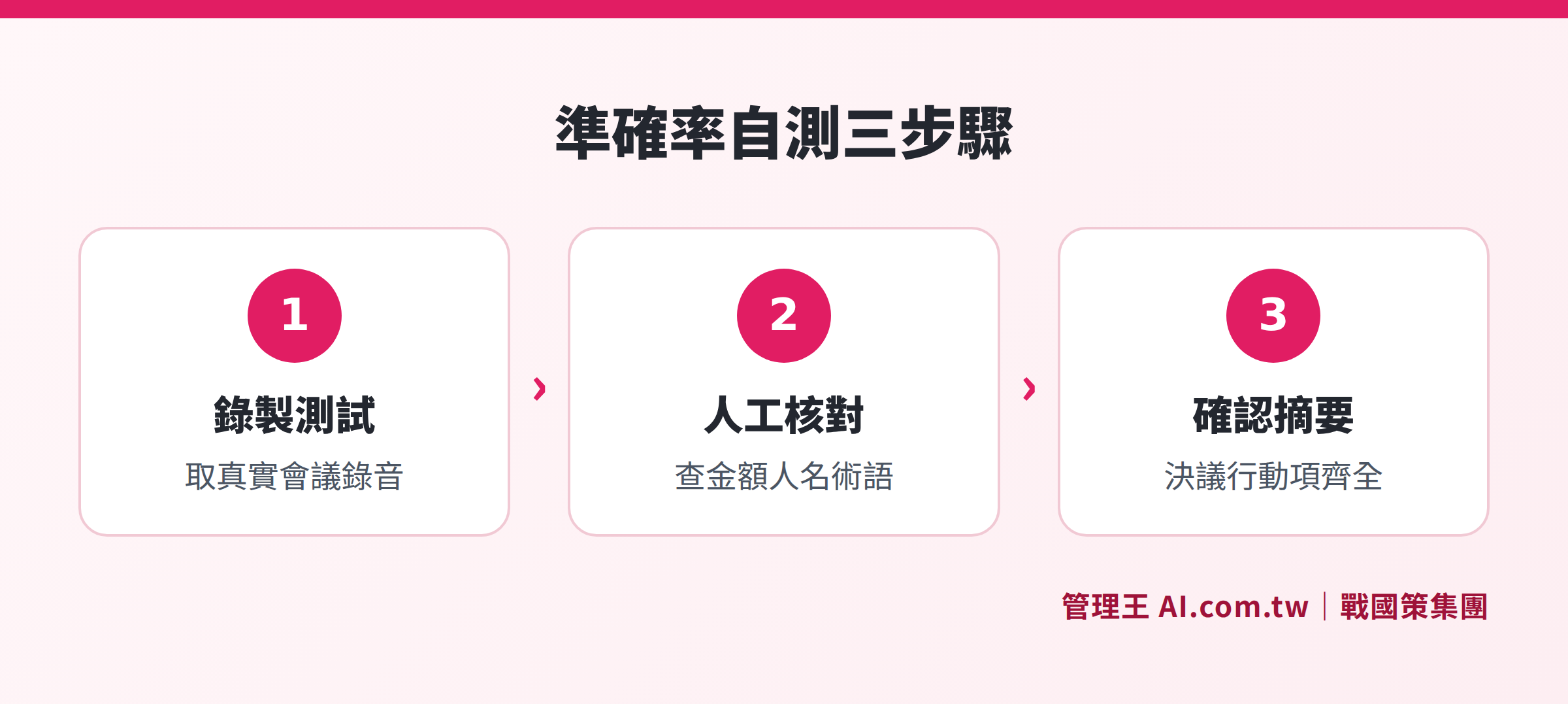
Three-step accuracy self-testing process from recording test clips to comparing transcripts and confirming action items
Privacy and Personal Data: Confirm Six Things Before Recording
According to Taiwan's Personal Data Protection Act, if voice or voiceprint data can identify specific individuals, it is considered personal data. Companies must legally inform the individuals of the purpose of collection, the scope of use, storage duration, and deletion methods, without exceeding what is necessary. If companies send recordings to a third-party AI service for processing, they must also sign a "Personal Data Outsourcing Processing Contract" beforehand.
Violating personal data laws can result in light administrative penalties, with a maximum fine of NT$15 million, and if there’s damage to a third party, individuals may seek compensation for damages. Companies using AI meeting recording tools must incorporate personal data compliance into their evaluation criteria instead of remedying it afterward.
According to Skyrealm Technology’s corporate governance recommendations in September 2026, the personal data management for AI meeting recording can be divided into six confirmations:
1. Purpose of Recording: Is it for organizing resolutions (which need summaries) or is a complete transcript required? The personal data risk level is different for both; complete transcripts include personal statements and therefore must have stricter preservation and access regulations.
2. Scope Definition: Should it be a full recording or only certain agendas? For sensitive topics like personnel, contracts, and trade secrets, manual records are recommended.
3. Tool Selection: Where is the data stored? Does it comply with Taiwan’s regulations regarding overseas transfers of personal data? Has an enterprise agreement with the AI vendor been signed to confirm that conversation data will not be used for model training?
4. Access Permissions: Who can view the raw recording, transcripts, and summaries? The three should have different access levels; it should not be assumed that all employees can see the raw recording.
5. Retention Period: Raw recordings pose the highest risk; they should be prioritized for deletion after proofreading. The retention period for transcripts and summaries should be set according to business needs and must not be kept indefinitely.
6. Notification Method: Provide the name of the tool used, data storage location, and access personnel in the meeting invitation, along with alternative options for those who do not wish to be recorded, rather than relying solely on platform notification sounds for active notification.
Integration Depth Determines the True Value of Tools
The biggest waste with AI meeting recording is printing out the organized action items and then manually re-entering them into the task system. The "integration depth" of the tool directly determines how much manual work can be saved after the meeting.
When evaluating integration depth, you can compare from the following five aspects:
- Task Linking: Can action items automatically create tasks and assign responsible people, or do you just receive a plain text list?
- CRM Connection: Can client visit records automatically link to CRM client profiles, avoiding duplicate entry by sales?
- Full Text Search: Can past meeting contents be searched across locations to quickly find contract terms discussed three months ago?
- Notification Mechanism: Can absentees automatically receive a five-minute summary after the meeting without relying on LINE forwarding?
- API Openness Level: Can it integrate with existing ERP, HR, and accounting systems, or are there extra integration fees?
Standalone tools (such as apps that solely convert recordings to transcripts) are typically weakest in the first two points, leading enterprise users to incur additional integration fees, or they may require IT to manually connect APIs, with these hidden costs often exceeding the tool's monthly fee itself.
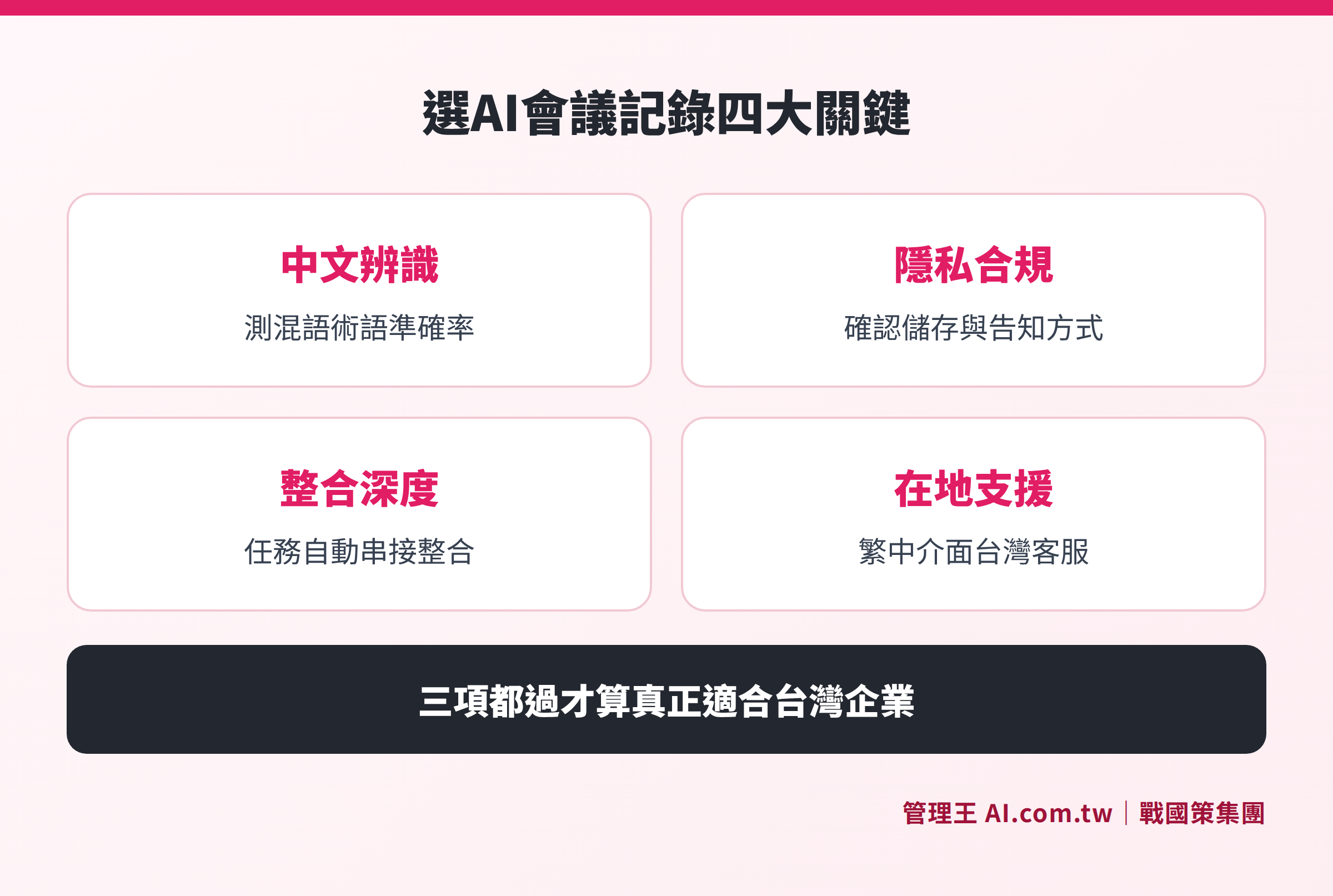
Comparison of capabilities in task linking, CRM association, and full-text search between standalone tools and integrated systems
Standalone Tools vs Integration Systems: How to Choose?
Table: Selection Comparison
| Comparison Dimension | Standalone AI Recording Tool | Enterprise Integration System |
|---|---|---|
| Main Advantages | Easy to adopt, low subscription cost | Native integration with CRM, tasks, and accounting |
| Applicable Audience | Individuals, freelancers, small teams under 10 | Small to medium-sized enterprises, multi-department collaboration |
| Data Storage | Mainly stored overseas (USA/Singapore) | Locally in Taiwan (compliant with personal data laws) |
| Backend Integration | Requires extra API integration fees | Built-in with no extra fees |
| Chinese Support | Significant quality variance, limited optimization for Traditional Chinese | Optimizable for Taiwanese business terms |
| After-sales Support | Typically no Chinese customer service | Local Taiwanese team |
| Compliance Risks | Overseas storage requires extra confirmations for compliance | Local in Taiwan, compliant with personal data laws |
For companies with more than 10 employees where meeting outputs need to be tracked across multiple departments, standalone tools often save on monthly fees but increase hidden costs for integration and maintenance. When calculating actual costs, include IT integration time, the man-hours for repeated entries across systems, and the combined monthly fees for multiple tools for comparison.
How to Use 管理王 AI Meeting Recording
管理王 AI Meeting Recording is a built-in feature of the "AI Tools" module within 管理王's nine systems, requiring no separate subscription or additional API integration. The complete process from uploading recordings to tracking subsequent tasks is as follows:
Step 1: Multi-source Recording Upload
Supports MP3, WAV, M4A uploads, can also import directly from Zoom, Google Meet, or record in real-time on mobile; it can recognize mixed Chinese and English and multiple conversations.
Step 2: Real-time Multilingual Recognition
The system automatically identifies Mandarin, English, and Japanese, displaying subtitles for all three languages simultaneously; the voiceprint recognition function matches the attendee list, replacing "Speaker A" with "Manager Zhang said," making the transcripts clear at a glance.
Step 3: AI Summary and Action Item Extraction
After the meeting, a key summary is generated, automatically marking "who is responsible, what to do, and deadline," which can be sent to all attendees (including absent colleagues), allowing those not present to grasp the meeting’s conclusions within five minutes.
Step 4: Connect to Task Management
Action items directly create tasks and assign responsible persons; relevant personnel can see the to-dos when they login to 管理王, eliminating the need for LINE reminders or manual forwarding.
Step 5: CRM Connection and Full Text Search
Client visit meetings automatically link to CRM client management files, and full-text search allows you to quickly find terms or commitments discussed in any meeting, even records from three months ago are instantly searchable.
About Data Security: 管理王's recordings and transcription data are stored in the 戰國策 Group’s data center in Taiwan (in compliance with ISO 27001 standards) and an enterprise agreement has been signed with OpenAI and Anthropic, ensuring that conversation data will not be used for model training, compliant with Taiwan's regulations on offshore data transfer.
Free plans can be used permanently, including basic AI meeting recording features; advanced usage and additional members can be upgraded to the economic plan (NT$5,000/month) or business plan (NT$10,000/month), with annual payment enjoying fees for 14 months.
Paired with AI Knowledge Base, companies can automatically consolidate meeting records into a searchable internal knowledge base; AI Employees can automatically assign tasks and trigger processes based on meeting decisions, allowing each meeting to directly drive subsequent actions.
To first understand the complete picture of the AI meeting recording system, refer to the overview article: How to Write Useful Meeting Records? Formats, Templates to AI Automatic Organization.
The 戰國策 Group services over 30,000 companies, and 管理王 AI.com.tw is designed for Taiwan's SMEs, featuring a Traditional Chinese interface and local Taiwanese customer support, with the free plan allowing complete feature trials without needing a credit card.
Let AI Automatically Organize Each Meeting Resolution
Consultants assist in assessing the most suitable AI meeting recording solutions for businesses, covering the needs for Chinese recognition, personal data compliance, and CRM task integration requirements, with free consultations.
Free consultation hotline: 0800-003-191
LINE Official Account: @119m
Official Website: app.AI.com.tw
Free trial: Apply for 管理王 now
FAQs
Does the meeting recording AI support Taiwanese or Cantonese?
Currently, mainstream AI speech recognition tools primarily train on Mandarin and English, and mixed Taiwanese parts may yield recognition errors. It is recommended to test actual effects with your own recordings containing Taiwanese before formally implementing, especially in sectors like manufacturing and traditional industries where Taiwanese usage is higher. 管理王 continues to update its corpus, and the extent of Taiwanese support can be confirmed with customer service for the latest status.
Do I need to inform attendees when using AI for recording meetings?
Yes. According to Taiwan's Personal Data Protection Act, if voice data can identify specific individuals, it is considered personal data, and you must clearly inform the individuals of the purpose, scope of use, and retention methods before collection. It is advised to explain the tools used and the data storage locations in the meeting invitation and to provide alternative options for those who do not wish to be recorded, rather than relying solely on platform notification sounds for active notification.
Is the accuracy of the AI summary high enough to send it out directly?
It is recommended that the responsible person or an attendee manually confirm before sending it out officially, especially for action items involving amounts, responsible persons, and deadlines. AI speech recognition might still have errors involving homophones, terminology, and multi-speaker disambiguation, and confirmation must be done for it to be considered effective meeting records. 管理王 AI meeting records will indicate confidence levels, allowing employees to prioritize reviews of low-confidence marked items.
What are the risks of placing data in overseas AI tools?
According to Taiwan's personal data law, if a company outsources personal data to be processed overseas, it must ensure that the other party meets appropriate protection standards and sign a processing outsourcing contract. If the data includes client names or trade secrets, placing them in overseas tools without confirmed compliance may lead to penalties under personal data laws (up to NT$15 million). Choosing tools that are stored locally in Taiwan and have signed enterprise agreements with AI vendors minimizes compliance risks.
How does 管理王 AI meeting record compare to Otter.ai and Notta?
Otter.ai focuses on English and does not support Chinese recognition, making it unsuitable for Taiwanese companies; Notta supports multiple languages, but data is stored overseas and requires additional fees to connect to other systems. The main differences of 管理王 AI meeting records are: (1) support for Traditional Chinese and simultaneous recognition of Chinese, English, and Japanese; (2) native integration with CRM, tasks, reporting, and over 100 other features; (3) data stored in Taiwan, compliant with offshore transfer regulations under personal data law; (4) free plans available that can be used permanently without needing a credit card.
Data Sources
- Personal Data Protection Act (National Legislation Database)
- AI Helps You Record Meetings, Who Manages the Recordings: First Set Notification, Access, and Deletion (Skyrealm Technology, September 2026)
- Can AI Meeting Records Be Recorded Directly? Recording, Personal Data, and Retention Lists (AgentJE)
- 管理王 AI Meeting Recording Function Page (app.ai.com.tw)
This article is for general information and does not constitute legal or tax advice; please refer to the latest announcements from the competent authority.