What is AI Phone Customer Service? Voice Bot Call Handling Process and Applications|Recommended AI Phone Customer Service
AI Phone Customer Service is an intelligent customer service tool that uses three layers of technology: voice recognition, natural language understanding, and backend integration, enabling the system to automatically answer calls and complete tasks like inquiries and reservations 24/7. This article explains the definition of AI Phone Customer Service, the five-step call handling process, differences from traditional IVR, applicable industry scenarios, implementation preparation checklist, and three main performance indicators: CSAT, FCR, AHT, to help small and medium enterprises in Taiwan make informed purchasing decisions.
AI Phone Customer Service refers to an intelligent customer service tool that uses natural language processing (NLP) and automatic speech recognition (ASR) technology to automatically answer or make phone calls and engage in conversations that feel human-like. Unlike traditional IVR (Interactive Voice Response) systems that only offer numeric menus for selection, AI Phone Customer Service can understand natural phrases like "When will my order from yesterday arrive?" or "I want to change my appointment time," providing answers or completing reservations without the need for human transfer. A survey by the Institute for Information Industry (III) indicated that around 87% of internet users in Taiwan have used AI customer service, making AI reception a common trend in corporate services. For small and medium enterprises, AI Phone Customer Service systems allow small teams to avoid missing calls 24/7, automatically record call highlights back to CRM after conversations, and eliminate the need for hiring night or holiday staff, making it a practical tool for enhancing service capacity while controlling labor costs.
What is AI Phone Customer Service? Core Definition and Three Technical Layers
The AI Phone Customer Service system is composed of three layers of technology; without any one layer, smooth voice dialogue cannot be achieved:
First Layer: Speech Recognition (ASR, Automatic Speech Recognition)
Instantly converts what customers say into text. Modern ASR models can recognize Taiwanese accents, Mandarin mixed with Taiwanese, and common abbreviations like "Shopee" and "COD". The Industrial Technology Research Institute (ITRI) has developed a Mandarin speech synthesis service that supports Mandarin, English, and Taiwanese languages, achieving a naturalness suitable for commercial application.
Second Layer: Natural Language Understanding (NLU, Natural Language Understanding)
Determines the "intent" of what customers say. For example, "I want to check my order" corresponds to an order inquiry intent, and "I want to change the time" corresponds to a schedule modification intent. This layer directly affects the accuracy of AI responses, making the training quality of the Mandarin model critical when small and medium enterprises make purchasing decisions.
Third Layer: Dialog Management and Backend Integration (Dialog Management + Integration)
Based on the intent, this layer connects to backend systems (CRM, ERP, reservation systems) to obtain actual data and voice responses or triggers automatic actions (sending confirmation messages, creating work orders, logging entries in the CRM). The depth of integration determines how much AI can "do" rather than just "talk".
In a Nutshell
AI Phone Customer Service = Speech Recognition (understanding) + Natural Language Understanding (determining intent) + System Integration (executing actions); all three layers are essential.
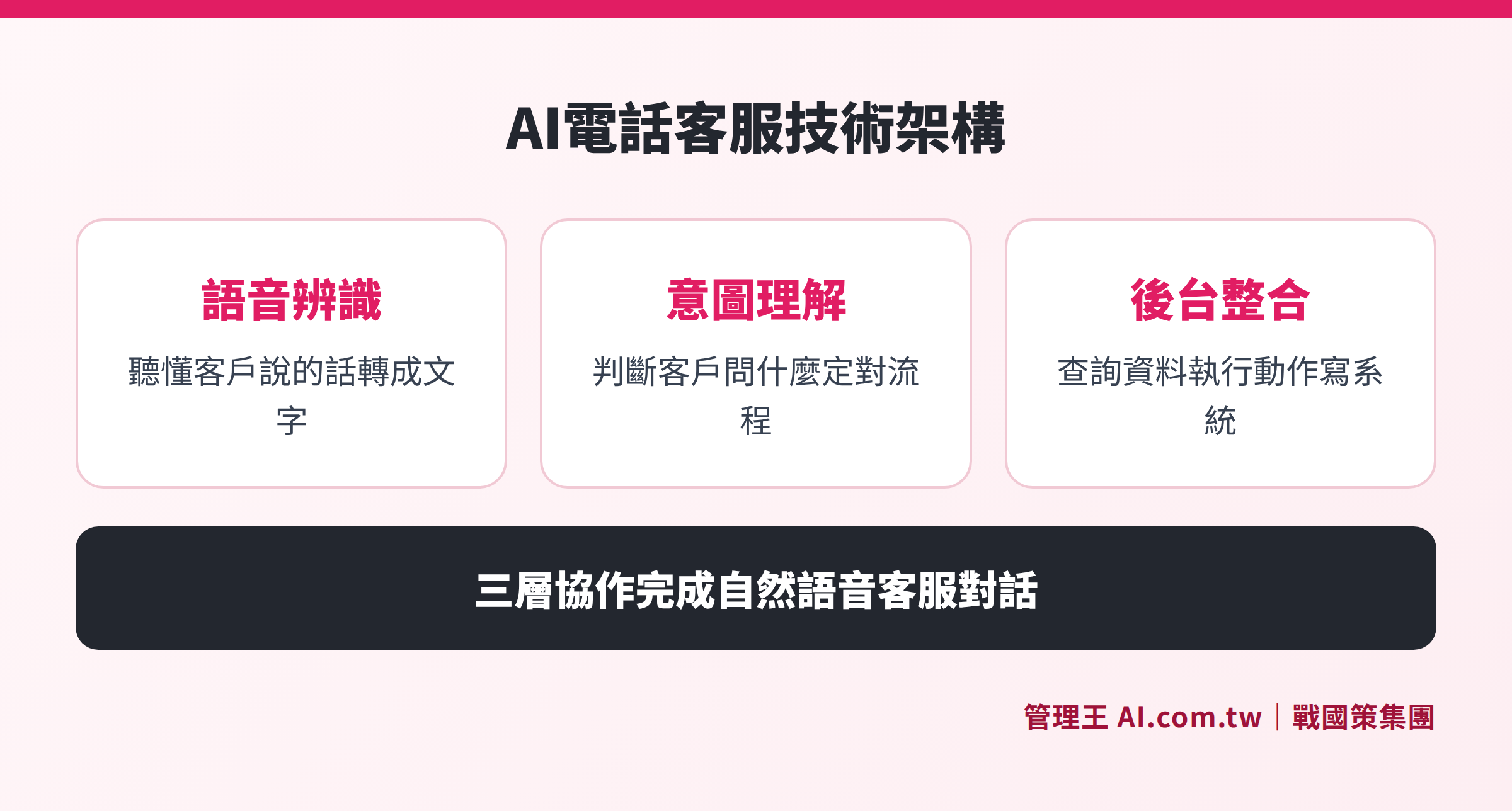
Illustration of how speech recognition, natural language understanding, and backend integration collaborate to complete an AI Phone Customer Service interaction
How Does the AI Voice Bot Handle Calls? Five-Step Complete Process
Understanding the operation flow of AI Phone Customer Service helps business owners determine which scenarios can benefit the most immediately and which aspects need prior preparation.
Step One: Customer Call, AI Answers Automatically
Retain the company's existing phone number or have the system issue a new dedicated line. Once customers call in, they enter the AI reception process directly without utilizing human customer service lines, ensuring there are no busy signals even during peak times.
Step Two: Voice Recognition and Intent Determination
ASR instantly converts speech to text, and NLU identifies intents such as "check order," "reservation," and "return/exchange request," then decides the next action based on pre-set processes. This process usually completes within one second, allowing customers to experience immediate responses rather than system delays.
Step Three: Connect to Backend to Obtain Actual Data
The system links to CRM or ERP; for instance, after the customer provides an order number, it automatically checks the shipping status or confirms available time slots from the reservation system. AI replies with specific answers in natural voice, rather than reading out a scripted response.
Step Four: Transfer to Human Agent When Unable to Handle
AI sets a confidence threshold (typically 75%); if it falls below this threshold or the customer states, "I want to talk to a human," it automatically transfers to a customer service representative while transferring the entire conversation history, intent tagging, and preliminary information, so the representative doesn’t need to ask everything again.
Step Five: End Call and Automatically Record Back to CRM
After hanging up, the system automatically generates a call summary, logging the customer’s name, inquiry details, handling results, and emotion tags back to the CRM system, allowing supervisors to review in real-time without relying on handwritten notes or verbal communication.
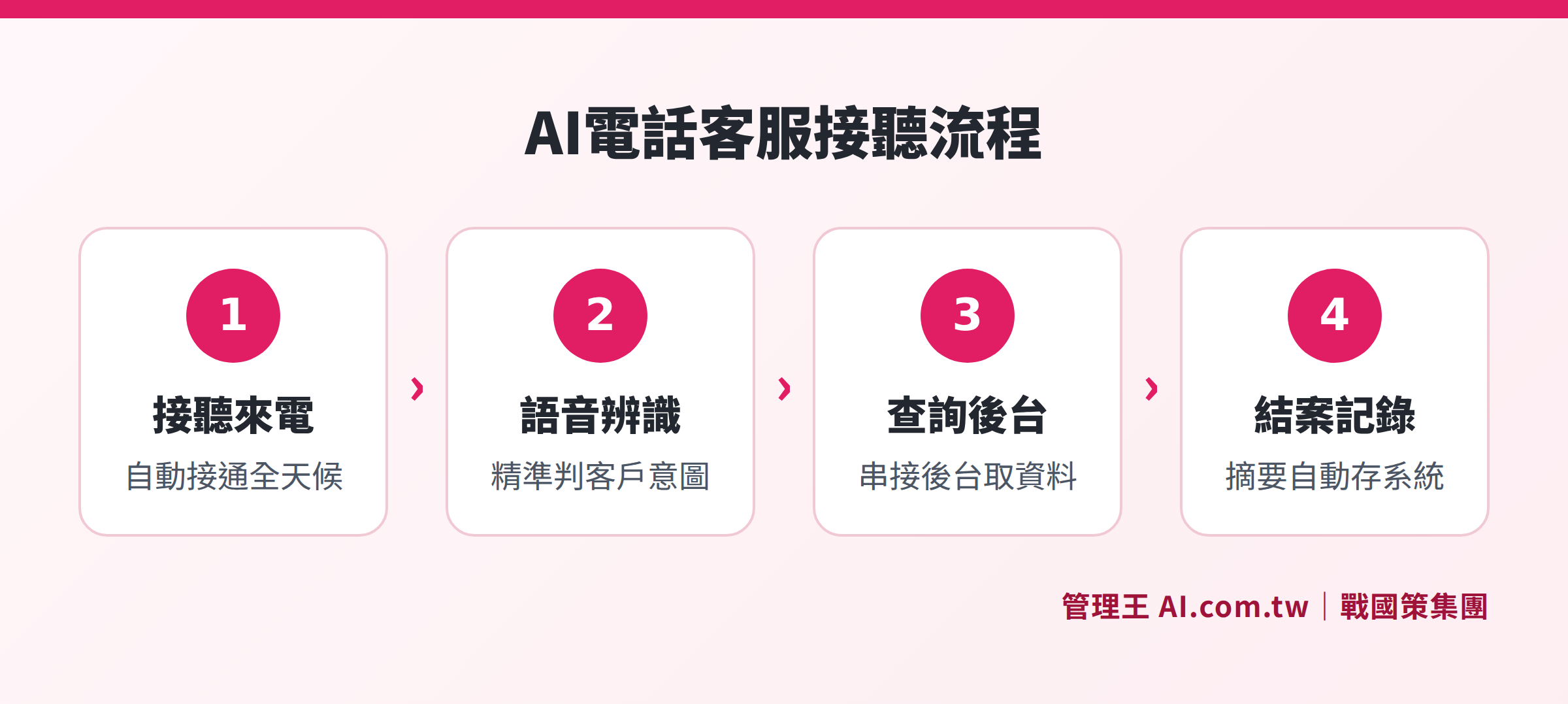
A complete five-step automated call handling process from customer call to call closure in AI Phone Customer Service
AI Phone Customer Service vs. Traditional IVR vs. Human Customer Service: A Comparative Analysis
Before selecting a customer service solution, it is important to clarify the core differences between these three models:
Table: Comparison of AI Phone Customer Service, Traditional IVR, and Human Customer Service Capabilities
| Comparison Item | AI Phone Customer Service | Traditional IVR (Key Selection) | Human Customer Service |
|---|---|---|---|
| Response Method | Natural voice conversation, understanding meaning | Press number options 1/2/3 | Real person conversation |
| 24/7 Service | Continuous around the clock | Available around the clock but limited functionality | Requires scheduling, incurs labor costs |
| Handling Complex Issues | Combines with CRM to handle inquiry-type issues | Can only transfer, unable to resolve | Can handle various situations |
| Post-Call Record | Automatic summary back to CRM | None | Manual entry, prone to omissions |
| Semantic Understanding Ability | High (NLU model) | None | High (human brain) |
| Implementation and Maintenance Cost | Moderate, once set up requires ongoing optimization | Low but limited effectiveness | High (salaries, scheduling) |
| Customer Experience | Natural and smooth, no need to remember menus | Requires memorizing number options | Varies based on personnel quality |
AI Phone Customer Service is not meant to replace human agents, but rather to allow AI to handle repetitive calls first, freeing human agents to focus on issues that truly require human judgment—this is the best combination for enhancing overall customer service quality.
Which Industries and Scenarios Are Best Suited for AI Phone Customer Service?
AI Phone Customer Service is not suitable for all calls; here are the most efficient application scenarios for small and medium enterprises in Taiwan:
Retail and E-commerce
- Inquiry about order shipping status and arrival time
- Confirm stock and handle preliminary return/exchange requests
- During peak holiday promotions, call volumes skyrocket; AI automatically diverts calls, avoiding missed connections due to insufficient manpower
Dining and Hospitality
- Automatically accept reservations, confirming available spots with immediate replies
- Remind customers of their reservations for the next day, reducing no-show rates
- Handle calls after hours and on holidays, ensuring no missed orders or customers
Medical Clinics and Beauty Salons
- Appointment registrations, checking patient wait times
- Notify customers about follow-up reminders or service expiry renewals
- Explain emergencies and referrals outside of service hours
B2B Enterprises
- First-line filtering of after-sales technical support; simple issues are directly answered by AI
- Prioritize VIP customer calls by automatically transferring to senior agents
- When sales staff are out, AI takes calls and records demand to prevent missed business opportunities
Scenes Not Suitable for Full AI Takeover: Complex customer complaints (when customers are emotionally agitated), negotiations requiring immediate judgment on discount authorizations, and issues needing cross-departmental coordination—these cases should quickly transfer to human agents instead of letting AI persist, as this can damage customer trust.
What Should Enterprises Prepare Before Implementing AI Phone Customer Service?
Being prepared with the following before implementation can significantly shorten the adaptation period and allow the system to generate benefits from day one:
1. Organize Frequently Asked Questions and Standard Answers (Knowledge Base)
Compile the most frequently asked questions by customer service into 30 to 50 items, covering product specifications, shipping policies, return/exchange rules, and reservation procedures. The more complete the knowledge base, the higher the initial accuracy rate of AI responses; lacking this step could result in frequent incorrect answers once AI is online, leading to customer complaints.
2. Define the Call Handling Process (Dialog Script)
Design branching processes based on different intents: for example, "Order Inquiry → Please provide your order number → Follow-up voice reply after checking." Initially, focus on 3 to 5 of the highest-frequency intents; there’s no need to set up all scenarios at once, and expansion can occur gradually.
3. Confirm the Quality of CRM Data
If AI is to query customer data, the names, phone numbers, and order numbers within the CRM must be clean and tidy. Dirty data can lead to AI not finding results or providing incorrect answers, impacting customer experience.
4. Set Confidence Thresholds and Transfer Rules
Determine when to transfer to a human agent: when AI confidence is below 75%, when customers state, "I want to speak to a human," or when the call exceeds a set duration without resolution. Ensure customers can see corresponding handover interfaces immediately when transferring.
5. Plan an Optimization Cycle
In the first two weeks post-launch, review call summaries intensively to identify cases where AI answered incorrectly and supplement the knowledge base. Generally, the accuracy rate can stabilize at a higher level after 4 to 6 weeks, after which monthly routine reviews may suffice.
Table: AI Phone Customer Service Implementation Preparation Checklist
| Preparation Item | Description | Priority Level |
|---|---|---|
| Knowledge Base (30-50 items) | Common questions and standard answers | High |
| Dialog Script (3-5 Intents) | Main process branching design | High |
| CRM Data Cleaning | Ensure customer phone numbers and names are correct | High |
| Confidence Threshold Setting | Decide when to transfer to human customer service | Medium |
| Transfer Backend Interface | Human agents can see call records | Medium |
| Optimization Cycle Scheduling | Weekly review of call summaries for the first 6 weeks | Medium |
How to Measure the Effectiveness of AI Phone Customer Service? Three Key Metrics
After implementation, track effectiveness using the following metrics and set baseline values for continuous optimization:
CSAT (Customer Satisfaction Score)
Automatically push a rating from 1 to 5 after the call, calculated as: (total of 4 and 5 ratings ÷ total responses) × 100%. An industry-standard of over 75% is considered good, while below 50% indicates that immediate review of processes is necessary.
FCR (First Contact Resolution)
Measures the rate at which AI solves problems in one call without transferring to human agents or needing follow-up calls. A higher FCR indicates a more complete knowledge base and a smoother dialogue process. The initial FCR target is recommended to be set at over 50%, which can mature to achieve 65% to 70%.
AHT (Average Handle Time)
The average call duration for calls answered by AI. A duration that is too short may indicate issues are hanging up unresolved, while a duration that is too long indicates a complicated process. Set reasonable benchmarks based on intent, such as targeting under 90 seconds for reservation processes and under 60 seconds for order inquiries.
SLA (Service Level Agreement) tracks the wait time after transferring to a human agent to ensure it stays within promised limits. The above metrics can be monitored through the Customer Satisfaction Dashboard, allowing supervisors to gain a comprehensive view of service quality across all channels on a single page.
Five Evaluation Criteria for Purchasing AI Phone Customer Service Systems
With multiple options for AI Phone Customer Service solutions available in the market, small and medium enterprise owners can use the following five standards for a comprehensive comparison:
1. Quality of Mandarin Voice Recognition
Directly test a few common phrases in Taiwanese to confirm the system's recognition accuracy. Foreign solutions often make similar-sounding misjudgments in Chinese recognition (e.g., confusing "Shopee" with "next batch"); localized solutions in Taiwan typically perform more stably with mixed Mandarin and Taiwanese.
2. Depth of CRM Integration
AI answering calls is not the goal; the long-term benefit is automating data entry post-call back into CRM. Confirm whether the system supports two-way integration: not just writing summaries but also reading customer data (name, order number, historical records) from the CRM for use during calls.
3. Flexibility of No-Code Setup Processes
After practically operating the backend, confirm whether the dialogue scripts can be adjusted independently or if every process change requires engineering intervention. With limited manpower in small businesses, being able to maintain processes autonomously is critical for continuous optimization.
4. Pricing Model and Hidden Costs
Confirm whether there are additional charges based on call minutes, whether AI credits are sufficiently provided, and what the conditions are for upgrading plans. Some solutions have low entry fees but can incur skyrocketing costs once call volumes exceed limits; it's essential to estimate average monthly call volumes in advance.
5. Local Technical Support and Customer Service
When issues arise with the system, can quick support be obtained in Taiwan's time zone? Offering 0800 toll-free phone lines and instantaneous responses via LINE is more suitable for the urgent needs of small and medium enterprises in Taiwan, especially during the initial phase of system deployment when local support becomes crucial.
How to Utilize the Management King AI Phone Customer Service System?
The AI Phone Customer Service System from Management King at AI.com.tw integrates the aforementioned five steps into a customizable platform, allowing small and medium enterprises to operate without the need to connect APIs or hire engineers:
Retain Existing Number or Assign Dedicated Line: Enterprises can keep their existing landline or mobile phone numbers, allowing the Management King system to answer calls, making backend changes invisible to customers; or they can apply for entirely new 0800 or landline numbers, flexibly allocated based on business needs.
No-Code Setup for Conversation Processes: The backend offers a visual process editor with pre-set reception process templates based on industries (dining, retail, B2B, medical clinics), allowing for testing on the very day of implementation without needing programming skills.
Automatic Call Summary Logging Back to CRM: After each call, the system automatically writes call highlights (customer name, inquiry content, handling results, emotion tags) back to the CRM system, enabling business supervisors to review all customer interaction records from the timeline without relying on handwritten notes.
AI Customer Service Ticket Integration: Issues that cannot be handled by AI automatically create a customer service ticket assigned to the corresponding customer service representative and track SLA. The AI Customer Service Center can also synchronize text customer service (LINE, Email, website chatbox) with phone customer service, managing all customer inquiries in one backend without the need to switch between multiple tools.
Automatic Satisfaction Collection: After calls, automatically push CSAT and NPS rating surveys, with negative feedback immediately notifying supervisors via LINE, enabling call-backs within 10 minutes to remedy situations.
Management King is a product refined by the experience of the 戰國策 group serving over 30,000 businesses, integrating over 100 functions such as CRM, customer service, ERP, HR, and accounting. The free plan is available for perpetual use, and the AI Phone Customer Service module includes a 30-day trial without requiring credit card binding for complete functionality testing.
Try the AI Phone Customer Service System for Free
Consultants assist in designing reception processes and building knowledge bases, allowing you to go live for testing in as little as 1 day, without needing to connect APIs; the free plan remains available forever.
Free consultation hotline: 0800-003-191
LINE Official Account: @119m
Official Website: app.AI.com.tw
Free trial: Apply for Management King Now
Frequently Asked Questions
Can AI Phone Customer Service Understand Taiwanese Accents and Mandarin Mixed with Taiwanese?
Modern AI voice recognition models have been specifically trained for the Taiwanese Mandarin accent and can recognize Chinese mixed with Taiwanese as well as common Taiwanese phrases such as "grouping together," "踩雷" (stepping on a landmine), "god teammate," and "COD" (cash on delivery). Management King's AI uses a specially trained Mandarin model, and after accumulating 30 to 50 articles in the knowledge base, recognition accuracy can reach over 85%; as usage increases, the accuracy continues to improve.
What Happens if the AI Phone Customer Service Gives a Wrong Answer and Dissatisfies the Customer?
The system features a confidence threshold mechanism: when AI's confidence in intent judgment falls below a set value (e.g., 75%), it automatically transfers to human customer service and marks it as "AI Transfer" so that customers do not get stuck in the wrong process. Once customer service intervenes, corrected content can be added to the knowledge base with one click, enabling AI to answer correctly on similar issues next time. This "human-machine collaboration feedback loop" is the fastest way to enhance AI response accuracy.
Is It Worth Implementing AI Phone Customer Service If Call Volumes Are Low?
Even with only 10 to 20 calls daily, if there are recurring issues (checking orders, making reservations, checking costs), AI can effectively share the workload. More importantly, it addresses the issue of missed calls after hours and during holidays—critical for service-oriented SMEs, as AI allows every incoming call to have a "human" response, preventing potential customer losses due to missed calls.
How Is AI Phone Customer Service Different from Text-Based Customer Service Bots, and Can They Be Used Together?
Text-based customer service bots handle text messages from LINE, Email, and website chat boxes; AI Phone Customer Service manages voice phone calls. The underlying technology (speech recognition ASR) differs. The two can be integrated within the same AI Customer Service Center, allowing customers to see the same interaction history regardless of the channel they use, enabling customer service to operate without switching between multiple systems.
How Long Does It Typically Take to Implement AI Phone Customer Service?
If the knowledge base data is well-prepared (30-50 FAQs), the Management King AI Phone Customer Service System can go live for testing in as little as 1 day; however, the full setup and optimization to a stable status usually take 2 to 4 weeks, depending on the complexity of the company’s processes. Consultants provide free assistance during implementation, including process design and knowledge base creation to reduce the time cost of self-exploration for businesses.
Data Sources
- Institute for Information Industry (III) Ten Key AI Technology Trends for 2025: AI customer service usage among Taiwanese internet users reaches 87% (2025 survey)
- Industrial Technology Research Institute (ITRI) Smart Customer Service Robot Technology: Research on the application of speech synthesis (TTS) and automatic speech recognition technology in customer service scenarios
- Management King AI Phone Customer Service System: Product functionality explanation and usage (based on public information from the official website, queried in November 2026)
- Management King Customer Satisfaction Dashboard: Explanation of CSAT/NPS tracking function