What is AI Resume Screening? How HR Uses AI to Find the Right Candidates Quickly|Recommended Resume Screening Tools
AI resume screening is a tool that automatically reads, scores, and ranks applicants' resumes using artificial intelligence, allowing HR to compress eight hours of a wide selection process into just five minutes of review. This article explains the seven key scoring dimensions, compliance highlights of Taiwan’s Personal Data Protection Act and Employment Service Act, measures to control AI bias risks, and how 管理王 automates the entire recruitment process from hiring to onboarding by integrating salary, performance, and onboarding systems.
AI resume screening (AI Resume Screening) is a recruitment process that automatically reads, analyzes, and scores applicants' resumes using artificial intelligence technology. The system quickly identifies the most interview-worthy candidates from hundreds of resumes based on skill, experience, educational background, and other dimensions compared to the job description (JD). According to a Microsoft and LinkedIn survey on AI application in the workplace in Taiwan for 2025, the adoption rate of AI in recruitment by Taiwanese companies has reached 43%, with 44% of HR using AI to assist in resume screening and 89% reporting significant time savings. For small and medium-sized enterprises, AI resume screening is no longer just a tool affordable for large companies—by choosing the right integrated system, HR can capture key candidates in five minutes across hundreds of resumes for a single position.
What is AI Resume Screening? Understand the Operating Principles at Once
Traditional resume screening relies on manual reading one by one, taking about 8 to 16 hours to review approximately 200 resumes for a single job. AI resume screening, on the other hand, is based on natural language processing (NLP) and large language models (LLM), executing three key steps:
Step One: Resume Parsing The system automatically extracts the job seeker’s education, work experience, skill keywords, and project experience, regardless of whether the resume is in Word, PDF, or plain text format.
Step Two: Job Matching AI performs semantic matching of the parsing results with the job description uploaded by HR, not only looking for the presence of keywords but also understanding the semantic similarity of skills—for example, "MSSQL" and "SQL Server" are regarded as the same skill.
Step Three: Scoring and Ranking Each resume receives a composite score, and HR can prioritize interviewing candidates ranked at the top, significantly reducing the time spent on the wider selection process.
In a Nutshell
AI Resume Screening = NLP semantic matching + multi-dimensional automatic scoring + recommended ranking, allowing HR to compress 8 hours of wide selection into 5 minutes of review.
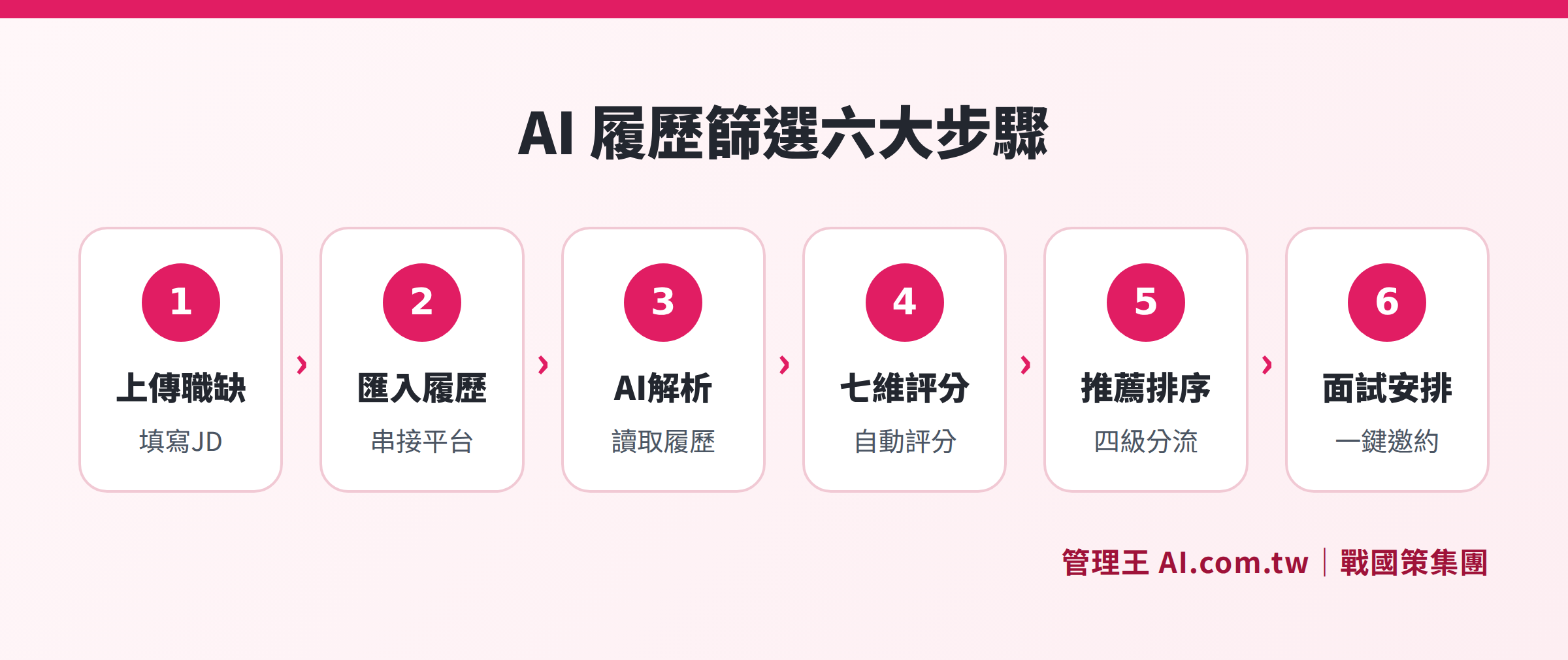
The complete process from JD upload, resume collection, AI parsing, multi-dimensional scoring, four-level recommendations to interview scheduling
What Dimensions Can AI Resume Screening Evaluate? Seven Scoring Criteria
Taking 管理王 AI.com.tw's AI resume screening feature as an example, the system automatically scores each applicant based on seven dimensions:
Table: Seven Key Scoring Dimensions of AI Resume Screening
| Scoring Dimension | Description | Common Application Scenarios |
|---|---|---|
| Skill Matching Degree | Degree of semantic match between required skills in the JD and those listed in the resume | Technical roles such as software engineers, designers |
| Industry Experience Match | Relevance of past industry employment to the target industry | Cross-industry roles in sales, marketing, procurement |
| Experience Suitability | Whether actual work experience meets the JD's required range | Management roles, senior positions |
| Education Background Relevance | Degree and field of study related to job requirements | Professional roles in law, accounting, engineering |
| Job-Hopping Frequency | Average length of tenure in past jobs | Positions requiring long-term training |
| Salary Expectation Gap | Discrepancy between applicant’s expected salary and company budget | Small and medium enterprises with limited budgets |
| Commute Distance | Estimated distance from residence to company location | On-site operation positions |
After completing the seven-dimensional scoring, the system categorizes applicants into four levels: Highly Recommended, Recommended for Interview, Under Observation, and Not Suitable, allowing HR to take action immediately starting with the top candidates in the backend.
What Regulations Must HR in Taiwan Follow When Using AI to Screen Resumes?
AI resume screening involves the collection and processing of personal data, and in Taiwan, at least three regulations must be considered:
Personal Data Protection Act (PDPA): Resumes include personal data as defined by Article 2 of the PDPA, such as name, date of birth, contact information, education background, and work experience. Before uploading applicants' resumes to a third-party AI platform (such as directly pasting into ChatGPT), companies must obtain consent from the individual; otherwise, they may face a fine of up to NT$15,000,000 under Article 19 of the PDPA. The Legal Director of 104 Job Bank has publicly warned that companies should choose compliant tools with a data processing agreement (DPA) that commit not to use the data for model training.
Article 5 of the Employment Service Act: Employers must not discriminate based on gender, age, marital status, appearance, disabilities, or other factors unrelated to job capability during recruitment. If the AI screening system implicitly weighs gender or age, it remains illegal. The Ministry of Labor is formulating guidelines for enterprises adopting AI in 2026, requiring companies to ensure that AI recruitment tools base their judgments solely on job-related capabilities.
Electronic Signature Act: The digitization of Offer Letters involves the efficacy of electronic documents, which must comply with the relevant provisions of the revised Electronic Signature Act (effective from 2019).
Table: Three Major Compliance Points for AI Resume Screening in Taiwan
| Regulation | Core Requirements | Non-compliance Risks |
|---|---|---|
| PDPA | Consent required to upload resumes to AI platforms; choose compliant tools | Maximum fine of NT$15,000,000 |
| Article 5 of the Employment Service Act | AI scoring standards must be based solely on job capabilities | Civil compensation, administrative penalties |
| Labor Standards Act | Trial period and salary payment must comply with regulations after hiring | Delayed salary, fines |
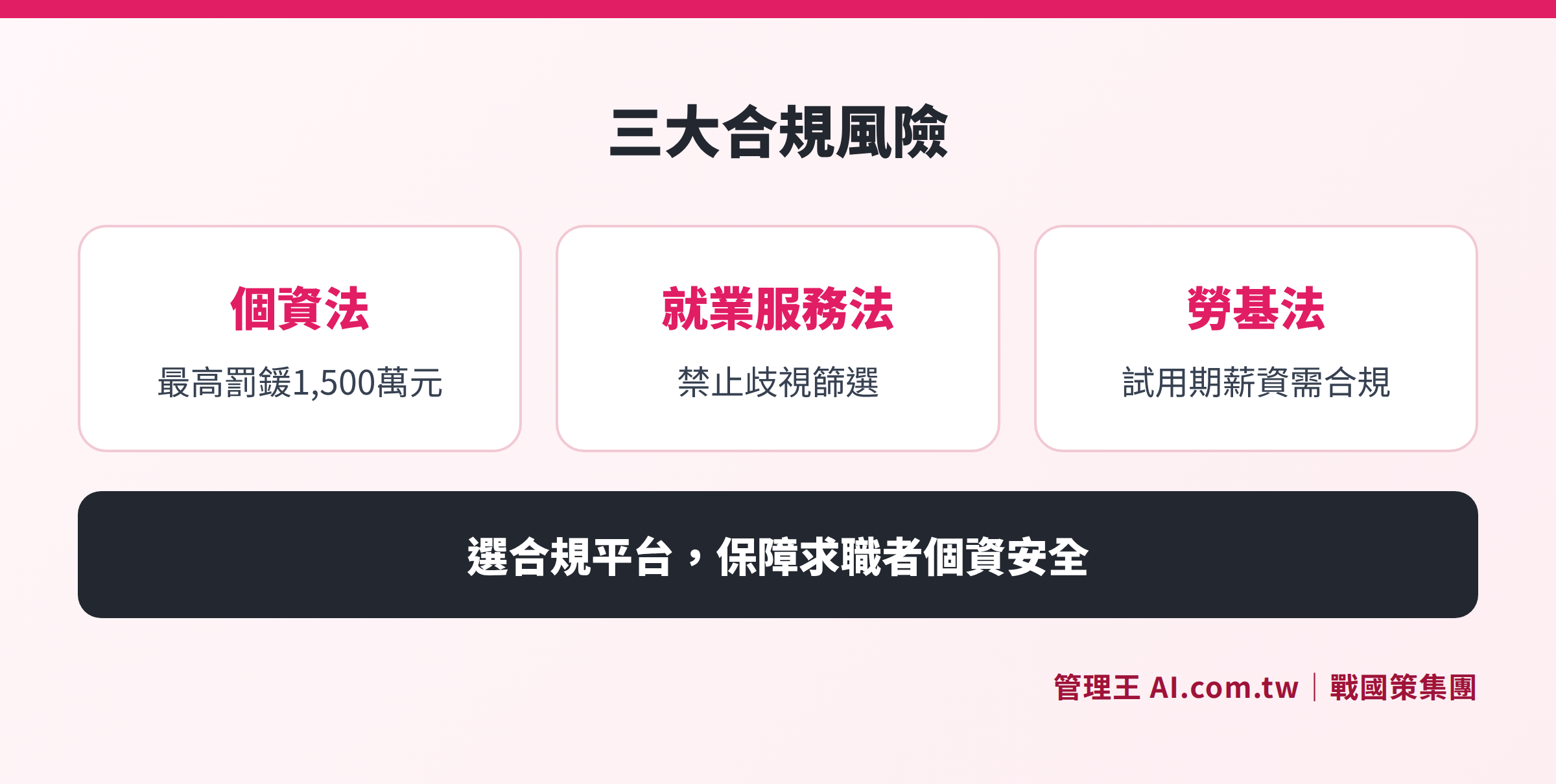
Comparison card of compliance requirements of the PDPA, Employment Service Act, and Labor Standards Act and consequences of non-compliance
How to Choose AI Resume Screening Tools? Five Key Questions
The AI recruitment tools on the market range from single-point services (such as AI resume screening plugins) to integrated systems (like 管理王 AI.com.tw). It is advisable to ask the following five questions when selecting:
1. Can it read internal company data? Pure plugin AI can only match JD and resumes, unable to access historical interview scores, employee performance data, and cannot learn the company’s actual hiring preferences. Integrated systems can connect to the HR database, improving accuracy over time.
2. Is it compliant with data protection laws? Confirm whether the vendor has signed a DPA, explicitly promises not to use customer data for model training, and whether the data is stored in Taiwan.
3. Is its Chinese language capability sufficient? Some foreign AI tools may struggle with semantic judgments in Traditional Chinese, potentially confusing roles like “sales representative” and “sales officer.” Choosing a locally optimized tool is safer.
4. Can it execute actions? AI recommendations alone are not enough; good systems should be able to generate interview invitations, schedule interviews, and create Offer Letters directly, saving HR time on subsequent processes.
5. Is the billing method transparent? Avoid per-character or per-use billing that leads to skyrocketing bills; choosing a monthly fee plan with an AI point limit offers better budget control.
How to Address Limitations and Bias Risks of AI Resume Screening?
Stanford University researchers (October 2025) found that some models gave higher scores to older male job applicants under the same conditions, indicating that historical biases in the training data may be reproduced by AI.
When adopting AI resume screening, companies should implement three risk control measures:
- Regular Bias Audits: Randomly check rejected resumes to confirm that rejection reasons are not unrelated to job capabilities.
- Manual Review Mechanism: AI should only provide initial screening suggestions; the final decision should be confirmed by HR, preventing AI from directly deciding who cannot be interviewed.
- Feedback Loop: Interviewers should provide feedback on AI recommendations after each interview, enabling the system to continuously learn the company’s true hiring standards.
How to Use 管理王 for AI Resume Screening?
管理王 AI.com.tw's AI resume screening is a feature built into a complete HR system, requiring no additional plugin installations or API connections. Here’s how to operate it practically:
Step 1: Create a Job and Upload JD In 管理王's HR system, add a new job position, paste the job description, and the system will automatically parse the required skills and criteria.
Step 2: Integrate Job Platforms It can connect to 104, 1111, LinkedIn to automatically import applicant data without manually uploading each resume.
Step 3: AI Automatic Scoring When new resumes are received, the system automatically executes seven-dimensional scoring in the background, and HR can view the ranked candidate list in the backend, with each applicant accompanied by a score from 0 to 100 and an AI summary.
Step 4: One-Click Interview Arrangement For candidates classified as “Highly Recommended,” select interview invitations, and the system automatically generates customized interview questions and starting salary suggestions, also sending out interview invitation emails.
Step 5: Supervisor Feedback to Optimize Preferences After interviews, supervisors provide feedback on AI recommendations, allowing the system to learn the company’s hiring preferences for better quality selection next time.
管理王's free plan is available permanently, providing one-time AI points for companies to try before buying, with no credit card required. The same system also includes modules for salary management, performance management, onboarding automation, AI employees, and AI knowledge base, ensuring seamless continuation of subsequent HR processes within the same platform.
How Can Companies Phase the Introduction of AI Resume Screening?
For most small and medium enterprises in Taiwan, radically changing recruitment systems at once poses high risks; thus, it is recommended to introduce them in three phases:
Phase One: Pilot Test on a Single High-Volume Job Choose a job with the highest applicant numbers (e.g., sales, customer service, factory operators) and run a round using the AI screening tool. HR should simultaneously manually review the top 20 AI-recommended candidates, comparing AI scores to HR intuitions. The goal of this phase is not to save time but to build trust in the tool.
Phase Two: Expand Scope with Dual-Track Parallel Operation The initial AI screening goes fully online, focusing HR on “Highly Recommended” and “Recommended for Interview” categories while sampling the “Under Observation” category for review. Additionally, interviewers should provide feedback on AI recommendation quality after each interview, allowing the system’s learning mechanism to start accumulating data.
Phase Three: Full Process Integration AI screening, interview scheduling, Offer Letter generation, and onboarding automation are interconnected, forming a complete recruitment-to-onboarding closed loop. At this stage, HR will truly experience time liberation, shifting from administrative tasks to strategic recruitment.
During the implementation process, a key indicator to monitor is: AI Recommendation Accuracy, which refers to the proportion of hires falling within the “Highly Recommended” or “Recommended for Interview” categories based on AI scores. The 管理王 system tracks this indicator internally, allowing HR to view it in real time in the backend as a basis for adjusting screening parameters. Initially low accuracy rates are normal; as feedback data accumulates, the system will continuously optimize recommendation quality, usually showing significant improvement after three months.
Differences Between AI Resume Screening and Traditional Manual Screening
Both traditional manual screening and AI screening have suitable scenarios; here are the core differences between the two:
Table: Comparison of AI Resume Screening vs. Manual Screening
| Comparison Item | Traditional Manual Screening | AI Resume Screening |
|---|---|---|
| Processing Speed | 3 to 5 minutes per resume | Seconds per resume |
| Consistency | Affected by HR fatigue and emotions | Standardized, unaffected by human emotions |
| Bias Risks | Human subjective bias | Algorithmic bias (requires proactive control) |
| Suitable Quantity of Job Vacancies | Few (fewer than 10) | Many (more than 50) |
| Assessment of Soft Skills | Better at identifying characteristics between the lines | Primarily based on hard skills and criteria |
| Compliance Audit Trail | Difficult to record | System retains complete scoring records |
| Implementation Cost | High labor costs | Subscription-based, low marginal cost |
For most small and medium enterprises in Taiwan, the best practice is to have “AI for preliminary screening, HR for judgment”: AI handles 80% of the screening work, while HR focuses on the top 20% of quality candidates and is responsible for assessing soft skills and cultural fit.
How Does AI Resume Screening Integrate with Other HR Modules?
The greatest value of AI resume screening lies not only in shortening screening times but also in the seamless integration with subsequent HR processes. Using 管理王’s framework as an example, after a hiring decision, the following workflows can be triggered directly:
Integrate with Salary Management System: AI has already analyzed applicants’ salary expectations and market conditions during the resume screening phase, allowing HR to directly retrieve this analysis when negotiating salary, speeding up Offer amount decisions.
Integrate with Performance Management: When establishing new employee records, the skill map recorded during the AI screening phase can be automatically brought into performance goal setting, eliminating the need for supervisors to re-enter employee capability benchmarks.
Integrate with Onboarding Automation: Upon confirming hiring, the system can automatically trigger a checklist based on the employee’s position—IT equipment applications, labor and health insurance enrollment, access control, training course assignments—allowing the entire onboarding process to automatically extend from the recruitment system, with HR only needing to confirm key nodes without re-entering data.
Integrate with AI Knowledge Base: After onboarding, the AI knowledge base can immediately respond to repetitive questions such as “What are the company’s leave policies?” and “What is the reimbursement process?” saving HR time in answering newcomers’ questions, enabling new employees to find answers independently in their first week.
This kind of seamless integration from “collecting resumes” to “employee onboarding” represents the core differentiated value of integrated enterprise AI systems compared to standalone AI tools.
Let AI Help HR Select the Right People
管理王 consultants assist in setting AI resume screening criteria and recommending suitable options, starting to save screening time from the very first job vacancy. The free plan allows for a trial of all features.
Free consultation hotline: 0800-003-191
LINE official account: @119m
Official website: app.AI.com.tw
Free trial: Apply for 管理王 now
Frequently Asked Questions
Is it legal to upload resumes to AI tools?
In Taiwan, resumes fall under the protection of the Personal Data Protection Act. Before using AI for resume screening, companies should ensure that the AI tool vendor has signed a Data Processing Agreement (DPA), explicitly promises not to use client data for model training, and ideally select a system that stores data in Taiwan. It is recommended to inform applicants in the company’s job advertisements that “our company uses AI tools to assist in resume screening,” allowing only compliant enterprise AI tools to access resume data and not directly pasting resumes into consumer versions of ChatGPT or Claude.
Will AI resume screening filter out the right people?
AI’s initial screening is primarily based on criteria matching; candidates with non-standard resume formats (e.g., skills listed under “Others”) or atypical backgrounds (career changers, cross-field talents) may receive lower scores. It is advisable to adopt a “AI preliminary screening + HR manual review” dual mechanism: After AI ranking, HR should also sample-review the “Under Observation” categories to avoid missing potential candidates. Regularly reviewing the AI rejection rates and the AI score distribution of the final hires also helps continuously optimize screening standards.
Can AI-generated interview questions be used directly?
They can serve as a reference, but it is advisable for interviewers to confirm whether the questions are appropriate for the specific job context before formal use. 管理王 AI automatically generates customized questions based on resume skills and JD, saving interviewers’ preparation time; interviewers can directly edit questions in the system, adding follow-up questions tailored to the candidates’ backgrounds, ensuring the interview is structured yet flexible.
What company size is AI resume screening suitable for?
Generally speaking, when the number of applicants for a single position exceeds 30, the benefits of AI screening become quite apparent. 管理王 AI.com.tw's AI resume screening is primarily designed for small and medium enterprises with 30 to 200 staff, but the free plan supports up to 10 members, making it accessible for smaller companies as well. For ultra-small enterprises with only single-digit applicants in each recruitment cycle, manual screening may indeed be more flexible.
Will 管理王’s AI resume screening learn the company’s hiring preferences?
Yes. The system has a built-in “latent preference learning” mechanism: each time a supervisor or HR provides feedback by recommending or not recommending an AI-recommended candidate, the AI captures these characteristics into the company’s preference model. After using the system for three to five recruitment cycles, the accuracy of recommendations noticeably improves. This is also why choosing an integrated enterprise AI system (as opposed to a consumer version like ChatGPT) holds long-term value.
Can the free plan use AI resume screening?
Yes. The 管理王 free plan offers one-time AI points, allowing companies to experience AI resume screening features before formal purchase without requiring credit card information. The free plan supports up to 10 members, with limits on job openings and AI points. For higher monthly AI points, additional member capacity, and complete functionality, one can upgrade to the economical (NT$5,000/month), business (NT$10,000/month), or flagship (NT$19,900/month) plans. For full plan comparisons, please refer to 管理王's pricing plans or call for a free consultation, where consultants can recommend the best options based on company size.
Source of Information
- Ministry of Labor: Ministry of Labor Drafting Guidelines for Enterprises to Implement AI to Reduce Discrimination and Protect Labor Rights, Central News Agency, March 2026
- Legal Director of 104 Job Bank warns: Using AI to Screen Resumes in HR Risks High—Fines up to 15 Million, United Daily News, 2024
- National Regulations Database: Personal Data Protection Act, Ministry of Justice
- National Regulations Database: Article 5 of the Employment Service Act, Ministry of Labor
- Microsoft & LinkedIn: Taiwan Work Trend Index 2025 — AI Adoption in HR, 2025
This article is for general information and does not constitute legal or HR management advice; please refer to the latest announcements from the competent authorities for actual guidance.