What is AI SEO? New Ranking Strategies for Small and Medium Enterprises in the Age of AI Search | Recommended AI SEO Tools

AI SEO integrates traditional SEO with generative AI optimization, allowing web pages to rank on Google while being actively cited by ChatGPT, Perplexity, and Google AI Overviews. In Taiwan, AI Overviews have appeared in over 30% of search results; without upgrading ranking strategies, CTR will continue to decline. This article provides a complete analysis of AI SEO definitions, the differences between AEO/GEO, the citation preferences of the three major AI platforms, and how Management Wang's AI SEO system can help small and medium enterprises in Taiwan efficiently handle keyword research, ranking tracking, and AI visibility monitoring.
AI SEO (Artificial Intelligence Search Engine Optimization) refers to the optimization of content for generative AI search engines like ChatGPT, Perplexity, and Google AI Overviews, in addition to traditional Google SEO. This ensures that your website not only appears in the blue link list but is also directly cited, summarized, and recommended by AI to the users asking questions. By 2026, Google AI Overviews appeared in over 30% of search results in Taiwan; without upgrading traditional ranking thinking, traffic will continuously be lost to the invisible AI summary boxes.
What is AI SEO? Fundamental Differences Between Traditional SEO and the AI Era
The core goal of traditional SEO is to have web pages rank high in Google’s search results page (SERP) to lead users to click into the site. AI SEO goes further: it aims to have AI systems actively cite your content when generating responses, meaning your brand and viewpoints are already included in the AI's answers even if users do not click any links.
This shift has birthed two new areas:
- AEO (Answer Engine Optimization): Optimizing content structure for conversational AIs like ChatGPT and Perplexity, with the goal of having AI directly cite your paragraphs as answer sources.
- GEO (Generative Engine Optimization): This broadly encompasses optimization strategies for all generative AI platforms, including evaluating how AI large language models select, score, and cite sources.
Table: Core Differences Between Traditional SEO and AI SEO
| Aspect | Traditional SEO | AI SEO (AEO/GEO) |
|---|---|---|
| Goal | Rank #1 in Google keywords | Be directly cited and recommended by AI |
| Performance Metrics | CTR, organic traffic, ranking | Number of citations, brand exposure, AI conversion rate |
| Content Format | Long articles, keyword density | FAQ structure, tables, data citations, question titles |
| Query Length | Average of 4 keywords | Average of 23-word conversational query |
| Citation Sources | Search engine algorithms | LLM training data + real-time crawling |
| Traffic Model | Click to enter | Direct summary (possibly zero clicks) |
Understand in One Sentence
AI SEO does not replace traditional SEO, but adds a layer of strategy aimed at making AI willing to cite you. Websites ranked #1 on Google have a 77% chance of appearing in ChatGPT and Perplexity, reinforcing each other.
AI Search Has Significantly Changed the Traffic Landscape (Real-Time Data for Taiwan)
AI search is not a future trend; it is already happening. Here are several key statistics:
Impact of Google AI Overviews
According to tracking reports from SEOProfy and Digital Applied, by March 2026, Google AI Overviews had appeared in about 48% of global search queries, a 58% increase compared to December 2025. When AI Overviews appear, the CTR of the top-ranking pages drops by an average of 34.5%; for definition-type queries like "What is...", the CTR drop is even higher at 89%.
Specific Changes in the Taiwan Market
Based on analysis from 91APP and GrowthhackersTW, the Taiwan market has shown the following changes:
- Google’s market share has decreased from about 87% two years ago to 78.5%;
- ChatGPT accounts for a staggering 75.96% of AI platform traffic in Taiwan;
- Google AI Overviews have appeared in over 30% of search results in Taiwan;
- The likelihood of the top-ranking page being cited by AI Overviews is 53%, while it drops to 36.9% for the tenth-ranking page.
Bad News and Good News Coexist
The bad news is that about 58% of Google searches now end with zero clicks. The good news is that the conversion rate of visitors from AI referrals is much higher than that of regular organic search traffic—about 11.4% for AI-referred visitors compared to 5.3% for traditional organic search, over twice as high (GetPassionFruit 2026 data). For small and medium enterprises, traffic may decrease, but every incoming visitor has a higher value.
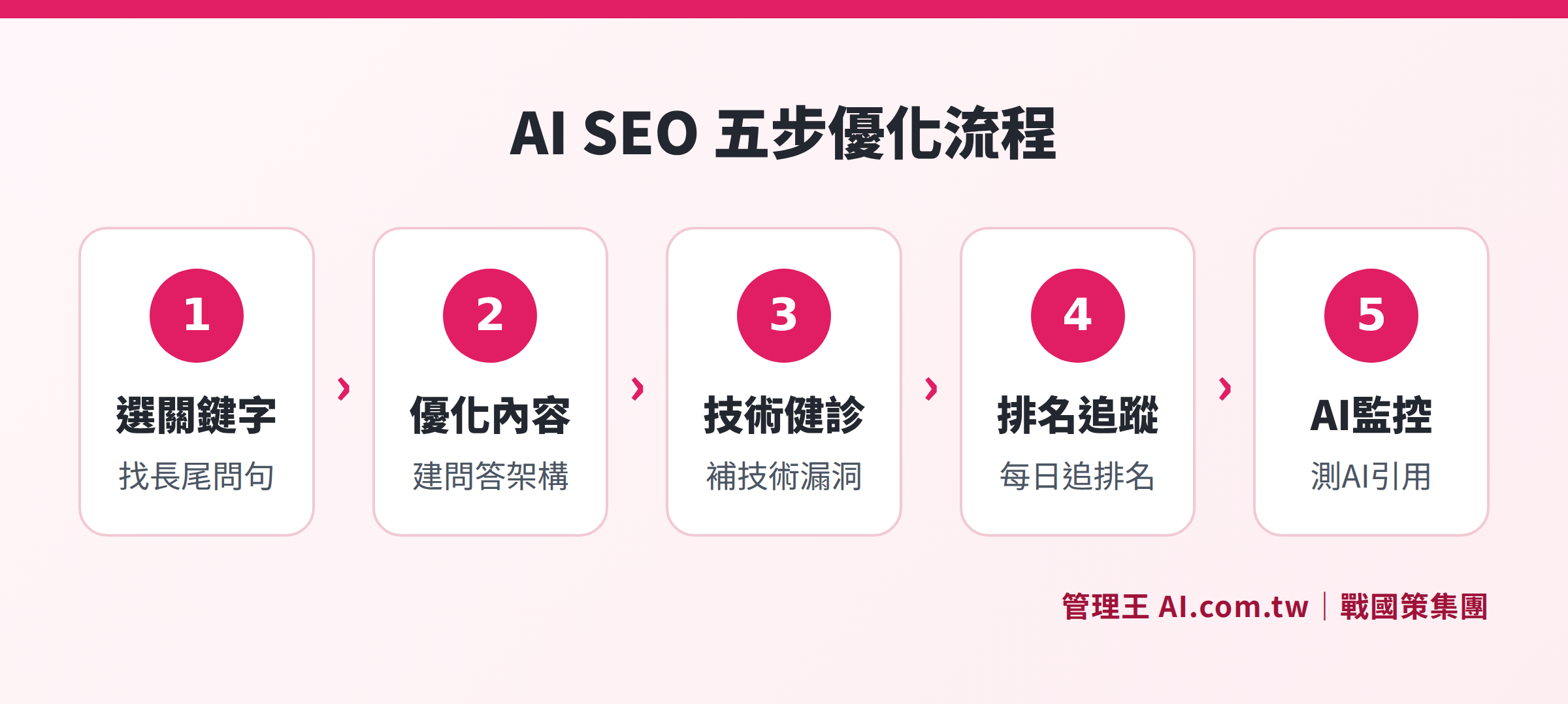
Illustration of the flow change from clicks to direct AI citations and high-quality visitor entries in the AI era
What is AEO? Three Key Principles to Get AI to Directly Cite Your Content
AEO (Answer Engine Optimization) revolves around the core logic that your content must be "structured clearly enough for AI to directly copy." Based on research by Contently, the following three principles can significantly increase AI citation rates:
Principle One: Structure Before Keywords
Tables and bullet lists are far more reliably extracted by AI than prose paragraphs. FAQ formats (question + direct answer) are currently the easiest content forms to enter AI summary boxes. Each H2 and H3 heading should ideally be phrased as questions that readers would ask.
Principle Two: Data and Citations Enhance Credibility
Contently's research shows that including statistics in content can increase AI visibility by 22%, while including cited quotations can enhance it by 37%. This means every article should have verifiable data sources rather than just subjective assertions.
Principle Three: The Top 30% is the AI's Reading Focus
About 44% of ChatGPT citations come from the top 30% of the page's content. This indicates that the opening paragraphs and the first H2 are crucial—you must clarify the most important answers before readers (and AI) lose patience.
GEO Generative Engine Optimization: Content Preferences of Different AI Platforms
The challenge with GEO is that the three major platforms—ChatGPT, Perplexity, and Google AI Overviews—each have different citation logics, making a one-size-fits-all approach ineffective:
Table: Content Preference Comparison of the Three Major AI Search Platforms
| AI Platform | Primary Citation Sources | Most Valued Factors | Reliance on Traditional Ranking |
|---|---|---|---|
| Google AI Overviews | Google indexed content | Highly correlated with traditional rankings | Highest (overlaps the most with SEO) |
| ChatGPT | Wikipedia, educational resources | Entity recognition in LLM training data | Medium |
| Perplexity | YouTube, professional resources | Content freshness is most important | Lower (values immediacy more) |
From this, it is evident that to fully cover AI search visibility, one must achieve: high-quality foundational SEO (to rank well on Google), credible external citations (to have ChatGPT recognize your brand in its training data), and continuously updated fresh content (to be prioritized by Perplexity).
It is worth noting that the stability of AI citations is lower than expected—according to tracking by GetPassionFruit, of queries that won AI citations within a month, 68% lost citation eligibility the following month, and only 7% maintained visibility for four months or longer. This indicates that AI SEO is an ongoing cultivation process rather than a one-time undertaking.
AI SEO Keyword Research: From "Short Phrase Competition" to "Long-Tail Question Layout"
The keyword strategy of traditional SEO focuses on finding high search volume, low competition terms. In the AI era, keyword research needs to incorporate a new dimension: conversational long-tail questions.
According to research by HubSpot, AI search users submit queries averaging 23 words, whereas traditional Google searches average only 4 words. Users are increasingly accustomed to asking AI complete questions, such as "How can small and medium enterprises do SEO without spending a lot of money," instead of merely entering "SEO tools."
Three Steps for AI Era Keyword Research:
- Find Core Themes: Identify your business's core keywords (e.g., "AI SEO," "SEO tools").
- Expand into Conversational Questions: Develop each core term into complete questions readers might ask AI (e.g., "What does AI SEO mean?", "Do small and medium enterprises need to do AI SEO?", "What is the difference between AI SEO and traditional SEO?").
- Assess Competition and Search Intent: Long-tail questions tend to have lower competition and stronger conversion intent, representing the easiest entry points for small and medium enterprises in the AI era.
Avoid "red ocean words" (e.g., core terms that compete directly with large brands) and target long-tail terms that have search volume but relatively low competition, providing the most practical strategy for enterprises with limited resources.
Topic Cluster Strategy: Allowing AI to Recognize Your Professional Depth
AI SEO keyword layout is not just about individual articles. It involves creating a "topic cluster" consisting of a pillar article that overview the entire topic, along with multiple cluster articles that delve into subtopics, all interconnected by internal links.
This structure is especially important for AI SEO for two reasons: first, AI systems tend to cite authoritative sources that cover a topic comprehensively, rather than sites with only isolated articles; second, the internal linking of topic clusters helps Google understand your site's area of expertise, further enhancing your overall ranking for related keywords and indirectly increasing the odds of being cited by AI Overviews.
For example, in the case of "AI SEO," the pillar article covers the entire topic's definition and strategies, while the cluster articles explore subtopics such as AEO optimization techniques, GEO platform differences, technical SEO diagnostics, and AI keyword research methods, with each cluster article linking back to the pillar article, creating a tightly-knit knowledge network.
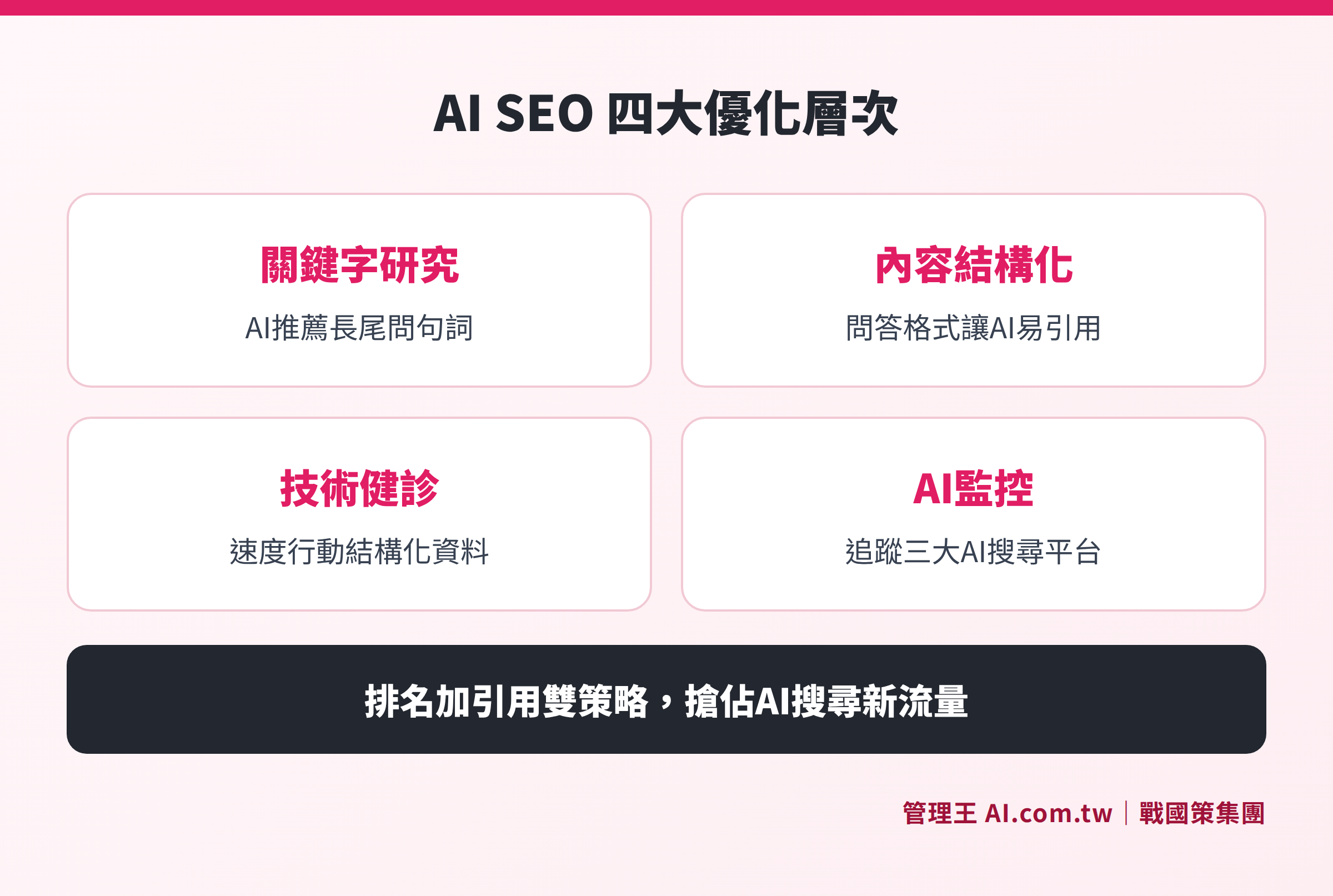
Covering four core optimization directions: keyword research, content structure, technical diagnostics, and AI visibility monitoring
Technical SEO Cannot Be Ignored in the AI Era
Many people mistakenly believe that in the AI era, it is enough to write good content, and technical SEO can be sidelined. In actuality, the opposite is true—technical issues can prevent AI crawlers from even reaching your content.
Core Technical SEO Checkpoints in the AI Era:
- Website Speed and Mobile Friendliness: Google Core Web Vitals remain essential reference indicators for AI Overviews citations.
- Structured Data (Schema.org): FAQ schema and Article schema make it easier for AI to recognize your content types and credibility.
- 404 Errors and Broken Links: Broken pages waste crawling budgets for AI crawlers.
- JavaScript Rendering Issues: Pages heavily reliant on JavaScript are less friendly to AI crawlers; research by 91APP indicates that this is a common problem with Taiwanese government websites.
- Internal Linking Structure: A clear Topic Cluster structure helps AI understand your site's thematic expertise.
According to analysis by Averi AI, even if your Google ranking is good, if your site has technical issues, you may still be overlooked in Perplexity or ChatGPT's real-time crawling. Technical SEO serves as the foundational base for AI SEO.
Structured Data as an Accelerator for AI SEO
Schema.org structured data is a markup language that enables search engines and AI systems to understand page content more rapidly. Common types include:
- FAQPage schema: Marks common questions in a Q&A structure, allowing Google to convert them directly into AI Overviews material, and can also display in the search result snippet box.
- Article schema: Marks the author, publication date, and modification date of the article to help AI judge content freshness and credibility.
- Organization schema: Helps AI more easily identify your brand entity and increases the likelihood of correct brand name attribution during citations.
For small and medium enterprises, starting with FAQ schema offers the highest ROI as FAQs are both easy to implement and directly correlate with the content forms most often cited by AI.
Content Structure Optimization: Encouraging ChatGPT and Perplexity to Cite You
Once you ensure a solid technical foundation, the writing style determines whether AI is willing to cite you. Here are some practical principles:
Adopt an “Answer First” Writing Structure
Directly provide the answer in the first paragraph of each H2 section and then elaborate. AI prefers this structure of “question → direct answer → supplementary explanation,” as it can directly extract the first paragraph as a response.
Utilize FAQ Sections Effectively
FAQ formats are currently among the most cited content forms by AI. Each question should be presented as an H3 header, with answers kept concise within 2-3 paragraphs. If your site has an FAQ schema structure, the chance of Google converting these Q&As into AI Overviews material increases.
Don’t Skimp on E-E-A-T Signals
Both Google and major AI platforms value E-E-A-T (Experience, Expertise, Authoritativeness, Trustworthiness). Concrete practices include citing official sources and research data, clearly indicating article update dates, and ensuring positive mentions of your brand in external media.
Avoid Content Types That AI Will Ignore
- Pure advertising copy (lacking substantial information value)
- Self-aggrandizing descriptions filled with “we are the best” assertions
- Statistics without verifiable sources
- Excessively repetitive keyword stuffing
AI Visibility Monitoring: Your Brand's Visibility in AI Searches
Traditional SEO can clearly view ranking and traffic data via Google Search Console. AI SEO monitoring is more complex, as ChatGPT and Perplexity do not provide official exposure data.
Current feasible monitoring methods include:
- Regular Manual Testing: Each week, ask your core keywords in ChatGPT, Perplexity, and Google AI Overviews to check if you are cited.
- Integrate Google Search Console: Track which queries bring organic traffic, which have AI Overviews, and observe CTR trends.
- AI Referral Traffic Monitoring: Set up AI platform referral tags in GA4 to track visitor behavior coming from ChatGPT and Perplexity.
- Brand Mention Monitoring: Use tools to track how often your brand is mentioned in third-party articles since 85% of AI brand citations come from external pages outside of your own site (GetPassionFruit data).
The GEO market is currently estimated at about 848 million USD (2025) and is projected to grow to 33.7 billion USD by 2034, with a CAGR of 50.5% (HubSpot research). Companies that invest in AI SEO layouts now will gain a competitive edge in this growth wave.
How to Do AI SEO with Management Wang AI.com.tw
For small and medium enterprises with limited resources, building an entire AI SEO workflow from scratch can be costly. Management Wang's AI SEO system integrates all the above-mentioned elements into an automated tool designed by a Taiwanese team. Here’s how it operates in practice:
Keyword Research: AI Recommends About 50 Target Terms
Input your industry or main services, and Management Wang AI will immediately recommend about 50 target keywords, along with their monthly search volumes and competition levels. This saves you the cost of purchasing additional SEO tools or estimating on your own, allowing you to directly target high-traffic, competitive long-tail keywords.
Daily Automatic Ranking Tracking
The system automatically crawls your site every day to find your ranking position for various Google keywords, graphing the trends of upward and downward movements. Which articles are starting to climb, which keywords drop out of the top ten pages—all is clear without needing to manually check rankings daily.
Competitive Intelligence Analysis at One Click
Input a competitor's URL, and Management Wang will automatically extract the keywords, content themes, and backlink sources they are targeting. You can clearly see your peers' SEO angles and identify your content gaps without guesswork. If deeper competitive analysis is needed, you can also utilize the competitor analysis function.
AI Content Generation
Input a keyword, and the AI will generate approximately 2,000-word draft articles compliant with SEO standards, complete with H1, H2, H3 title structures and internal link suggestions, reducing what used to take an entire day to create long articles to just a few minutes. Combined with AI Copywriter, social media posts can also be produced simultaneously.
Technical SEO Diagnostics
The system automatically checks website speed, mobile-friendliness, structured data, and 404 errors, supporting automatic Schema.org tagging generation and internal link optimization suggestions, addressing the technical foundation that AI crawlers are most concerned about.
AI Visibility Monitoring
Linking real data from Google Search Console, the system automatically sends monthly SEO ranking reports and can monitor your brand's exposure in AI searches from ChatGPT, Perplexity, Gemini, etc. This functionality is rare in the market as it can simultaneously monitor both traditional SEO and AI search visibility.
Regarding costs, the Management Wang free plan can be used permanently, and advanced AI features will be available after the free trial period based on plan upgrades, requiring no additional subscription to ChatGPT Plus or other SEO tools. Coupled with marketing automation, social scheduling, and ad management features, your marketing workflows can be seamlessly integrated.
For detailed plans and pricing, please visit the Management Wang Service Plan Page.
Let Consultants Assist You in Planning Your AI SEO Strategy
Management Wang consultants offer a free assessment of your current SEO status, helping small and medium enterprises develop a comprehensive optimization strategy for the AI search era, covering everything from keyword research to AI visibility monitoring all in one place.
Free consultation hotline: 0800-003-191
LINE Official Account: @119m
Official website: app.AI.com.tw
Free trial: Apply for Management Wang Now
Frequently Asked Questions
What is the difference between AI SEO and traditional SEO?
The goal of traditional SEO is to achieve a high ranking on the Google search results page to lead users to click into the site. AI SEO goes further by optimizing for generative AI search engines, such as ChatGPT, Perplexity, and Google AI Overviews, to have AI actively cite your content when responding to users’ questions. The two are not in opposition; AI SEO is an advanced strategy built on the foundation of traditional SEO.
Do small and medium enterprises need to do AI SEO?
Yes. By 2026, Google AI Overviews appeared in over 30% of search results in Taiwan, and traditional ranking strategies must be upgraded to AI SEO; otherwise, webpage click-through rates (CTR) may significantly decline. However, the conversion rate of visitors coming from AI search referrals is higher (approximately 11.4% versus 5.3% for organic search), so the returns on investing in AI SEO are more promising.
How can I get ChatGPT or Perplexity to cite my content?
There are three main directions: first, use FAQ formats and question titles to make it easy for AI to extract answers; second, include cited statistics in your content to boost credibility; third, ensure a solid technical SEO foundation (website speed, Schema.org structured data). Research shows that approximately 44% of ChatGPT citations come from the top 30% of content, thus opening paragraphs are particularly important.
How long will it take to see results from AI SEO?
The stability of AI citations is lower than expected; about 68% of queries may lose their citation status the following month after receiving a citation. Therefore, AI SEO requires continuous effort. It is advised to regularly test the exposure status of core keywords on major AI platforms and monitor CTR trends through Google Search Console, gradually adjusting content strategies.
What are some good AI SEO tools available in Taiwan?
Small and medium enterprises in Taiwan seek features such as a Chinese interface, Taiwanese keyword data, and integrated marketing functions rather than just ranking tracking tools. Management Wang's AI SEO system integrates six major functions: keyword research, ranking tracking, competitive analysis, AI content generation, technical diagnostics, and AI visibility monitoring. The free plan can be used forever and is a one-stop solution designed by the Zhanguo Ce Group for Taiwan's small and medium enterprises, currently serving over 30,000 businesses.
Data Sources
- Google AI Overviews Statistics and Trends 2026 — SEOProfy
- Generative Engine Optimization (GEO) Marketing Guide — HubSpot Blog
- AI Search Statistics 2026 — GetPassionFruit
- What Is Answer Engine Optimization (AEO)? — Contently
- What Is AI SEO? 2026 Complete Guide — 91APP
- Similarweb 2026 AI Search Report: Taiwan E-commerce Comparison — GrowthhackersTW