Should You Hire an Accountant or Use an Accounting System Yourself? Cost and Division of Labor Comparison|Accounting System Recommendations

The monthly cost of hiring an accountant is about NT$2,000 to 4,000, totaling around 14 months a year; the free plan of the accounting system can be used indefinitely. This article organizes cost breakdowns, division of labor comparisons, and selection timing to help small and medium-sized business owners make the most suitable decision.
Should You Hire an Accountant or Use an Accounting System Yourself? Cost and Division of Labor Comparison|Accounting System Recommendations
For small and medium-sized enterprises, the question of "Should I hire an accountant?" often arises in the first year of operation. The monthly cost for hiring an accountant is approximately NT$2,000 to 4,000, with actual annual expenses calculated at about 14 months due to annual reporting services; at NT$3,000 per month, this amounts to NT$42,000. The alternative is to implement an accounting system for self-bookkeeping. The 管理王 free plan can be used indefinitely and supports invoice OCR, profit and loss statements, and the three major financial statements. These two paths are not mutually exclusive, as many businesses adopt a hybrid model of "using the system for daily bookkeeping and hiring an accountant for seasonal assistance with reports." This article organizes the cost structure of hiring accountants, statutory division of labor, and selection timing based on official sources, allowing business owners to make the best decision for their company after reading.
What is an Accountant? Clarifying the Statutory Scope
According to Article 2 of the "Accountant Law," an accountant is a practitioner who has passed the national examination (professional technology examination) and holds a practice certificate issued by the Ministry of Finance. The scope of services for accountants is specified in Article 13:
- Business registration, changes, cancellations, applications for suspension, and resumption
- Agent for various tax declarations (including sales tax, income tax, etc.)
- Tax consultation
- Authorized handling of business accounting matters
Important Restrictions: Accountants cannot handle tax audit certification declarations (tax signatures), appeals, or administrative litigation, nor can they conduct company registration and capital verification, as these tasks are reserved for certified public accountants. If a business requires a "tax signature" (typically when annual revenue reaches a certain scale), they must hire an accounting firm.
Accountants and "bookkeeping and tax declaration agents" are two different qualifications; the former has examination requirements, while the latter is subject to separate management regulations under Article 35 of the Accountant Law. Businesses should confirm the practitioner's qualifications before outsourcing.
In a Nutshell
Accountants can help you with bookkeeping and tax declarations, but they cannot issue financial statements or perform capital verifications; these tasks require a certified public accountant.
How Much Does It Actually Cost to Hire an Accountant Each Year?
Many business owners see the "monthly fee of NT$2,500" and think it totals only NT$30,000 for the year, but accountant fees are typically calculated based on 14 months. The reason is that several additional tasks are performed each year:
- Annual closing and accounting adjustments
- May business income tax final declaration
- January withholding tax declaration
- Dividend details and shareholders' tax credit declarations
Table: Market Rates for Outsourced Accountants (per company type, reference values based on the Ministry of Finance's income standards)
| Company Type | Monthly Fee Range | Actual Annual Expenditure (× 14) |
|---|---|---|
| Small Sole Proprietorship (no invoices) | NT$1,500–2,500 | NT$21,000–35,000 |
| Limited Company (low invoice volume) | NT$2,500–4,000 | NT$35,000–56,000 |
| Public Company (standard transaction volume) | NT$3,000–6,000 | NT$42,000–84,000 |
| Import/Export Trade (high invoice volume) | NT$4,000–8,000 and above | NT$56,000–112,000 and above |
The Ministry of Finance sets a reference minimum price for accountant services in the "Income Standards for Practitioners" (Year 110): NT$2,500 per month per item for municipalities and cities, and NT$2,000 per month per item for counties. Actual market rates vary based on invoice volume, company complexity, and firm size.
Accountants' monthly fees do not include: company formation costs, special tax planning consultation, assistance with tax authority audits (appeals), and more, which are usually charged separately.
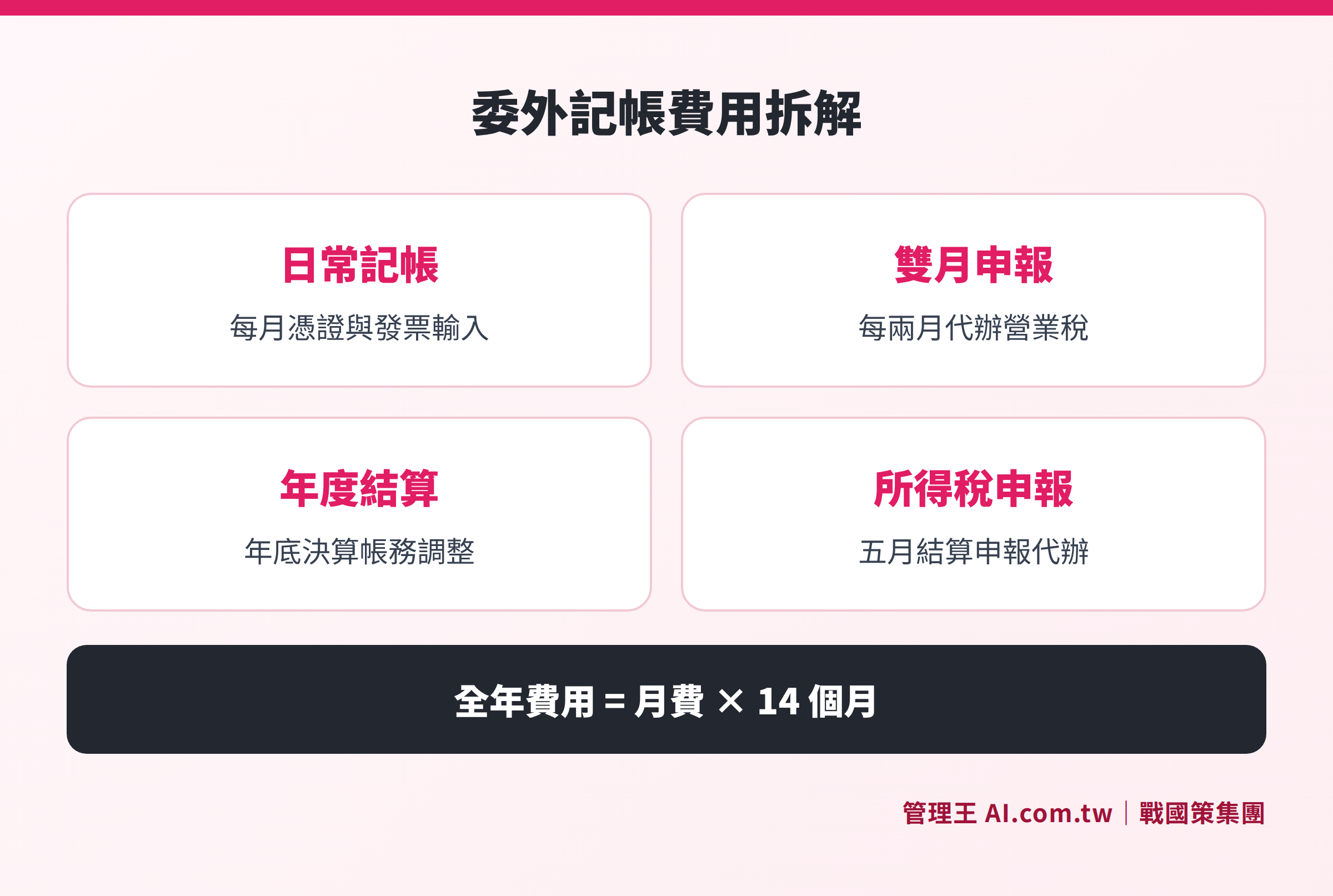
Outsourced accounting costs = Monthly fee × 14, including daily bookkeeping, bi-monthly declarations, annual closings, and income tax finalizations
How Much Does It Cost to Use an Accounting System Yourself?
The cost structure of accounting systems is the opposite of that of accountants — initial investment is almost zero (if using a free plan), with the main costs being personnel learning time and initial setup.
Table: Cost Structure of Accounting Systems (using 管理王 as an example)
| Cost Item | Amount | Description |
|---|---|---|
| Software Monthly Fee (Free Plan) | NT$0 | Free for teams of ten or fewer, indefinitely, includes accounting system |
| Software Monthly Fee (Economy Plan) | NT$5,000/month | For up to 30 people, includes all modules and 100+ features |
| Implementation Setup Time | Self-Estimated | Basic setups typically completed in 1–3 days |
| Custom Development | NT$1,000/hour | Only needed for special process requirements |
| Annual Declaration Consulting Fee | Based on need | Can work alongside accountant for seasonal assistance |
The cost of an accounting system is not fixed each month; rather, it’s the labor time exchanged for savings on outsourcing costs. If the company has a large volume of invoices each month and the finance staff possess basic bookkeeping skills, the system's marginal cost is relatively low; however, if the owner prefers to outsource completely without dealing with accounting, hiring an accountant remains the most hassle-free option.
Comparison of Division of Functions Between Accountants and Accounting Systems
Table: Comparison of Functions between Accountants vs. Accounting Systems
| Comparison Item | Outsourced Accountant | Self-Used Accounting System |
|---|---|---|
| Daily Bookkeeping | Operated by the accountant | Input by oneself or auto-recognition via OCR |
| Invoice Management | Collected and handed to the accountant at month-end | Real-time entry by photographing invoices (completed in three seconds) |
| Profit and Loss Statement | Visible only after monthly closure | Can be generated at any time with one click |
| Bi-Monthly Sales Tax Declaration | Handled by the accountant | System generates reports, but still requires filing |
| Annual Income Tax Declaration | Fully handled by the accountant | Recommended to collaborate with accountant for signatures |
| Tax Signatures/Financial Signatures | Not applicable (requires a CPA) | Not applicable (requires a CPA) |
| Consolidated Financial Statements for Multiple Companies | Incurs additional costs | Single account manages multiple companies |
| Real-Time Access for Owners | Requires a phone call to the accountant | Access via mobile at any time |
| Integration with CRM Sales | Cannot automatically connect | Automatically generates vouchers, avoiding duplication |
| Cost | NT$2,000–6,000/month (× 14) | Starts at NT$0 (Free Plan) |
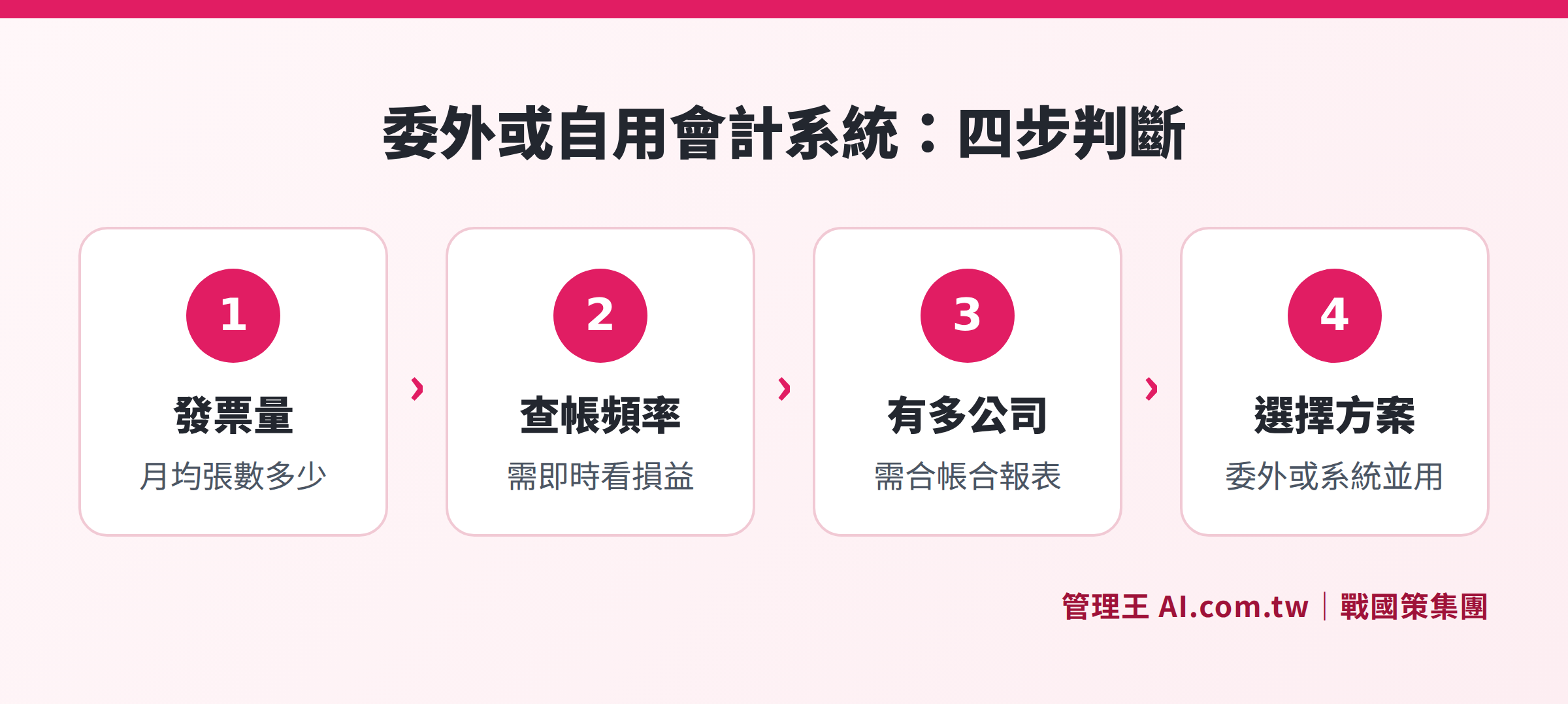
Determine based on invoice volume and owner's access needs: Low invoice volume and no need for real-time access suit purely outsourcing; high invoice volume or need for real-time reports suit using a system alongside outsourcing
When Is It Most Cost-Effective to Continue Outsourcing an Accountant?
In the following situations, purely outsourcing an accountant is a reasonable choice:
1. Small Scale, Low Transaction Volume
For sole proprietorships or small limited companies with fewer than 50 invoices per month and straightforward business types, a monthly fee of NT$2,000 to 2,500 is sufficient, making the time cost of implementing a system not worthwhile.
2. Owners Do Not Want to Deal with Accounting
Some owners excel in business or technical skills, so fully outsourcing finances allows them to focus on their core competencies. This is not a right or wrong choice, just a preference.
3. Complex Tax Issues Require Planning
If the company has foreign employees, cross-border transactions, investments in subsidiaries, or requires tax-saving plans, the advisory value of an accountant (or CPA) far exceeds the monthly fee itself.
4. The Company Just Started
For newly established companies where processes are not yet fixed, having an accountant assist in setting up accounts is more time-efficient than navigating it alone. Once processes stabilize and transaction volumes increase, reevaluation of system implementation can be considered.
What Situations Are Suitable for Implementing Your Own Accounting System?
In the following circumstances, using a self-managed accounting system can provide significant benefits:
1. Owners Need Real-Time Financial Data
In traditional outsourcing models, owners must wait until month-end to see profit and loss. If the owner needs to track gross profit and cash flow weekly or even daily, a system is the only way to achieve this.
2. High Invoice Volume, Increasing Accountant Fees
When there are more than 100 invoices per month, accountant fees may exceed NT$5,000; implementing a system allows finance personnel to operate independently while reducing reliance on outsourcing.
3. Multiple Departments or Companies Require Consolidated Management
Accountants charge high costs for cross-company bookkeeping; systems support the splitting and merging of accounts across multiple companies, allowing a group financial supervisor to manage across a single account.
4. Business, Procurement, and Payroll Processes Already in the System
If the company is already using a procurement ERP system, payroll system, or CRM, allowing the accounting system to directly utilize upstream data saves on the labor cost of duplicating entries, which is the system's greatest value.
Using Both Together: The Golden Division of Labor between Accountants and Accounting Systems
Many companies in Taiwan with a workforce of 20 to 100 employees adopt a "mixed mode":
- System Responsibilities: Daily bookkeeping, invoice OCR entry, real-time generation of profit and loss statements, accounts receivable and payable management
- Accountant Responsibilities: Overseeing bi-monthly sales tax declarations, May income tax finalizations, and providing tax consultation as needed
This division of labor reduces monthly fees to NT$1,500 to 2,000 (only seasonal reporting assistance), while the instant financial visibility provided by the system remains intact. The accountant shifts from a role of "feeding data each month" to that of a "consultant during reporting season," clarifying the relationship between the two parties.
A written mandate should be signed between the accountant and the company, in accordance with Article 14 of the Accountant Law, which requires the contract to specify the scope of services, fees, and mandate duration, allowing the business to confirm the scope of outsourcing and liability clearly.
How to Use 管理王's Accounting System?
管理王's accounting system is designed with the real pain points of small and medium enterprises in Taiwan in mind — bookkeeping is not just about entering numbers, but ensuring that owners can understand their financial status at any time.
Basic Operating Process:
- Invoice OCR Entry: Take a photo or upload an invoice, and AI automatically recognizes the buyer, seller, amount, tax ID, and item description, completing entry in about three seconds
- Automatic Subject Suggestions: Online creation of income and expenditure forms, transfer orders, and discount notes, with the system automatically suggesting accounting classifications, no accounting degree required
- Integration with Procurement and Sales: Automatic generation of vouchers from procurement payments and sales receivables, avoiding duplicate entry
- One-Click Generation of Three Major Financial Statements: The profit and loss statement, balance sheet, and cash flow statement are accessible at any time without waiting for month-end closure
- Bank Reconciliation: Import bank statements, and the system automatically matches them, reducing month-end reconciliation time from three days to one day
- Export for Collaboration with Accountants: Supports exporting in formats suitable for 鼎新, 用友, 正航, 文中, etc., to be used directly by accountants during reporting season
The free plan can be used indefinitely, and teams with ten or fewer do not need to pay monthly fees to access invoice OCR and the three major financial statements. For more complex management, cost centers, or larger teams, it can be upgraded to Economy or Business Plans.
If you are evaluating an accounting system, you can refer to these articles:
- How to Choose an Accounting System? A Mapping for SMEs from Bookkeeping to Reporting
- Recommended Accounting Systems: Comparing Public Information on 鼎新, 文中, 天心, and More
- Can Free Accounting Software Last Indefinitely? Hidden Costs of Free Versions
Furthermore, the approval and review process can be integrated with the accounting system, allowing expense claims and reimbursements to be handled online, saving time on paper-based operations.
Calculate Your Bookkeeping Costs for Free
Consultants will help you compare the actual cost differences between outsourcing bookkeeping and using an accounting system. Experience 管理王 for free in 30 seconds and find the most suitable bookkeeping solution for your company size.
Free consultation hotline: 0800-003-191
LINE Official Account: @119m
Official website: app.AI.com.tw
Free trial: Apply for 管理王 Now
Frequently Asked Questions
What is a Reasonable Fee for an Accountant?
The Ministry of Finance's "Income Standards for Practitioners" (Year 110) set a reference minimum price: NT$2,500 per item per month for municipalities and cities, and NT$2,000 per item per month for counties. Actual market rates depend on the company type and volume of invoices, typically ranging from NT$1,500 to over 6,000. Limited companies with standard transaction volumes (fewer than 50 monthly invoices) usually fall between NT$2,500 and 4,000, with actual annual expenses calculated over 14 months due to annual reporting services.
If You Only Use an Accountant Without an Accounting System, Can Owners See Their Financial Status Anytime?
Typically not. In traditional outsourcing models, accountants only provide reports after each month’s closing, so owners cannot view daily income, expenses, or cash flow in real time. If real-time financial visibility is required, an accounting system should be implemented or at least a cloud tool that supports real-time reporting should be used.
What is the Difference Between an Accountant and a CPA?
Accountants obtain their credentials by passing the "Professional Technology Examination" and can handle bookkeeping and tax declaration representations; CPAs pass the "Professional High Examination" and are licensed to handle tax signatures, financial signatures, capital verification, and audits. If a company requires "audited statements” or public disclosure forms, it must hire an accounting firm.
Do You Still Need to File Taxes if You Use an Accounting System?
Yes. The accounting system organizes accounts and produces reports, but bi-monthly sales tax declarations and annual income tax finalizations still need to be filed either by yourself or by hiring an accountant. Most businesses choose a hybrid model of "daily bookkeeping via the system and seasonal assistance with accounting for filing," reducing outsourcing costs while maintaining professional support for reporting.
What Size of Company Should Implement an Accounting System?
There is no fixed threshold, but a few key moments are worth evaluating: exceeding 100 invoices monthly (indicating low efficiency for manual entry), owners needing real-time financial data, companies with multiple departments or entities needing consolidations, or those already using procurement or business systems and wishing for financial data integration.
Data Sources
- Accountant Law (National Regulations Database), Ministry of Finance, amended May 2022
- Income Standards for Practitioners (Year 110), Ministry of Finance
- Key Points for Implementation of Electronic Invoicing, Ministry of Finance, updated in 2024
- Taipei City Accountant Association, Taipei City Accountant Association
- National Association of Accountants of the Republic of China, National Federation
- 2024 Small and Medium Enterprises White Paper, Ministry of Economic Affairs, Small and Medium Enterprises Administration
This article is for general informational purposes only and does not constitute legal or tax advice. Actual content should conform to the latest announcements from competent authorities.