Complete Guide to Competitive Analysis: Structure, Steps, and AI Tools Learning All at Once|Recommended Competitive Analysis Tools

A complete guide to competitive analysis covering three major frameworks (SWOT, Porter's Five Forces, PEST), a six-step operational process, and AI tools for automated tracking, helping Taiwanese SMEs identify market differentiation entry points and establish a continuously updated competitive intelligence system.
Competitive analysis (Competitive Analysis) is a method for businesses to systematically compare themselves with competitors in terms of products, pricing, marketing, and customer strategies to identify market gaps and competitive advantages. For SMEs in Taiwan, conducting a complete competitive analysis every quarter and tracking significant competitor dynamics every month can greatly enhance pricing decision accuracy and prevent losing customers to competitors unknowingly. This article serves as a complete guide to competitive analysis, covering three major frameworks, six steps of the process, AI tool selection, and report writing, allowing you to learn all at once and continuously apply.
What is Competitive Analysis? Why Do SMEs Need It?
Competitive analysis is a systematic intelligence gathering and comparison process aimed at helping businesses clearly understand "our relative position in the market." It's not just for large enterprises; many SMEs in Taiwan realize they have fallen behind only when customers leave or competitors launch new offerings. The cost of remedial action afterward is far higher than regular intelligence tracking.
Competitive analysis can answer these core questions:
- What is the competitor's pricing strategy? What plans do they have?
- What are the strengths and weaknesses of the competitors?
- What are the unmet customer needs in the market?
- Where should our differentiation entry point be?
In a nutshell
Competitive analysis is not about mimicking competitors but about identifying the market position you can "monopolize."
According to Asana (2026), the recommended frequency for updating competitive analysis is: light tracking every quarter, and a complete analysis every six months to a year. This rhythm allows businesses to neither overconsume resources nor be oblivious to market changes. Smaller companies can effectively use competitive analysis tools for automated daily monitoring, allowing manpower to focus on analysis and decision-making instead of repetitive manual data collection.
Three Major Frameworks for Competitive Analysis: SWOT, Porter's Five Forces, and PEST
Choosing the right framework can significantly enhance analysis efficiency. Here are the three most commonly used structures:
Table: Comparison of the Three Major Frameworks for Competitive Analysis
| Framework | Analysis Level | Core Questions | Optimal Timing |
|---|---|---|---|
| SWOT Analysis | Comprehensive internal and external | Strengths, weaknesses, opportunities, and threats | Annual strategic planning, new product launches |
| Porter's Five Forces | Industry competitive structure | Barriers to entry, bargaining power of suppliers and buyers | Entering new markets, assessing competitive intensity |
| PEST Analysis | External macro environment | Political, economic, social, and technological trends | Long-term planning, pre-assessment for internationalization |
SWOT Analysis is the most intuitive introductory framework, organizing competitive information into four quadrants: competitors' strengths, weaknesses, market opportunities, and external threats. Coupled with Porter's Five Forces, it adds an industry structure perspective beyond the enterprise level.
Porter's Five Forces, introduced by Harvard Business School Professor Michael E. Porter in 1979, analyzes industry competitive intensity from five aspects:
- Intensity of rivalry among existing competitors
- Threat of potential new entrants
- Threat of substitute products
- Bargaining power of buyers
- Bargaining power of suppliers
This is applicable to industries such as Taiwan's SaaS software industry, e-commerce, and food service. For example, in Taiwan's convenience store industry, the competitive landscape among 7-ELEVEN, FamilyMart, and Hi-Life is a typical case where the threat of substitutes is low (high habitual attachment), the bargaining power of buyers is low, but competition among rivals is fierce—so the strategic focus in this structure is to capture locations and enhance loyalty, rather than relying on differentiated features.
PEST Analysis focuses on the macro external environment of the business: policies and regulations (e.g., amendments to labor laws), economic trends (e.g., interest rate impacts on consumer power), social trends (e.g., the aging population affecting the labor market), and technological changes (e.g., AI tools impacting industries). It is suitable for longer-term market planning and is often used in conjunction with Porter's Five Forces.
Practical advice: SMEs can start with SWOT for foundational awareness, then use Porter's Five Forces to confirm whether "the market is worth continued resource investment." The three frameworks can be selected based on purpose and do not necessarily all have to be used.
Six Steps of Competitive Analysis: Complete Operational Process
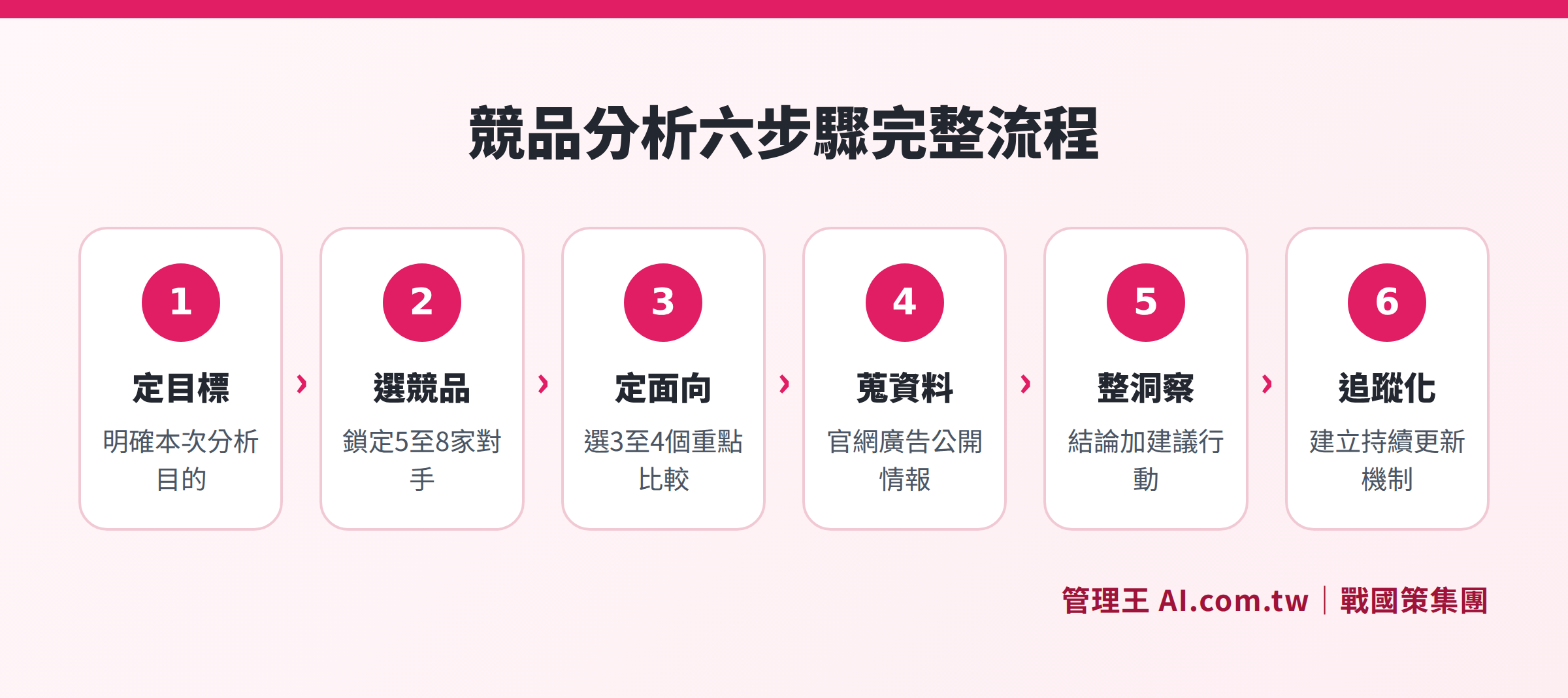
From defining objectives to continuous tracking, the six operational steps of competitive analysis and their main outputs
A complete competitive analysis involves six steps, each yielding a clear output to avoid situations where "the analysis concludes but lacks conclusions":
Step One: Define Analysis Objectives
First, ask yourself: What problem is this analysis trying to solve? Is it to adjust pricing, launch a new feature, or understand the competitor's advertising strategy? Different objectives require different data collection. Vague objectives will cause the analysis to lose focus.
Step Two: Identify a List of Competitors (5 to 10)
Divide them into three categories: direct competitors (similar products, overlapping customer base), indirect competitors (substitutes, such as using Excel instead of ERP), and potential entrants (large firms capable of entering your market). It's advisable to choose 5 to 8 key competitors to track, avoiding resource dispersion.
Step Three: Define Analysis Aspects
Commonly used six aspects: product functions, pricing schemes, brand positioning, marketing channels, customer reviews, and market volume. Choose 3 to 4 key aspects to delve into based on the objective from Step One, rather than superficially touching on every aspect.
Step Four: Collect and Validate Data
Prioritize data sources: official websites, public financial reports, government databases, followed by social media, advertising materials, and then third-party reports and customer interviews. Pay attention to data timeliness; a competitor's pricing page may update at any time, so when taking screenshots, be sure to record the query date.
Step Five: Organize into Actionable Insights
Raw data must be transformed into "conclusions + recommended actions." For example: "Competitor A's pricing is 20% higher than ours, but customer reviews repeatedly mention unstable functionality" → "Opportunity: differentiate by highlighting stability and local service, no need for price reduction competition."
Step Six: Establish a Continuous Tracking Mechanism
Competitive analysis is not a one-time report, but a continuously updated intelligence system. It is recommended to conduct a complete review once a quarter and set up alert indicators for important metrics (such as if a competitor's price reduction exceeds a set threshold or launches a new plan).
Table: Estimated Timeline for Executing the Six Steps of Competitive Analysis
| Step | Estimated Manual Time | Main Output | After Tool Assistance |
|---|---|---|---|
| Define Analysis Objectives | 0.5 hours | List of Analysis Objectives | Unchanged |
| Identify Competitor List | 1 to 2 hours | Competitor Tracking List | Unchanged |
| Define Analysis Aspects | 0.5 hours | Analysis Framework Table | Unchanged |
| Collect and Validate Data | 3 to 8 hours | Raw Data Repository | Reduced to 30 minutes |
| Organize Insights | 2 to 3 hours | Draft Report | Reduced to 1 hour |
| Establish Tracking Mechanism | 8 to 20 hours monthly | Monitoring Dashboard | 1 to 2 hours weekly |
Four Key Aspects of Competitive Analysis: What to Analyze for Effectiveness?
Good competitive analysis does not indiscriminately collect all information, but focuses on "the aspects that most influence strategic decisions." The following four aspects are worth in-depth understanding for most SMEs in Taiwan:
Pricing and Plan Structure
The pricing strategy of competitors directly impacts performance. Analyze: the starting price of basic plans, functional differences among plans, whether there are hidden costs (like overage fees, integration fees), promotion frequency, and extent. Once a competitor lowers their price, you need to be notified immediately to decide whether to follow suit or pivot to a value competition, rather than discovering it when a customer switches orders.
Functionality and Product Roadmap
Compare the coverage of core functionalities, the frequency of new feature releases by competitors, and the most frequently mentioned pros and cons in user reviews. Recruitment postings can also hint at the direction competitors are focusing on—if a competitor is recruiting many AI engineers, they may accelerate AI feature development, warranting early planning for differentiation.
Marketing Strategies and Advertising Spend
Through the Facebook Ad Library (Meta Ad Library), you can publicly view competitors' advertising spend: themes, types of materials, and timing. By combining changes in SEO keyword rankings, it's possible to see which customer base competitors are targeting; coupled with advertising management, this enables more effective planning of your own advertising strategy.
Brand Volume and Customer Reviews
Social media follower growth rates, average ratings on Google reviews, and recurring issues in negative reviews often point to your opportunities. When customers repeatedly mention "the competitor's customer service is too slow" or "the functions are too complicated" in their reviews, these are concrete directions for differentiation, even more direct than any market research.
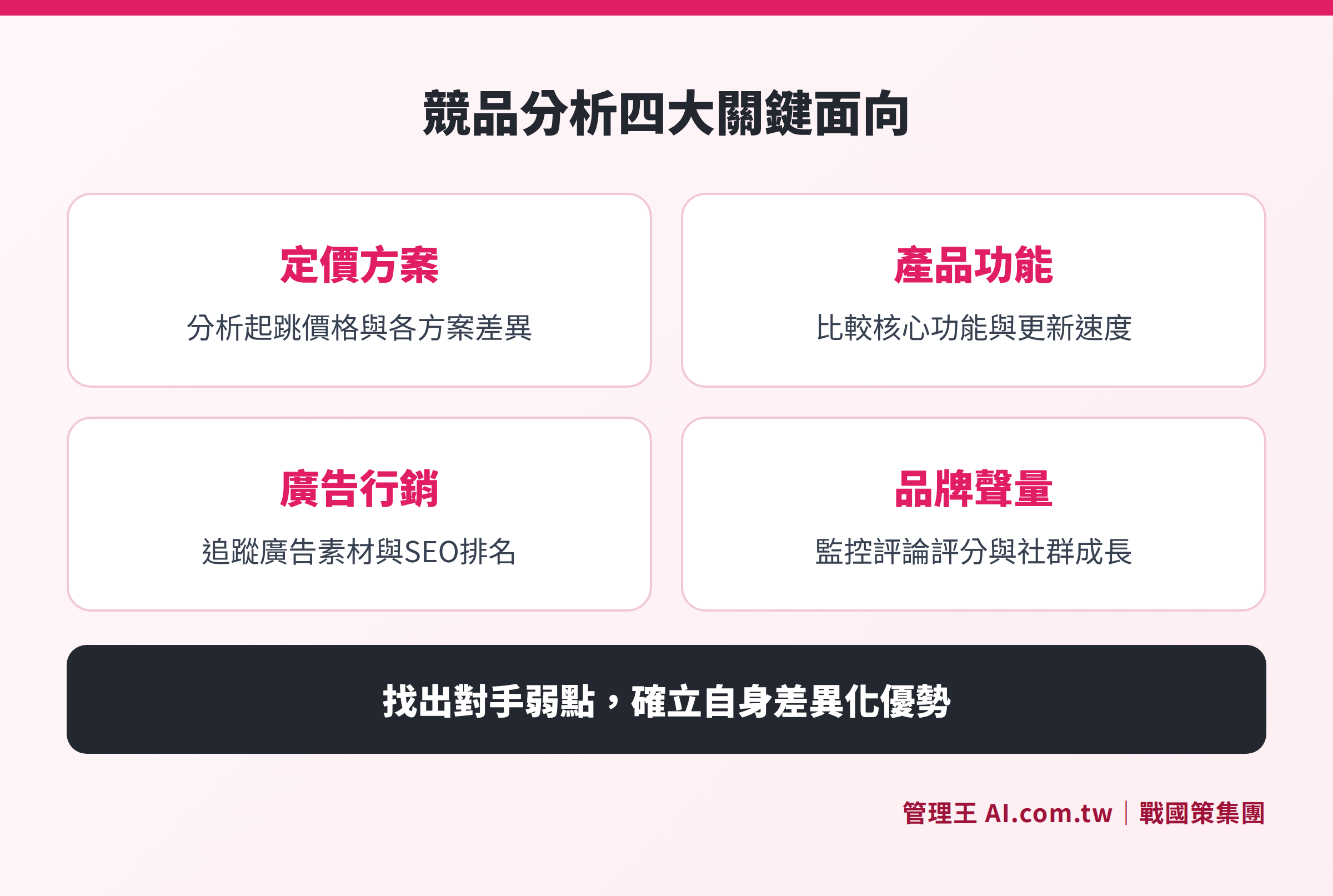
Pricing plans, product functionality, marketing advertising, and brand volume are the four most critical aspects of competitive analysis
How to Write a Competitive Analysis Report? Structure and Key Points
After completing data collection and analysis, you need to organize it into a report that supervisors or bosses can quickly read. The following four-section structure is recommended:
1. Executive Summary (1 page)
Explain the purpose of this analysis, the number of competitors covered, the three most crucial findings, and recommended actions. Busy executives typically only look at this page, so conclusions and recommendations should be included in the summary.
2. Competitive Overview Comparison Table
Use a matrix-style table to list the scores or descriptions of each competitor on key aspects. Visual representation makes differences immediately apparent, facilitating easier discussion in meetings than lengthy texts.
3. In-Depth Analysis of Key Competitors (1 to 2 pages each)
Conduct a deep dive into 2 to 3 of the most direct competitors: details of pricing structures, analysis of advertising appeals, aggregation of customer reviews, and forecasting the next strategic direction.
4. Strategy Recommendations and Tracking Mechanism
Based on analysis results, clearly outline "what we should do": is it to adjust pricing, enhance certain features, or change advertising appeals? Conclusions should be actionable and specify who will be responsible for tracking and how often updates will occur.
Utilizing report analysis tools can seamlessly integrate competitive monitoring data into management dashboards, enabling the boss to monitor market trends at any time without waiting until the end of the month for a report.
Common Mistakes in Competitive Analysis and How to Avoid Them
Even when following steps, there are several common errors to be particularly mindful of:
Error One: Only Looking at Large Competitors, Ignoring Emerging Challengers
Many businesses focus on market leaders but overlook fast-growing new startups or niche competitors. New entrants often capture specific customer segments with lower prices and more focused features, and by the time you notice, you've already lost some customers. It's recommended to include at least 1 to 2 recently established, rapidly growing competitors in your list.
Error Two: Collecting Data but Not Turning It into Action
If analysis reports are piled in a folder and no one looks at them, that's a significant waste of competitive analysis. Every report should include a clear "next action" section, designating responsible parties and completion deadlines, ensuring the analysis leads to real strategic adjustments.
Error Three: One-Time Analysis, Lacking Ongoing Tracking
The market changes daily. Completing a competitive analysis and then putting it aside will cause the data to expire in six months. Truly effective competitive intelligence is dynamically updated—at minimum, set an automated monitoring mechanism to notify you when competitors make significant moves.
Error Four: Subjective Bias Affecting Data Interpretation
It’s easy to see “what you hope to see” during analysis. It's advisable to use a structured scoring framework (e.g., scoring each aspect from 1 to 5), and involve members from different departments in analysis to avoid underestimating competitors' advantages due to personal bias.
Use Management Wang for Competitive Analysis
Management Wang AI.com.tw Competitive Analysis Function allows SMEs to establish a continuously operating market intelligence system at low cost. The operating process is simple: input the URLs of 1 to 5 competitors, and the system automatically crawls their latest updates daily, compiling them into a differentiated comparison dashboard.
Main functionalities include:
- Real-time Notifications for Competitor Price Reductions: Set price alert thresholds (e.g., a reduction of more than 10%), and receive notifications on the same day competitors adjust their prices, allowing immediate decisions on whether to follow suit or pivot to a value strategy.
- Automatic Collection of Advertising Materials: Integrates with Facebook Ad Library, presenting competitor advertising materials in chronological order, clarifying the evolution of their appeals.
- Social Volume Tracking: Works with AI Social Radar to monitor competitors' social media follower growth and topic volume.
- Recruitment Direction Prediction: Monitor competitors' job postings on recruitment platforms to gauge their strategic direction through talent layout.
- Automatic Weekly Reports Generation: Automatically generates "Competitors' Dynamics of the Week + Suggested Response Directions" weekly, allowing supervisors to make decisions after reviewing.
- Automatic SWOT Analysis: AI automatically drafts a SWOT analysis based on the collected data, which can be used after manual adjustments.
Management Wang's competitive analysis tool seamlessly integrates with marketing automation and CRM systems, allowing competitive intelligence to be directly linked to marketing strategy adjustments without manual copying and pasting between multiple systems. The Strategy Group services over 30,000 businesses, with features specifically designed to align with Taiwanese business practices (traditional Chinese interface, LINE notification integration, compliance with local regulations) instead of applying foreign SaaS templates.
In marketing, the competitive analysis tool combines with AI SEO functionality, allowing simultaneous tracking of keyword ranking changes for both your business and competitors to quickly discover competitors' SEO strategies and seize unfilled search traffic gaps.
The free plan is available for permanent use, with basic competitive tracking features already included, suitable for SMEs just beginning to establish a competitive analysis habit. Advanced AI analysis reports and unlimited competitor monitoring can be upgraded to business or flagship plans.
Let AI automatically track competitor dynamics, no more manual monitoring
The Management Wang consultancy assists in setting up competitive monitoring and differentiation analysis frameworks, with the free plan available for permanent use, transforming competitive analysis from a one-time report into a continuously updated market intelligence system.
Free consultation hotline: 0800-003-191
LINE official account: @119m
Official website: app.AI.com.tw
Free trial: Apply for Management Wang now
Frequently Asked Questions
How often should competitive analysis be conducted?
It’s recommended to track in layers: use tools for daily auto-monitoring of significant competitor dynamics (e.g., price cuts, new plans launched); compile a summary of key changes monthly; and perform a complete competitive analysis update quarterly. Asana (2026) suggests light updates every quarter and a thorough analysis every six months to a year. Excessive frequency consumes resources, while too little means being blind to market changes.
What is the difference between competitive analysis and market research?
Market research studies the market as a whole, including customer needs, market size, and overall trends; competitive analysis focuses on specific competitors, comparing differences between both. The two complement each other: market research tells you "what customers want," while competitive analysis tells you "how competitors meet those needs and where your differentiation opportunities lie."
How much resources do SMEs need for competitive analysis?
Without using any tools, establishing an initial complete analysis may require several workdays (depending on the number and depth of competitors), with daily tracking needing approximately 8 to 20 hours monthly. Using AI competitive analysis tools can reduce daily tracking to just 1 to 2 hours weekly, freeing employees from repetitive manual monitoring to focus on analysis and decision-making.
What are the legal boundaries for competitive data?
Legal competitive analysis may only use publicly available information: official websites, advertising (such as Facebook Ad Library), public social media, public financial reports, and news reports. It is not permissible to obtain internal competitor data through unauthorized methods, invade systems, or acquire trade secrets through fraud; such actions may violate the Trade Secrets Law and the Personal Data Protection Act.
How should competitive analysis reports be presented to different audiences?
Adjust the depth based on the audience: the version for bosses and management should emphasize strategic recommendations and decision bases, be concise (1 to 3 pages), and focus on conclusions; the version for marketing and sales teams should provide more execution details, such as advertising material screenshots, keyword lists, and customer review aggregates. The key is to ensure that decision-makers can quickly absorb and act on information, rather than simply piling all data together.