Recommended Competitive Analysis Tools: Comparison of Traffic, Social Volume, and AI Monitoring | Recommended Competitive Analysis Tools

A comparative analysis of three major types of competitive analysis tools—traffic analysis (SimilarWeb, Semrush), social volume monitoring (OpView, Brandwatch), and comprehensive AI monitoring—highlighting their functional differences and pricing trends to help small and medium enterprises in Taiwan select the right combination of tools.
Competitive analysis tools are software that systematically track competitor dynamics for marketing and sales teams, mainly divided into three categories: traffic analysis tools (understanding visitor sources and scale of competitor websites), social volume monitoring tools (tracking discussions about brands on social media), and AI comprehensive monitoring tools (automatically aggregating competitor pricing, ads, content, and generating action suggestions). Each type of tool has its strengths, and it is rare for one set to cover all functionalities. A common mistake among small and medium enterprises in Taiwan is relying solely on Google Alerts for competitive tracking, missing two critical dimensions: traffic structure and social volume. This article organizes the functional differences and pricing trends of common tools based on publicly available information from the tools' official websites (as of November 2026) to help Taiwanese businesses find the right model combination for their scale.
What Are the Three Major Categories of Competitive Analysis Tools?
Competitive intelligence can be approached from three dimensions, with corresponding tool types answering different business questions.
First Category: Traffic Analysis Tools
Analyzing monthly average visitor numbers, traffic source distribution (search, ads, social, direct visits), bounce rate, and time spent on competitors' websites. Representative tools include SimilarWeb and Semrush .Trends. The core function is to answer "Which channels are competitors investing resources in, and which channel brings the most visitors?"
Second Category: Social Volume Monitoring Tools
Tracking the frequency and sentiment of discussions about a brand or keywords on platforms such as Facebook, Instagram, PTT, Dcard, and YouTube. Representative tools are Taiwan-based OpView and international enterprise-level Brandwatch. Mainly answering, "What is the recent reputation of the competitor on social media, and have there been any signs of brand crisis?"
Third Category: AI Comprehensive Monitoring Tools
Automatically crawling competitors' official websites, advertising materials, recruitment dynamics, and pricing to integrate actionable insights. Mainly answering, "What did the competitor do this week, and how should we respond?" This saves the time of manually comparing data one by one.
The three types of tools can be combined based on budget and needs. Smaller teams often start with AI comprehensive tools, establish monitoring habits, and then add traffic analysis or volume monitoring modules as needed.
Recommended Traffic Analysis Tools: Understanding Where Competitors Attract Visitors From
The core value of traffic analysis tools is to "observe competitors' digital performance externally." Without needing access to their backend, one can estimate the monthly visitor count, channel proportions, and main landing pages of competitors.
SimilarWeb
SimilarWeb is the world's leading website traffic estimation platform, allowing queries about any website’s monthly average visitors, traffic source distribution, popular pages, and audience interests. The free version allows viewing the overview of a single website (3 months of data, limited daily queries), while the paid Competitive Intelligence plan is approximately $125 USD/month (as of November 2026 according to official website information), unlocking multi-competitor horizontal comparisons and traffic trend alerts. Enterprise-level Team / Business plans start at $14,000 per year, providing API data and more historical data.
SimilarWeb is suitable for evaluating the traffic scale of competitors in the Taiwan market, determining which channels competitors focus their media budget on, and comparing the monthly active visitor rankings of multiple competitors. Note that SimilarWeb's data are estimates, and for smaller Taiwanese websites, the numerical errors may be larger due to a smaller sample size, making it suitable for trend judgment rather than precise numeric references.
Semrush
Semrush's basic Pro plan ($139.95 USD/month, based on November 2026 official information) offers features such as organic search keyword analysis, ad copy monitoring, and backlink analysis. Traffic estimation requires an additional purchase of the .Trends module starting at around $289 USD/month. If the budget is tight, one can start with Semrush Pro for keyword and ad competitor analysis, and upgrade to the traffic module when scaling up.
Semrush's Competitor Analysis feature allows viewing which keywords competitors rank for and which ad copies they are running, especially useful for small and medium enterprises competing in search engines and Google Ads. 管理王 also offers an AI SEO tool module to track keyword ranking dynamics within the same system.
Table: Cost Comparison of Traffic Analysis Tools (as of November 2026 based on each official website's published information)
| Tool | Starting Cost | Suitable Scale | Primary Use |
|---|---|---|---|
| --- | --- | --- | --- |
| SimilarWeb Free Version | Free | Individual / Micro | Single Website Traffic Overview (limited) |
| SimilarWeb Competitive Intelligence | Approx. $125 USD/month (annual payment) | Small to Medium | Multi-competitor Traffic Comparison, Channel Analysis |
| Semrush Pro | $139.95 USD/month | Medium | Keyword, Ad Competitor Analysis |
| Semrush Pro + .Trends | Starting at approximately $289 USD/month | Medium to Large | Complete Traffic + Market Share Estimation |
Recommendations for Social Volume Monitoring Tools: Grasping Market Reputation Trends
Social volume monitoring complements the dimensions that traffic tools cannot see: how consumers talk about your brand and the sentiment distribution in discussions about competitors. Particularly for e-commerce, dining, and service industries, reputation equates to conversion rates.
OpView (Taiwan Local Choice)
OpView Social Reputation Database is Taiwan's largest Traditional Chinese social monitoring platform, covering over 220,000 channels, continuously crawling data 24/7, with AI semantic analysis covering major Chinese channels such as PTT, Dcard, Facebook groups, Instagram, YouTube, and news media. The enterprise version's pricing needs to be inquired with official sales (contact: sales@eland.com.tw), as there is no public pricing; there is also a lighter version, OpView Trend, suitable for medium-sized enterprises to track specific keyword volume trends.
OpView's local contextual analysis capabilities are far superior to international tools, especially for crawling local forums and groups. It is recommended for brands that primarily compete in the Taiwan market to evaluate it first.
Brandwatch (International Enterprise-Level)
Brandwatch monitors over 100 million media sources globally, recording billions of social media posts daily, renowned for its AI sentiment analysis, Boolean syntax search, and AI summary functions. Pricing is not publicly listed, but according to market reports, monthly fees typically exceed a thousand dollars, primarily serving mid-to-large enterprises with global brand monitoring needs. Most small and medium enterprises in Taiwan do not have scenarios where they directly subscribe, making it more suitable for teams with global presence or dedicated analysts.
Google Alerts and Lightweight Alternatives
Google Alerts is a completely free monitoring tool that sends automatic email notifications whenever news, blogs, or webpages feature specified competitor brand names or keywords. Its coverage focuses mainly on publicly available web pages and does not include social private messages or closed forum groups, making it suitable for basic news monitoring.
Mention (now acquired by Agorapulse) provides multi-platform social monitoring. The Company Plan costs around $599 USD/month (as of November 2026 based on official information). Its operational threshold is lower than Brandwatch, but coverage of local Chinese sources in Taiwan is limited.
Table: Comparison of Social Volume Monitoring Tools (as of November 2026 based on each official website's published information)
| Tool | Language Support | Taiwan Coverage | Cost (according to official information) |
|---|---|---|---|
| --- | --- | --- | --- |
| Google Alerts | Chinese and English | Mainly news and blogs | Free |
| OpView | Priority for Traditional Chinese | Full coverage of PTT, Dcard, and FB groups | Inquire for pricing |
| Mention (Agorapulse) | Multilingual | Mainly international platforms | $599 USD/month (Company Plan) |
| Brandwatch | Multilingual (including Chinese) | Mainly international platforms | Usually $1,000 USD/month and above |
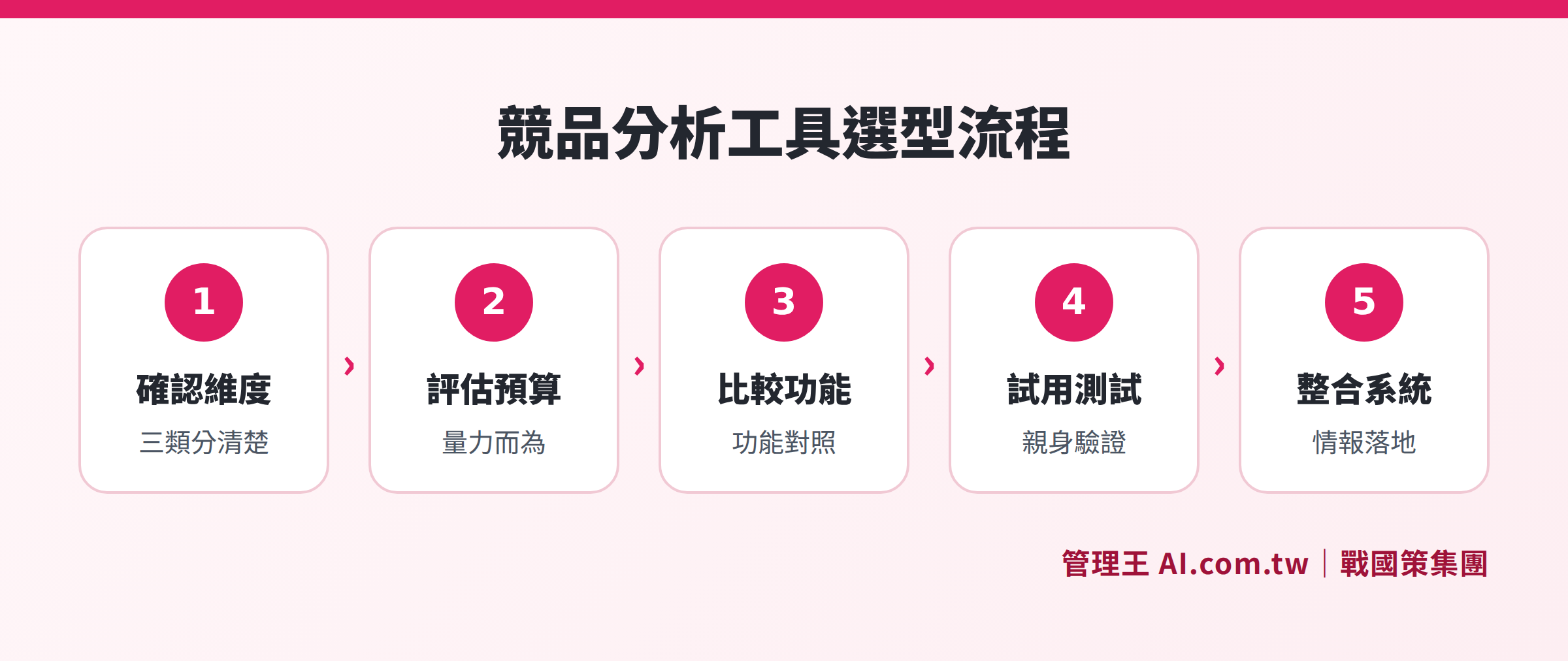
Five-step selection process from confirming monitoring dimensions, evaluating budget, comparing features, free trials to system integration
AI Competitive Monitoring Tools: From Intelligence Gathering to Decision Recommendations
Traffic tools and volume tools each have independent operational thresholds. For most small to medium enterprises in Taiwan with marketing and sales personnel ranging from 10 to 50 people, analysis is not a full-time job. What is truly needed is a one-stop tool that allows for "inputting competitor names, and the system automatically tells me what competitors have done and how I should respond."
Understanding in One Sentence
AI competitive monitoring tools automatically aggregate intelligence scattered across official websites, ad libraries, and recruitment platforms into actionable suggestions, saving small and medium enterprises significant manual tracking hours each week.
The core features of AI comprehensive competitive monitoring include:
- Automatic Daily Crawling of Official Website Dynamics: Monitoring product listings and removals, price adjustments, and newly published content, so one knows what competitors did the next day.
- Ad Monitoring: Automatically capturing competitor FB/IG ad materials and copy through Meta Ad Library to grasp the appeals competitors are currently emphasizing.
- Recruitment Intelligence: Monitoring new job openings by competitors to infer the next steps in their business or product strategy from their workforce expansion direction.
- Real-time Price Drop Alerts: LINE notifications or in-system alerts are immediately pushed when a competitor's pricing drops below a set threshold, allowing decision-makers to respond promptly.
- Automatic Generation of AI Weekly Reports: Weekly automated reports include "Competitor Dynamics This Week + Our Suggestions,” with SWOT analysis and market share estimates, directly shareable for managerial decision-making.
Compared to traffic tools or volume tools, the advantages of AI comprehensive monitoring tools lie not in data depth but in automation and actionability: intelligence is no longer limited to numerical reports but directly generates concrete recommendations on "what we should do next week."
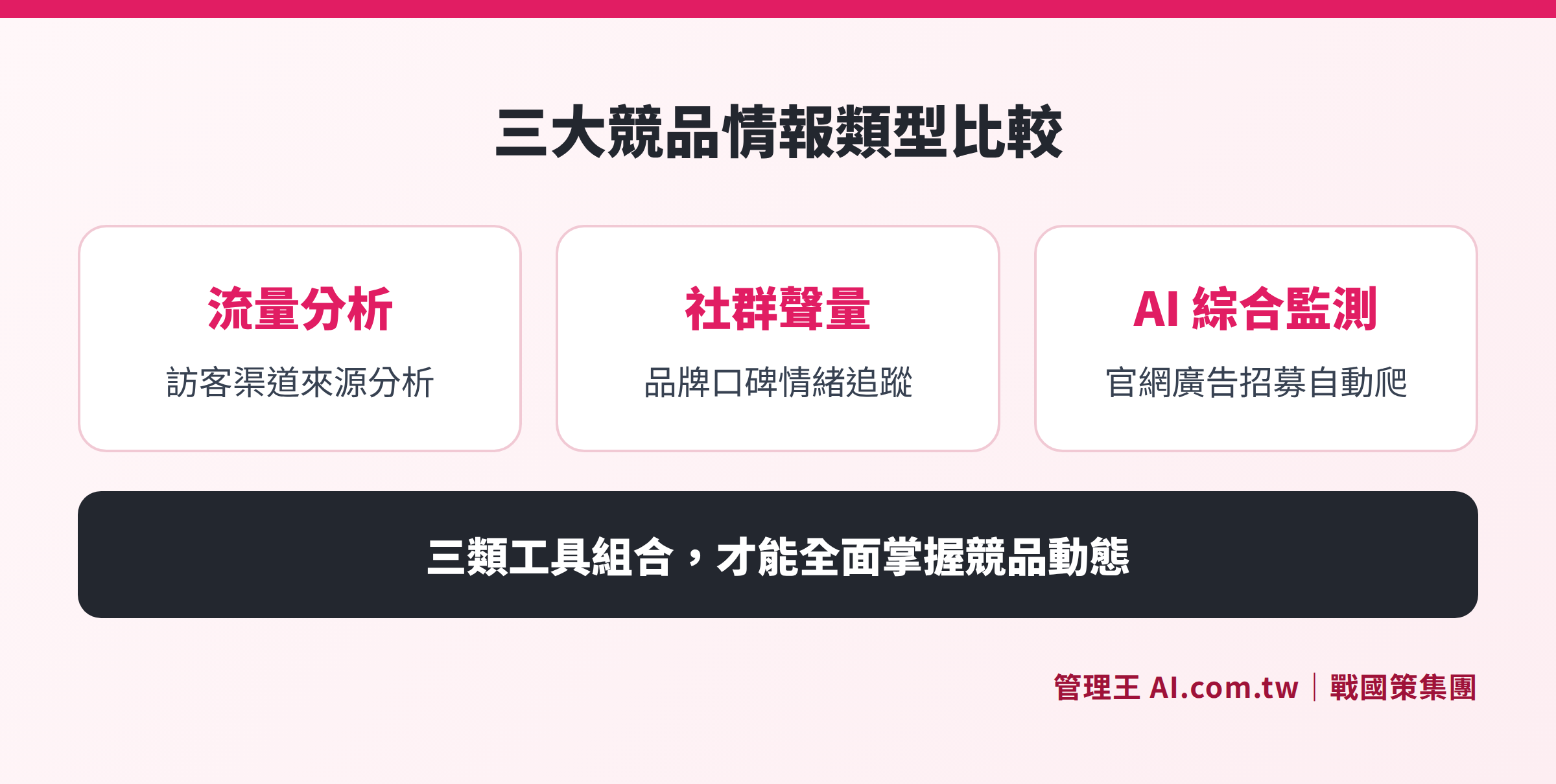
How traffic analysis, social volume, and AI comprehensive monitoring tools fit different scenarios and output types
Three Steps for Taiwanese Small and Medium Enterprises to Select Competitive Analysis Tools
Before selecting tools, it is advisable to clarify three questions to save substantial trial time and budget.
Step One: Confirm Which Dimension Needs Monitoring the Most
- High ad ratio, key competitors fighting for ranking in search engines → Prioritize evaluating Semrush or SimilarWeb paid versions
- E-commerce brands, high reputation risk, main battlefield in social discussions → Prioritize evaluating OpView or Brandwatch
- Comprehensive monitoring for small and medium enterprises, no dedicated analysts, limited budget → Prioritize evaluating AI comprehensive monitoring tools
Step Two: Assess Who Will Analyze These Data
No matter how powerful the tools are, if no one is analyzing them regularly, the data becomes dormant assets. Choose tools with low operational thresholds that can automatically generate recommendation reports to ensure intelligence can translate into action.
Step Three: Confirm Compatibility with Existing Systems
The ultimate goal of competitive intelligence is to be converted into business or marketing actions. If tools can directly integrate with CRM systems, ad management, or marketing automation, the efficiency of intelligence flow is maximized, avoiding the need to manually copy and paste data into another system.
How to Do Competitive Analysis with 管理王
管理王 AI.com.tw Competitive Analysis Tool integrates AI monitoring features within a single account, requiring no extra installations or connections to third-party services:
- Input the official website URLs of up to five competitors, and the system automatically crawls new content, product pricing, and discount adjustments from competitor websites every day.
- Automatically capture competitor ad materials through FB Ad Library while monitoring newly opened recruitment positions to infer business expansion trends.
- The differentiated comparison dashboard displays the prices, social volume, and SEO keyword rankings of our company alongside competitors, making relative positioning clear at a glance.
- Instant notifications are pushed when competitor pricing drops below a set threshold, allowing sales managers to quickly decide whether to follow suit or switch to a value war.
- Every week, automatically generate an "This Week's Competitor Dynamics + Our Action Suggestions" AI report, ready to share with managers for decision-making.
After integrating with AI Social Radar, social volume monitoring needs are also covered without the need to purchase third-party volume tools. Coupled with data reporting and analysis functions, all competitive intelligence and internal company KPIs are presented on the same dashboard, enabling the boss to grasp market positioning in real-time.
For more frameworks and operating methods regarding competitive analysis, refer to The Complete Guide to Competitive Analysis: Structure, Steps, and AI Tools.
The free plan is permanently available, with the competitive analysis module ready for trial at any time without a credit card. For deeper AI analysis needs, one can upgrade to monthly subscription plans ranging from NT$5,000 to NT$19,900. For complete pricing, please see the service plan page.
Free Trial of Competitive Analysis Tools to Keep Track of Competitor Dynamics
管理王 consultants assist you in quickly establishing a competitive monitoring system to automatically track competitor pricing, ads, and social volume, with weekly AI reports delivered directly to managerial decision-makers.
Free consultation hotline: 0800-003-191
LINE Official Account: @119m
Official website: app.AI.com.tw
Free trial: Apply for 管理王 Now
Frequently Asked Questions
What are the differences between competitive analysis tools and SEO tools?
SEO tools (such as Ahrefs, Semrush) primarily focus on keyword rankings, backlinks, and organic search traffic, being a subset of competitive analysis tools. Broadly, competitive analysis tools also cover traffic structures (comprehensive comparisons of paid, direct, and social channels), social reputation monitoring, ad material tracking, and pricing intelligence, answering the question of "how does the competitor's overall business perform" rather than focusing solely on search performance. If the budget is limited, one can start from the free tier of Semrush and then supplement other dimensions based on needs.
Are free competitive analysis tools enough to use?
Google Alerts can monitor mentions in news and blogs, the SimilarWeb free version offers a single website traffic overview, and the Facebook Ad Library allows for free viewing of any brand's ad materials. Combining these three tools can provide basic coverage for micro-enterprises with limited budgets. The limitations are in the lower data accuracy and lack of automated aggregation and alert mechanisms; if competitive monitoring is part of daily work, upgrading to paid tools generally shows return on investment within three months.
Are there more suitable social monitoring tools for small and medium enterprises than Brandwatch in Taiwan?
Yes. OpView Trend and QSearch are local social volume tools in Taiwan that have better coverage for PTT, Dcard, and Facebook Chinese content compared to Brandwatch. Pricing needs to be inquired with the official sources but is usually lower than Brandwatch's international plans. Additionally, 管理王's AI Social Radar is integrated into the monthly subscription plan, eliminating the need to pay for a third-party volume tool, making it the lowest threshold choice for small and medium enterprises with limited budgets.
Are the traffic data from competitive analysis tools accurate?
Traffic tools like SimilarWeb provide "estimated values" based on their algorithms and sampling sources, and for small to medium-sized websites in Taiwan, the error margin may be larger due to a smaller sample size. It is recommended to use such data for trend judgments and ranking comparisons, and not to serve as precise visitor figures for external quoting. Using multiple tools for cross-validation, one can use trends instead of absolute numbers to minimize the risk of false judgment.
What is the minimum combination of competitive analysis tools needed for a one-person marketing team?
A one-person marketing team is recommended to have a "minimum viable combination": Google Alerts (free, news monitoring) + SimilarWeb free version (traffic overview) + Facebook Ad Library (ad monitoring) + 管理王 competitive analysis tool (automatic aggregation + AI weekly report). The first three tools are free, and only with the 管理王 subscription can most manual tracking tasks be replaced, significantly reducing time costs.
Data Sources
- Official SimilarWeb Website (Queried in November 2026)
- Semrush Official Pricing Page (Queried in November 2026)
- Official Brandwatch Website (Queried in November 2026)
- Official OpView Social Reputation Database Website (Queried in November 2026)
- Facebook Ad Library (Meta's official free tool)
- 管理王 AI.com.tw Competitive Analysis Function Page