What is a Contract Management System? Essential Features for Small and Medium Enterprises to Review Before Implementation|Recommended Contract Management Systems

A Contract Management System centralizes, version-controls, automatically reminds of expirations, and integrates electronic signatures into a complete workflow for enterprise contracts. This article covers six core features, the legal basis for electronic signatures in Taiwan, key management points for common contract types, five critical questions for purchasing evaluation, and the integrated operation methods of 管理王, making it suitable for reference by Taiwanese SME owners and sales managers before implementation.
A Contract Management System is a digital tool used by enterprises to centralize, track, and manage the entire lifecycle of all contracts, covering contract drafting, approval, execution, expiration reminders, and renewal decisions. For small and medium enterprises in Taiwan, there are two direct values of a Contract Management System: first, it consolidates contract documents scattered in emails, drawers, and personal computers, allowing anyone to access them instantly at any time; second, it replaces human memory with automated reminders, transforming expiration, penalty fees, and renewal negotiations from "luckily remembered" to "system proactively notified." This article provides a comprehensive overview of what Taiwanese small and medium enterprises need to know before implementing a Contract Management System, from feature lists to regulatory bases, purchasing evaluations, and practical operations.
What is a Contract Management System? Understanding Core Concepts from Five Dimensions
The core of a Contract Management System is "Contract Lifecycle Management" (CLM), which systematically manages each node of a contract from drafting to termination.
In traditional methods, a procurement contract might go through a journey like this: a salesperson drafts it in Word → sends it via Email to the legal team → prints it, seals it → scans and saves it in a folder → half a year later, nobody remembers when it expires. Each node in this pathway poses risks: version confusion, unaware approvers, no tracking of expirations, clients questioning clauses based on outdated contracts.
A Contract Management System digitizes and "institutionalizes" this process, mainly covering five dimensions:
- Centralized Storage: All contract documents (PDF, Word, scanned files) are stored uniformly, categorized by type (sales, procurement, labor, leasing), searchable in full text, and can be retrieved in seconds.
- Version Control: Every modification leaves a historical record, allowing traceability of who made changes to any clause and when, providing complete evidence during disputes.
- Approval Process: Internal multi-level approvals (supervisor, legal, finance) and external electronic signatures combined into a single process for multiple-party sign-offs.
- Expiration Reminders: The system notifies relevant supervisors at multiple levels 90, 60, 30, and 7 days before expiration, ensuring that no contract is silently renewed or expires.
- Integration of Finance and Sales Systems: Contract amounts and payment plans are linked to accounting, contract status is synchronized with CRM, and delivery milestones trigger tasks, forming a complete sales flow.
In short
The core mission of a Contract Management System is to transform "the contract risks remembered by human brains" into "system-managed regulatory lines automatically."
What Happens If Small and Medium Enterprises Do Not Use a Contract Management System?
Many small and medium enterprises in Taiwan share several common pain points in contract management. Below are the five most common real scenarios:
Contracts expiring unnoticed: An annual service contract expires at the end of November; the salesperson assumes finance is tracking it, and finance thinks the salesperson is aware. As a result, the contract quietly expires, and the vendor's service is discovered to have ceased on that day. The losses are not just in sales, but also in negotiation leverage.
Version confusion causing disputes: A client claims terms from the third version, while your team is executing based on the fifth version, but every version is named "contract_v3_final_revision.docx," leaving no one clear on which version counts.
Employees leaving with information: When a salesperson leaves, the quotes, contract signing records, and special terms remain on their personal computer and email, leaving the new person without context, and the client unwilling to start from scratch.
Penalty fees go unnoticed: A procurement contract includes penalty clauses for delivery delays, but without system tracking, it is only discovered at closing that the vendor has exceeded the deadline by 45 days, and that clause has long been forgotten.
Documents unavailable during audits: Regulatory authorities request a labor contract from a certain year, and after searching the document room for half a day, it is found that the contract was never scanned and only exists in paper form, now lost.
Altogether, these scenarios could lead to hidden losses for a 30-person SME that far exceed the subscription costs of a Contract Management System.
Six Essential Core Features of a Contract Management System
Before purchasing a Contract Management System, first confirm whether it covers these six core features:
Table: Contract Management System Feature Evaluation Checklist
| Feature Item | Description | Why It Matters |
|---|---|---|
| Centralized Storage and Full Text Search | All contract documents are uniformly stored, supporting keyword, counterparty, amount, and date searches | Allows for instant retrieval of any contract, avoiding wasted staffing time searching for files |
| Tiered Expiration Reminders | Automatically notifies different levels of supervisors 90/60/30/7 days before expiration | Prevents silent expirations or missing renewal opportunities |
| Version Control and Change Tracking | Each modification leaves a historical record that can compare version differences, displaying the modifier and time | Strongest basis for evidence in disputes and audits |
| Integration with Electronic Signatures | Supports domestic electronic signatures, allowing the other party to sign online via a link | Taiwan's revised Electronic Signature Act grants electronic signatures the same legal effect as written documents |
| Multi-Party Approval Process | Internal multi-level approvals and external multi-party signatures incorporated into a single process | Replaces the need for mailing hard copies, compressing cross-company signing from weeks to days |
| Finance and Sales Integration | Links contract amounts with payment plans in accounting, synchronizes statuses with CRM | Avoids financial disputes caused by discrepancies in contract, invoice, and payment data |
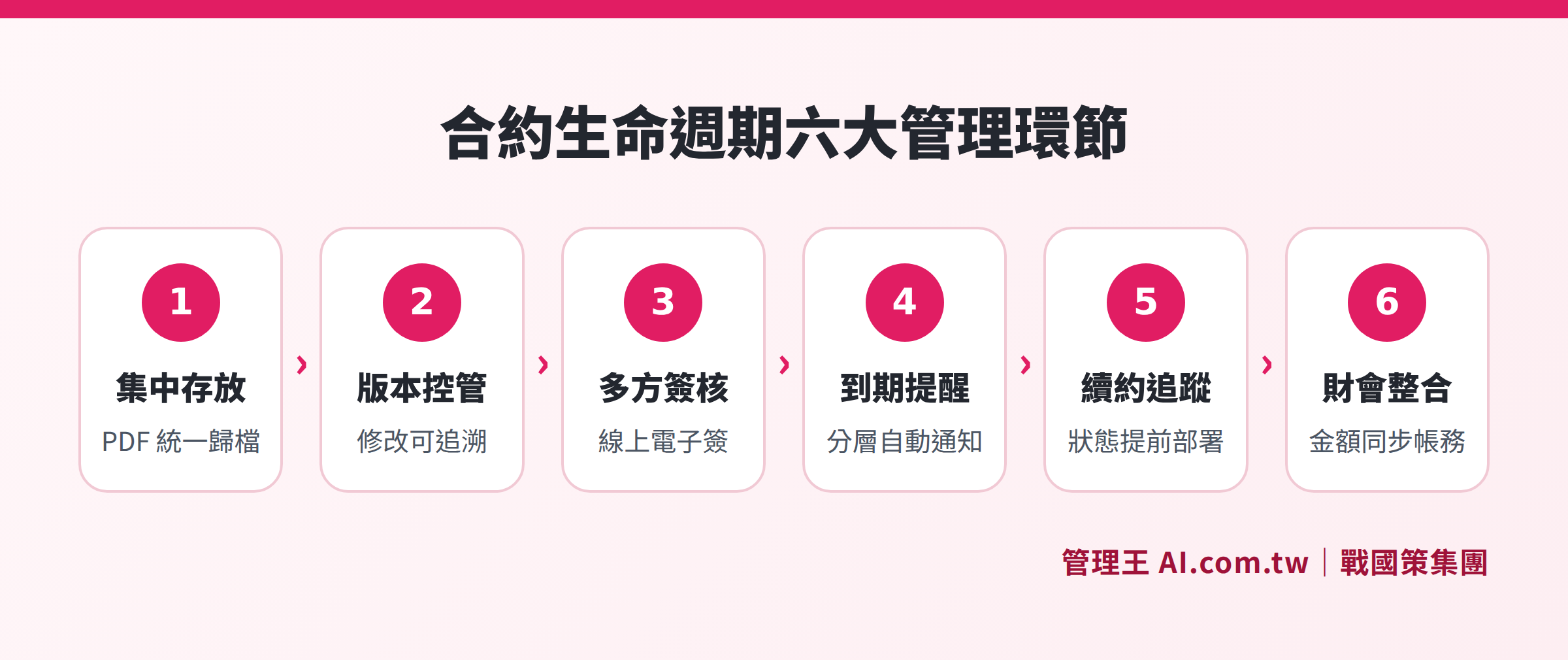
The contract lifecycle is managed in a systematic way from drafting, signing, execution, expiration reminders to renewal decisions, with all six aspects integrated.
Contract Types and Management Focus: A Summary Table
Different types of contracts have varying focal points in management. Below are the most common contract types among Taiwanese small and medium enterprises, along with their corresponding management focus:
Table: Common Contract Types and Management Focus Comparison
| Contract Type | Common Risks | System Management Focus |
|---|---|---|
| Sales Contracts (B2B) | Delivery schedules, quality assurance, and penalty clauses are overlooked | Expiration reminders, delivery milestones, and amount verification |
| Procurement Contracts | Vendor delays go unnoticed, penalty fees are miscalculated | Delivery tracking, automatic penalty calculations, and payment scheduling |
| Labor Contracts | Protection of personal data clauses and intellectual property ownership unclear | Version tracking, personal data clause tagging |
| Leasing Contracts | Automatic renewal clauses activate without awareness | Long-term warnings (90 days) before expiration; renewal status tagging |
| Non-Disclosure Agreements (NDA) | Varying effective periods make it hard to track uniformly | Categorized management of expiration dates, reminders for both parties |
| Employment Contracts | Probation periods and non-compete terms become problematic once expired | Expiration reminders, version control of clauses |
Legal Basis for Contract Management in Taiwan: Electronic Signatures and Civil Code Provisions
There are several important legal backgrounds for contract management in Taiwan that should be taken into account when choosing system functionality:
Electronic Signature Act (effective May 15, 113)
According to the National Law Database, Article 4 of the Electronic Signature Act clearly states: "Documents and signatures that are required by law to be in writing may be executed in electronic form and have the same effect as written documents." Article 6 further stipulates that digital signatures using certificates issued by accredited agencies are presumed to be signed by the individual.
This means that as long as the Contract Management System has a compliant electronic signature process built-in or integrated, electronic contracts have the same legal effect as paper contracts in Taiwan and do not need to be printed, sealed, and mailed.
Civil Code Article 153: Requirements for Contract Formation
Article 153 of the Civil Code stipulates that a contract is formed when the parties mutually express their agreement, whether explicitly or implicitly. In other words, verbal contracts are legally effective, but difficult to prove; written contracts or electronic contracts with complete electronic records are far easier to prove.
Short-Term Statute of Limitations for Commercial Claims (Civil Code Article 127)
Article 127 of the Civil Code sets a 2-year short-term statute of limitations for specific commercial transactions (e.g., claims for payment for goods supplied by a merchant). A Contract Management System that records payment progress and timestamps can significantly reduce evidence difficulties when claiming overdue payments.
Retention Period Reference
According to the Business Accounting Act and related tax regulations, proof documents generally should be retained for 5 to 10 years. The electronic archiving function of a Contract Management System can automatically comply with document retention requirements, based on the latest announcements from regulatory authorities.
This article provides general information and does not constitute legal or tax advice; actual compliance should be based on the latest announcements from the regulatory authorities.
How to Evaluate and Purchase a Contract Management System? 5 Essential Questions
There are many types of Contract Management tools available in Taiwan, ranging from stand-alone SaaS to integrated enterprise systems. The following five questions can help you quickly filter options:
1. Is it a standalone tool or integrated within the enterprise system?
Standalone Contract Management SaaS specializes in functionality but remains independent of CRM, accounting, and approval systems, requiring manual data bridging; integrated systems allow contract data to flow naturally into sales, finance, and HR modules, saving integration costs and data discrepancies.
2. Does the electronic signature comply with Taiwan regulations?
You need to confirm whether the electronic signature service integrated with the system uses a compliant certification agency in Taiwan or at least provides complete electronic records (timestamps, IP, identity verification) to meet the evidentiary needs of the Electronic Signature Act.
3. How is the mobile experience?
Executives are often outdoors; if they can only review contracts on a desktop, approval times will be extended. Confirm whether the system allows smooth contract reviewing and approving on mobile devices and if it supports LINE notifications.
4. Is the permission management detailed?
Salespeople should see only the contracts they are responsible for, finance should access only relevant financial fields, and supervisors should have cross-department visibility—this level of granular permission is crucial in environments containing business secrets.
5. Customization needs and pricing transparency?
If standard features do not meet the needs of specialized industries, can the system vendor customize it, and how are costs calculated? Some vendors adopt a "black box" approach to pricing, making post-costs difficult to predict; choosing vendors with transparent hourly billing poses lower risks.
Preparation Steps Before Implementing a Contract Management System: 3 Essential Steps
After deciding to implement a Contract Management System, three preparatory steps directly influence its effectiveness:
Step 1: Inventory Existing Contracts and Their Storage Locations
Before officially importing into the system, conduct a comprehensive audit of all contracts within the company: What’s in emails? What’s in personal computers? What’s available only in paper form? Clarifying the total contract quantity and scattered locations will help to formulate a reasonable import plan. Common practice is to start with contracts that are still valid in the current year, dealing with historical contracts in batches.
Step 2: Define Contract Classification and Naming Rules
The system can help you search, but it requires consistent classification logic. It’s recommended to establish internal naming conventions for contracts (e.g., client name + year + contract type) and uniform contract classifications (sales, procurement, labor, leasing, confidentiality) before implementation, avoiding confusion from different naming styles when uploaded later.
Step 3: Confirm Contract Approval Processes and Responsibilities
A major function of the Contract Management System is to automate the approval process, but this requires knowing in advance who within the company should review and approve contracts, and what the monetary thresholds are. It’s advised to outline the existing contract review process (even informally) before implementation to correctly set up approval nodes in the system and avoid discovering misdesigns after setting it up.
Completing these three steps typically shortens the implementation cycle and helps employees quickly adapt to new processes once the system is live.
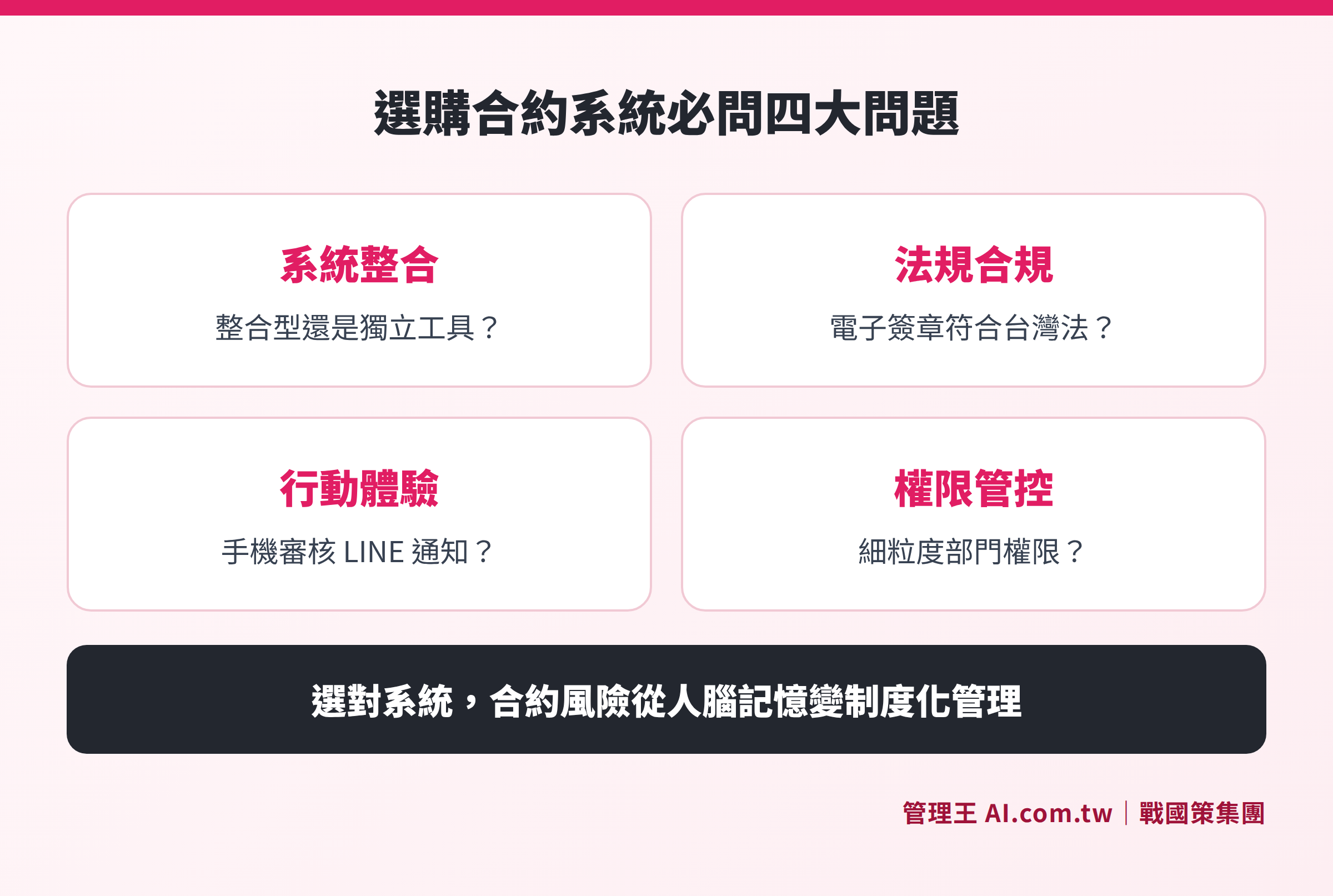
From integration, regulatory compliance, mobile, permission management to customization transparency, these five questions help SMEs quickly filter suitable systems.
How Does 管理王's Contract Management Function Work?
The contract management function of 管理王 AI.com.tw is a comprehensive solution designed specifically for small and medium enterprises in Taiwan, with the main operational processes as follows:
Step 1: Create a Contract File
Upload contract PDFs, Word files, or scanned documents to the system, select the contract type (sales, procurement, labor, leasing, confidentiality), and fill in the counterparty, amount, effective date, and expiration date. The system automatically creates a contract card.
Step 2: Set Expiration Reminder Tiers
On the contract card, set different levels of expiration reminders: 90 days before expiration, notify the sales supervisor to assess renewal; 60 days, notify finance to confirm payment plans; 30 days, notify the corresponding salesperson to initiate negotiations; 7 days, upgrade the notification to the CEO. All notifications are sent through LINE and internal system messaging.
Step 3: Initiate Electronic Signature Process
When needing to sign a new contract, generate a contract link from the system and send it through the built-in electronic signature function to the other party. Once they complete the signing online, both parties are automatically archived without needing a printer or mail exchanges.
Step 4: Link Business and Financial Data
The contract amount can be linked to the accounting system's receivable plan, and the contract's client data is automatically synchronized to the CRM system. Quotes can be one-click converted to contracts through the quotation system, and internal approvals are completed in the Approval Center, with no need for repeated data entry throughout the entire process.
Step 5: Version Control and Audit
Each time a contract is modified, the system automatically saves historical versions, displaying the modifier, time, and specific changes made. Should disputes arise later, the complete version history serves as the basis for evidence.
The free plan allows permanent use of basic contract management functions, including centralized storage and expiration reminders; advanced electronic signature, multi-party signing, and AI contract summaries are available in paid plans. It’s recommended to first experience the core processes through the free plan, then evaluate upgrading based on actual needs. Detailed plans can be referenced on the 管理王 pricing page.
Free Consultation for Contract Management Advisory
Assistance in planning centralized storage, expiration reminders, and electronic signature processes. A single system integrates CRM, approvals, and finance, with 戰國策 Group servicing over 30,000 enterprises.
Free consultation hotline: 0800-003-191
LINE official account: @119m
Official website: app.AI.com.tw
Free trial: Apply for 管理王 now
Frequently Asked Questions
What size companies is a Contract Management System suitable for?
Any company with more than 10 contracts (sales, procurement, employee, leasing combined) per year is worth implementing a Contract Management System. The risks of contract management do not decrease with company size: a 10-person company can similarly lose customers or incur penalty fees if expired contracts are not tracked. 管理王's free plan supports permanent free use for teams under 10 members, making it suitable for small teams to get started.
Do electronically signed contracts have legal force in Taiwan?
Yes, but they must comply with regulations. According to Taiwan's Electronic Signature Act (effective May 15, 113), electronic documents, when fulfilling legal requirements, have the same legal force as written documents. Using digital signatures from certified agencies may also be presumed as signed by the individual under Article 6. It is recommended to choose an electronic signature system with complete electronic timestamp and identity verification records to ensure ample evidentiary support later. Please refer to the latest announcements from the regulatory authorities (Ministry of Digital Development).
How long should contract documents be retained?
According to the Business Accounting Act, accounting documents should generally be retained for 5 years; based on tax regulations, some documents related to declarations need to be kept for at least 5 to 7 years, with variations depending on circumstances. Refer to the latest announcements from regulatory authorities. A Contract Management System can be set to remind document retention periods, assisting enterprises in meeting statutory retention requirements without manually calculating when each document can be disposed of.
What is the difference between a Contract Management System and a CRM system?
CRM (Customer Relationship Management) primarily tracks client relationships and business opportunities, overseeing the entire sales funnel from potential client development to final sale; a Contract Management System focuses on tracking the lifecycle of contract documents, from drafting and signing to expiration and renewal. The two systems are highly complementary: contract data after a sale should flow into CRM; client data from CRM should automatically transfer into the new contract. 管理王 integrates these two functionalities into one platform, allowing seamless data exchange without additional connection costs.
How long does it take to implement a Contract Management System?
This depends on the quantity and organization of existing contracts. The contract management function of 管理王 is cloud-based and ready to use without installation or IT setup; accounts can be established, and usage can begin on the same day. If a large number of historical contracts need batch import, the 管理王 consulting team can assist in planning the import process, typically completing core setups within two weeks.
Data Sources
- Electronic Signature Act (effective May 15, 113), National Law Database, Ministry of Digital Development
- Civil Code (amended 110) Articles 127, 153, 490 and following, National Law Database, Ministry of Justice
- 管理王 AI.com.tw Contract Management Function Page, 管理王 (戰國策 Group)
- 管理王 AI.com.tw Electronic Signature Function Page, 管理王 (戰國策 Group)
This article is general information and does not constitute legal or tax advice; actual compliance should be based on the latest announcements from regulatory authorities.