How to Do Coupon Marketing? Understand Design, Distribution, and Redemption at Once|Coupon System Recommendations

This article fully explains the core concepts of coupon marketing, six types (cash discount, minimum purchase discount, buy one get one free, etc.), five key design elements, precise distribution strategies via LINE/EDM, digital redemption processes, four key performance indicators, and summarizes important points of fair trade and personal data regulations, assisting SMEs in implementing effective coupon campaigns.
Coupon marketing is one of the most commonly used promotional tools by SMEs. Well-designed coupon campaigns can significantly boost sales in a short period by attracting new customers, stimulating repurchase, and increasing the average transaction value. However, many business owners only know how to "issue discount codes" without understanding the types of coupons, distribution timing, redemption processes, and performance tracking. This article starts with the basic concepts of coupons and thoroughly explains the practical methods for design, distribution, redemption, and analysis, and organizes Taiwan’s regulatory requirements to help you maximize the value of every coupon.
What is Coupon Marketing? Clarifying Core Concepts
A coupon is a form of discount certificate issued by companies to consumers, allowing them to enjoy discounts, gifts, or other benefits when specific conditions are met. Broadly, coupons include: discount codes, vouchers, gift vouchers, free shipping coupons, buy one get one free coupons, and various forms of e-tickets.
The effectiveness of coupon marketing lies in its ability to stimulate consumer action through a sense of scarcity and deadlines. A clearly designed coupon with reasonable conditions can simultaneously achieve multiple marketing goals:
- Attract new customers: Lower the trial threshold for new customers through first purchase discounts.
- Encourage repurchase: Send repurchase coupons a certain number of days after a purchase to stimulate further spending.
- Increase average transaction value: Set minimum purchase conditions to encourage customers to buy a little more.
- Clear inventory: Issue specific discounts for certain products or services.
- Word-of-mouth referrals: Incentivize existing customers to introduce new customers through referral rewards.
In a nutshell
Coupons are not just about "discounting"; they are a tool to transform marketing objectives into quantifiable actions.
Six Types of Coupons and Appropriate Scenarios
Different types of coupons are suitable for different contexts, and using the wrong one can greatly diminish promotional effectiveness. Below are the six most common types:
Table: Comparison of Six Major Types of Coupons
| Type | Description | Suitable Scenarios |
|---|---|---|
| Cash Discount | Direct discount of a fixed amount, e.g., discount of 50 NTD. | Encouraging repurchases, holiday promotions. |
| Percentage Discount | Discount based on the consumption amount, e.g., 20% off. | Anniversary sales, clearance promotions. |
| Minimum Purchase Discount | Only usable when spending a certain amount, e.g., spend 1000 NTD to get 100 NTD off. | Increase average transaction value. |
| Buy One Get One Free | Purchase a specific product and get the same or a designated product for free. | New product promotion, dining promotions. |
| Free Shipping Coupon | Waives shipping fees, commonly found in e-commerce. | Reduce cart abandonment rates. |
| Gift Voucher | Exchangeable for specific gifts after making a purchase. | Member rewards, new product trials. |
Before choosing a type, ask yourself a key question: What is the core objective of this campaign? Is it to attract new customers, encourage repurchase, increase the average transaction value, or clear inventory? Different objectives correspond to different coupon types. Making every promotion just about "discounting" is the most common mistake.
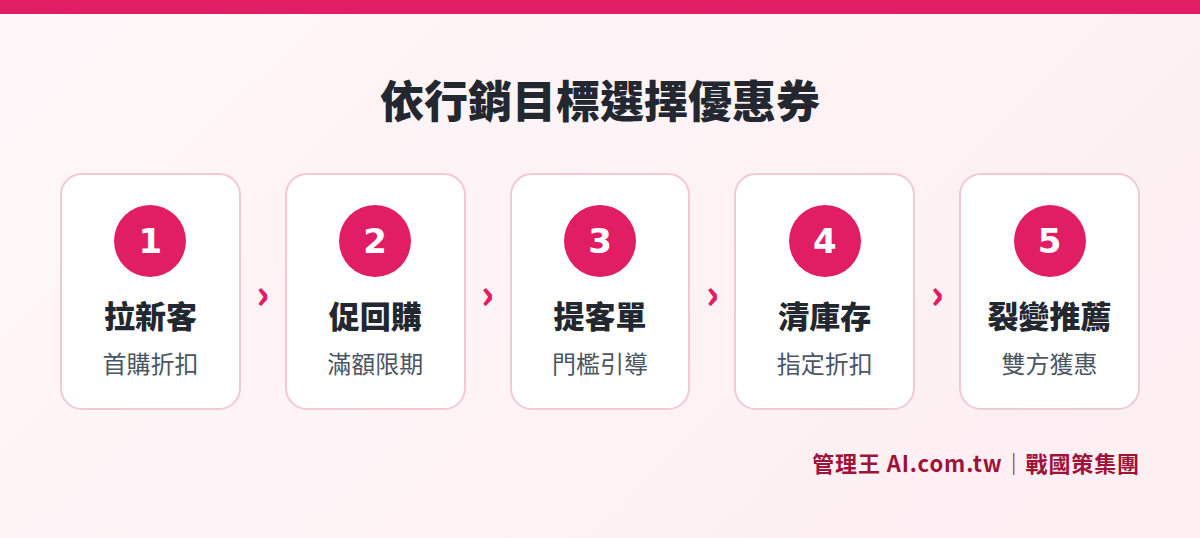
Decision-making process for choosing the appropriate coupon type based on marketing objectives
Five Key Elements in Coupon Design
An effective coupon, whether physical or digital, must include the following information, which is also required by Taiwan’s Fair Trade Commission's promotional advertising handling principles:
1. Discount Content
Clearly state the discounts or gifts, such as "100 NTD off" or "20% off," avoiding vague phrases like “great deal.”
2. Usage Conditions
This includes minimum spending amounts, specific products, designated stores, and member level restrictions. The clearer the conditions, the less dispute there will be during redemption.
3. Validity Period
Clearly indicate the start and end dates of use; avoid phrases like "from now until the end of the event." According to Article 21 of the Fair Trade Act, advertising content must be true and must not have misleading representations.
4. Redemption Method
Explain how the consumer can use this coupon: entering a discount code, scanning a QR code, or showing a screen—all must be clearly indicated.
5. Restriction Statements
Clarify whether it can be combined with other offers, usage limits per person, or whether it is transferable, all of which should be clearly stated on the coupon or event page.
Three Distribution Channels and Precise Targeting Strategies for Coupons
Even well-designed coupons can be ineffective if they are delivered to the wrong audience. The key to precise distribution is "at the right time, to the right people, through the right channels."
LINE Broadcast: Suitable for stores with an official LINE account, has a high open rate, but should control the frequency of messages carefully to avoid customer blocking. Coupled with social scheduling management, festive messages can be set in advance.
Email (EDM): Suitable for e-commerce and B2B businesses, allowing for detailed segmented sending. It's recommended to use personalized names and targeted offers to increase open rates. An email newsletter system can assist in managing subscriber lists and sending schedules.
Printed QR Codes: Suitable for physical stores, print QR codes on receipts, packaging, or in-store DM that links to electronic coupons, directing customers to online channels.
Table: Comparison of Three Distribution Channels
| Channel | Characteristics | Optimal Scenarios |
|---|---|---|
| LINE Broadcast | High open rate, real-time. | Flash promotions, weekend events. |
| Email EDM | Segmentable, low cost, trackable. | Birthday discounts, repurchase reminders. |
| Printed QR Code | No need for customers to actively subscribe. | On the back of receipts, inside packaging. |
Targeting suggestions should be based on member tags in the CRM system: new customers, inactive customers, high-value customers, offering different levels of discounts rather than sending the same discount to all.
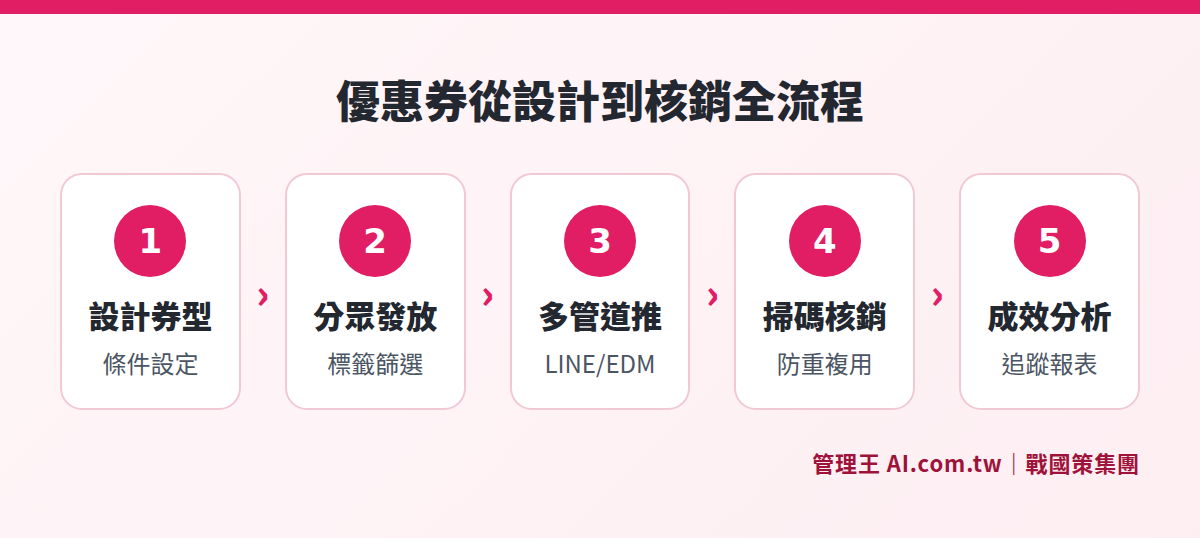
Complete operational flow from designing coupon conditions to system verification and redemption
How to Design the Redemption Process to Avoid Mistakes?
Redemption is the stage of the coupon process where mistakes are most likely to occur. Issues such as repeated use, excess redemption, or incorrect condition judgment can lead to minor profit losses and serious impacts on customer trust.
The three major problems with traditional manual redemption:
- Store staff's manual verification is difficult to prevent repeated use.
- Physical coupons cannot update usage status in real time.
- Cannot quickly verify if conditions for membership level or spending thresholds are met.
Standard digital redemption process:
- Consumers present a QR code or enter a discount code.
- The system automatically checks: validity period, usage count, membership eligibility, and spending threshold.
- If conditions are met → discount applied automatically, marked as used.
- If conditions are not met → display reason, reject redemption.
- After checkout is completed → redemption records are written to the backend report.
The core of this process is error-proofing: ensuring that the status of every coupon is entirely controlled by the system and not dependent on manual judgment, thus effectively preventing abuse and protecting profit margins.
Coupon Analysis: Four Key Indicators for Continuous Improvement
If coupon activities are not tracked for effectiveness, they are merely money-burning, not investment. Here are four key indicators that form the basic framework for analyzing coupon activities:
1. Redemption Rate
The ratio of issued coupons to actual used coupons, reflecting the attractiveness of the discount and distribution accuracy. A low redemption rate may indicate insufficient discount strength or imprecise target audience.
2. Impact on Average Transaction Value
What is the difference in average transaction value between orders that used coupons and those that did not? If a minimum purchase discount effectively raises the average transaction value, it indicates reasonable condition settings.
3. New Customer Ratio
What proportion of consumers using coupons are first-time buyers? A high new customer ratio indicates good acquisition effectiveness, but if the profit margin is too thin, long-term value needs to be evaluated.
4. Expired and Unused Rate
How many of the issued coupons expired without being used? This represents potential repurchase opportunities that could be salvaged—sending reminders three days before expiration often leads to a surge in repurchases.
Differences in Coupon Marketing Strategies by Industry
Coupons are not a one-size-fits-all formula; different industries have varying usage habits and customer expectations, and strategy design needs to be tailored accordingly.
Food and Beverage Industry: High frequency of customer consumption makes coupons most suitable for "repurchase reminders" and "filling seats during off-peak times." For example, buy one get one free for weekday lunches or enjoy 10% off by revisiting within 14 days after a purchase, aimed at increasing customer visit frequency. The food and beverage industry should especially ensure that validity periods are not too short to avoid customer rush near the deadline, which affects service quality.
Retail E-commerce: Suitable for using "first purchase discount codes" to lower the barrier for new customer conversion, as well as "abandoned cart recovery coupons"—when customers add products to the cart but fail to check out, an automatic coupon is sent 24 hours later to effectively revive purchasing intent. E-commerce is also particularly suitable for conducting A/B tests to assess the impact of different discount strengths on conversion rates.
Beauty, Medical, and Service Industries: Appointment-based services are suitable for distributing coupons in the form of "first appointment gifts," such as "receive a care experience voucher with your first appointment," lowering the psychological barrier for first-time trials. A two-way reward system like "both the referrer and the new customer receive 500 NTD" can also be implemented to bring in new customers through word-of-mouth.
B2B and Consulting Services: Direct discounts are less effective; they are more suitable for "extending free trial periods" or "priority service rights," emphasizing service value rather than price competition.
Regulatory Considerations in Taiwan: Disclosure Obligations for Coupons
When conducting coupon promotional activities in Taiwan, it is essential to be aware of the relevant provisions of the Fair Trade Act:
- Discount conditions, usage periods, and scope of use must be clearly disclosed and not just indicated in small print or hidden ways.
- The "original price" and "market price" in advertising must be genuine benchmarks and not fabricated high original prices to create a false impression of discounts.
- When issuing discount vouchers or coupons, the methods of use, duration, and scope must be clearly stated; failure to do so may constitute misleading advertising under Article 21 of the Fair Trade Act.
- Violations can incur fines of up to 25 million NTD.
Additionally, when collecting member data for precise distribution, compliance with the Personal Data Protection Act is required, including obtaining party consent and informing them of the purpose of use.
How to Use 管理王 Coupon Center
The Coupon Center from 管理王 AI.com.tw is a one-stop promotional management tool designed specifically for SMEs in Taiwan, with a free plan offering permanent access to basic features.
The practical operation process is as follows:
- Create Coupon Type: Select the discount type (cash/percentage/minimum purchase/buy one get one/free shipping/gift) in the backend, set usage conditions, validity periods, maximum issuance limits, and per-person usage limits.
- Set Distribution Targets: Connect CRM member data and filter target customer groups based on tags (e.g., inactive customers who have not spent in 30 days, high-value customers who spent over 5000 NTD).
- Select Distribution Channels: Configure distribution through LINE broadcasts, EDM, or generating QR codes for printing, with scheduled send times available.
- Store QR Code Redemption: Staff scan customer QR codes with their phones, and the system verifies in real time to prevent repeated use, eliminating the need for manual verification of physical coupons.
- Track Performance Reports: The backend instantaneously displays redemption rates, sales uplift, expiration reminders, and reports can be exported for future optimization after the activity ends.
The Coupon Center is deeply integrated with 管理王’s member points system, marketing automation, and advertising management, ensuring that marketing data circulates within the same platform without the need for manual exports and imports. Consultants can assist in planning the overall marketing automation process.
Avoiding the Six Common Coupon Marketing Mistakes
Many SMEs make the following mistakes when implementing coupon activities, resulting in less-than-expected outcomes and even profit losses:
1. Uniform Discount Strength for All
Providing high discounts to loyal customers who are already willing to buy amounts to giving away profits. Different levels of discounts should be designed for different customer segments: offer larger discounts to new customers to lower the trial barrier, while older customers could redeem points or receive smaller discounts with exclusive services.
2. Setting Too Short or Too Long of a Validity Period
If the validity period is too short, customers may not have enough time to respond before it expires; if too long, customers may procrastinate and forget. Generally, promotional coupons should have a validity of 14 to 30 days, while repurchase reminder coupons should be 7 to 14 days to instill a moderate sense of urgency.
3. Self-Contradicting Usage Conditions
For example, "store-wide discount, but excluding sale items" lacks clear definitions for what constitutes a sale item, or phrases like "spend 500 NTD to get 100 NTD off but may not go lower than the final sale price" create ambiguity that could lead to disputes during redemption, harming brand image.
4. Ignoring the Relationship Between Distribution and Redemption Tracking
Not knowing which distribution channel brought in which orders is akin to throwing darts blindfolded. Each distribution batch should have a unique identifier to allow the system to attribute redemption to the correct campaign.
5. Overlooking Re-marketing Opportunities for Expired Coupons
Expired and unused coupons indicate a customer’s intent to purchase that did not convert into action. This group represents the most valuable re-marketing targets and should be prioritized in the next activity.
6. Designing Activities Without Considering Profit Margin
Before issuing coupons, it’s important to calculate: Does the discount amount, combined with the customer acquisition cost, still maintain a positive profit margin for this transaction? If not, a short-term boost in performance could lead to long-term losses. It’s advisable to calculate the break-even point separately for each product category before deciding on a discount ceiling.
Combination Strategies for Using Coupons with Other Marketing Tools
Using coupons alone has limited effects; combining them with other marketing tools can generate a multiplier effect:
- Coupons × Landing Page: Create a dedicated one-page sales page for each activity to guide advertising traffic to an event page with discount codes, increasing conversion rates.
- Coupons × Referral Programs: Existing members refer new friends, both receiving coupons, leveraging word-of-mouth effects to reduce new customer acquisition costs.
- Coupons × POS System: Physical stores can redeem coupons directly through the POS system, allowing online and offline discounts to be used interchangeably.
- Coupons × E-commerce: Built-in discount code input on the checkout page of an online store system automatically checks eligibility.
Let consultants help plan your coupon activities
The 戰國策 Group consultants can assess your coupon marketing strategy for free, designing the complete workflow from issuance to redemption. Feel free to consult with us for free.
Free consultation hotline: 0800-003-191
LINE Official Account: @119m
Official website: app.AI.com.tw
Free trial: Apply for 管理王 now
Frequently Asked Questions
Will setting a minimum spending threshold for coupons annoy customers?
Setting thresholds is a common practice and generally does not annoy most customers; the key is whether the threshold is reasonable. It’s recommended to set the threshold between 120% to 150% of the average transaction value of that customer group, which can elevate the average transaction value without feeling out of reach for consumers. Too high of a threshold may lead customers to give up on using the coupon, resulting in a noticeable drop in the redemption rate.
Can coupons be used both online and in physical stores?
Yes, as long as the system has a unified redemption backend. If the online e-commerce and physical stores use different systems, redeeming the same coupon on both ends simultaneously could pose risks of duplicate use. It is advisable to manage all channel coupons within a single system, allowing the system to automatically mark their usage status.
Should customers be reminded of soon-to-expire discount coupons?
Strongly recommended. Sending push notifications (via LINE or EDM) three days before the coupon expires can often trigger a wave of repurchases. Marketing practices show that expiration reminders can convert dormant coupons into actual consumer actions, with very low sending costs. Reminder messages should avoid saying, "Your coupon is about to expire," and instead use a more positive tone like, "You still have a discount waiting for you to use."
What redemption rate is considered normal after issuing coupons?
This varies significantly depending on the type of coupon and distribution channel. Generally, coupons distributed to specific high-intent customer groups (like recently purchased customers or members with birthdays this month) usually have redemption rates higher than those sent broadly to all members. If consistently low redemption rates are observed, the first step is to check: Are the discount strengths sufficient? Is the validity period too short? Are the distribution targets accurate?
What regulations must coupon marketing comply with?
Mainly, two regulations need to be followed: one is the Fair Trade Act, which mandates that promotional conditions must be true and adequately disclosed, without misleading representations in ads; the other is the Personal Data Protection Act, which requires obtaining consent when collecting member data for the purpose of precise distribution. It's advisable to have legal or consultant confirmation on the legality of the text and rules on the coupons and events before launch.
Data Sources
- Fair Trade Commission's principles for handling promotional advertising cases, Fair Trade Commission
- Article 21 of the Fair Trade Act, National Regulatory Database
- Personal Data Protection Act, National Regulatory Database
- Executive Yuan Consumer Protection Committee - Consumer Protection Act, Executive Yuan Consumer Protection Committee
This article is for general information only and does not constitute legal advice. Actual regulations should follow the latest announcements from authorities.