How to Calculate Coupon System Costs? Comparing Custom Build, Platforms, and SaaS|Coupon System Recommendations

A comparison of the cost structures of custom-built, e-commerce platform (SHOPLINE, Cyberbiz), and SaaS integrated (Management King) coupon systems, breaking down GMV percentages, annual fees, and hidden costs to help businesses choose the most cost-effective solution.
The cost of a coupon system depends on the deployment model you choose: custom-built systems, e-commerce platforms, or SaaS integrated subscriptions. The cost structures of these three models vary significantly, and it’s not enough to just compare monthly fees; you must also account for GMV percentages, integration costs, and maintenance manpower to see the true total cost of ownership over five years. For most SMEs with a monthly revenue of less than NT$500,000, the SaaS integrated option has the lowest entry barrier and the least hidden costs; e-commerce platform models are more suitable for retailers with official brand stores and stable traffic; while custom builds are almost exclusively suitable for large enterprises or platform providers with dedicated technical teams. This article dissects the cost components and common hidden costs of the three models and compiles a comparison table to help you calculate before making a decision.
Understanding in One Sentence
The monthly fee of a coupon system is just the starting point; the actual cost comes from the GMV percentages, integration fees, and maintenance manpower combined.
Three Major Calculation Models for Coupon System Costs
In the Taiwan market, there are three main ways to acquire coupon functionalities, each with a different cost structure:
Model 1: Custom Build
Companies commission a software firm or develop coupon functionalities from scratch with internal engineers, having complete control over data and logic, but they must bear the development, maintenance, and upgrade costs.
Model 2: E-commerce Platform Model (e.g., SHOPLINE, Cyberbiz)
Coupon functionality is built into the e-commerce platform solution, structured as an annual fee plus transaction percentages (GMV percentage), suitable for businesses focused on official brand e-commerce.
Model 3: SaaS Integrated Subscription (e.g., Management King AI.com.tw)
A subscription model where the monthly fee covers over 100 functionalities, including a coupon center, CRM, and marketing automation, without additional GMV percentages, suitable for SMEs that need cross-department integration.
Table: Overview of Cost Structures of Three Models (2026 Information)
| Model | Initial Cost | Monthly Fee Structure | GMV Percentage | Integration Cost |
|---|---|---|---|---|
| Custom Built System | Development cost (depends on requirements) | Maintenance manpower costs | None | Self-integration required |
| E-commerce Platform Model (SHOPLINE) | Activation fee NT$5,000 | Annual fee about NT$40,000-88,000 | About 1.5%-2.0% | Additional costs for paid modules |
| E-commerce Platform Model (Cyberbiz) | Enterprise version setup fee NT$49,000 | Annual fee about NT$27,000-64,800 | About 0%-5% | Additional costs for paid modules |
| SaaS Integration (Management King) | None | Free plan permanently free; paid plans start from NT$5,000/month | None | Native integration of 100+ functions |
The above e-commerce platform data is based on gtlimc.com (Good Times Chestnut Integrated Marketing) publicly compiled data as of October 2026; please refer to the latest announcements on each platform's official website for actual data.
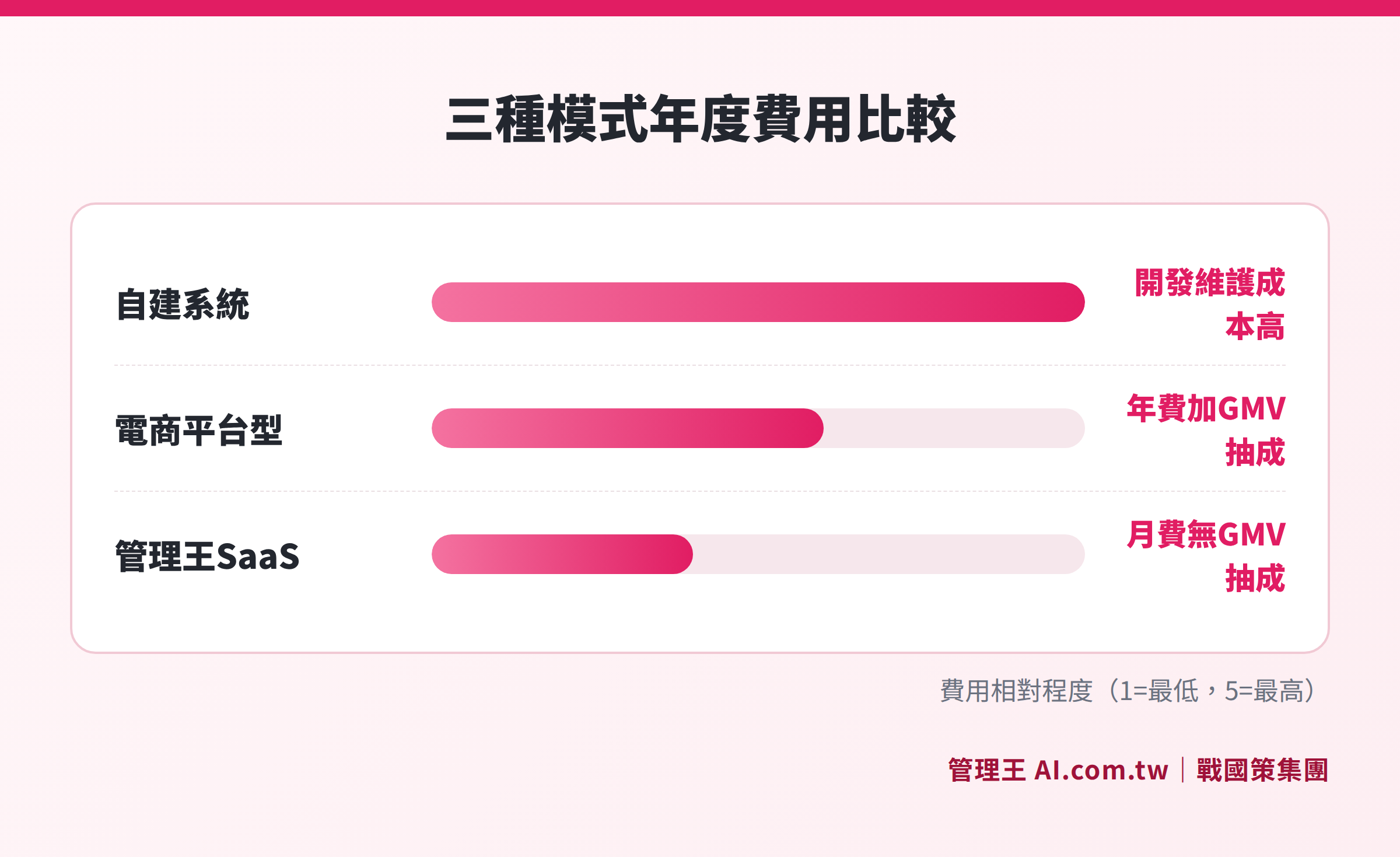
Differences in initial costs, monthly fees, and GMV percentages among custom-built, e-commerce platforms, and SaaS integration models
Custom Built Coupon System: Cost Structure and Hidden Costs
The costs of a custom-built coupon system can be divided into the following levels:
Development Costs
The initial development costs depend on the complexity of the system, including: discount code logic, usage condition settings, membership verification, redemption API, backend reporting, and so on. The more complex the issuance rules (e.g., bundled coupons, cross-platform redemptions, referral split mechanisms), the longer the development hours.
If integration with LINE messaging, electronic invoices, POS systems, or existing ERP systems is required, each integration point incurs additional development hours.
Long-term Maintenance Costs
The long-term maintenance costs are often the most underestimated aspect of a custom-built system:
- Bugs fixing
- System version upgrades and security updates
- New feature requirements (e.g., adding A/B Testing, referral splits)
- Server and cloud hosting costs
For SMEs without dedicated engineers, each modification requires contacting outsourced vendors, waiting for scheduling, confirming requirements, and acceptance testing, resulting in high time costs.
Suitable Candidates
Custom builds are only suitable under the following conditions:
- The business has a stable technical team (at least 1 to 2 backend engineers)
- There are highly customized needs that cannot be met by market solutions
- The scale is large enough to amortize the investment in development
Costs of E-commerce Platform Models (Examples: SHOPLINE, Cyberbiz)
In e-commerce platform solutions, coupon functionalities are typically included, with a cost structure of "annual fee + GMV percentages."
SHOPLINE
SHOPLINE’s annual fee structure in Taiwan ranges from NT$40,000 to NT$88,000, with a one-time activation fee of NT$5,000 and a GMV service fee of about 1.5% to 2.0%. The coupon functionality is built into the platform, supporting discount code settings and redemption processes.
The Real Impact of GMV Percentages: For a monthly revenue of NT$100,000, a 2% GMV fee amounts to NT$2,000 per month; as monthly revenue grows to NT$500,000, the monthly fee increases to NT$10,000, which adds up to an additional annual fee of NT$120,000. The higher the revenue, the greater the absolute amount of GMV fees.
Cyberbiz
Cyberbiz's annual fee is approximately NT$27,000 to NT$64,800, with an enterprise version setup fee of NT$49,000; the GMV fee ranges from about 0% to 5%. The coupon functionality supports bulk creation, EDM, and LINE OA distribution, along with various discount types.
The above data is based on gtlimc.com (Good Times Chestnut Integrated Marketing) publicly available information as of October 2026; for detailed plans, please refer to the latest announcements on each platform's official website.
Hidden Costs of E-commerce Platform Models
In addition to the annual fee and GMV percentages, also be aware of:
- Payment processing fees: Card fees range from about 2.5% to 2.8% (paid to banks, not platform fees)
- Annual fees for electronic invoice systems: About NT$6,000 or more
- Additional purchase fees for advanced modules: Some advanced features require additional payments
- SMS notification fees: OTP verification, event notifications cost about NT$1.5 to NT$2.0 each
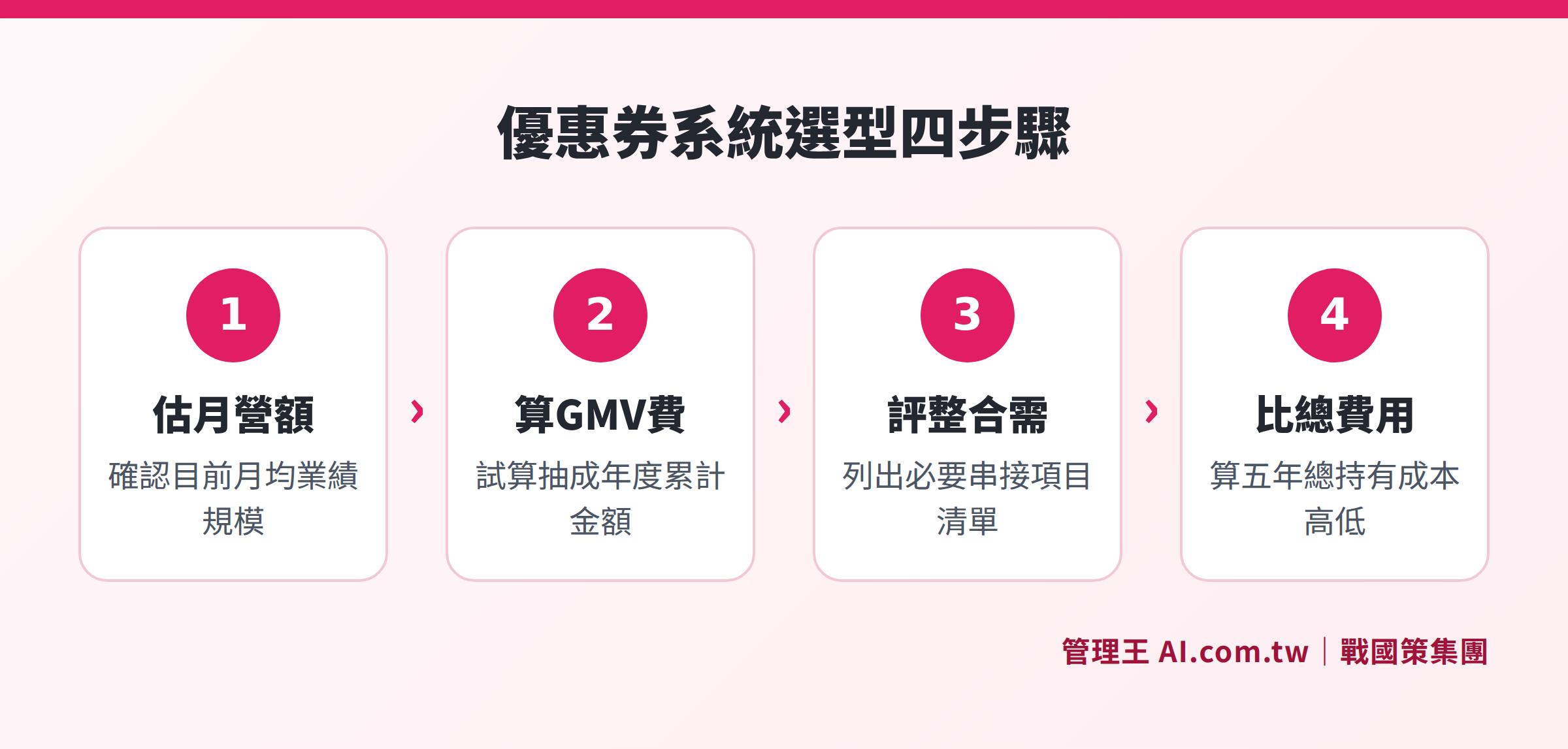
A four-step evaluation process for selecting custom-built, e-commerce platform, or SaaS integrated systems based on business scale and needs
SaaS Integrated System: Management King's Pricing Explanation
Management King AI.com.tw offers the Coupon Center as a subscription service, without GMV percentage deductions, with the following cost structure (the numbers below are based on Management King’s official pricing page; please refer to app.ai.com.tw/pricing for the latest announcements):
Table: Management King's Subscription Plans and Coupon Functionality
| Plan | Monthly Fee (Monthly Payment) | Maximum Members | AI Points | Coupon Functionality |
|---|---|---|---|---|
| Free Plan | NT$0 (permanently free) | 10 people | One-time quota | Basic functionality |
| Economical Plan | NT$5,000 | 30 people | 1,000 points/month | Complete functionality |
| Business Plan | NT$10,000 | 60 people | 3,000 points/month | Complete functionality |
| Flagship Plan | NT$19,900 | Unlimited | 10,000 points/month | Complete functionality |
Annual payment plans give you 14 months for the price of 12. Customized development is transparently priced at NT$1,000/hour, and consultants first evaluate needs for free.
Differences in Costs of Management King's Coupon Center Compared to E-commerce Platform Models:
- No GMV percentages mean greater savings as sales increase
- The coupon center is natively integrated with the CRM system, marketing automation, loyalty program, and Landing Page with no additional integration costs
- Data is stored in the 戰國策 group's Taiwan data center (ISO 27001), eliminating additional costs for security compliance
Framework for Calculating Total Cost of Ownership Over Five Years
When assessing the costs of a coupon system, it is recommended to estimate the Total Cost of Ownership (TCO) over five years, including the following items:
1. Direct Costs
- Annual or monthly fees × Number of months used
- GMV percentages (calculated based on estimated revenue)
- Initial activation or development fees
2. Indirect Costs
- Integration and connection costs (LINE, payment processing, ERP, invoicing)
- Costs of employee training and online time
- Data migration costs
3. Opportunity Costs
- Revenue loss due to feature gaps (e.g., inability to track which coupon generated which order)
- Delays in promotional launch times due to technical bottlenecks
Many SMEs initially just look at the monthly fees, overlooking the compounding effect of GMV percentages that grow with revenue, as well as the long-tail spending on integration and maintenance fees.
How Different Scale Enterprises Should Choose
Based on business scale and needs, here are some selection recommendations:
Monthly Revenue Below NT$500,000 (Early Stage or SMEs)
It is recommended to start with a SaaS integrated approach. Management King’s free plan offers permanent access, and upgrading to NT$5,000/month provides complete coupon center functionality while also integrating CRM and marketing reports without additional integration fees.
Monthly Revenue NT$500,000 to NT$2,000,000 (Growing Retailers)
If the core business is focused on official brand e-commerce stores, SHOPLINE or Cyberbiz’s one-stop e-commerce solutions are worth considering. Be aware of the cumulative effects of GMV percentages as business performance grows and whether additional payments will be needed for integrating LINE official accounts and CRM.
Monthly Revenue Over NT$2,000,000 (Large or Chain Enterprises)
The larger the business, the higher the absolute amount of GMV fees, and the ROI of custom-built systems or customized development starts to become evident. If choosing SaaS, it is advisable to evaluate flagship plans in conjunction with customized development to ensure they meet complex business needs.
How to Use Management King’s Coupon Center
Management King AI.com.tw’s Coupon Center is designed as a one-stop promotional engine for SMEs in Taiwan, with a free plan that allows for permanent use of basic functionalities. Below is a description of the actual operational process:
Establish Discount Rules: In the backend, choose from six types of coupons (cash discounts, percentage discounts, minimum purchase discounts, buy one get one free, free shipping coupons, gift coupons) and set minimum spending requirements, designated products, specific branches, effective periods, and user limits.
Link Member Data for Precise Distribution: Integrate member tags from the CRM system to filter recipients based on purchase history, tier, or last purchase date, delivering through LINE push notifications, EDM, or printed QR codes via multiple channels.
Instant Redemption through Scanning: Staff can scan the customer’s QR code using a mobile phone, with the system automatically verifying validity periods, usage counts, and membership status, preventing duplicate redemptions and ensuring a smooth checkout process.
Performance Report Tracking: The backend shows real-time redemption rates, changes in average transaction values, expiration warnings, and reports can be exported after the activity ends to serve as a basis for future optimization.
The coupon center is deeply integrated with marketing automation, loyalty programs, and advertising management, allowing marketing data to be centralized in the same backend without the need for manual export and import. To learn more about coupon marketing design, refer to How to Conduct Coupon Marketing? Understand Design, Distribution, and Redemption at Once and Digital Coupons vs. Paper Coupons: A Cost and Tracking Effectiveness Comparison.
Not Sure Which Coupon Plan is the Most Cost-effective?
Consultants are available for free evaluation of your business scale and needs, helping to calculate the total cost of ownership for the custom-built, platform, and SaaS options over five years, identifying the most suitable selection direction.
Free consultation hotline: 0800-003-191
LINE official account: @119m
Official website: app.AI.com.tw
Free trial: Apply for Management King Now
Frequently Asked Questions
What is the main hidden cost of a coupon system?
GMV percentages are often the most underestimated hidden costs. E-commerce platform solutions typically charge between 1.5% to 5% of the transaction amount, with costs rising as revenue increases. For a monthly revenue of NT$300,000 and a 2% GMV fee, the monthly charge can exceed NT$6,000, accumulating to NT$72,000 annually—equivalent to paying an additional subscription fee. Choosing a no GMV percentage plan can save significant expenses as sales grow.
Is a custom-built coupon system necessarily more expensive than SaaS?
Not necessarily, but it requires a long-term perspective. While the initial development costs of custom-built systems are higher, if the company has a significant amount of customization needs and dedicated technical teams, it may not end up being more expensive than subscription fees over the long term. However, for SMEs without engineers, every modification requires outsourcing, and the time and costs often exceed expectations. SaaS solutions offer predictable costs, with the supplier responsible for maintenance, making them more suitable for resource-limited SMEs.
What limitations are there in Management King’s free plan?
Management King’s free plan provides basic coupon functionalities, with a member limit of 10 people and one-time AI function usage. Some advanced features (e.g., complex bundle rules, A/B testing reports, high-volume LINE pushes) require an upgrade to a paid plan. Overall, the free plan is suitable for early-stage companies validating their marketing strategies; after maintaining stable performance, they can upgrade based on needs, with detailed functionality differences based on the Management King pricing page.
Are migration costs high when switching coupon system platforms?
Migration costs include exporting and importing historical coupon data, reconstructing member relationships, and integrating with other systems anew. Management King supports CSV import for members and subscribers, with consultants assisting in migration at no cost. If the original system was a custom-built one, the differences in data formatting may lead to longer migration hours. It is advisable to evaluate portability when making selections to avoid being locked into a single platform.
Which is more suitable for the food and beverage industry: e-commerce platform models or SaaS integration?
The food and beverage industry often has needs for multiple outlets, offline redemptions, and LINE notifications. E-commerce platform models are primarily designed around online shopping, with limitations for food and beverage redemption scenarios; SaaS integrated solutions that natively support POS integrations, LINE notifications, and multi-location management usually provide better cost-effectiveness. Before choosing, it is advisable to confirm if the system supports offline QR code scanning for redemptions and integration with Taiwan’s electronic invoicing.
Data Sources
- Management King AI.com.tw Plans and Pricing (Management King official, queried November 2026)
- 2027 E-commerce Platform Fees Comparison! Analysis of 11 Major Platforms including SHOPLINE, 91APP, Cyberbiz (Good Times Chestnut Integrated Marketing, last updated October 2026)