What is a CRM System? An Overview of Business Management from Leads to Transactions|CRM System Recommendations
A CRM system (Customer Relationship Management System) consolidates the entire business process from lead development to post-sale care into one platform, addressing major issues such as scattered leads, lost opportunities, and customer attrition. This article explains four key aspects: the definition of CRM, core functions, sales funnel operations, compliance points of personal data laws, and selection criteria, along with how 管理王 CRM assists small and medium enterprises in Taiwan.
A CRM system (Customer Relationship Management System) is a digital tool that consolidates the entire sales process of "lead development, follow-up records, quotes, transactions, and post-sale care" into one place. Simply put, every action taken by a salesperson, from the first phone call to the last payment received, is recorded in the system, preventing loss upon employee turnover, and allowing management to access it at any time. The most common issues that small and medium enterprises in Taiwan solve with CRM are "scattered leads on personal phones, everything lost when a salesperson leaves" and "quote sent out with no follow-up, causing the deal to go cold." The global CRM market is expected to reach $128 billion in 2024, and Gartner predicts it will grow to $216 billion by 2029, indicating that this management logic has become standard equipment for modern sales teams.
What is a CRM System? Core Definition and Three Major Values
CRM stands for Customer Relationship Management, originally referring to the strategy and processes that companies use to manage customer interactions, later referring to the software system that supports these processes. Salesforce defines CRM as "a platform driven by AI that integrates company-wide data, connects every customer touchpoint, and empowers employees," with the core goal of "improving relationships, simplifying processes, and driving growth."
For small and medium enterprises in Taiwan, the three main practical values of CRM are:
- Customer data no longer follows individuals: All interaction records are linked to the company account, enabling a complete 360-degree view of the customer for new employees without having to rebuild relationships from scratch.
- Sales process visualization: Management doesn’t have to rely on meetings to ask about performance; they can open the dashboard to see how many cases each salesperson is handling, where they are stuck, and how much is expected to be collected this month.
- Automation reduces lost opportunities: Automatic reminders for follow-ups after seven days, automated tracking replies for sent quotes, and birthday cards sent automatically to customers ensure hot leads don’t cool off during busy times.
Understanding in One Sentence
A CRM system is a management tool that keeps "sales actions, customer data, and business opportunity progress" all within the company, visible to management at any time.
Why Do Small and Medium Enterprises in Taiwan Need CRM? Six Real Pain Points
Based on observations from 管理王's services to over 30,000 companies in Taiwan, six common issues frequently arise in sales management:
Table: Six Major Pain Points in Sales Management for Small and Medium Enterprises in Taiwan and Corresponding Impacts
| Pain Point | Common Phenomenon | Actual Loss to the Company |
|---|---|---|
| Salesperson takes leads upon leaving | Customer data stored on personal phones and LINE | Data leaves with the person; the next salesperson starts from zero |
| Confused versions of Excel manage customers | Three people in the same company have three different datasets | End-of-month statistics consume significant manpower but yield inaccurate results |
| No maintenance for old customers | Lose contact after a deal, only remember before renewal | Old customers taken by competitors, repeat purchase rates continue to decline |
| High cost of acquiring new customers | High advertising costs, low response rates to cold outreach | Leads come in, but no one follows up; money spent while deals go stale |
| Two salespeople compete for the same customer | Lack of a shared leads database; the same company approached twice | Customers doubt the company's professionalism, internal conflicts arise |
| Boss can only ask for performance in meetings | Figures rely on verbal reports from salespeople, with different calculations | Only knowing the difference at the end of the month, too late for remediation |
The common root of these six problems is that customer data isn’t managed centrally, and sales actions lack a visualization mechanism. The CRM system is designed to fill this gap.
What Are the Core Functions of a CRM System?
A comprehensive CRM system typically includes the following modules, covering the entire process from customer development to after-sales:
1. Customer Data Management (Customer 360)
Basic information about a company, all contacts, historical interaction records, quotes, contracts, and payment statuses are presented on one page. The 管理王 CRM system supports AI business card scanning for direct record creation and can also batch import CSV/Excel files, eliminating the need for salespeople to manually input data.
2. Opportunity Tracking (Sales Funnel)
Built-in customizable pipeline stages, from "Potential" → "In Development" → "In Cooperation" → "Completed" → "Lost", with each opportunity setting an amount and conversion probability. Management can instantly see how much can be collected this month and which cases have been stalled the longest.
3. Follow-Up Reminders and Automation
If a customer hasn’t been followed up with for more than the set number of days, the system automatically notifies the salesperson and management. After a quote is sent, follow-ups are automatically tracked, and customer replies are recorded back into the customer file, ensuring hot cases don’t go cold amidst busyness.
4. Development of Cold Leads
Automatically collect lists of companies that have not yet engaged, based on industry, region, and keywords, completing emails and contact methods. After filtering out existing customers, these leads go directly into the database, ideally used together with the B2B Lead Development System.
5. Automatic Performance Reports
Daily, weekly, monthly, and yearly transaction amounts, target achievement rates, and sales rankings are automatically compiled and delivered promptly to LINE groups or via email so that managers do not need to manually pull reports. The Sales Daily Report System can be used in conjunction.
6. Reviving Dormant Customers
The system automatically identifies customers who haven’t interacted for more than the set number of days, grouping them by spending amounts and purchase items, generating a wake-up list with the Dormant Customer Reviving function, allowing salespeople to focus their efforts on customers they already know.
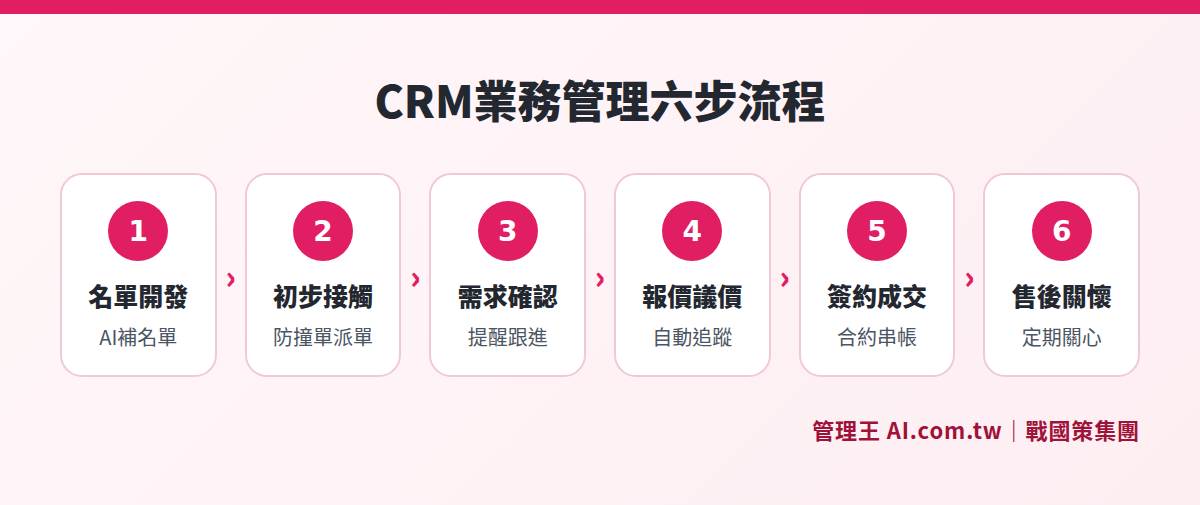
Six-Step Business Management Process from Lead Development to Post-Sale Care
What Are the Differences Between B2B and B2C CRM?
When selecting a CRM, Taiwanese companies often overlook the fundamental differences in business processes between B2B (business-to-business) and B2C (business-to-consumer). Choosing the wrong direction can make it difficult to leverage the system once purchased.
Characteristics of B2B CRM
B2B sales cycles are long, involve multiple decision-makers, and typically consist of high-value transactions. A company might have procurement contacts, technical evaluators, and decision-makers, each having different communication priorities. A B2B CRM should support "one company corresponding to multiple contacts," "recording the content and roles of each visit," and "tracking decision-making progress and reasons for stalls." 管理王 CRM’s 360-degree view of customers can link multiple contacts within the same company while annotating their roles and positions, making it suitable for the complex communication scenarios in B2B sales.
Characteristics of B2C CRM
B2C deals with a larger number of customers, smaller per-transaction amounts, and shorter repurchase cycles. The focus of CRM is on "segmented marketing," "automated care," and "purchase behavior analysis." Average consumers don’t need salespeople to follow up individually but instead maintain relationships through automated mechanisms such as email segmentation, LINE broadcasting, and satisfaction surveys. The marketing activities, bulk messaging, and dormant customer wake-up functionalities in 管理王 CRM are specifically designed as bulk maintenance tools for B2C scenarios.
Common Mixed Scenarios for Small and Medium Enterprises in Taiwan
Many Taiwanese small and medium enterprises are actually "B2B + B2C hybrids": wholesalers sell to downstream manufacturers (B2B) while also processing retail orders directly (B2C); consulting firms have both long-term client contracts and individual clients for one-time consultations. In such cases, selecting a CRM that allows flexible configuration of different pipelines and segmentation conditions is more practical than rigidly applying a single model.
How to Manage the Sales Funnel with CRM? Full Process from Leads to Transactions
The sales funnel is the core operational logic of a CRM. The following table shows what the CRM system automatically does at each stage:
Table: Automation Explanation of Each Stage in the Sales Funnel
| Funnel Stage | Sales Actions | CRM Automated Assistance |
|---|---|---|
| Lead Development | Search for potential customers and obtain contact information | Automatically collect leads based on industry and region; AI completes emails |
| Initial Contact | Make calls, send development emails | Assign salespeople, lock down leads to avoid collisions for 30 days |
| Confirm Needs | Understand customer needs, arrange demos | Record interaction timelines, remind if no follow-up after 7 days |
| Quote Negotiation | Send out quotes, respond to questions | Automatically track replies after quotes are sent, customer responses auto-linked to the customer file |
| Signing Transaction | Send contracts, confirm payment | Automate contract signing processes; payment status updates automatically |
| Post-Sale Care | Confirm usage status, address issues | Periodic automatic care emails, birthday cards, satisfaction surveys |
This funnel table also explains why CRM systems are more effective than Excel: Excel only records current status, whereas CRM records the entire history and proactively pushes the next step.
CRM Systems and Personal Data Law: Compliance Points Essential for Taiwanese Companies
Implementing a CRM system means centrally managing a large volume of customer personal data, which must comply with the Personal Data Protection Act (the latest revised version as of 2023). The competent authority is the Personal Data Protection Committee (PDPC).
Four key compliance requirements are:
- Purpose of collection must be clear: Before collecting customer data, the organization must inform the entity name, collection purpose, data category, and the rights that the involved parties can exercise (Article 8 of the Personal Data Law).
- Must not exceed necessary range: The handling and use of customer data must not exceed the necessary range for specific purposes (Article 5 of the Personal Data Law).
- Parties have the right to unsubscribe: Customers may request to cease all marketing communications at any time, and businesses must implement this after receiving the request, automatically excluding the customer from all future automated emails.
- Obligation to delete data: When a party requests deletion under Article 11 of the Personal Data Law, the business must respond and act within 30 days, or they will be penalized.
The 管理王 CRM system includes a built-in "Do Not Contact" checkbox mechanism. Once checked, all care emails, follow-up emails, and marketing activities are automatically skipped; customers can also unsubscribe from the bottom of the emails, complying with the Personal Data Law and protecting the company's emailing reputation.
Cloud CRM vs. On-Premise: How Do Taiwanese SMEs Choose?
Many Taiwanese bosses face the choice between "cloud or on-premise" CRM when evaluating options. The following compares the differences between the two architectures:
Table: Comparison of Cloud CRM and On-Premise
| Comparison Item | Cloud CRM (SaaS) | On-Premise |
|---|---|---|
| Initial Cost | Low (monthly subscription, no hardware) | High (server and setup costs) |
| Maintenance Responsibility | Handled by the service provider | Handled by the enterprise's IT staff |
| Mobile Access | Anywhere, anytime, cross-device | Usually requires VPN, less convenient |
| Data Location | Cloud (confirm data center location) | Corporate internal server |
| Upgrade Flexibility | Automatic updates with continuously increasing functions | Requires purchasing upgrade versions separately |
| Suitable Audience | Small and medium enterprises with 1 to 50 people | Large enterprises with special security needs |
For most Taiwanese small and medium enterprises, cloud CRM is a more practical choice: no IT maintenance needed, can be accessed directly on mobile devices, and costs can be adjusted as needed. 管理王 CRM data is stored on servers in Taiwan, providing the flexibility of cloud services with the reassurance of local support.
How to Choose a CRM System Suitable for Small and Medium Enterprises? Four Key Points
1. Will Salespeople Use It?
If the interface is too complicated or input fields are too numerous, salespeople will skip it, causing data quality to collapse. Before selecting a CRM, let salespeople test it for three days to see if they have any complaints.
2. Does the Mobile Experience Satisfy?
Salespeople rely on mobile devices for fieldwork; if the app loads slowly or operates sluggishly, records won’t be updated in real-time. Confirm if it supports voice input, photo capturing for records, and other mobile-friendly features.
3. Can It Integrate with Existing Tools?
If the CRM is an isolated system, data still needs to be manually copied to quoting systems and accounting systems, creating additional steps. Choose a solution that integrates natively with pricing, contract, and invoicing processes to avoid "purchasing a system but still having scattered data." Features like sales target management and sales rankings are common modules used together.
4. Is AI Added Value Built-in?
The competitiveness of modern CRM lies in AI: Can it automatically predict closing probabilities, automatically draft follow-up emails, and automatically analyze which lead sources convert best? If these functions require a separate AI tool subscription, total costs will quickly rise.
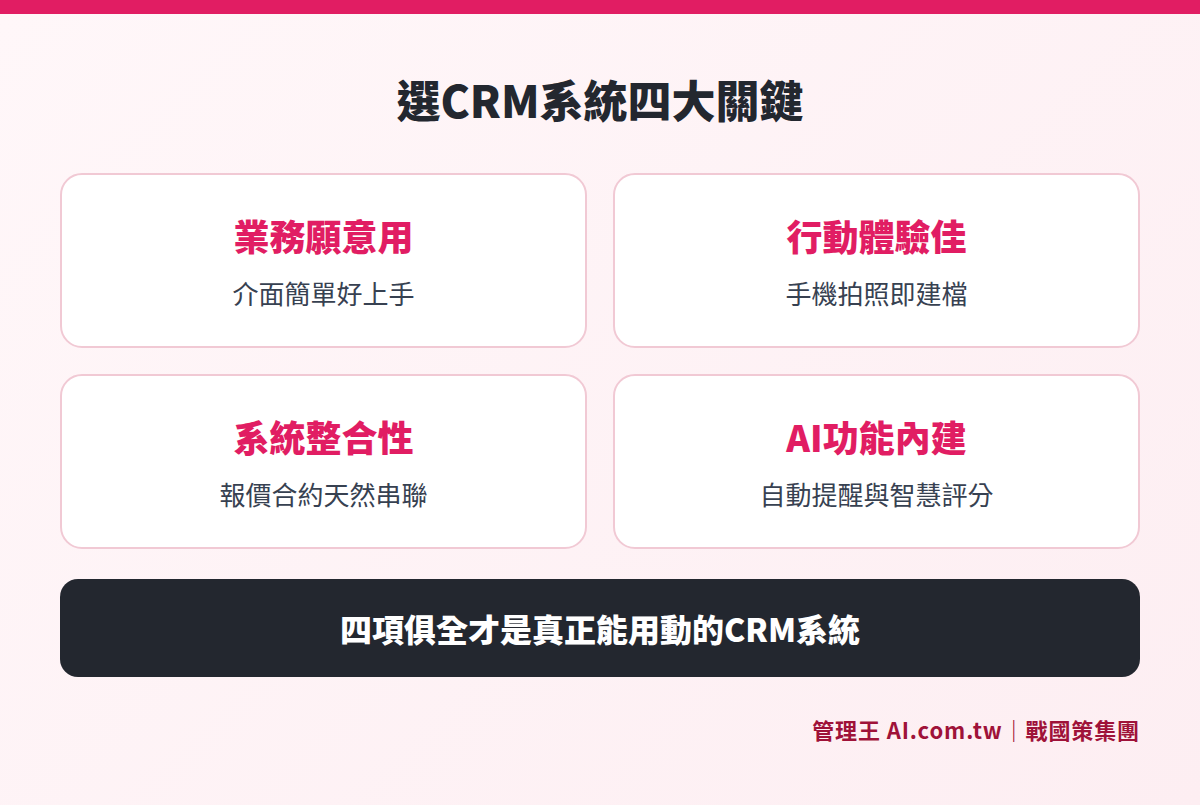
Evaluation framework for salesperson acceptance, mobile experience, system integration, and AI capabilities
How to Use 管理王 CRM?
The 管理王 AI.com.tw CRM system is a business management tool tailored for small and medium enterprises in Taiwan, designed to align with the actual workflows of Taiwanese sales:
First day online: Import existing leads
Batch import leads saved across various sales Excel files (in CSV format) or let salespeople use AI business card scanning to photograph and create records. The AI business card function supports recognition of both Chinese and English business cards.
First week: Set up the sales funnel and follow-up rules
Customize pipeline stages based on the company's sales process, set reminders for days without contact, and enable daily performance LINE reports, allowing managers to see the team's dynamics every morning.
After the first month: Start viewing data for decision-making
Data on product inquiries distribution, lead source conversion rates, and individual sales achievement rates is accumulated within the system, enabling managers to adjust development strategies based on data rather than gut feelings deciding marketing budgets.
Free plan available for permanent use for up to 10 members, suitable for initial startups or teams looking to evaluate first. For larger scales, upgrade to economical (NT$5,000/month, 30 people), business (NT$10,000/month, 60 people), or flagship (NT$19,900/month, no member limit). For complete plan details, please visit the 管理王 pricing page.
The 戰國策 group has served over 30,000 businesses, and every function in 管理王 CRM is designed based on feedback from Taiwanese clients, not just a replication of foreign SaaS templates. The customer service ticketing system and AI customer service can also continue to maintain relationships with clients after sales, forming a complete customer lifecycle management process.
管理王 CRM is natively integrated with nine other major systems, meaning processes after a sale don't require manual handover: Once a quote is confirmed, a contract is automatically generated, and after the contract is approved, it enters the payment process; once payment is completed, customer service can direct access the complete purchase history for after-sales support. This "data entry only once" design presents the efficiency advantage that small and medium enterprises need more than large companies—especially when understaffed, every repeat data entry consumes the most valuable time of salespeople. The project management function can take over tracking delivery progress after a deal, ensuring that commitments made by sales extend beyond just the contracts.
Let a Sales Consultant Help Assess Your CRM Implementation Plan
管理王 consultants offer free interviews to assist Taiwanese SMEs in finding the most suitable CRM configuration for their sales process from lead management to transaction tracking.
Free consultation hotline: 0800-003-191
LINE official account: @119m
Official website: app.AI.com.tw
Free trial: Apply for 管理王 now
Frequently Asked Questions
What’s the difference between CRM systems and ERP systems?
CRM focuses on "external" customer relationship management: developing leads, following up on sales, closing quotes, and post-sale care; ERP (Enterprise Resource Planning) manages "internal" operational processes: inventory, procurement, finance, and production. The intersection of the two lies in orders: once a quote generated by CRM is confirmed, it flows into ERP for shipment and financial records. 管理王 provides both CRM and ERP, with data naturally integrating without the need for additional linkages.
Do small companies (fewer than 5 people) need a CRM system?
If there are salespeople in the field and multiple salespeople developing customers simultaneously, it is worth using a CRM. Small companies often face not the issue of "too much data to handle" but rather that "fewer people mean every customer's follow-up is even more important"; missing one promising lead means less revenue. 管理王’s free plan supports permanent use for teams of fewer than 10 members, posing no entry barrier for small teams.
How do Taiwanese CRM systems comply with personal data regulations?
Taiwanese businesses using CRM systems should confirm the following: (1) informing and obtaining consent from customers before collecting their data; (2) providing a "Do Not Contact" mechanism within the system, allowing customers to unsubscribe from marketing emails; (3) being able to process data deletion requests within 30 days. 管理王 CRM features built-in unsubscribe and do-not-contact functionalities and stores data on local Taiwanese servers, meeting basic requirements of data laws.
How long does it take to implement a CRM system?
Using 管理王 as an example, basic functionality (lead import, funnel setup, reminder activation) can usually be completed within a day without the need for IT staff. Both business and flagship plans include 8 to 16 hours of remote implementation training, helping sales managers and salespeople quickly master advanced functions. Generally, sales teams can develop the habit of consistently recording in the system within two weeks.
Can the CRM system integrate with LINE?
The 管理王 CRM supports automatic performance report push notifications to LINE groups (daily, weekly, monthly, annually), allowing managers to track performance dynamics without opening the system. Simultaneously, customer data from LINE inquiries can auto-link to the CRM lead database, and sales follow-up records can be managed centrally, ensuring that important customers don’t only exist in personal LINE conversations.