How to Develop Customers? A Systematic Process from Lists to Transactions for SMEs|Recommended Customer Development Tools

The core of B2B customer development is to establish a replicable and systematic process. This article breaks down the seven most practical steps for Taiwanese SMEs, from defining the ideal customer profile, acquiring high-quality lists, writing personalized development emails, designing automated follow-up sequences, to opportunity management and transactions, and introduces how to use the management tool, 管理王 AI, effectively.
Developing customers is the core task for the growth of every SME. In simple terms, "customer development" refers to the complete process of proactively identifying potential targets for your products or services, establishing the first contact, and systematically tracking to convert strangers into paying customers. The biggest difference between B2B (business-to-business) customer development and B2C (business-to-consumer) is that the decision-making chain is longer and the transaction cycle is longer (usually ranging from weeks to months). Thus, relying solely on personal effort makes scaling difficult; a "replicable, trackable, and optimizable" systematic process must be employed. This article breaks down the seven most practical B2B customer development steps for Taiwanese SMEs, from defining the ideal customer profile to acquiring high-quality lists, writing personalized development emails, designing automated follow-up sequences, and opportunity management to transactions, while explaining how to effectively utilize AI tools to significantly increase the number of potential customers each salesperson can reach daily.
What is B2B Customer Development? Three Core Objectives
B2B customer development (Business Development) aims not just to "find more contacts," but to accomplish the following three objectives:
1. Establish a Predictable Opportunity Funnel: Ensure the sales team has a stable influx of new potential customers each month, rather than relying on word-of-mouth or random referrals.
2. Shorten the Time from List to Transaction: Through timely follow-ups and personalized communication, help willing potential customers advance more quickly to quoting and signing agreements.
3. Build Company Assets Independently of Individuals: Customer data, contact records, and follow-up statuses belong to the company, reducing loss when salespeople leave.
In a Nutshell
The essence of B2B customer development is "establishing replicable processes" so that every salesperson can generate stable opportunities using the same system, rather than relying on personal skills or luck.
The most common dilemma for Taiwan's SMEs is that salespeople contact clients using personal LINE accounts, lists are spread across various spreadsheets, and follow-ups rely solely on memory, which makes it challenging for supervisors to see what sales are doing. As the number of employees grows from 5 to 20, this method will begin to cause significant order losses and stagnation in sales performance.
Step 1: Establish the Ideal Customer Profile (ICP)
Before spending time searching for lists, the most crucial preliminary task is to define the "Ideal Customer Profile" (ICP). The ICP describes the types of customers that are easiest to convert and least likely to churn after a transaction.
Defining an ICP usually includes the following dimensions:
- Company Size: Number of employees, annual revenue range
- Industry: Manufacturing, trading, services, technology
- Geographic Location: North, Central, and South Taiwan, specific overseas markets
- Decision Maker Titles: Owner, procurement manager, IT supervisor, sales director
- Common Pain Points: High onboarding costs, difficult integrations, slow implementations, non-compliance with Taiwanese regulations
The clearer the definition, the higher the quality of the lists obtained later, and the better the conversion rate of development emails. Many sales teams skip this step and directly purchase lists, resulting in extremely low response rates to development emails; they mistakenly believe it is a copywriting issue, when in fact the list itself is imprecise.
Step 2: Acquire High-Quality Potential Customer Lists
After confirming the ICP, the channels for obtaining lists can generally be divided into the following four categories:
Table: Comparison of Four Main Channels for B2B Customer Development Lists
| Channel | Applicable Scenarios | Advantages | Limitations |
|---|---|---|---|
| Self-Built Lists (Google Maps, Industry Directories) | Local B2B, Physical Services | Up-to-date, high accuracy | Requires manual or AI assistance to extract |
| Exploration of Foreign Trade Buyers | Exporters, Manufacturers Seeking Overseas Customers | Quickly identifies international importers | Requires English development capability |
| LinkedIn and Social Media Platforms | Technology Industry, Consulting Services, SaaS | Direct access to decision-makers | High time cost, difficult to scale |
| Exhibition and Event Lists | Manufacturing, Specific Industries | Filtered parties willing to engage | Only a few opportunities per year |
In digital development, the most efficient way is to use tools to directly scrape Google Maps business data and corporate websites' emails, and then connect services like Hunter.io to find decision-maker emails by company domain, automating list collection. Once the lists enter the central list pool, the system should automatically deduplicate (to prevent different salespeople from contacting the same company) and design daily quota distribution to corresponding sales personnel, ensuring usage is controllable and not excessive.
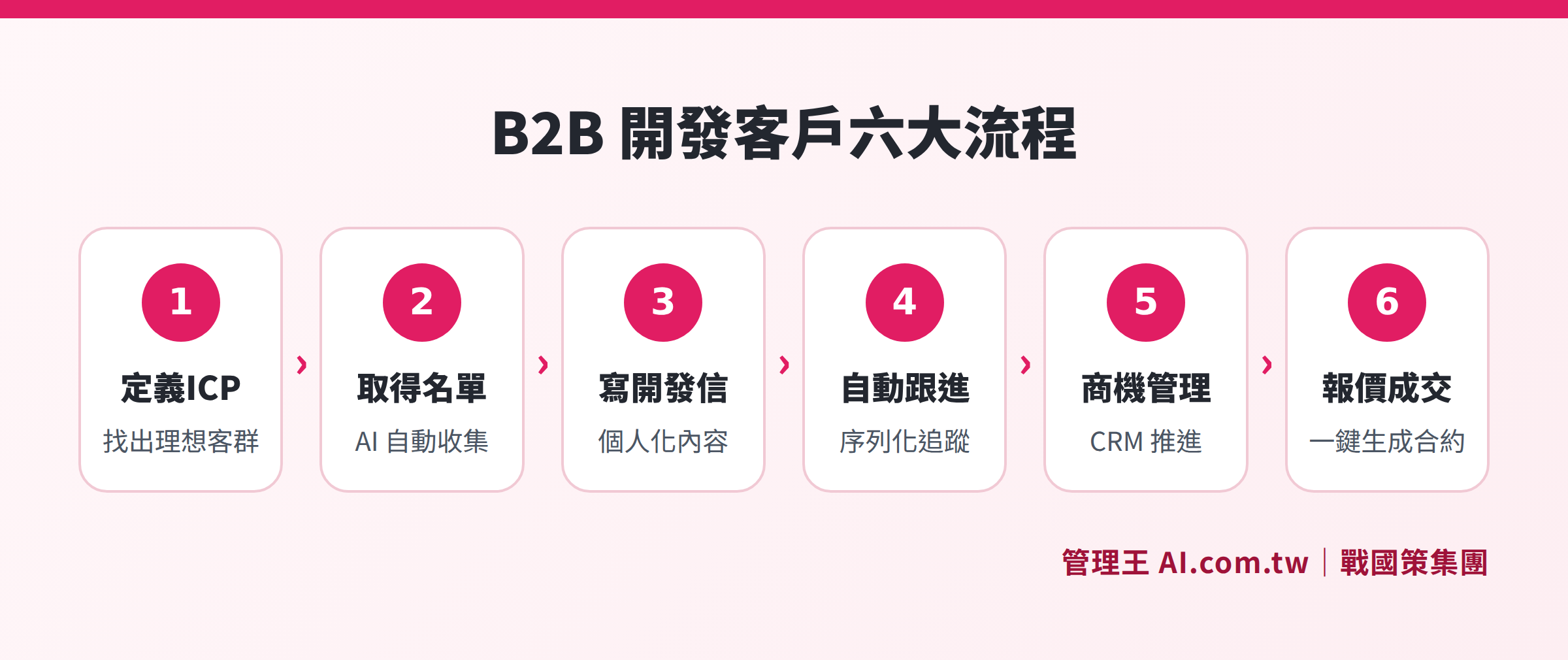
Complete process from defining ICP, obtaining lists, writing development emails, follow-up sequences, opportunity management to transactions
Step 3: Write Personalized Development Emails and EDMs
The quality of development emails directly determines the response rate. Standard mass emails usually have a very low response rate, while personalized emails that are customized based on the recipient's industry and title can significantly improve open rates and willingness to respond.
An effective B2B development email should include:
- Subject Line: A question or a statement addressing the recipient's pain point, such as "Can [Company Name] speed up the procurement process by 30%?"
- Opening: One sentence explaining the reason for writing, relevant to the recipient (not "We are a great company...")
- Core Value: Clearly state how you can solve their problems
- Social Proof: Similar types of clients you have already served (do not fabricate)
- Call to Action (CTA): A low-barrier next step, such as "Is it convenient to schedule a 15-minute call this week?"
EDM content (email marketing) is suitable for mid-term nurturing, regularly sharing valuable content with potential customers who are not yet ready to buy, until they enter the purchase cycle.
Step 4: Design Automated Follow-Up Sequences
A key fact in B2B sales is that most transactions occur after the third contact, but most salespeople give up after no reply during the first two attempts. Designing an "automated follow-up sequence" is precisely aimed at solving this problem.
Examples of standard follow-up sequences:
- Day 1: Send the initial development email
- Day 3: Send the first follow-up email, adding new information or value (not just asking "Did you see my last email?")
- Day 7: Send the second follow-up, providing relevant case studies or solutions
- Day 14: Send the final follow-up, stating this will be the last contact but welcome future inquiries if needed
The system should automatically send follow-up emails on the specified dates and track the customer's email opening and clicking behavior through IMAP. When customers open an email or click a link, salespeople should immediately receive push notifications (for example, via LINE), enabling them to follow up at the best time—these hot leads have a much higher probability of conversion compared to cold contacts.
Step 5: Ensure Email Delivery—SPF, DKIM, DMARC Settings
Writing the best development emails is futile if they end up in the junk folder. Email authentication settings are a technical foundation for B2B development, and the three key standards are:
SPF (Sender Policy Framework): Declares which IPs have permission to send emails using your domain through DNS TXT records, preventing sender forgery. The technical standard is RFC 7208.
DKIM (DomainKeys Identified Mail): Uses digital signatures to verify that the email content has not been tampered with during delivery; the technical standard is RFC 6376.
DMARC (Domain-based Message Authentication, Reporting & Conformance): Combines SPF and DKIM, defining the recipient's handling policy in case of verification failures (reject/quarantine/pass). The technical standard has been updated to RFC 9989 for 2024.
Starting in 2024, Google and Yahoo require senders who send more than 5,000 emails daily to set up DMARC, making this a strict requirement for businesses looking to scale B2B development. It is recommended to use tools to automatically check the health status of your domain's SPF/DKIM/DMARC before beginning significant email outreach, ensuring emails are reliably delivered to inboxes.
Table: Comparison of the Three Major Email Authentication Standards SPF, DKIM, and DMARC
| Standard | Function | Technical Document | Necessity |
|---|---|---|---|
| SPF | Authorize legitimate sending IPs | RFC 7208 | Essential for all commercial emails |
| DKIM | Verify email integrity | RFC 6376 | Essential for all commercial emails |
| DMARC | Define verification failure handling policy | RFC 9989 (2024) | Essential for high-volume sending |
Step 6: Opportunity Management—From Contact Records to Quotes and Transactions
Lists and development emails are merely the starting point; effective business management lies in tracking and advancing "opportunities." Every potential customer that responds should be converted into an "opportunity," recording the following information:
- Current sales stage (Initial Contact / Demand Confirmation / Quoting / Contracting / Completed / Lost)
- Estimated transaction amount and probability
- Next action and deadline
- All contact records (calls, emails, visits)
CRM systems are core tools for opportunity management. When an opportunity advances to the quoting stage, it should be possible to generate a quote directly from the CRM with one click, and after online signing, the quote should automatically convert into a contract, forming a complete "Inquiry → Quote → Contract → Payment" streamlined process without needing to copy and paste between different systems.
Sales managers should monitor key metrics such as the number of calls made, new opportunities generated, and quoted amounts through the daily sales report, rather than waiting until the end of the month to discover lagging performance.
Step 7: Telephone Development and Multi-Channel Integration
B2B development should not rely solely on email. Telephone development (Cold Calling) still has irreplaceable value for obtaining quick feedback and confirming decision-maker identities. Effective telephone development includes:
- Researching the recipient's company and decision-maker backgrounds in advance
- Preparing clear "opening lines" and scripts for handling common rejections
- Recording results and next action immediately after each call
- Setting fixed time slots for phone development daily to form a habit
Telephone development and email sequences can be integrated into a multi-channel follow-up system: emailing on the first day, calling on the third day, and sending another follow-up email on the seventh day, allowing potential clients to perceive your ongoing interest from different channels.
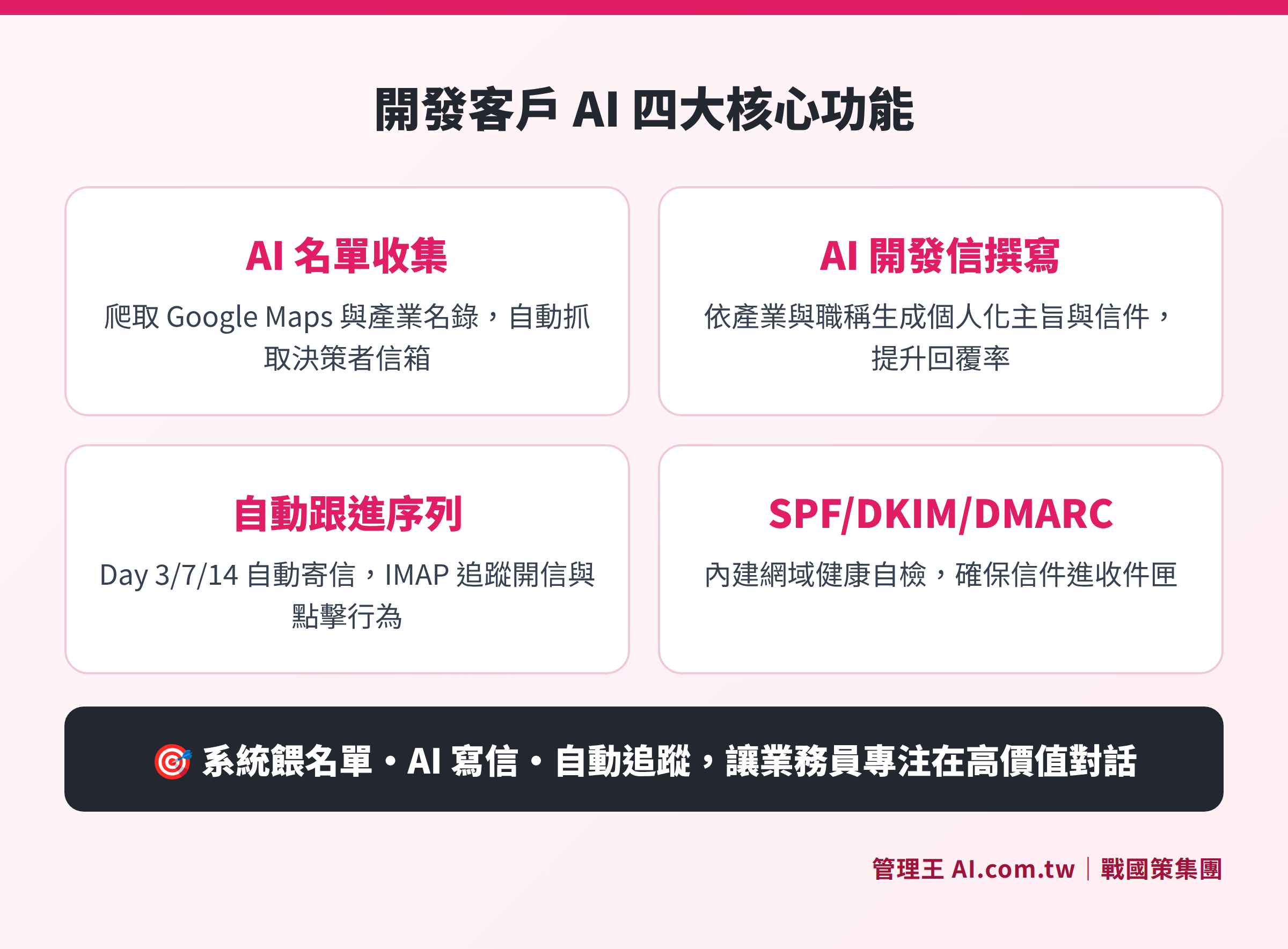
Four core functions of CRM: opportunity tracking, automated follow-up sequences, transactions, and sales visualization
Common Mistakes in Customer Development and How to Avoid Them
Even with a complete process established, the following common mistakes can still hinder overall effectiveness:
Mistake 1: Subject Lines are Too Sales-Oriented
Subject lines like "Lowest Price in the Market! Limited Time Offer!" often trigger spam filters immediately. An effective subject should focus on the recipient's problems, rather than your product's advantages.
Mistake 2: Sending Too Many Emails at Once Without Warming Up
Sending a large volume of emails immediately after activating a new domain will be judged as a source of spam by email service providers. The correct approach is to start with 20 to 30 emails daily and gradually increase weekly while monitoring the bounce rate to keep it below 2%.
Mistake 3: High Barrier CTAs
Asking the recipient to "sign an NDA before further discussion" in the first email sets a too high barrier that will lead potential customers to disengage. A more effective approach is to suggest low-friction actions: "Is it possible to schedule a 15-minute call?" or "Can I send you a presentation for reference?"
Mistake 4: Lists Too Broad Without ICP Filtering
Spending a lot of time sending emails, but the lists include industries that are completely unrelated to your products not only wastes resources but may damage domain reputation. Before each development activity, check the list's alignment with the ICP. A good standard is: if the recipient receives your email and thinks, "This email isn't meant for me at all," it indicates the list is too broad and needs refining.
Mistake 5: Never Reviewing Data
Regularly review open rates, response rates, and bounce rates for email campaigns weekly, adjusting the subject, content, and sending time based on data, rather than sticking to a fixed script. Data reviews should include: which industries have the highest response rates, which subject formats have the best open rates, and which times yield the best results. Continuous optimization is the long-term competitive advantage in B2B customer development.
How to Use 管理王: One-Stop AI Automation for B2B Customer Development
管理王 AI.com.tw's AI automated customer development (for B2B) integrates the seven steps into a single automated engine. The actual operational process is as follows:
List Collection: Enter the "AI Customer Development" feature, select target industries and regions, and the system proactively scrapes Google Maps businesses and industry directories, automatically fetching corporate website emails and can connect to Hunter.io to find decision-maker emails based on the domain. If you need to develop overseas markets, switch to "International Maps Mode" for specified countries, or use "Foreign Trade Buyer Exploration" to input target buyer descriptions in natural language (e.g., "Home goods importers in the USA"), enabling the AI to find overseas B2B buyers.
List Management: All valid lists enter the corporate central list pool, automatically deduplicated and assigned (to prevent different salespeople from contacting the same accounts) depending on the subscription plan, ensuring transparency and control in usage.
Writing Development Emails: The AI generates personalized questioning subject lines and email content based on the recipient's industry and title, and can also customize EDM content. Coupled with marketing automation features, once configured, the system automatically sends follow-up emails on Day 3, Day 7, and Day 14.
Email Delivery Health: Built-in SPF / DKIM / DMARC domain self-check tools ensure development emails land in inboxes rather than junk folders.
Real-Time Notifications: IMAP instantly interprets customer replies and clicking behaviors; once a customer takes action, a LINE notification is immediately pushed to the responsible sales person, allowing them to follow up at the optimal time.
AI Employee Option: If the "AI Employee" function is enabled, the system automatically explores a batch of new buyers each day and drafts development emails, allowing salespeople or bosses to send them with just one approval click, semi-automating the entire development process.
Telephone Development: Coupled with the built-in "telephone development module" (online call records, AI script coach, daily list quota), stranger development shifts from needle-in-haystack to a "system feeds lists, AI writes emails, auto tracks" replicable process.
All features are natively integrated with 管理王's CRM system, with potential customer data, contact records, and quotes all flowing within the same system, requiring no additional integration fees. The free plan can be used indefinitely for basic features; for plan details, please see the service plan page.
Let AI Help You Automatically Develop B2B Customers Every Day
管理王 consultants assist you in building a complete B2B customer development process from list collection, personalized development emails to automated follow-ups, offering free consultations to find the suitable plan for you.
Free consultation hotline: 0800-003-191
LINE official account: @119m
Official website: app.AI.com.tw
Free trial: Apply for 管理王 now
Frequently Asked Questions
Do SMEs have to use AI tools for customer development?
It is not mandatory, but the main advantage of using AI tools is scalability. A salesperson can manually write 5 to 10 personalized development emails each day, while AI assistance can expand that to dozens, while maintaining a level of personalization, enabling limited sales staff to create more entry points for opportunities. If the company is just starting out and client sources rely primarily on referrals, establishing a systematic process takes priority over AI tools.
What if my development email is marked as spam?
First, confirm that your domain correctly sets SPF, DKIM, and DMARC (you can use free tools like MXToolbox for testing). Secondly, avoid using all capital letters in subject lines, excessive promotional language, or images. The sending account should use a corporate-owned domain (e.g., name@yourcompany.com) rather than a free email address, and start with a small volume, gradually increasing daily counts while ensuring the bounce rate remains below 2%.
How can salespeople update customer information on the go?
管理王 uses responsive web design, allowing salespeople to smoothly operate the CRM on their mobile browsers, supporting voice input for meeting notes, automatic business card scanning for adding contacts, and quickly adding clients and opportunities via the LINE Bot. Salespeople do not need to be in the office to update data, reducing instances of missed entries.
Will customer lists be taken away when salespeople leave?
Under systematic CRM management, all customer data belongs to the company. The 管理王 CRM system provides a "customer domain lock" mechanism, allowing the system to freeze export permissions before a salesperson leaves, enabling supervisors to hand off customers directly to new sales personnel in the backend, ensuring customer relationships remain uninterrupted.
Can one person use this system to develop customers?
Yes. 管理王's free plan can support up to 10 members, making it usable for one-person companies or small sales teams. For companies with only 1 to 2 salespeople, the AI automation feature is especially valuable, allowing a small staff to maintain an adequate volume of customer development. Particularly, the "AI employee" feature can continually explore potential lists and prepare drafts for development emails while salespeople focus on face-to-face visits.
Sources
- Taiwan External Trade Development Council (TAITRA) Official Website: Resources for Taiwanese SMEs in overseas market development, including Taiwantrade buyer-seller matching platform and international exhibition services
- RFC 7208 - Sender Policy Framework (SPF): SPF email authentication technical standards document
- RFC 6376 - DomainKeys Identified Mail (DKIM): DKIM digital signature technical standards document
- RFC 9989 - DMARC Core Protocol: Latest technical standard document for DMARC as of 2024
- 管理王 AI.com.tw Official Function Page: Introduction to AI automated customer development (for B2B)