How to Choose a Customer Service System? Small and Medium Enterprises Customer Service Process and Purchasing Guide|Customer Service System Recommendations
This article provides a comprehensive explanation of the definition of customer service systems, core functional modules, key metrics like CSAT/NPS/SLA, seven evaluation dimensions for purchasing, and a five-step implementation process, helping Taiwanese small and medium enterprise owners select the most suitable customer service system.
A customer service system is a software tool that consolidates customer inquiries from various contact channels (LINE, Facebook Messenger, Email, website chat) into a unified backend for management, allowing customer service representatives to avoid switching between five apps, while also using tickets, knowledge bases, and satisfaction metrics to help companies continuously improve service quality. For small and medium enterprise owners, the core question in selecting a good customer service system is simply: can it ensure that every customer receives a quick and correct response without increasing manpower? This article starts from customer service pain points and comprehensively explains the core functions of a customer service system, key metrics like CSAT/NPS/SLA, evaluation dimensions for purchasing, and the actual implementation process for Taiwanese SMEs.
What is a Customer Service System? A Comprehensive Look from Tickets to Omnichannel Integration
A customer service system refers to software that helps companies manage customer service processes. It can be divided into three levels based on functional depth:
Basic Ticketing System: Converts customer messages from emails or forms into tickets, assigns them to corresponding customer service representatives, and follows them until closure. This is the most basic type, suitable for small enterprises with low inquiry volume and single channels.
Omnichannel Integration System (Full-Channel Customer Service): Integrates all channels like LINE, Facebook Messenger, Instagram DM, Email, website chat, and phone into a unified backend, allowing customer service to respond to all channels from a single interface. If a customer contacts through different channels repeatedly, the system automatically identifies them as the same person, avoiding repeated identity inquiries.
AI Intelligent Customer Service System: On the basis of omnichannel integration, it adds features like AI automatic first responses, smart tagging, semantic search in the knowledge base, and satisfaction measurement, allowing common questions to be handled by machines, while customer service addresses more complex cases.
Table: Comparison of Three Types of Customer Service System Functions
| Type | Channel Integration | AI Auto Response | Ticket Tracking | SLA Management | Suitable Audience |
|---|---|---|---|---|---|
| Basic Ticketing System | Partial | No | Yes | Limited | 1-5 customer service representatives, few channels |
| Omnichannel Integration System | Full-channel | Partial | Yes | Yes | 5-20 customer service representatives, multiple channels |
| AI Intelligent Customer Service System | Full-channel | About 80% of common questions | Yes | Complete | Any scale, emphasizes efficiency |
One-Sentence Summary
Customer Service System = Unified Inbox × Ticket Tracking × AI Auto Response, enabling small teams to handle large volumes of inquiries.
The Most Common Customer Service Pain Points for SMEs
Common issues faced by customer service in Taiwanese SMEs are almost identical, all rooted in the words "fragmented channels, manual tracking":
- Message Overlook: When LINE official accounts, Facebook messages, Instagram DMs, and Emails belong to different platforms, it is easy to overlook a few messages during busy times without a unified backend, causing customers to seek competitors when they do not receive a reply.
- Repeated Identity Verification: The same customer might ask about returns on LINE in the morning and follow up on progress via Email in the afternoon. Customer service is unable to recognize them as the same person and has to start from scratch, asking for names and order numbers, which can frustrate customers.
- Repetitive Questions Consuming Manpower: Questions like “Has it shipped?”, “Can I return or exchange?”, “What are your hours?” constitute a large proportion of customer service workload. Relying solely on manual responses is costly, yet these inquiries cannot be ignored.
- Supervisors Unable to Quantify Service Quality: Whether the response speed is fast or customers are satisfied relies solely on gut feeling, making it impossible to present numerical data to the boss or accurately identify areas for improvement.
- Important Customers Not Receiving Priority Service: VIP customer inquiries mixed with general requests without an automatic diversion mechanism may wait for hours before being replied to, damaging relationships.
These issues can be managed when inquiry volumes are low, but as business grows and channels increase, service bottlenecks will form.
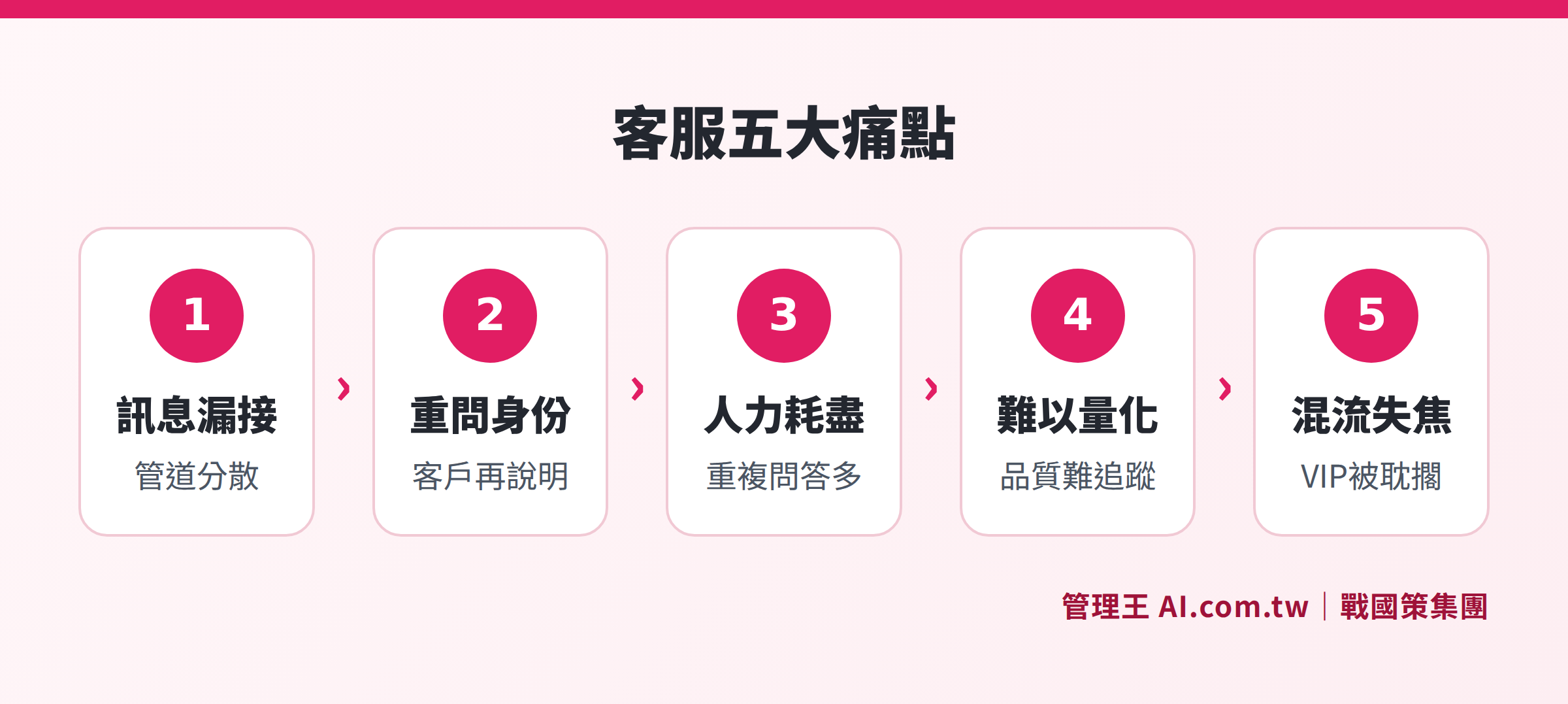
Diagram explaining the relationship between message overlook, repeated inquiries, manpower exhaustion, inability to quantify, and VIP mixing issues.
What Are the Core Functions of a Customer Service System? Breakdown of Six Major Modules
A complete customer service system for small and medium enterprises should include at least the following six modules:
Unified Inbox Across Multiple Channels
All messages from LINE official accounts, Facebook Messenger, Instagram DMs, Emails, and website chatboxes are processed into one backend interface. Customer service representatives only need to open one window to see the message queue from all channels, arranged by time or priority, ensuring no messages are missed or duplicated.
AI Chatbot First Response
Integrating the company’s knowledge base, the AI chatbot can automatically respond to high-frequency questions within seconds, such as business hours, return and exchange policies, shipping cost calculations, and common operational tutorials. The higher the proportion of problems that can be handled automatically, the more time customer service representatives have to address complex cases that require human communication.
Human Handoff and Ticket Assignment
When the AI cannot manage a situation, conversations can seamlessly transition to human customer service, bringing along the complete dialogue history so the customer doesn't have to repeat themselves. After taking over, tickets can be assigned to corresponding departments based on case type (returns, technical queries, pricing inquiries, etc.) and SLA response time limits can be set, with overdue alerts automatically sent to the responsible person.
SLA Tracking and Automatic Reminders
SLA (Service Level Agreement) in customer service contexts refers to commitments for response times, such as “general inquiries replied within 4 hours, VIP customers within 15 minutes.” The system automatically tracks time, alerting customer service representatives when approaching deadlines, ensuring commitments are not just verbal.
Knowledge Base Management
Organizing the company's common questions, product descriptions, operational guides, etc., into knowledge base articles that serve as answers for the AI chatbot and are also quickly referenced by customer service during replies. A good knowledge management interface should support semantic searching (finding related articles by typing keywords) and allow customer service personnel to add new knowledge base entries with one click after completing a response, continuously optimizing AI accuracy.
Satisfaction Surveys (CSAT/NPS)
Automatically send satisfaction questionnaires after each conversation closure to collect CSAT (Customer Satisfaction Score) and NPS (Net Promoter Score), providing objective metrics to track service quality and generating trend graphs for managers to review regularly.
How to Interpret Key Customer Service Metrics? Complete Explanation of CSAT, NPS, FCR, SLA
Four common core metrics in customer service systems, each measured from different aspects:
Table: Explanation of Four Key Customer Service Metrics
| Metric | Full Name | Calculation Method | Measurement Aspect |
|---|---|---|---|
| CSAT | Customer Satisfaction Score | Percentage of responses rated 4-5 | Instant satisfaction of a single interaction |
| NPS | Net Promoter Score | Percentage of Promoters (9-10) minus percentage of Detractors (0-6) | Long-term brand loyalty and willingness to recommend |
| FCR | First Contact Resolution | Percentage of tickets resolved on first contact | Customer service efficiency and problem-solving ability |
| FRT | First Response Time | Time from ticket creation to first reply | Whether response speed meets SLA |
According to IBM’s definition of NPS, the score ranges from -100 to +100, derived from asking the respondent, “How likely are you to recommend our product or service to friends or colleagues?” (0-10 score). Scores of 9-10 are Promoters, 7-8 are Passives, and 0-6 are Detractors, with NPS = percentage of Promoters - percentage of Detractors.
CSAT focuses on single service interactions, calculating the percentage of customers responding “satisfied” or “very satisfied” out of all respondents, reflecting real-time feelings, suitable for tracking immediate effects after each process change.
One-Sentence Summary
NPS measures long-term loyalty, CSAT reflects single interaction feelings, tracking both gives a comprehensive view.
Seven Evaluation Dimensions for Purchasing a Customer Service System
Before purchasing a customer service system, it is recommended to evaluate it based on the following seven dimensions:
1. Channel Coverage
Confirm whether the channels supported by the system cover the tools primarily used by your customers. In Taiwan, market solutions must support LINE official account integration, which is a weakness of many foreign tools.
2. AI Chinese Comprehension Ability
The accuracy of AI first responses depends on its natural language processing (NLP) capabilities in Chinese. Test the response quality with your top 20 frequently asked questions, observing whether it can understand Taiwanese vocabulary, abbreviations, and context.
3. Flexibility of Ticket Assignment Logic
Basic distribution relies on load balancing, while advanced requirements might include prioritizing based on customer tier (VIPs first), semantic interpretation (returns go to Group A, technical issues to Group B), or time periods (night shifts or holidays). Verify whether the system supports flexible distribution rules.
4. Depth of CRM Integration
Can customer service representatives see a customer’s past orders and interaction history directly while replying? If the CRM and customer service systems are separate silos, representatives must switch between two windows, which can lead to errors and wasted time.
5. Knowledge Base and AI Learning Mechanisms
The establishment threshold for the knowledge base, update methods, and the AI learning speed determine the long-term performance of the chatbot. The smoother the feedback loop of “after a customer service modification → AI correctly responds next time” is, the lower the maintenance costs will be.
6. Data Security and Compliance
The location where customer data is stored (Taiwan vs. overseas), encryption standards for transmission, access permission designs, and compliance with personal data laws are critical, especially for industries like insurance, healthcare, and finance that have sensitive data needs.
7. Pricing Models and Hidden Costs
Pay attention to pricing like “per agent”: costs grow linearly with increasing staff. Also, note AI usage limits, message volume caps, and additional module costs. Pull total cost of ownership (TCO) into a one-year evaluation for a true comparison.
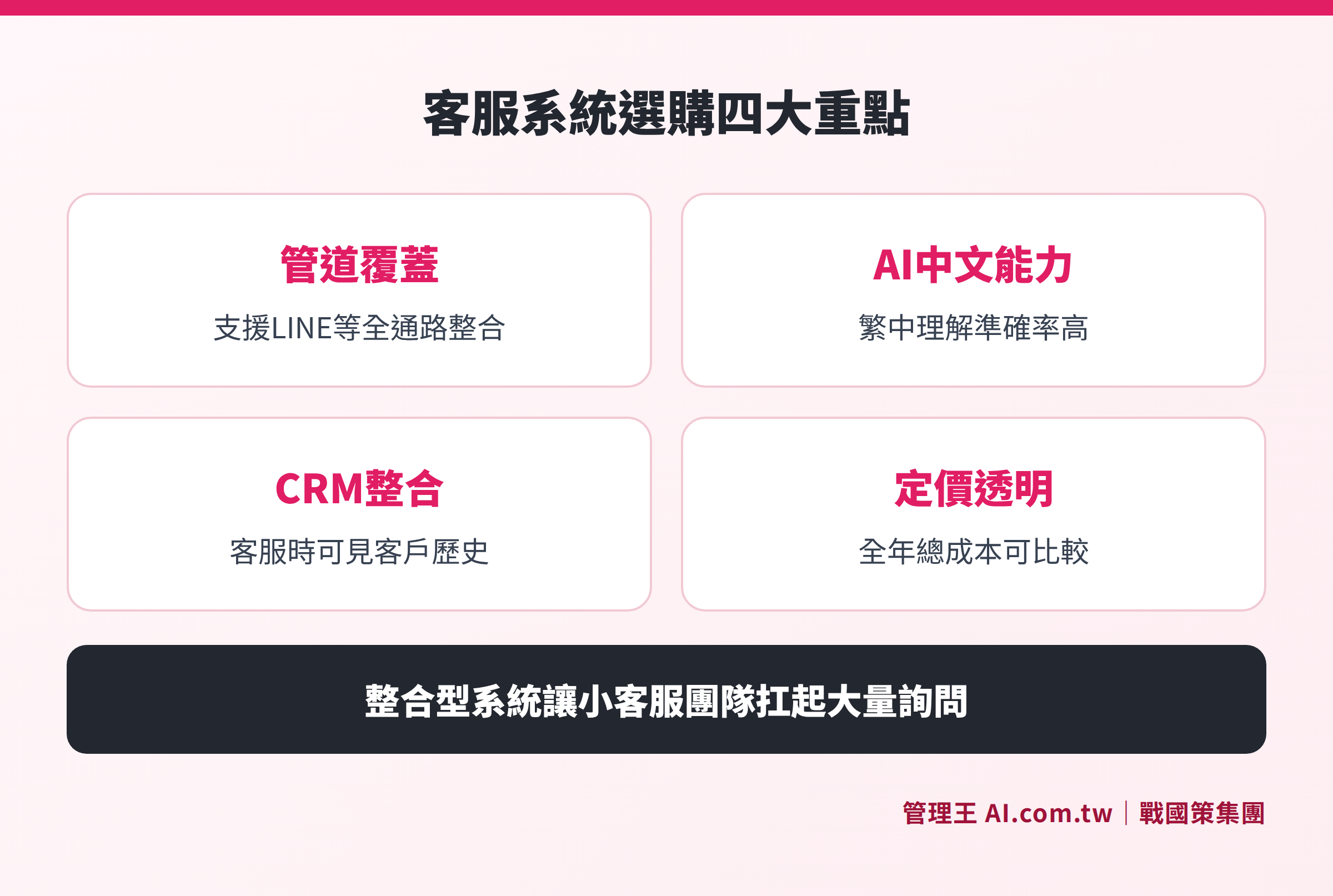
Seven evaluation items listed in card form including channel coverage, AI Chinese ability, ticket flexibility, CRM integration, knowledge base learning, data security, and pricing model.
Omnichannel Customer Service vs. Single-Point Tools: How to Determine What You Need?
Many small and medium enterprises initially use single-point tools (such as only using LINE official account chat management features or only using email customer service software), but as the number of channels increases, the marginal costs of this approach rise:
- Each new channel adds another backend to manage
- Customer service records from different channels cannot be integrated, making it difficult to see complete interaction history
- It is challenging to uniformly track SLA and satisfaction since data is recorded separately on different platforms
The advantage of an omnichannel system is that it integrates once, manages uniformly, and shares data seamlessly, but initial implementation requires time to connect channels and build the knowledge base. If a business currently has only one customer service channel and a low monthly inquiry volume, a single-point tool may suffice; once channels exceed two or inquiry volumes begin to increase, consideration of an integrated system should be made.
For industries with high inquiry volumes like B2C e-commerce, subscription services, and educational platforms, the automation benefits of AI first responses are especially significant: the higher the percentage of common questions, the more manpower AI saves.
How to Achieve This with Management King's AI Customer Service Center
Management King's AI.com.tw AI Customer Service Center is an omnichannel smart customer service solution designed for Taiwanese SMEs, integrating LINE official accounts, Facebook Messenger, Instagram DM, Email, and website chat, ensuring all messages enter a unified backend so customer service does not need to switch between multiple apps.
The actual operational process is as follows:
- Establish Knowledge Base: Organize the company’s common questions, product FAQs, return and exchange rules, and service terms into knowledge base articles that the AI chatbot will use as response references.
- Set AI First Response Rules: Enable AI auto replies for specific keywords or question types, and set confidence thresholds; when AI confidence falls below the threshold, it automatically transfers to human customer service.
- Configure Ticket Assignment Logic: Set assignment rules based on semantics, customer tier (VIP first), or customer service skills, along with SLA timing and overdue notifications.
- Integrate CRM: Customer service representatives can directly see a customer’s past orders, interaction history, and RFM classification while responding, without having to switch screens.
- Activate Satisfaction Surveys: Track CSAT, NPS, and first contact resolution through the Customer Satisfaction Dashboard, with instant alerts for negative feedback to supervisors.
A free plan can be used indefinitely and includes AI one-time credits, allowing companies to first experience AI first responses and ticket tracking effects before upgrading according to needs. If more AI usage or integration features are required, you can choose the economical plan starting from NT$5,000 per month (refer to pricing plans).
Related features that can be bundled together include:
- Customer Service Ticketing System: Automatically convert incoming queries into tickets, AI classify urgency, SLA tracking
- AI Phone Customer Service System: Automatically answer calls, convert speech to text, call summaries into CRM
- Survey Tool: Create customized satisfaction surveys and send them automatically
- AI Knowledge Base: Semantic search and automatic recommendation for related articles
- AI Smart Reply: Customer service representatives input keywords, and AI generates suggested reply drafts
The 戰國策 Group has served over 30,000 enterprises, and Management King's customer service module considers native integration with over 70 modules, including CRM systems, HR, accounting, etc., from day one, eliminating extra API connection costs and time.
Implementation Steps for Customer Service Systems: Five Steps from Evaluation to Launch
The implementation of a customer service system usually consists of five stages:
Step 1: Inventory the Current Situation
List all current customer service channels, average monthly inquiry volume, the top 20 most frequently asked questions, average response time, and the number of customer service staff along with their schedules.
Step 2: Define Requirements Prioritization
Prioritize requirements based on the severity of pain points: Is the issue with fragmented channels, excessive repetitive questions, or supervisors lacking data? Prioritize solving the most significant pain points to avoid incorporating too many functions at once, which could delay go-live time.
Step 3: Build the Knowledge Base
This is the key preparation determining the quality of AI first responses. Organize at least 30 to 50 FAQ articles, each containing clear problem descriptions and answers, as well as synonyms (e.g., “returns” and “exchanges”).
Step 4: Trial Run and Adjustment
In the initial go-live phase, it is recommended to run with a lower AI confidence threshold (transfer all uncertain issues to humans), gradually increasing as real conversation data accumulates, allowing the AI accuracy to improve in practice.
Step 5: Continuous Optimization
Review CSAT, NPS, FCR, and SLA achievement rates monthly, identifying areas with low metrics for targeted improvements; regularly update the knowledge base to keep the AI informed of the latest product information, promotion rules, and policy changes.
Free Consultation for SME Customer Service Systems
Consultants assist in evaluating the most suitable customer service system solutions for your business scale, including omnichannel integration, AI first response settings, and ticket assignment rule establishment.
Free consultation hotline: 0800-003-191
LINE Official Account: @119m
Official Website: app.AI.com.tw
Free Trial: Apply for Management King Now
Frequently Asked Questions
What is the difference between a Customer Service System and a CRM?
A CRM (Customer Relationship Management) system focuses on recording customer basic data, interaction history, and sales opportunities, and is a sales-oriented tool; a customer service system focuses on managing individual service interaction ticket processes and response efficiency, making it a customer service-oriented tool. The ideal scenario is integration between the two: customer service representatives can see customer background information in the CRM while replying, and summaries after issue resolution can be automatically written back to the CRM, forming a complete customer service history record.
Does a one-person customer service team need a customer service system?
Yes, provided that your customer service channels exceed one, or monthly inquiry volume becomes overwhelming. Even with just one customer service representative, a unified inbox can prevent messages from being overlooked, a knowledge base can accelerate responses, and an AI first response can help filter out repetitive inquiries, allowing a single person’s efficiency to approach that of two or three people.
What if the AI customer service robot answers incorrectly?
A good AI customer service system designs a confidence threshold mechanism: when AI cannot determine an answer, it does not force a reply but instead hands off to a human. All AI auto responses are marked on the customer service side, allowing humans to intervene and correct within seconds. After correcting, the accurate answer can be added to the knowledge base with one click, ensuring AI knows how to respond next time.
How long does it take to implement a customer service system?
For small and medium enterprises with standard functional requirements, the timeline for going live can be very short, usually starting trial runs once channel connections and an initial knowledge base are set up. Complex custom integrations (such as connecting proprietary ERP systems or special assignment logic) may require more time, depending on the development workload.
What risks are associated with storing customer data overseas?
For Taiwanese businesses, customer personal data is governed by the Personal Data Protection Act, and if stored overseas, compliance must be assessed. Choosing a system that stores data locally in Taiwan can reduce concerns about cross-border data transfer compliance and make audit processes smoother when cooperating with government agencies.
Data Sources
- IBM Think: What is Net Promoter Score (NPS)
- Executive Yuan Consumer Protection Committee: Explanation of the Scope of Service Responsibilities under the Consumer Protection Act
- Management King AI.com.tw - AI Customer Service Center Features Page
- Management King AI.com.tw - Customer Service Ticketing System Features Page
- Management King AI.com.tw - Customer Satisfaction Dashboard Features Page
- Management King AI.com.tw - Pricing Plans