How to Write a Department Annual Plan? A Complete Guide from Goal Setting to Quarterly Tracking|Recommended Annual Planning Tools

This article provides a comprehensive explanation of the five key elements of a department annual plan, methods for goal setting (SMART, KPI, OKR), principles for designing quarterly milestones, human resource budget allocation, monthly tracking mechanisms, common reasons for execution failures, and solutions suitable for small to medium-sized business owners and department managers to reference when establishing an annual planning system.
A department annual plan is a core tool for companies to translate their corporate vision into the daily actions of various units, helping managers break down abstract goals into executable quarterly milestones, monthly actions, and budget allocations. A good annual plan is not merely an Excel sheet, but a shared commitment between department managers and teams: clearly stating "what we need to achieve," "how responsibilities are divided," "what resources are needed," and "what will be checked each quarter." For small and medium-sized enterprises in Taiwan, the annual plan often represents the first opportunity for the boss to let department managers truly understand the company’s direction; if done well, execution capacity throughout the year can be greatly enhanced; if done poorly, there may only be empty promises left twelve months later. This article explains everything from basic concepts to practical steps, helping you write a trackable and executable department annual plan.
Understand in One Sentence
Department Annual Plan = Company KPI × Department Responsibilities × Quarterly Milestones × Budget; missing any component means failing to reach the end of the year.
What is a Department Annual Plan? Definition and Importance
A Department Annual Plan is a strategic execution document drafted on an annual basis and led by department managers. It is aligned upwards with the company's overall annual goals and unfolds downwards into specific tasks assignable to each employee.
A complete department annual plan typically includes the following five key elements:
- Annual Goal: A commitment to the department's contribution to the company's KPI (quantitative or qualitative)
- Quarterly Milestones: What interim results need to be achieved each quarter to confirm whether the plan is on track
- Monthly Action Plan: Specific execution items corresponding to the milestones and their responsible persons
- Human Resource Allocation: Task responsibility matrix (RACI) or labor hour allocation
- Budget Planning: Estimated costs and phased arrangements required to achieve the goals
The core reason why businesses need a department annual plan is that the more layers of organization there are, the more likely information will be distorted. What the boss says in the board meeting—"This year we want to expand our market share"—might become "let’s target more customers" when reaching the sales department, while the administrative department might not understand how this relates to them. The annual plan clarifies for each department: "What role do we play in the company’s larger goals, what results do we need to deliver this year, and when should we check in?"
Before Writing the Annual Plan: Clarifying the Company's Overall Direction
Before each department drafts its annual plan, the boss or CEO must first establish and announce the answers to three questions across the company:
- What is this year’s core strategy? (e.g., deepening existing customer services, exploring new markets, reducing cost structures)
- What are the 3 to 5 KPIs at the company level? (e.g., new customer count, customer retention rate, gross margin)
- What known constraints exist? (budget limits, personnel structure, seasonal factors)
If this step is skipped and each department fills in their goals independently, the most common result is "everyone does their own thing"—the sales department focuses on acquiring new customers, the administrative department cuts expenses, and the marketing department pushes for exposure, leading to conflicting directions that cancel each other out by year-end.
For example, a certain retail chain in Taiwan holds a strategic consensus meeting every November where the boss explains the focus for the next year. After the department managers take this back, they start drafting their annual plan. In mid-December, they conduct inter-departmental reviews to ensure that their goals do not conflict before finalizing the plans. This method of "top-down announcement and bottom-up commitment" significantly improves overall execution efficiency for the year.
Goal Setting Methodologies: How to Choose Between SMART, KPI, and OKR?
The quality of the goals in the annual plan directly impacts the strength of execution throughout the year. The following three methodologies are the most common in Taiwanese companies, each suitable for different scenarios:
SMART Principle: The Foundation of All Goal Setting
SMART is the basic framework for goal setting. Whether using KPI or OKR, the goals should be validated through the SMART criteria:
Table: Five Elements of the SMART Principle
| Letter | Element | Description | Example (Sales Department) |
|---|---|---|---|
| S | Specific | Clearly describe "what to do" | Develop medium-sized manufacturing customers in Taichung |
| M | Measurable | Include numerical or verifiable standards | Add 20 paying customers |
| A | Achievable | Challenging yet practically attainable | 15 from the same period last year; a growth of 33% |
| R | Relevant | Consistent with company strategic direction | Aligns with the company’s goal of "deepening the central market" |
| T | Time-bound | Set a clear deadline | By December 31, 2026 |
Goals that do not pass the SMART validation, such as "we want to improve customer satisfaction this year," leave employees unsure of what to do, how much to do, or when it’s considered complete—essentially rendering the goal meaningless.
KPI and OKR: Maintaining Operations vs. Driving Breakthroughs
KPI (Key Performance Indicators) and OKR (Objectives and Key Results) represent two different logical frameworks for goal setting and are not mutually exclusive; mature companies typically use them in combination:
Table: Comparing KPI and OKR Characteristics
| Comparison Item | KPI | OKR |
|---|---|---|
| Applicable Scenario | Maintain standards, ensure bottom line | Drive innovation, challenge breakthroughs |
| Achievement Standard | Must achieve 100% | 70% is considered success |
| Linked to Compensation | Usually directly linked to bonuses | Usually not directly linked |
| Review Cycle | Monthly or yearly | Primarily quarterly |
| Applicable Departments | Customer service, finance, production | R&D, marketing, new ventures |
| Acceptance Rate in Taiwanese Enterprises | Relatively high (implemented for years) | Gradually becoming widespread (mainly in large enterprises) |
For most small and medium-sized enterprises in Taiwan, if they are establishing a formal annual plan for the first time, it is advisable to first adopt the KPI framework to ensure basic business metrics have numerical commitments; they can then gradually incorporate an OKR mindset for creative tasks, providing teams with more autonomy.
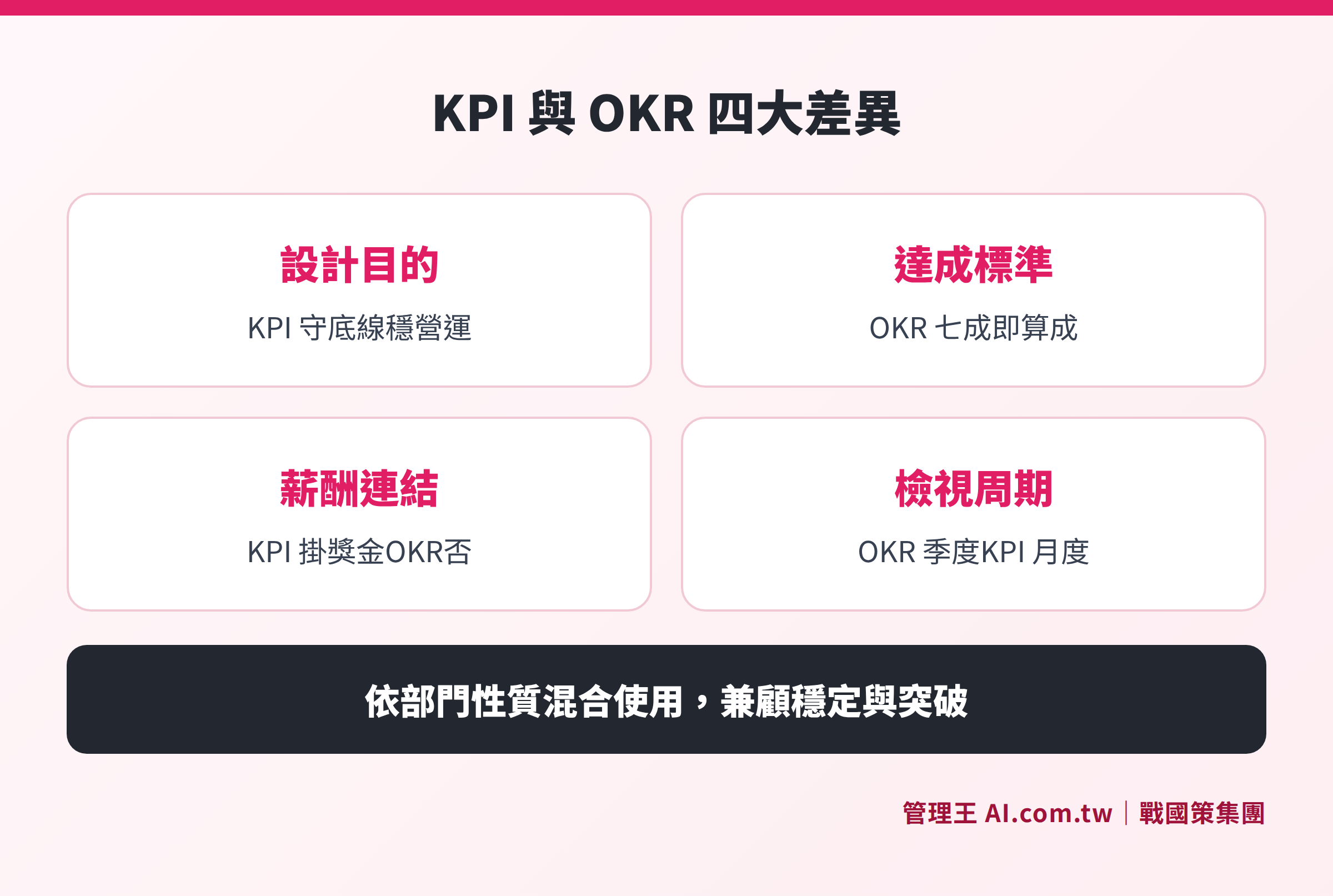
KPI is suitable for maintaining standards, while OKR drives innovation; the combination allows the annual plan to balance stability and breakthroughs.
Quarterly Milestones: The Key to Making Annual Goals "Trackable"
The most common failure reason for annual goals is realizing too late that one is off track. With only 12 months in a year, if goals are only checked at the end of December, it’s too late for corrections. Quarterly milestones break an annual goal into four verifiable interim results, allowing managers to assess in Q1, Q2, and Q3 whether adjustments are needed.
Principles for Designing Quarterly Milestones:
- Milestones do not equal "25% completion"; rather they represent "the state to be achieved by this phase"
- Good milestones are "yes/no verifiable": "Completed customer database construction (containing 500 records) in Q1" is clearer than "completed preparatory work in Q1"
- Each quarter's end should reserve one week for a "quarterly review": examining achievement rates, analyzing gaps, and adjusting plans for the next quarter
Taking business development as an example, the annual goal of "adding 20 paying customers" could be broken down as follows:
- Q1 Milestone: Complete construction of 200 potential customer records, complete initial visits to 30 companies
- Q2 Milestone: Enter proposal stage with 15 companies, close deals with 8 companies (cumulatively)
- Q3 Milestone: Cumulatively close deals with 15 companies, achieve 5 repeat customers
- Q4 Milestone: Achieve the annual goal of 20 companies, compile 3 benchmark cases
This breakdown allows sales managers to determine by the end of Q2: "We currently have a cumulative total of 6, which is 2 behind expectations. What actions need to be intensified in Q3?" rather than discovering a significant gap at year-end that cannot be salvaged.
Human Resource Allocation and Budget Planning
Human Resource Allocation: Clarifying "Who Does What" with a Responsibility Matrix
In an annual plan, no matter how well the goals are set, without clearly assigning execution responsibilities, the situation often devolves into "everyone is waiting for someone else to do it." A commonly used tool is the RACI matrix:
- R (Responsible): The actual doer
- A (Accountable): The manager ultimately responsible for the outcome
- C (Consulted): Related personnel who need to be consulted
- I (Informed): Stakeholders who need to be informed of progress
For small and medium-sized enterprises, a complete RACI chart may not be necessary, but it's essential to ensure that each annual action plan has a clear "name of the responsible person," instead of vague terms like "XX department responsible."
Budget Planning: Categorize, List, and Retain Flexibility
Department annual budgets are typically divided into a few categories:
- Fixed Costs: Staff salaries, rent, licensing fees
- Variable Costs: Advertising costs, travel expenses, materials
- Investment Expenditures: System implementation, equipment procurement, training
It is advisable to reserve 10% to 15% of the budget for flexibility in planning, to respond to opportunities or risks that arise mid-year, preventing missed business opportunities due to rigid budgeting.
Monthly Tracking and Rolling Adjustment Mechanism
The annual plan is not just a document that gets written and put away. The key to effective execution is establishing a consistent tracking rhythm:
Weekly: 15 to 30 minutes of team stand-up meetings to confirm completion rates of this week’s action items
Monthly: 1-hour monthly performance meetings to compare monthly KPI achievement rates and decide adjustments for the next month's actions
Quarterly: Half a day for quarterly reviews, examining the status of completing quarterly milestones, and adjusting plans for the next quarter
The correct mindset for rolling adjustments is: "The plan itself does not fail; the market and environment are changing." If in Q2 a strategy is found to be ineffective, it should be openly discussed and adjusted during the quarterly review rather than blindly executed further.
A common tracking mistake among small and medium-sized enterprises is "only tracking numerical results, not tracking action completion rates." For example, looking only at sales figures without tracking "did we make 20 development calls this week?" The action completion rate is a leading indicator of the lagging indicator (sales results), and tracking actions allows for early intervention before problems with results emerge.

Combining the annual plan with monthly check-ins and quarterly reviews forms a complete management cycle of goal setting → execution → tracking → adjustments.
Key Points of the Annual Plan for Different Departments
Although the annual plans of each department follow the same format, the indicators they focus on differ:
Table: Recommended Core Indicators for Each Department’s Annual Plan
| Department | Recommended Annual KPI | Key Points of Quarterly Milestones |
|---|---|---|
| Sales | Number of new customers, total sales, customer unit price, conversion rate | Building lists → Initial visits → Proposals → Close deals |
| Marketing | Website traffic, number of potential leads, advertising ROI | Brand exposure → Lead acquisition → Conversion optimization |
| HR | Recruitment success rate, employee retention rate, training completion rate | Personnel completion → Education and training → Satisfaction surveys |
| Customer Service | Customer complaint resolution time, customer satisfaction, repeat contact rate | Establish SOPs → Education and training → Quality audits |
| Finance/Accounting | Days sales outstanding, budget achievement rate, expenses ratio | Optimization of reconciliation processes → Automation of monthly reports → Annual audits |
| Manufacturing/Production | On-time delivery rate, defect rate, production capacity utilization | Process optimization → Equipment maintenance plans → Quality certifications |
These indicators are just starting points; actual settings should adjust according to company strategy priorities, ensuring that each KPI has corresponding action plans behind it.
Common Mistakes: Why Do Annual Plans Fail to Execute?
Many companies create annual plans every year but often forget about them six months later. Here are the most common four reasons for execution failure:
- Too Many Goals: Each department lists 20 annual goals, which equates to having no goals at all. It is advisable for each department to focus on 3 to 5 core KPIs, concentrating limited resources on the most important directions.
- No Tracking Mechanism: Without regular reviews after the plan is completed, the lack of external pressure leads to employees losing focus, turning the plan into merely a document filled out at the beginning of the year.
- Lack of Manager Engagement: Plans are filled out by staff and signed by managers, leading to a lack of identification and responsibility from executors, resulting in insufficient execution power.
- Goals Not Communicated Downwards: Department goals only circulate among management levels, leaving front-line employees unaware of how their work connects to the annual plan, causing them to focus only on immediate tasks.
The core solution is to "make the plan part of daily management"—weekly meetings, monthly reports, and quarterly reviews should revolve around the annual plan, allowing everyone to see progress numbers monthly, naturally creating tracking pressure. The annual plan itself is not complex; the challenge lies in building a habit of continuous tracking management, which is also where tool systems can provide the most value.
Using 管理王 to Achieve This
The department annual planning feature of 管理王 AI.com.tw allows managers to design the annual plan format without starting from scratch. By simply inputting the year, department name, company KPI, and headcount, AI will reference actual department data and automatically generate goal breakdowns, quarterly milestones, monthly action plans, human resource allocation suggestions, budget frameworks, and risk indicators. Each column can be directly modified, and once completed, you can export it to Excel for record keeping.
What is most beneficial for managers of small and medium enterprises is native integration with other modules: once the department annual plan is set, quarterly milestones can directly turn into specific tasks in task management, and monthly KPI numbers automatically come from report analytics, allowing managers to see progress without manually collecting data from various systems. Coupled with CEO War Room, the boss can view the real-time achievement rates of all department annual plans on one page, without waiting until the end of the month for a report to know the situation.
The performance management module can also link department annual KPIs directly to personal performance evaluations, letting employees clearly understand how their results connect to departmental goals, addressing the issue of "employees not knowing what role they play in the company’s overarching goals."
The project management feature visualizes annual plan action items across departments, allowing managers to track the timelines of each milestone using Gantt charts, avoiding discovering bottlenecks just as key tasks are nearing deadlines.
The free plan allows permanent use of basic functions, suitable as a starting point for SMEs establishing their annual planning system for the first time. For detailed plan comparisons, please refer to the service plan page.
Let AI Help You Automatically Generate Your Annual Plan
管理王 consultants offer free assistance to small and medium business owners in setting department annual goals, quarterly milestones, and tracking mechanisms, with a quick start in 30 minutes.
Free consultation hotline: 0800-003-191
LINE Official Account: @119m
Official website: app.AI.com.tw
Free trial: Apply for 管理王 now
Frequently Asked Questions
How detailed should a department annual plan be?
The level of detail in the plan should match the size and execution habits of the team. For departments of fewer than 10 people, a 1 to 2 page document including annual goals, quarterly milestones, and responsible personnel suffices; for departments of 20 or more, it is advisable to include monthly action plans, budget breakdowns, and a RACI chart. The most important standard is: the manager should be able to glance at it and know the current progress, while employees should finish it knowing what they need to do in the next month. Overly complex plans tend to be neglected, losing their tracking function.
How often should an annual plan be updated after it’s completed?
The "goals" of the annual plan typically remain unchanged throughout the year (unless there is a major shift in company strategy), but "action plans" should be adjusted quarterly based on execution results. It is recommended to formally revise the plan at the end of each quarter, adjusting specific action items for the next quarter; if significant market changes occur, emergency review meetings can be called at any time rather than waiting for the quarter's end.
If KPIs are set too high, employees may give up; if set too low, there’s no challenge. How do you balance this?
A common reference standard is the "stretch goal" principle: set a number that has a 70% to 80% probability of being achieved with 100% effort from employees. Goals that are too easy to achieve lack drive, while goals that are too difficult lead to early abandonment. It’s advisable for managers and employees to discuss goal numbers together, involving employees in the goal-setting process, which can better inspire intrinsic motivation and sense of responsibility compared to top-down declarations.
In small and medium enterprises without HR or strategy departments, who leads the annual plan?
The most common practice in small and medium enterprises is for the boss (or CEO) to personally lead the setting of company-level goals. Each department manager drafts their department plan, which the boss then reviews for alignment. For companies with fewer than 30 people, an all-hands meeting can be used to confirm annual goals together; transparency is more important than formal processes.
Is an annual plan the same as OKR or KPI?
An annual plan is an integrative document, whereas OKR and KPI are different methodologies for setting the "goals" portion of the annual plan. KPI is suitable for maintaining existing business standards (such as achievement rates or complaint rates), while OKR is suitable for driving innovative breakthroughs (such as new product development or new market expansion). Most companies’ annual plans will mix the two, choosing suitable tools based on the nature of departments and types of tasks.
Sources
- How to Set Annual Goals for a Company|EMBA Magazine (Consultation date: October 2026)
- What is OKR? How Does It Differ from KPI?|Manager Monthly (Consultation date: October 2026)
- How to Properly Implement Goal Management? Understand it All From the SMART Principle, KPI, and OKR|Epicloud (Consultation date: October 2026)