Digital Coupons vs Paper Coupons: Cost and Tracking Effectiveness Comparison | Coupon System Recommendations

The cost structure, redemption rates, and tracking capabilities of digital coupons and paper coupons differ significantly. This article provides a complete comparison using data to help small and medium-sized enterprises in Taiwan determine when to transition from paper to digital coupon systems.
What are the differences between digital coupons and paper coupons? In simple terms, digital coupons are discount vouchers sent through digital channels and redeemed using a QR Code or discount code, while paper coupons are the traditional form distributed physically after being printed, used by manual cutting or presentation. The key difference between the two lies not in appearance but in cost structure and tracking capability: every redemption cost of digital coupons is lower than that of paper coupons while accurately recording who received, who used them, and how much revenue they generated. According to a survey by 創市際研究市場股份有限公司 in 2024, the proportion of Taiwanese consumers using digital vouchers has reached 74.1%, increasing for three consecutive years; if your store still relies on paper coupons, this article will help you identify the timing for transitioning.
Digital Coupons vs Paper Coupons: Core Differences Overview
The gap between digital and paper coupons goes far beyond simply "whether it is printed". From distribution to redemption, the operational processes, data density, and cost compositions of the two are entirely different.
Table: Comprehensive Comparison of Digital Coupons vs Paper Coupons
| Comparison Item | Digital Coupons | Paper Coupons |
|---|---|---|
| Distribution Channels | LINE push, EDM, SMS, App | Flyers, DM, magazine inserts, receipts |
| Redemption Method | Scan QR Code or enter discount code | Staff visual confirmation, manual cutting |
| Redemption Rate | About 5-7% (digital load-to-card) | About 0.2-0.4% (newspaper insert FSI) |
| Anti-counterfeiting Capability | Unique code, one-time use, system automatic locking | Easy to counterfeit or repeatedly present |
| Tracking Capability | Real-time view of distribution numbers, redemption numbers, revenue generation | Cannot track individual users |
| Environmental Cost | No printed paper | Printing, transportation, storage |
In Summary
Every 100 digital coupons issued result in an average of 5-7 redemptions; while every 100 paper coupons only lead to 0.2-0.4 redemptions. With the same budget, digital coupons yield more effective conversions.
How to Calculate Cost Structure? Printing Costs are Just the Tip of the Iceberg
Many business owners think they have grasped all costs associated with paper coupons by looking at printing quotes, but the actual costs go far beyond this. According to the TVBS ESG report, the combined printing, logistics, and storage costs of paper coupons exceed 30% of total coupon operating costs, which are costs that digital coupons do not incur.
Hidden costs of paper coupons:
- Design setup costs: Pay each time there is a revision
- Printing costs: Higher unit price for smaller quantities
- Logistics costs: Sending to customers or distribution to the store
- In-store backup inventory: Risks of holding paper for its validity period
- Labor for redemption manual work: Staff confirmation, registration, reporting
- Waste from expired coupons: Wasted inventory that goes unused
The main costs of digital coupons are only system monthly fees and design labor hours, with no need for printing, distribution, or storage, and conditions can be adjusted immediately after the campaign is launched, offering far more flexibility than paper.
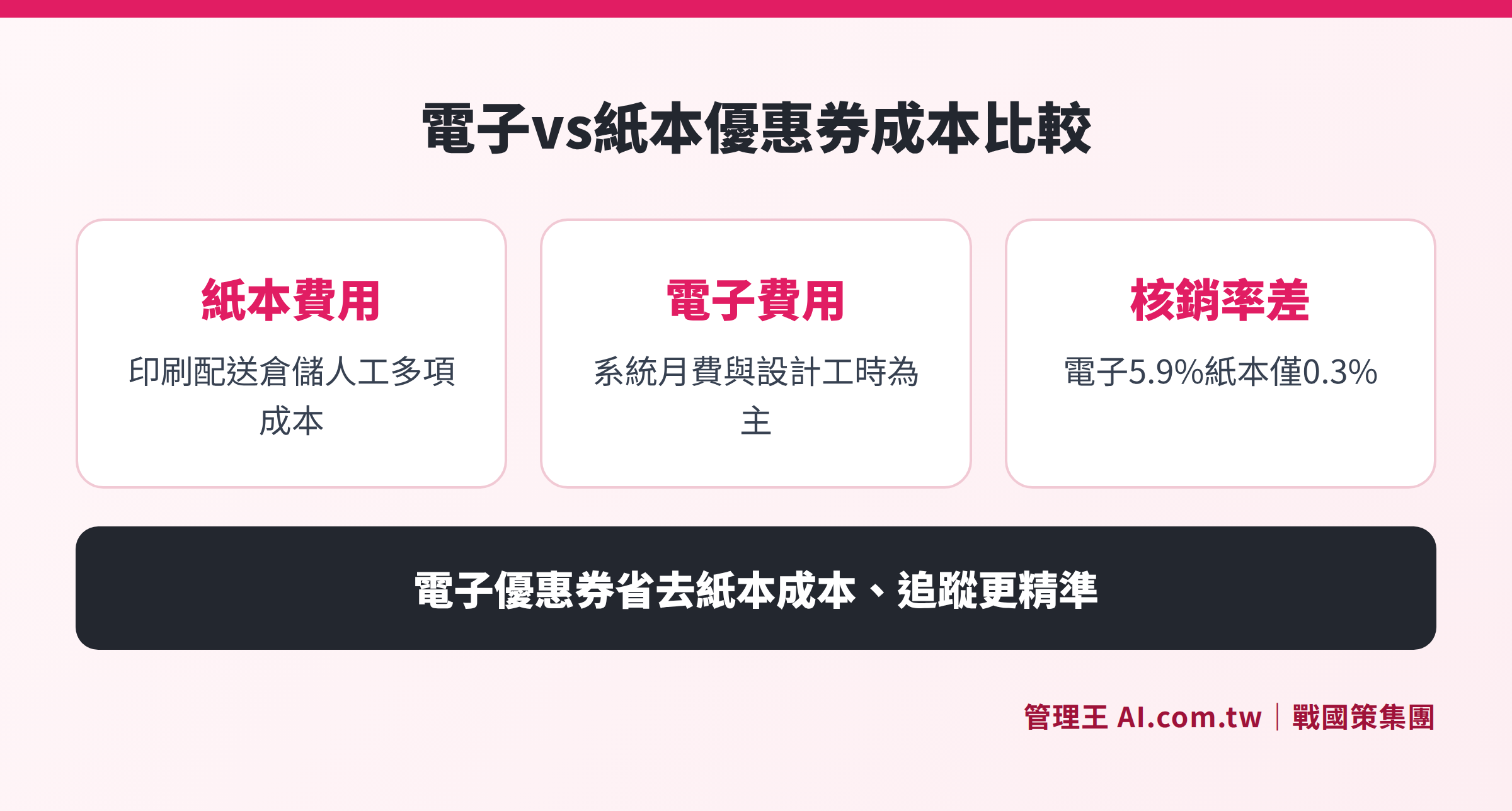
The cost of paper coupons includes five main items: design, printing, logistics, storage, and labor; the main costs of digital coupons are just system fees and design labor hours.
Why is the Redemption Rate So Different? The Reasons Behind the Data
According to reports from Inmar Intelligence and Capital One Shopping, the redemption rate of digital load-to-card coupons reached 5.92% in 2024, the highest among all coupon formats; while traditional newspaper insert paper coupons (FSI) had a redemption rate of only 0.2-0.39%. In other words, with the same issuance of 1,000 coupons:
- Digital coupons: About 59 people actually use them
- Paper FSI coupons: About 2-4 people actually use them
The stark difference in redemption rates can be attributed primarily to three reasons:
- Distribution Precision: Digital coupons can be targeted to customers who have made purchases, specific member levels, or certain areas; meanwhile, paper DM can only be broadly distributed to uninterested individuals. The more precise the distribution, the higher the probability of the targeted customers seeing and using each coupon.
- Usage Threshold: Digital coupons reside on smartphones and can be scanned when needed; paper coupons require being remembered, which consumers tend to forget easily. According to consumer behavior studies, mobile tools can significantly shorten the gap between "intention" and "actual usage".
- Expiration Reminders: Digital coupons can automatically push reminders three days before expiration; once paper coupons are issued, there’s no way to re-contact consumers, seeing the coupons expire without utilization.
Tracking Effectiveness: From "Somewhat Effective" to "Exactly Knowing ROI"
This is the most decisive advantage of digital coupons. Once digitized, you can accurately know the contribution of each coupon to revenue.
Table: Comparison of Tracking Capabilities for Digital Coupons vs Paper Coupons
| Tracking Metrics | Digital Coupons | Paper Coupons |
|---|---|---|
| Redemption Rate (Real Time) | Traceable | Cannot be traced |
| Who Used It | Traceable (Member Data) | Cannot be traced |
| Impact on Average Transaction Value | Quantifiable | Can only be estimated manually |
| New vs Returning Customer Ratio | Traceable | Cannot be traced |
| Expired and Unused Rate | Automatically calculated | Cannot be traced |
| A/B Testing | Different versions executable | Difficult to operate |
| ROI per Redemption | Precisely calculated | Not calculable |
With this data, marketing managers can answer the most important question: For this coupon campaign, how much revenue was generated for every NT$1 spent? Should the next campaign increase the budget or reduce the discount strength?
Issuing paper coupons is almost like "throwing them out and hoping for the best". Digital coupons can be continuously optimized once they are released.
Digital coupons can track the number issued, redemption rate, impacts on average transaction value, new customer ratio, and ROI in real-time, while paper coupons are entirely unquantifiable.
Taiwan Market Trends: Consumers are Shifting Towards Digital Coupons
According to a survey by 創市際研究市場股份有限公司 in 2024, the frequency of Taiwanese consumers using digital vouchers has reached 74.1% (up from 62.6% in 2022 and 72.9% in 2023), showing an upward trend for three consecutive years. The main reasons consumers prefer digital vouchers are "convenience of mobile scanning" and "environmentally friendly paperless".
What does this trend imply? If your customers have already adapted to digital vouchers, issuing paper coupons will only increase friction. Consumers will need to remember to bring the paper coupons, search for them, and present them, which requires several more steps than simply scanning a QR code, leading to a natural decline in redemption willingness.
From a global market perspective, in 2024, digital coupons have surpassed paper coupons for the first time, accounting for 53.4% of all coupon redemptions (data from Inmar Intelligence). This marks a clear turning point: digital coupons are not just a choice for the future but are already dominating the market.
What Situations are Digital Coupons Suitable For? Are Paper Coupons Still Useful?
Digital coupons are not a cure-all; understanding the appropriate contexts for each can lead to the best allocation.
Digital coupons are most suitable for:
- Businesses with a LINE official account or CRM system that can directly reach customers
- E-commerce, subscription services, SaaS — online redemptions naturally favor digitization
- Marketing activities that require diverse discount levels for different audiences
- Marketing teams that want to track ROI and conduct A/B tests
- Multiple stores and chains — for unified management and real-time status checks at each store
Situations where paper coupons still have advantages:
- Target audiences are older individuals with lower usage rates of digital tools
- On-site distribution and immediate redemption without the need for backend tracking
- Integrated marketing with magazine advertisements or catalogs
For most small and medium-sized enterprises in Taiwan, the combination of "digital distribution + QR code redemption" can meet over 80% of coupon needs, leaving only 20% to consider paper backup.
Implementing Digital Coupons with 管理王's Coupon Center
管理王 AI.com.tw's Coupon Center is a one-stop promotion engine designed for small and medium-sized enterprises in Taiwan, covering the entire lifecycle of digital coupons: design, distribution, redemption, and reporting.
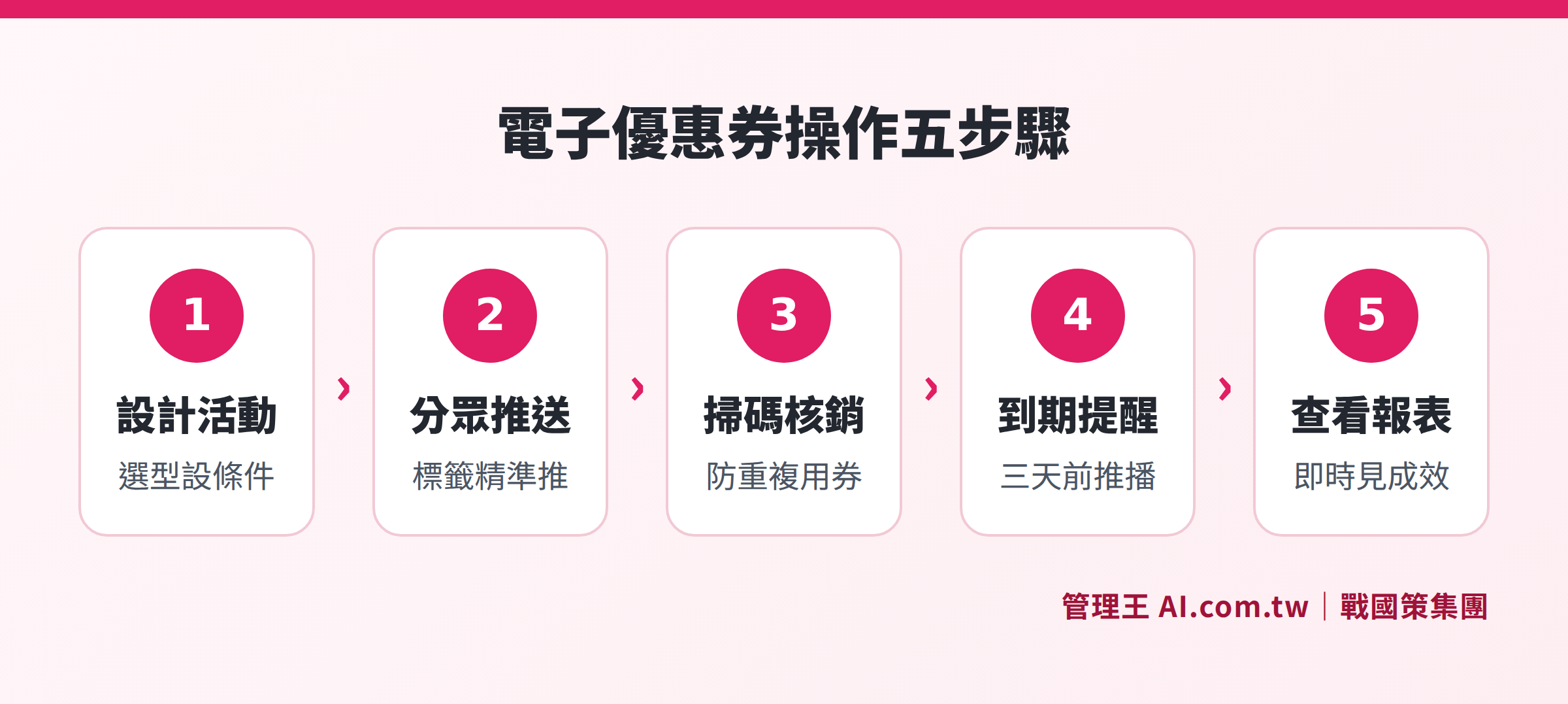
The actual operational process is as follows:
- Establish Promotion Activities: Choose from one of six types: cash discount, percentage discount, conditional discounts, buy one get one, free shipping coupons, or gift vouchers, and set usage conditions (minimum spending, limited products, specific member levels, effective period, maximum limit for distribution).
- Select Distribution Targets: Filter target audiences from the CRM system by member tags, such as "dormant customers for 60 days" or "high-value customers who have spent more than NT$3,000".
- Precise Multi-Channel Distribution: Send via LINE push, EDM, or print QR code for distribution, with each coupon having a unique identification code.
- Scan Redemption: Staff scan the QR code on the customer's phone; the system automatically verifies conditions and prevents reuse.
- View Performance Reports: View the number issued, redemption rates, impact on average transaction value, and expired but unused rates in real-time.
- Set Expiration Reminders: The system automatically sends push reminders three days before the coupon expires, saving coupon engagements that are about to go dormant.
When integrated with the member points system, you can also set up a referral mechanism like "refer a friend to get a coupon, old customers get points back", turning each satisfied customer into a partner who brings in new customers.
管理王 offers a free plan for permanent use, allowing teams of fewer than 10 to try out complete functionalities before confirming suitability for upgrade. For more details, see Service Plans and Pricing.
If you are planning a coupon marketing strategy from scratch, it is recommended to first refer to a complete Coupon Marketing Intro Guide, along with this article's digital vs. paper selection guide.
Recommended related functionalities:
- Marketing Automation: Connect coupon distribution with CRM trigger conditions.
- Social Media Scheduling Management: Schedule posts for social media related to coupon activities.
- Landing Page: Create dedicated sales pages for each promotional activity.
Want every coupon campaign to have data?
管理王 Coupon Center offers a free trial for complete tracking from issuance to redemption to reporting, with consultants assisting enterprises with fast launches and transparent costs.
Free consultation hotline: 0800-003-191
LINE official account: @119m
Official website: app.AI.com.tw
Free trial: Apply for 管理王 now
Frequently Asked Questions
Is the redemption rate of digital coupons really that much higher than paper coupons?
Yes. According to the Inmar Intelligence 2024 report, the redemption rate for digital load-to-card coupons is about 5.92%, while traditional newspaper insert paper FSI coupons only have a redemption rate of 0.2-0.39%, with a difference of about 15-30 times. The core reason for the redemption rate gap is that digital coupons can be accurately pushed to those with purchasing intent, and the usage threshold (scanning) is much lower than that of paper (presenting after bringing it out).
Do small stores with only a few hundred members really need a digital coupon system?
The number of members is not a determining factor; it’s about whether you need to track effectiveness. Even with only 200 members, digitizing allows you to know which 20 used the coupons, how much revenue those 20 brought, and who should receive coupons next time. If you are issuing coupons every month without knowing the effectiveness, you are wasting your budget each time. 管理王 offers a free plan to use the Coupon Center, so it's recommended to give it a try.
How can digital coupons be sent to customers who don't use LINE?
管理王 Coupon Center supports multiple distribution channels: in addition to LINE pushes, there are also EDM emails, SMS, and printed QR codes (attached to receipts, packaging, or in-store posters). Customers can scan the physical QR code and still enter the digital redemption process, enjoying all the tracking benefits while also accommodating those who do not use LINE.
Do existing redemption processes need a major overhaul when transitioning paper coupons to digital?
Usually, there is no need for major changes to operational processes. The main adjustment is for staff to use a smartphone or tablet to scan instead of visually confirming. The interface of 管理王 Coupon Center is designed for Taiwanese usage habits, with a Traditional Chinese interface, and most staff can get up to speed within a day. Redemption rules (validity period, usage frequency, member levels) are automatically judged by the system, resulting in lower chances of error.
What regulations must be adhered to when issuing digital coupons?
The Taiwan Fair Trade Commission requires vouchers to clearly indicate: discount contents, usage conditions, validity periods, redemption methods, and usage limitations (such as the number of times per person and whether they can be combined with other discounts). These regulations apply equally to both paper and digital formats. The advantage of digital coupons is that the complete terms can be displayed on the activity page without the restrictions of printing space, making full disclosure easier to achieve.
Data Sources
- 創市際研究市場股份有限公司: 2024 Digital Voucher Usage Behavior Survey (cited by Edenred Taiwan, published by Key Opinion Network, August 2024)
- DemandSage: Coupon Statistics 2024 (citing Inmar Intelligence data)
- TVBS ESG: Analysis of Paperless Electronic Voucher Costs
- Fair Trade Commission: Principles for Handling Promotional Advertising
- Snipp: The Digital Coupon Market Infographic (2024)