How to Wake Up Dormant Customers? A Complete Guide to Reactivation Strategies|Recommended Tools for Customer Reactivation
Dormant customers represent the lowest cost opportunity for business performance. This article explains the systematic approach to reactivating old customers, from RFM analysis methods, industry-specific dormancy thresholds, five reactivation strategies to effectiveness measurement indicators, and how 管理王 automates segmentation and multi-channel outreach to make the reactivation process a reproducible routine.
Dormant customers are defined as old customers who have made purchases and interacted with the brand but have not repurchased beyond a specific timeframe. The core logic of waking dormant customers is simple: these people already know you and trust you, so the cost of re-engaging them is much lower than acquiring new customers. According to marketing research, the cost of waking up a dormant customer can be up to eight times lower than acquiring a new customer; even just improving retention rates can significantly boost overall profitability. This article starts with the definition of dormant customers and explains RFM analysis methods, five major reactivation strategies, reference dormancy thresholds for different industries, and how to use systematic tools to make reactivation a reproducible automated process, helping small and medium-sized enterprises in Taiwan effectively convert their old customer lists into continuous income sources.
Who Are Dormant Customers? Definition and Three Levels of Identification
The core definition of a dormant customer (Dormant Customer) is: a customer who has previously made purchases or interacted significantly but has not purchased again within the expected consumption cycle. This "expected cycle" varies greatly across industries and cannot be generalized.
There are three levels to identify dormant customers:
- Time Threshold Method: The simplest, setting a rule of "if no purchase has been made for N days, consider it dormant," suitable for industries with stable consumption cycles (e.g., restaurants, beauty services, gyms).
- RFM Segmentation Method: Considers recent purchase time (Recency), purchase frequency (Frequency), and purchase amount (Monetary) to identify "previously high-value, now silent" customer segments, yielding higher accuracy.
- Behavioral Signal Method: Tracks email open rates, website login frequency, and app activity; if these indicators continue to decline, even before reaching the time threshold, it can be considered a warning sign of a customer about to become dormant.
Table: Comparison of Identification Methods
| Identification Method | Suitable Situations | Advantages | Limitations |
|---|---|---|---|
| Time Threshold Method | Small businesses, stable consumption cycles | Simple to set, easy to execute | Unable to differentiate high-value from low-value customers |
| RFM Segmentation Method | Businesses with a certain amount of customer data | Precise segmentation, resource concentration | Requires data integration and analysis tools |
| Behavioral Signal Method | Businesses with digital touchpoints | Strong preemptive warning, allows for early intervention | Requires tracking system support |
Regardless of the method used, the key is to clearly define your own dormancy threshold first, to avoid mistakenly labeling customers who are within their normal consumption cycle as dormant, which could lead to unnecessary hassle.
Why Should We Pay Attention to Dormant Customers? Cost-Benefit Analysis
Small and medium business owners often concentrate their marketing budgets on acquiring new customers, neglecting the lower-cost opportunity represented by dormant old customers in their lists.
The Three Natural Advantages of Old Customers:
- Brand Awareness Already Established: New customers need repeated advertising exposure to build trust, while old customers have real purchase experiences, making re-marketing less of a hurdle.
- Data Completeness and Personalization: Knowing what the other party has bought, the amount spent, and contact details allows for truly personalized re-engagement communication rather than blanket marketing.
- Low Cost for Repurchase Incentives: A small discount coupon or a text message saying "long time no see" is often sufficient for familiar brand customers; the same budget spent on new customers yields far less effect.
In Summary
The cost to wake up a dormant old customer is at most eight times lower than developing new ones — old customers in your list are assets you have paid for but have not fully utilized.
The "Five-to-Twenty-Five Rule" (Bain & Company) indicates that reducing customer churn by 5% can increase company profits by 25% to 95%. This figure emphasizes not only the importance of waking dormant customers but also the need for systematic management to prevent customers from slipping into dormancy in the first place.
RFM Analysis: Use Three Numbers to Identify Worthy Lists to Reactivate
RFM is the most classic customer segmentation tool in marketing, consisting of three dimensions:
- R (Recency): How long ago was the last purchase? The shorter the time, the higher the R score.
- F (Frequency): How many times have purchases occurred within a certain period? The higher the frequency, the higher the F score.
- M (Monetary): How much has been spent in total? The higher the amount, the higher the M score.
Each dimension is usually scored from 1 to 5 (or 1 to 3), with the combination of these three dimensions resulting in different customer groups, each assigned corresponding re-engagement strategies.
Table: Common RFM Customer Groups and Corresponding Strategies
| Customer Group Name | RFM Characteristics | Recommended Strategy |
|---|---|---|
| Champion Customers | High R, High F, High M | Maintain the relationship, prioritize service, invite for referrals |
| Important Retained Customers | High F, High M, Medium R | Regular interactions, enhance loyalty programs |
| At-Risk Customers | Low R, Previously High F, Previously High M | Prioritize reactivation, exclusive returning offers |
| Dormant Customers | Low R, Low F, Low M | Low-cost outreach, survey to understand departure reasons |
| New Customers | High R, Low F, Low M | Guide to second purchases, cultivate purchasing habits |
For small and medium-sized enterprises, resources for reactivation are limited, and priority should be given to "At-Risk Customers" — this group has previously been highly active but is now silent, indicating they have not been completely lost and represent the highest ROI re-engagement targets.
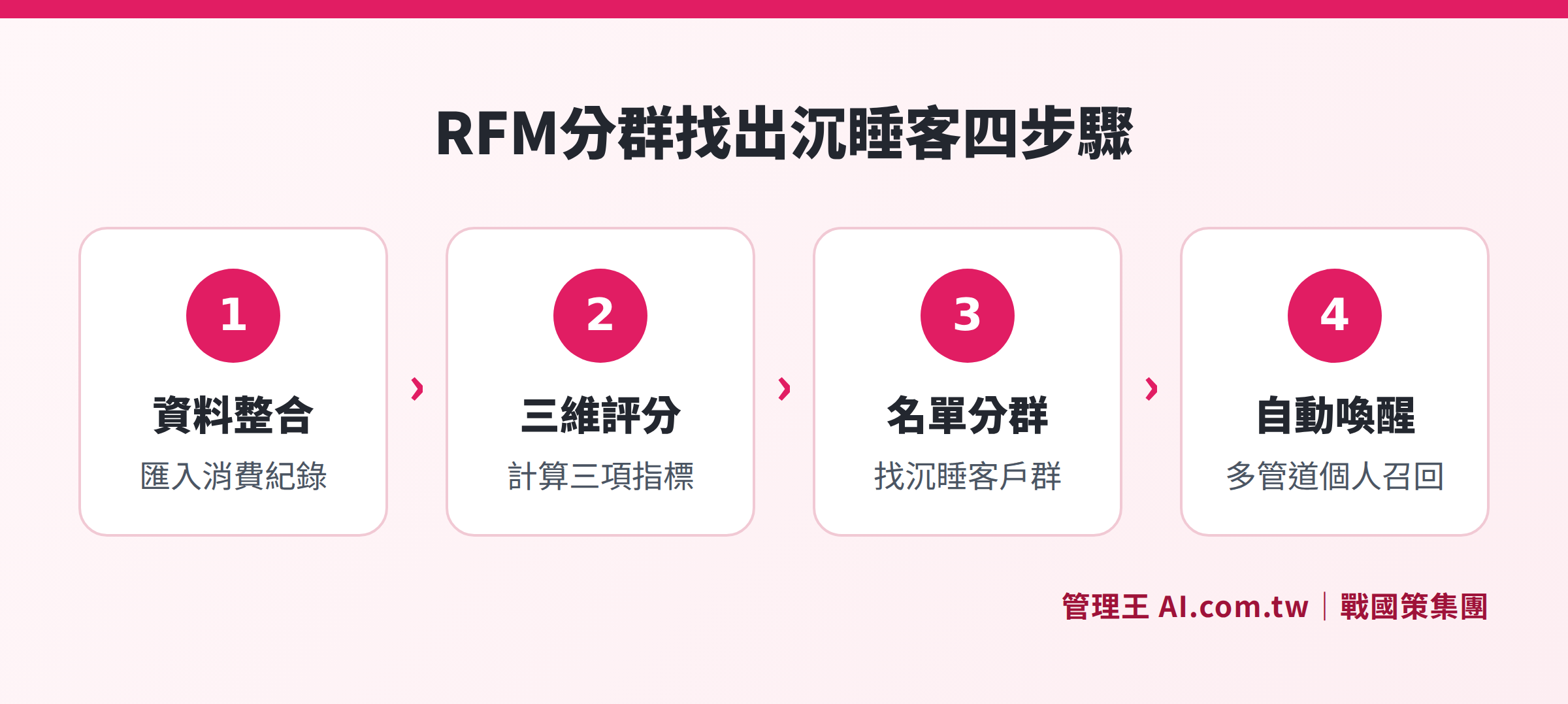
From the customer database, scoring according to R, F, M dimensions, to targeting at-risk lists, and executing personalized reactivation — the complete process
How to Set Dormancy Thresholds by Industry?
"How many days without purchase counts as dormant?" There is no universal answer; it must be determined based on your industry's consumption cycle. Below are reference ranges for common industries for small and medium business owners to adjust:
Table: Dormancy Days Reference by Industry
| Industry | Normal Consumption Cycle | Recommended Dormancy Threshold | Description |
|---|---|---|---|
| Food Service | Weekly to monthly | 30 to 60 days | Frequent visits; intervene after a month of inactivity |
| Beauty Industry | Monthly to quarterly | 60 to 90 days | Adjust based on service type (dyeing vs. cutting) |
| Apparel Retail | Quarterly | 90 to 120 days | Should trigger early before seasonal changes |
| Gyms | Weekly | 14 to 30 days | High-frequency service; intervene after a month of inactivity |
| B2B Services | Quarterly to annually | 90 to 180 days | Determine based on contract cycles and purchase frequency |
| Furniture and Appliances | Every 3 to 5 years | 360 to 720 days | Low-frequency, high-value; should include annual reminders |
After setting the thresholds, it is recommended to add a layer of "Spending Amount Filtering": prioritize reactivating the top 20% of dormant customers based on historic total spending to concentrate resources more effectively.
Five Major Strategies for Reactivating Dormant Customers
After mastering the list, how should you recall them? The following five strategies can be combined according to industry and customer group characteristics.
Strategy 1: Personalized Emotional Messages
Messages like "We haven’t seen you in a while!" are effective because they break away from typical advertising, evoking past customer experiences with the brand. Including the customer’s name, the last purchased items or services in the message allows them to feel "remembered," rather than receiving a cold bulk marketing message.
Strategy 2: Limited-Time Returning Offers
Incorporate loss aversion psychology by designing exclusive discounts or gifts with a deadline. For example, stating "Your exclusive returning discount will expire in 7 days" can effectively increase action rates compared to just a simple discount.
Strategy 3: Reminder of Points or Benefits Expiring Soon
If your system has a points or membership points system, a message like "You have 500 points expiring soon" is a powerful reactivation trigger. Customers would naturally return to purchase to avoid expiration without needing additional discounts.
Strategy 4: Multi-Channel Outreach
Email open rates are around 20%, while SMS open rates can exceed 90% (common data cited by marketing research organizations). Combining both, along with surveys to understand departure reasons, significantly increases recall chances. Different customer groups also prefer different communication channels: older customers lean towards phone calls and SMS, while younger customers prefer LINE or Email.
Strategy 5: Post-Purchase Care Surveys
Proactively asking dormant customers, "What kept you from coming back?" not only has a reactivation effect but also gathers genuine feedback to improve products or services. A short five-question survey, along with a reward for filling it out, can achieve both reactivation and brand repair purposes simultaneously.
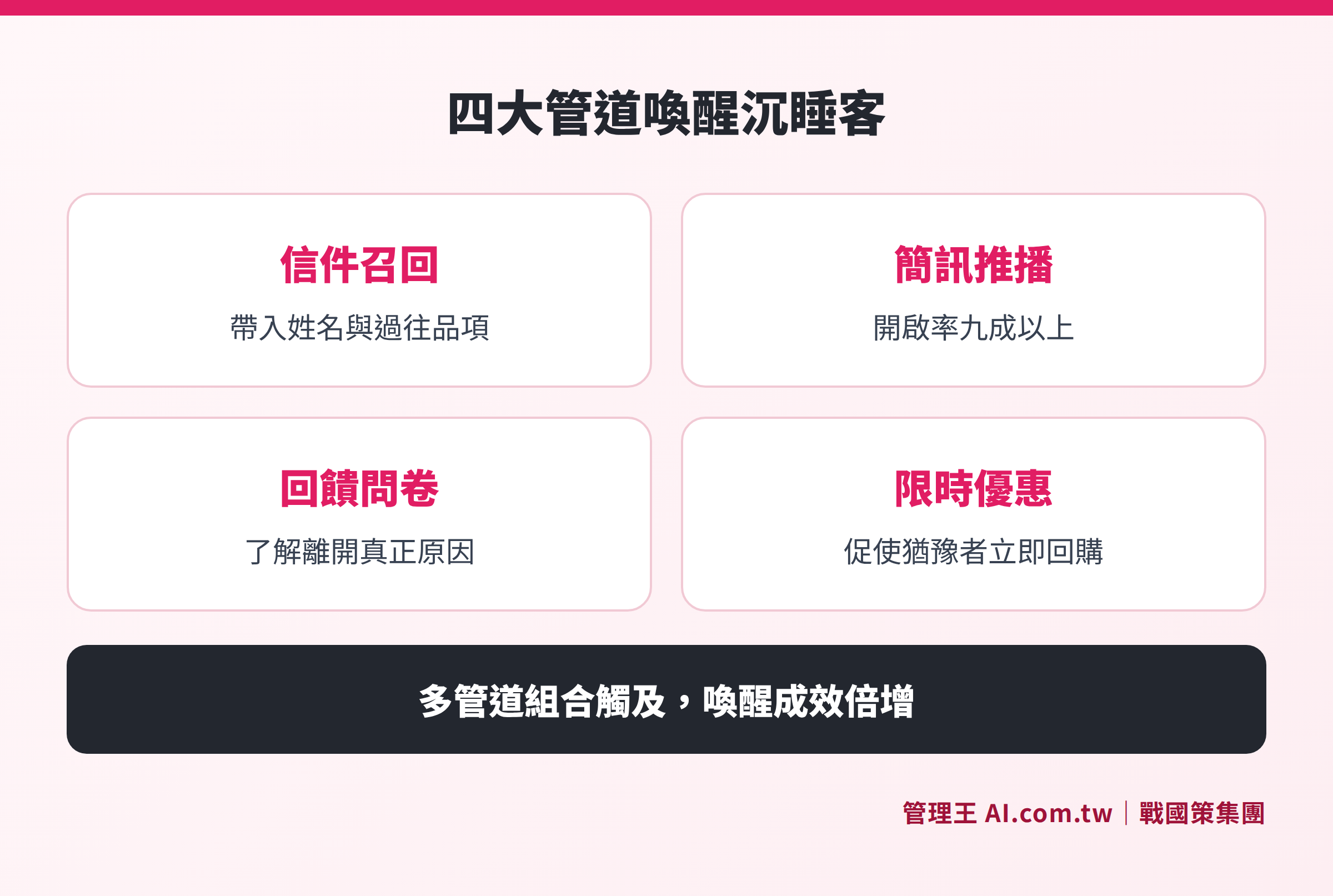
Comparison of applicability for five reactivation methods: personalized messages, limited-time offers, points reminders, multi-channel outreach, and surveys
How to Measure Reactivation Effectiveness? Four Key Indicators
After implementing reactivation activities, it's crucial to use data to measure effectiveness for continuous optimization.
- Reactivation Rate: The proportion of dormant customers who made purchases during the reactivation period. Marketing research suggests that reactivation rates for high-value dormant customers can reach 15% to 25%, while general customer groups are around 5% to 10%.
- Cost per Reactivation: Total expenses of reactivation activities ÷ Successful reactivated customers. This figure should be compared to new customer acquisition costs to validate the cost-effectiveness of reactivation strategies.
- Average Order Value of Reactivated Customers: The average order amount of reactivated customers can assess whether they are high-value customers returning, rather than just making one-time purchases for discounts.
- Re-dormancy Rate: The percentage of customers who go dormant again within 90 days after reactivation. A high rate suggests effective reactivation messaging but inadequate retention mechanisms, necessitating the incorporation of loyalty schemes for sustained engagement.
It is recommended to review the reactivation activity reports each quarter, comparing the effectiveness of different channels and message contents, gradually identifying the optimal reactivation combinations for your industry.
Common Errors in Reactivating Dormant Customers and How to Avoid Them
Many businesses execute reactivation campaigns but find effectiveness falls short; issues often arise in the following areas:
Error 1: Treating All Dormant Customers as One Group
The most common mistake is sending the same message to the entire dormant list. High-value old customers and potential customers who have never truly purchased require entirely different messaging strategies. A message like "Welcome back, we’ve missed you!" may resonate with high-value customers but will fail to connect with low-value customers who have only made one purchase. Segmentation using RFM principles should be the first step, followed by creating tailored content for each group.
Error 2: Lack of Retention Mechanisms After Reactivation
Many businesses succeed in reactivating customers but have not designed subsequent retention processes, leading to rapid dormancy again after a single purchase. The correct approach is to actively offer a "Welcome Back Gift" within the first month, invite customers to join a loyalty program, and follow up within 30 days to ensure satisfaction. Reactivation and retention are two distinct processes that need to be designed together.
Error 3: Excessively Frequent Outreach Leads to Annoyance
Sending five reactivation emails within a month often prompts customers to unsubscribe immediately. The essence of reactivation activities is to "repair the relationship", not "bombard with messages". It is suggested to send at most three outreach attempts within a 30 to 60 day window, each at least ten days apart. If three attempts receive no response, it’s advisable to cease outreach and move the customer to a "long-term observation list", reassessing after six months.
Error 4: Relying Solely on Discounts for Re-engagement
Overreliance on discounts can create a customer base that only shops when there are promotions, ultimately harming brand pricing power. Start with emotional recall messages; some customers will return simply to feel remembered, while discounts can be supplementary and only used for discount-sensitive groups or when initial reactivation is ineffective.
Error 5: Lack of Tracking Specific Purchase Data
Many owners know they are conducting reactivation efforts but are unaware of the actual revenue generated. Without data, you cannot optimize or explain the marketing budget’s efficacy to management. Each wave of activity should track: the number of messages sent, open rates, click-through rates, actual reactivated customer counts, and total revenue generated, calculating the ROI of every dollar spent on marketing.
From Dormancy to Loyal Customers: Establishing a Long-term Circulation System
Reactivation activities should not be a one-time event but a regular part of a company’s customer management system. Comprehensive customer lifecycle management should include the following four phases:
Phase One: Continuous Segmentation and Monitoring
Monthly automatic updates of RFM segmentation to keep track of who is transitioning from active to dormant. Intervening during the "about to churn" phase is far more effective than waiting until a customer is completely dormant before attempting to reactivate.
Phase Two: Layered Reactivation Strategies
Design three to four different message templates based on RFM segmentation: personalized emotional messages for high-value groups, time-limited offers for medium-value groups, and low-cost surveys for low-value groups. An automated system should trigger corresponding processes based on segmentation without needing manual judgment.
Phase Three: Post-Purchase Retention Design
After a successful reactivation, automatically trigger a "Welcome Back Sequence": first week provide a reward gift or points, second week share new features or product updates, third week invite to join loyalty programs or VIP membership. Design the thirty days following reactivation as an experience journey, rather than just a single transaction.
Phase Four: Regular Review and Iteration
Every quarter, review the overall performance of reactivation activities, comparing which channels, which message frameworks, and which customer groups yield the highest ROI for continued optimization in the next quarter. Standardize successful templates into the company’s Standard Operating Procedure (SOP), ensuring that the capacity for reactivation becomes a replicable and transferable organizational capability, rather than relying on the personal experience of a single marketer.
The core philosophy of this system is: make it difficult for customers to fall dormant, allow for automatic recall if they do, and have mechanisms in place to retain them after reactivation — these three links are interconnected and represent true customer asset management.
How to Operate with 管理王's Dormant Customer Reactivation System
管理王 AI.com.tw integrates the above processes into an automated engine, eliminating the need for marketing personnel to manually sort lists and send messages one by one. Below are practical steps for operation:
Step One: Set Dormancy Thresholds
In the system backend, customize "the number of days without purchase is considered dormant" based on the industry; different customer groups can set different thresholds. The system will automatically score and segment all customers based on the RFM three dimensions, clearly displaying groups like "about to churn," "dormant," and "important retention".
Step Two: Set Up Automated Reactivation Processes
After targeting the desired segments, the system can automatically schedule the sending of surveys, emails, or SMS messages, incorporating personalized data such as customer names and last purchased items. Once set, these will automatically execute without manual operation by sales personnel.
Step Three: Track Performance Reports
Each wave of reactivation activities comes with a complete report: number of messages sent, open rates, number of purchases, total revenue generated, making it easy to calculate the return on investment for every marketing budget dollar.
Step Four: Integrate CRM to Form a Cycle
Customers who return after reactivation automatically update their segment, re-entering normal customer maintenance processes; if they fall dormant again, the next round of reactivation processes will be automatically triggered, creating a long-term cycle of "identifying dormancy → recall → re-segmenting".
管理王's dormant customer reactivation system natively integrates with the CRM system, marketing automation, survey features, newsletter distribution, and loyalty program, requiring no API or additional integration; data flows naturally between systems. The free plan is available for permanent use, and registration takes just 30 seconds with no credit card needed.
戰國策 Group serves over 30,000 businesses, and each feature of 管理王 is designed based on real feedback from Taiwan’s small and medium enterprises. For consultation on implementation needs, please check the service plans or call for a free inquiry directly.
Revitalize Your Old Customer List
Consultants from 管理王 assist in setting RFM segmentation and multi-channel reactivation processes, continuously driving performance from dormant old customers.
Free consultation hotline: 0800-003-191
LINE Official Account: @119m
Official Website: app.AI.com.tw
Free Trial: Apply for 管理王 Now
Frequently Asked Questions
What is the difference between a dormant customer and a lost customer?
Dormant customers are those who have "temporarily ceased purchasing behavior" but have not fully left the brand; lost customers have usually canceled subscriptions, requested data deletion, or their purchasing intervals have vastly exceeded the normal cycle. Dormant customers still hold reactivation potential, whereas lost customers require more intensive recovery strategies. Differentiation usually hinges on the length of dormancy and interaction signals, and customers who have had no interactions for over a year should initially be confirmed via a survey to assess ongoing relations.
Are dormancy thresholds uniform across different industries?
No, they vary. The food service industry recommends 30 to 60 days, beauty services 60 to 90 days, B2B services 90 to 180 days, and low-frequency purchasing industries like furniture and appliances may extend to over a year. The core principle is: the dormancy threshold should be slightly longer than the normal consumption cycle for the industry to avoid misclassifying customers in their normal cycle as dormant, thus causing undue disruption. The 管理王 system supports setting thresholds according to industries or customer groups without requiring uniform settings.
How many times should reactivation messages be sent? Won't this annoy customers?
It is recommended to send three messages during the 30 to 60 day reactivation period: the first for emotional recall, the second for a limited-time offer, and the third as a reminder of the impending end of the offer. Sending more than three times may invite unsubscribing or negative feelings. If a customer does not respond to all three, you should cease proactive outreach to avoid damaging the brand image and move that customer to a long-term observation list for reassessment after six months.
How much data is needed to start RFM analysis?
Generally, 100 or more purchase records are needed for RFM analysis to yield meaningful segmentation results. The larger the amount of data (ideally over 200 records), the higher the accuracy of the segmentation, and AI recommendations will be more precise. If data volume is insufficient, you can start with the "Time Threshold Method" and upgrade to RFM automated segmentation once data accumulation permits. The 管理王 system will automatically notify you when data reaches the recommended level, eliminating the need for manual judgement.
What level of discount is effective for reactivation activities?
The discount level does not necessarily have to be high. Studies show that for high-value dormant customers, personalized emotional messages coupled with a 10% to 15% exclusive discount often outperform indiscriminate high discounts. Excessively large discounts might attract one-time buyers only interested in the incentive, causing them to return to dormancy soon after. Initially test with emotional recall messages; if the response rate is low, then consider incorporating discount incentives to progressively find the optimal combination for your specific customer group.
Sources
- How to Bring Customers Back? Five Strategies to Effectively Reactivate Dormant Customers - Ocard Blog (2025)
- What is RFM Analysis & Why It Matters for B2C Marketers - MoEngage (2025)
- How to Conduct RFM Analysis: Segment Members Based on Recent Purchases, Frequency, and Amount and Implement Action - 91APP (2026)
- Inactive Customer Reactivation: Who to Target, at What Cost - Marketing Mix (2024)
- 管理王 AI.com.tw Dormant Customer Reactivation Feature Page (Reported on November 2026)