How to Calculate the Costs of an Electronic Contract System? Comparing Per Document and Per User Plans | Recommended e-Signatures

The costs of an electronic contract system vary based on the billing method: per document billing is suitable for low-frequency usage, while per user monthly fee structures are ideal for high-frequency business or HR scenarios. This article summarizes the rates of mainstream platforms and the 5 major hidden fees to help businesses calculate the true costs of each contract.
The costs of an electronic contract system are mainly divided into two billing logics: per document billing (charged for each contract sent) and per user billing (fixed monthly fee per user, with no limit on the number of contracts). Choosing the wrong billing method can lead to paying one to three times more each month. Generally speaking, businesses that send fewer than 15 contracts per month are suitable for per document billing; if they exceed 20 contracts, the per user monthly fee structure is actually more cost-effective. This article summarizes the fee structures, hidden cost items, and minimum requirements under Taiwan's regulations, allowing you to clearly calculate the true cost of each contract before signing.
What Items Make Up the Costs of an Electronic Contract System?
When implementing an electronic contract system, businesses often only see the "monthly fee" or "annual fee" while overlooking several additional fees that can inflate the actual expenditure.
Common cost components include:
- Basic subscription fee: monthly or annual fee, usually calculated based on the number of user accounts or fixed seats
- Overage document fee: charged for each additional document once the included document limit is exceeded (DocuSign's overage cost is about NT$90 to NT$240 per document)
- Advanced features fee: features like SMS OTP verification and identity verification (ID comparison, business registration verification) are typically charged separately
- API integration fee: some vendors charge per call for integrating with in-house ERP or CRM systems
- Customization development fee: adjustments to processes, addition of fields, color changes, etc. are usually charged by the hour by Taiwanese vendors
- Data export/archiving fee: some platforms charge extra for retrieving complete data when deactivated
In a nutshell
The surface monthly fee is just the starting point; the overage document fee is often the culprit for rising costs.
Per Document Billing vs. Per User Billing: How to Determine Which is Right for You?
Each billing model has its applicable scenarios, with the core difference being "how many contracts do you send each month?"
Table: Comparison of Per Document Billing vs. Per User Billing
| Comparison Item | Per Document Billing | Per User Billing |
|---|---|---|
| --- | --- | --- |
| Charging Method | Charged for each contract sent | Fixed monthly fee per user, unlimited contracts |
| Suitable Sending Volume | Less than 15 per month | More than 20 per month |
| Cost Predictability | More difficult to predict (higher costs with volume) | Easier to estimate (fixed monthly fee) |
| Target Audience | Startups, low-frequency businesses | Sales teams, HR high-frequency signing |
| Overage Risk | High (costs explode with increased volume) | Low (fixed cost per person avoids overage) |
| Representative Services | Some API solutions, enterprise packages | DocuSign Standard, 管理王 |
Calculation Example:
A sales team of 10 people sends 5 contracts each per month, totaling 50 contracts.
- Per document plan at NT$60 per document: 50 × 60 = NT$3,000/month
- Per user plan at NT$500 per person per month: 10 × 500 = NT$5,000/month, but no worries about overages
If sending volume doubles to 100 contracts during a peak sales season, the per document cost immediately jumps to NT$6,000, while the per user plan remains at NT$5,000. The more frequent the peaks, the more stable the per user billing becomes.
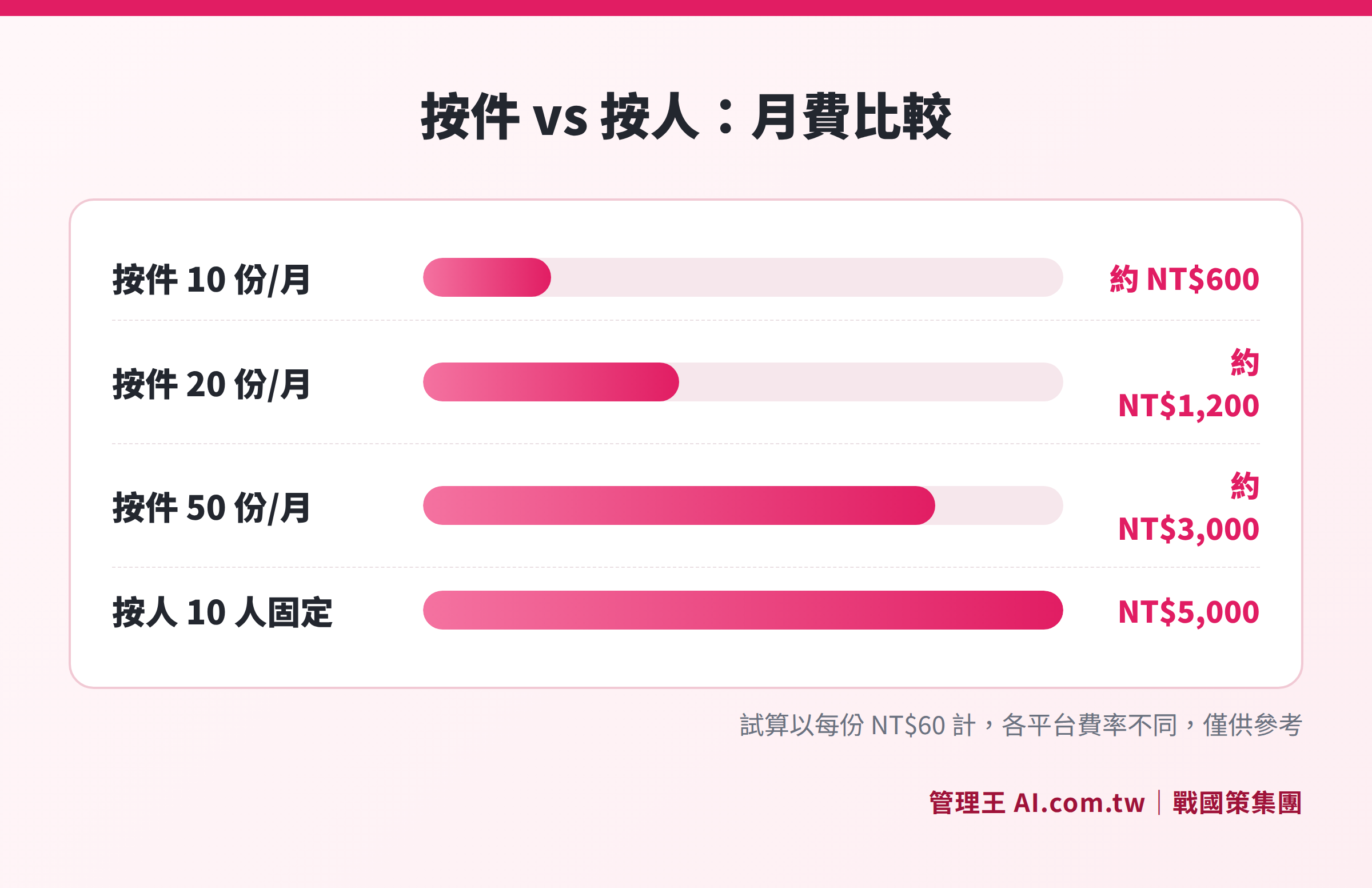
Once the monthly contract volume exceeds the breakeven point (about 15–20 contracts), the total cost of per user billing is lower than that of per document billing
Rate Comparison of Mainstream Electronic Contract Platforms
The following summarizes the rates of commonly used electronic contract platforms by Taiwanese enterprises, based on publicly available information from each platform; consultation date November 2026.
Table: Comparison of Mainstream Electronic Contract Platform Plans (Consulted November 2026)
| Platform | Free Quota | Entry Plan | Billing Mode | Chinese Interface | Taiwan CA Certificate |
|---|---|---|---|---|---|
| --- | --- | --- | --- | --- | --- |
| DocuSign | 5 contracts per month | About USD$25/user/month | Per user, annual fee | Partial | No |
| DottedSign | 3 invitation contracts per month | Professional plan (as announced on the official website) | Per user | Yes | Chunghwa Telecom 快意簽 |
| Adobe Acrobat Sign | No free plan | USD$12.99/month (individual) | Per user | Partial | No |
| 管理王 AI.com.tw | Permanent free (including electronic signatures) | NT$5,000/month (full module) | Per user, full module subscription | Yes (100% Traditional Chinese) | Compliant with e-Signature Law |
Note: Each platform's plans are subject to change at any time; please refer to the latest announcements on their official websites. DocuSign and Adobe Acrobat Sign are billed in USD, and exchange rate fluctuations will affect actual costs in New Taiwan Dollars.
Legal Validity Requirements for Electronic Contracts in Taiwan
Many companies worry about whether "electronic contracts have legal validity?" According to Taiwan's e-Signature Law, it is stipulated:
Article 4: "Those that meet the requirements of this law shall not be denied legal validity solely on the grounds that they are made in electronic form." This means that electronic contracts have the same legal effect as paper contracts under Taiwanese law, provided that the electronic signature meets the following conditions:
- Both parties consent to sign in electronic form
- The electronic document is available for future reference and fully presents the original content
- If using a digital signature, it must use a certificate issued by a certificate authority (CA) recognized by the competent authority, and the certificate must be within its validity period
Practical Focus: When choosing an electronic contract system, the audit trail (who signed, when, from which IP, and which device) is the most important evidence in case of disputes. If the system only records the words "signed," without a complete operational record, legal protection significantly reduces.
In Which Situations is Per Document Billing Suitable?
The following scenarios are particularly suitable for evaluating per document billing or one-time purchase contract packages:
- Extremely uneven seasonal usage: Most months hardly any contracts are sent, and bulk sending occurs only at year-end peaks (e.g., annual contract updates for franchises)
- Occasional need for multiple signatories: If less than 50 contracts are sent per year, it's not worth purchasing a monthly fee plan
- API integration purposes: In scenarios where contracts are sent in batches via programs, some vendors offer pay-per-call APIs, providing higher flexibility
- Short-term projects: Temporary needs that won't be required after a few months
> Note: One-time "contract packages" may seem cheap, but the validity period for points is usually only one year, and unused points are non-refundable. Confirm the usage period and refund policy before making a purchase.
In Which Situations is Per User Billing (Monthly Fee System) Suitable?
Most small and medium-sized enterprises find that once they reach a certain scale, monthly fee systems are even more economical:
- High-frequency sending by business or HR: As long as each person sends more than 10 to 15 contracts per month, the "marginal cost is zero" makes the monthly fee very cost-effective
- Need for automatic reminders and overdue alerts: Such process management features are usually only available within subscription plans
- Multiple people sharing templates: The entire team can share contract templates and signature field settings, reducing repetitive setup time
- Need to integrate with other systems: CRM client data, HR personnel systems, accounting, monthly fee plans usually have complete integration
Hidden Costs: 5 Common Pitfalls
In addition to the base rates, here are common hidden costs that are often overlooked:
- SMS verification fee: Requiring signers to use mobile OTP verification, some platforms charge an additional NT$2 to NT$5 per message
- Brand customization fee: Changing the system's outgoing emails to feature your company's logo and name sometimes requires an upgraded plan
- Limit on the number of multi-signatories: Free or entry-level plans usually limit each document to only 2 to 3 signatories, exceeding that requires an upgrade
- Data retention fee: Contract data must be retained for 7 years to comply with Article 30 of Taiwan's Labor Standards Act and tax regulations; some vendors charge archiving fees for old data
- Data migration fee upon service termination: When switching platforms, some vendors do not provide the option to export all historical contracts, or charge additional fees
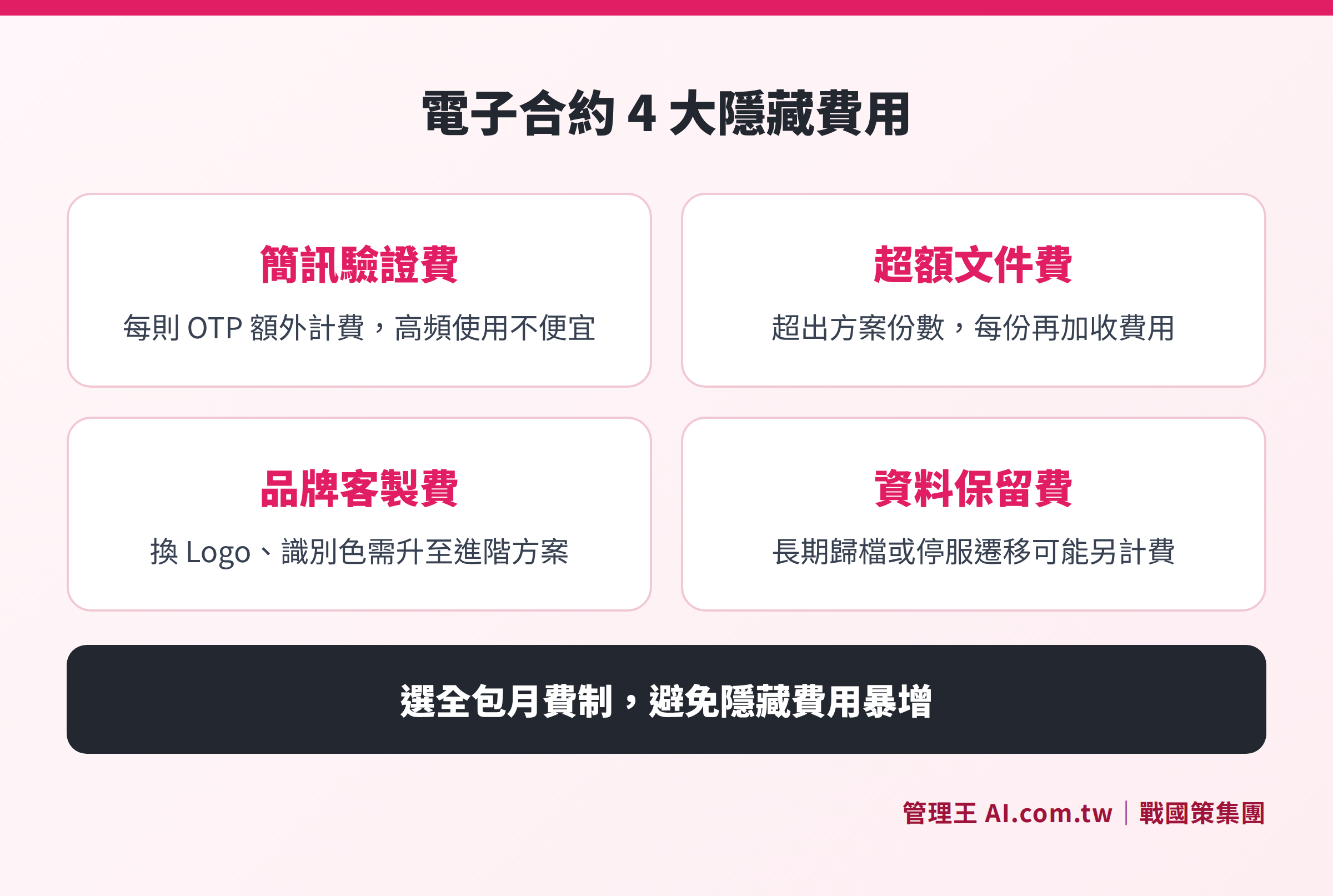
Lists five common hidden costs: SMS verification, brand customization, multiple signatories, data retention, and data migration
Calculate Before Implementation: 3 Steps for Cost Assessment
Before officially comparing vendors, first frame your needs with 3 questions to avoid erroneous calculations later:
Step 1: Statistically evaluate the contract sending volume over the past 3 months
Add up all business contracts, HR employment documents, purchase orders, and NDAs to get the average total per month. If you have not yet started using electronic contracts, estimate the current volume of documents processed on paper; switching to electronic typically increases this volume as processes become faster, and employees are more willing to send.
Step 2: Confirm how many "senders" accounts exist
Per user billing is calculated based on "the number of accounts that need to send contracts"; accounts solely for reading or signing do not require payment. Typically, only active roles sending contracts, such as sales, HR, or procurement need accounts, not the total number of employees.
Step 3: Compare total costs over 12 months
Calculate both billing options for an annual fee: the monthly fee of per document billing plus estimated overage costs, compared to the annual fee of per user billing (which usually includes discounts). If the difference between the two is less than 20%, prioritize the per user billing, as once the volume grows, there will be no more overage pressure.
How to Use 管理王
管理王 AI.com.tw Electronic Contracts / e-Signature Feature adopts a full-module subscription system, with electronic contracts not billed separately per document. The free plan allows permanent use of electronic signatures, and the number of sent contracts and advanced features after an upgrade depend on the plan:
- Free plan: Permanently available, suitable for individuals or initial testing
- Economy plan NT$5,000/month: For 30 people or less, suitable for small businesses or HR teams
- Business plan NT$10,000/month: For 60 people or less, includes 8 hours of remote implementation training
- Flagship plan NT$19,900/month: Unlimited number of people, includes 16 hours of implementation training
In 管理王, electronic contracts are not standalone modules but are natively integrated with CRM, quotations, HR, procurement, and approval center, all within the same account. After providing sales quotes, contracts can be transformed into electronic contracts directly; when HR onboards new recruits, labor contracts can be automatically sent without needing to manually copy data to another system.
Automatic signature reminders (if unsigned after 3 days, resend automatically, maximum 3 times), overdue reminders (7, 3, and 1 day prior to expiration), and audit trails (time, IP, device) are all included in the standard plan without additional fees. Custom development is transparently priced at NT$1,000/hour, with free initial consultations to assess hours before starting work.
The 戰國策 group serves over 30,000 enterprises, and 管理王 is designed as an integrated system for Taiwanese small and medium businesses. If you are evaluating an electronic contract system, you can try the free plan first without binding a credit card.
Free Trial to Calculate Your Electronic Contract Costs
Consultants assist in analyzing whether per document or per user billing is more economical while explaining the all-inclusive monthly fee plan of 管理王 for electronic contracts.
Free consultation hotline: 0800-003-191
LINE official account: @119m
Official website: app.AI.com.tw
Free trial: Apply for 管理王 now
Frequently Asked Questions
What are the approximate costs of an electronic contract system?
Entry plans range from free (with limits) to over NT$2,000 to NT$10,000 per month, depending on the platform and number of users. Per document billing is about NT$30 to NT$300 per document (depending on platform and feature differences); per user monthly fee structures range from several hundred NT$ for individual plans to NT$500 to NT$2,000 per month per person for enterprises. 管理王's free plan allows permanent use of electronic signatures, while paid plans cover full modules without extra fees for electronic contracts; see the official pricing page for details.
Which is more cost-effective: per document billing or per user billing?
The number of contracts sent each month is the key indicator. Approximately 15 to 20 contracts per month serve as the dividing line: below this volume, per document billing offers more flexibility; above this amount, per user fixed monthly fees are usually more economical. Businesses with high-frequency usage, such as sales or HR, are almost always suited to monthly fee structures to avoid seasonal cost spikes.
Do electronic contracts have legal effect in Taiwan?
Yes. According to Article 4 of Taiwan's e-Signature Law, legal validity cannot be denied solely due to electronic form. The premise is that both parties agree to sign electronically, the document is complete and accessible, and if using a digital signature, a certificate issued by a recognized CA is used. The audit trail (time, IP, device) is a crucial piece of evidence in case of disputes, so be sure this feature exists when selecting a system.
What hidden costs should be noted when implementing an electronic contract system?
Common hidden costs include: SMS OTP verification fees (NT$2-5 per message), additional document fees for exceeding the plan, brand customization fees, limits on the number of multi-signatories, long-term data archiving fees, and data migration fees when shutting down service. It is advised to directly inquire about these items before selecting a system, or choose a monthly fee plan that includes all features to reduce uncertainty.
How long should electronic contract data be retained?
According to Article 30 of Taiwan's Labor Standards Act, attendance records must be retained for 5 years; tax-related documents need to be kept for 10 years under commercial accounting regulations. If electronic contracts involve labor relations (employment contracts, termination agreements) or financial transactions, it is recommended to retain them for at least 7 years to comply with the strictest regulatory requirements. Ensure to confirm data retention periods and export functions when selecting a platform to avoid data loss when changing systems.
Sources
- e-Signature Law (National Legislative Database)
- 管理王 AI.com.tw Electronic Contracts / e-Signature Function Page
- 管理王 AI.com.tw Service Plans and Pricing
- DottedSign Official Pricing (based on publicly available information, November 2026)
- DocuSign Official Pricing (based on publicly available information, November 2026)
This article is for general information and does not constitute legal or tax advice; please refer to the latest announcements from the competent authorities for actual guidelines.