What is an Electronic Signature? Legal Validity, Processes, and Key Considerations for Business Implementation | Recommended Electronic Signatures

Electronic signatures streamline the contract process from "print → send → scan → return" lasting several days, to a simple link click. After the amendments to Taiwan's Electronic Signature Act in 2024, the function of electronic signatures is equivalent to that of physical signatures, with digital signatures holding even greater presumptive legal validity. This article covers definitions, regulations, implementation processes, and system selection criteria, making it the most comprehensive guide for small and medium-sized enterprises entering the world of electronic signatures.
An electronic signature is a signature or seal created electronically, used to identify the signer and verify the authenticity of electronic documents. According to Taiwan's Electronic Signature Act (amended on May 15, 2024), any electronic document and electronic signature that complies with this law is functionally equivalent to physical documents and signatures and cannot be denied legal validity solely because of their electronic form.
In simple terms, electronic signatures are legal, valid, and hold the same efficacy as paper documents. After implementing electronic signatures, the contract signing process can be reduced from the cumbersome paper method of "print → send → sign → scan → return" taking several days to simply clicking a link, allowing completion on a smartphone in just a few minutes.
The Electronic Signature Act in Taiwan underwent its first comprehensive revision in over 20 years, strengthening the legal presumptive validity of digital signatures, removing the previous requirement of needing "consent from the counterpart" and expanding the applicability of electronic documents. Small and medium-sized enterprises can now legally use electronic signatures in place of physical stamps for labor contracts, procurement contracts, NDA confidentiality agreements, and employment documents.
This article thoroughly explains the definition of electronic signatures, the differences between electronic and digital signatures, key highlights of the latest regulations, corporate implementation processes, and critical criteria for system selection, making it the most comprehensive introductory guide for Taiwanese small and medium-sized enterprises venturing into electronic signatures.
What is an Electronic Signature? Definition and Core Concepts
An electronic signature refers to data attached to an electronic document used to identify the signer and confirm approval of the document's content. In layman's terms, it replaces the traditional act of "handwritten signature or seal" with an electronic format.
According to Article 2 of Taiwan's Electronic Signature Act, an electronic signature is defined as: "Data attached to an electronic document and related to it, used to identify and confirm the identity and qualification of the electronic document signer and the authenticity of the electronic document." The governing body is the Ministry of Digital Development.
How Electronic Signatures Work
The core of electronic signatures lies in "identity binding" and "tamper-proofing". When the signer clicks to confirm the signature, the system will:
- Record the signing time, IP address, and device used
- Generate a unique identifier for the signing record
- Lock the document content (any changes will invalidate the signature)
- Automatically archive and notify relevant parties
These mechanisms collectively create an "Audit Trail," ensuring that electronic signatures are not just "signed and done" but that each step is timestamped for validation. In the event of a dispute, this provides substantiated evidence.
Electronic Signature vs. Scanned Handwritten Signature
Many people confuse "electronic signatures" with "scanned images of handwritten signatures", which are fundamentally different:
- Scanned signature images: Merely an image that can be easily copied and pasted by anyone, lacking verification capability
- Electronic signature systems: Ensure that identity verification (email verification codes, SMS OTP, etc.) guarantees that it is indeed the person operating, leaving a complete audit trail
In Taiwan, when judging the legal validity of electronic documents, the focus is not on "whether there is a person's name or image" but on "whether there is a reliable identification mechanism".
Electronic Signatures vs. Digital Signatures: What's the Difference?
Electronic signatures encompass a broad category, while digital signatures represent the highest level of security within that category.
Core Technical Differences
Digital signatures use an "asymmetric encryption algorithm": the system generates a pair of "private keys" and "public keys" for the signer, where the private key is held by the signer and used to encrypt the document hash value during signing; the verifiers use the public key to decrypt and confirm that the content has not been tampered with and that it is indeed signed by the holder of the private key.
This process requires a "Certificate Authority (CA)" to issue digital certificates. Legal certificate authorities in Taiwan are regulated by the Ministry of Digital Development.
According to Article 2 of the Electronic Signature Act, a digital signature is defined as: "Data obtained by calculating an electronic document into a fixed-length digital format using mathematical algorithms or other methods, encrypted with the signer's private key, forming an electronic signature that can be verified with the public key."
Comparison of Security Levels and Legal Validity
Table: Comparison of Electronic Signature Types
| Type | Technical Mechanism | Identity Verification Strength | Legal Validity | Applicable Scenarios |
|---|---|---|---|---|
| Basic Electronic Signature | Click confirmation + Audit Trail | Email/OTP verification | Functionally equivalent to paper | Daily contracts, HR documents |
| Enhanced Electronic Signature | Encryption algorithm + multi-factor | Dual Email + OTP | Functionally equivalent to paper | Medium to high-value contracts |
| Digital Signature | CA-issued certificate | PKI digital certificate | Presumed to be personally signed | High-value contracts, legal documents |
In Summary
Taiwan's Electronic Signature Act stipulates: electronic signatures are functionally equivalent to physical signatures; while digital signatures (with CA certificates) enjoy the strongest efficacy of "presumed personal signing".
Practical Recommendations for SMEs
For small and medium-sized enterprises in Taiwan, using electronic signature systems that include email verification codes or SMS OTP for typical commercial contracts (sales contracts, NDAs, service contracts) is generally sufficient to meet regulatory requirements and provide ample evidence in litigation. Only in special cases involving high-value financial transactions is a digital signature (CA certificate) necessary.
Legal Validity of Electronic Signatures: Key Points of the 2024 Amendments to Taiwan's Electronic Signature Act
The Electronic Signature Act in Taiwan originally came into effect in 2001 and has seen little significant amendment over 20 years, finally completing a comprehensive overhaul on April 30, 2024, with official publication on May 15, 2024.
Key Differences Before and After the Amendments
Old law provisions: The use of electronic signatures or documents required "consent from the counterpart" to be valid. This condition posed practical challenges—if the other party clicked to sign, they could still claim later that they did not consent to the electronic form and deny its validity.
New law provisions: The requirement of "consent from the counterpart" as a precondition was removed and replaced with a criterion that allows an opportunity for the other party to object in an objective and reasonable way prior to using electronic signatures. In simple terms, as long as the other party is informed and has the chance to object before electronic signing, the subsequent electronic signature has legal validity.
Three Core Principles of the New Law
1. Principle of Functional Equivalence
The Electronic Signature Act explicitly states: electronic documents and electronic signatures that comply with this law are functionally equivalent to physical documents and signatures and cannot be denied legal validity solely because of their electronic format. This is the most crucial clause, establishing electronic signatures on equal footing with paper.
2. Presumptive Validity of Digital Signatures
The new law grants digital signatures made using government-recognized certificate authorities presumption of being "personally signed or sealed". In legal proceedings, the burden of proof shifts: if one party denies their signature, they must provide evidence to refute.
3. Clarification of Exemptions
The new law clearly specifies exceptions to the applicability of electronic signatures; these must adhere to laws or legally authorized orders, and government agencies cannot unilaterally announce exemptions. Exclusion regulations announced during the old law period will expire one year after the new law comes into effect (i.e., after May 15, 2025).
What Documents Currently Have Special Limitations?
According to the current legal framework, the following types of documents may have additional regulations:
- Judicial Procedure Documents: Complaints, petitions, etc., to be announced separately by the Judicial Yuan or the Ministry of Justice
- Specific Administrative Documents: Subject to separate regulations from government agencies
- Some Financial Documents: Subject to regulations from financial supervisory authorities
Common business contracts, labor contracts, procurement contracts, and confidentiality agreements used by small and medium-sized enterprises can currently all use electronic signatures legally. If in doubt, it is advisable to consult legal professionals and refer to the latest announcements from the Ministry of Digital Development.
This article provides general information and does not constitute legal advice; it is based on the latest announcements from governing authorities.
Most Commonly Used Document Types for Electronic Signatures in Business
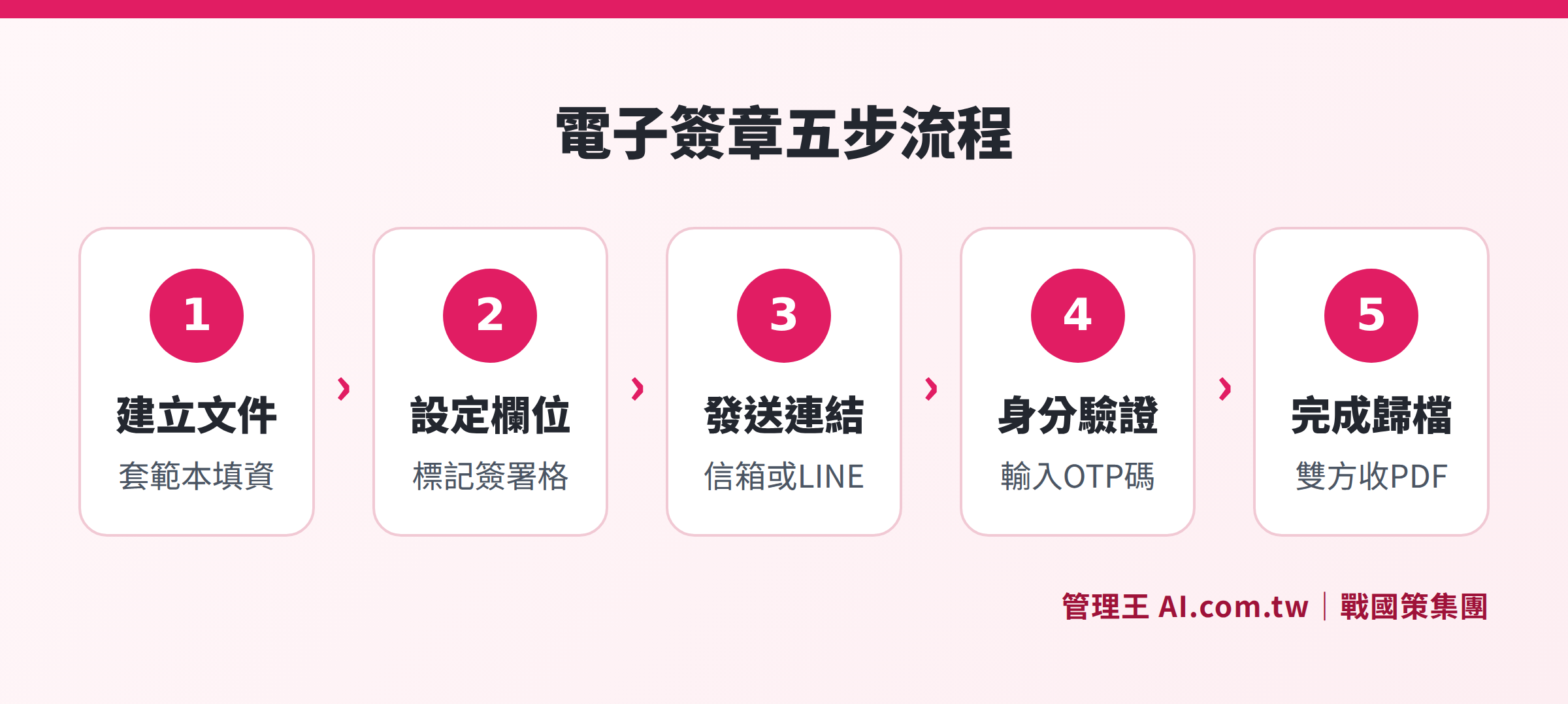
Complete six-step process for electronic signatures: Create document templates → Set up signing fields → Send links → Signer identity verification → Complete signing → Archive audit trail
Sales and Procurement
Sales Contracts: Customer confirms the items, amounts, and delivery conditions for purchases. Electronic signatures can reduce contract turnaround times, allowing sales to quickly finalize orders.
Procurement Contracts: Framework agreements or individual purchase orders placed with suppliers. The electronic format saves the procurement department from a lot of paper back-and-forth, seamlessly integrating into the purchasing process after signing.
Quotation Confirmation Letters: Written confirmation of quoted prices from clients, forming a legally binding contract basis. Combining with quotation systems allows for a complete chain from inquiry to transaction.
Personnel and Labor
Labor Contracts: Essential documents for employee onboarding that include job conditions, salaries, and duty descriptions. Electronic signatures enable remote hires and the onboarding of offsite employees, and can connect to the HR system for automatic record-keeping.
Non-Disclosure Agreements (NDA): Agreements ensuring both parties do not disclose business secrets, applicable to new employees, vendors, and consultants.
Resignation Agreements: Confirmation of resignation conditions, end date of service, and non-compete clauses.
Performance Evaluation Forms: Documents confirming the results of annual or quarterly performance discussions.
Business Cooperation
Service Contracts: Agreements for consulting services, agency contracts, licensing agreements, etc.
Lease Agreements: Written agreements for office space or equipment leases.
Supplier Information Forms: Collecting company information and bank account details of new suppliers, requiring their signature for confirmation.
Table: Document Types and Recommended Electronic Signature Levels
| Document Type | Recommended Level | Identity Verification Method | Remarks |
|---|---|---|---|
| Daily Business Contracts | Basic Electronic Signature | Email Verification Code | Most commonly used in general business |
| Labor Contracts | Basic Electronic Signature | Email or SMS OTP | Meets written requirements under labor laws |
| Non-Disclosure Agreements (NDA) | Basic Electronic Signature | Email Verification Code | Audit trail retention is sufficient |
| High-Value Procurement Contracts | Enhanced Electronic Signature | Multi-factor verification | It is advisable to retain complete trails |
| Specific Financial Documents | Digital Signature | CA Certificate | Processed according to regulations from supervisory authorities |
Comprehensive Process for Business Implementing Electronic Signatures
Implementing electronic signatures is not just about "choosing a software system", but rather involves a process reengineering. Below are typical steps for corporate implementation:
Step 1: Inventory Documents for Digitization
Start by listing the types of documents the company frequently signs, takes the longest time, or are most likely to be lost. Typically, starting with "external contracts" (sales contracts, procurement contracts) or "personnel documents" (labor contracts, NDAs) offers the least resistance and the quickest benefits.
Step 2: Confirm Regulatory Compliance Requirements
Check if there are special provisions for the documents intended for digitization:
- The written requirements under labor laws for labor contracts (electronic forms that comply with the Electronic Signature Act have been accepted)
- Whether it involves documents from government agencies or judicial procedures
- Whether there are specific regulations by industry supervisory authorities (such as finance, healthcare)
Step 3: Choose an Electronic Signature System that Meets Needs
Key evaluation points when selecting a system:
- Compliance with Taiwan's Electronic Signature Act
- Completeness of the audit trail (timestamps, IP address, used devices)
- Strength of identity verification (email verification code, SMS OTP)
- Support for multi-party signing and sequential signing
- Automated reminder and expiration notification mechanisms
- Integration level with existing systems (such as CRM, HR, ERP)
Step 4: Design Internal Approval Process
Decide which documents need to be internally reviewed before being sent to the counterpart. Once the business drafts the contract, will it be sent out directly or first submitted for legal or managerial review? How will signing permissions be managed? Clarifying these process designs will allow electronic signatures to genuinely replace traditional paper stamps.
Step 5: Create Templates and Train Employees
Frequently used contracts should be saved as system templates, with signing fields and required information configured, enabling sales personnel to apply them with a single click instead of resetting for each instance. Training focus should center on three key aspects: how to send, how to remind for signature, and how to check progress.
Step 6: Go Live and Monitor Usage Data
After the system goes live, monitor metrics such as signing rates, average signing turnaround time, and overdue percentages. These indicators will quickly reveal bottlenecks in the process: whether the recipient was wrong, if no deadlines were set, or if the wrong verification method was chosen.
Key Features to Consider When Selecting an Electronic Signature System
When choosing an electronic signature system, small and medium-sized enterprises in Taiwan should pay particular attention to the following functional aspects:
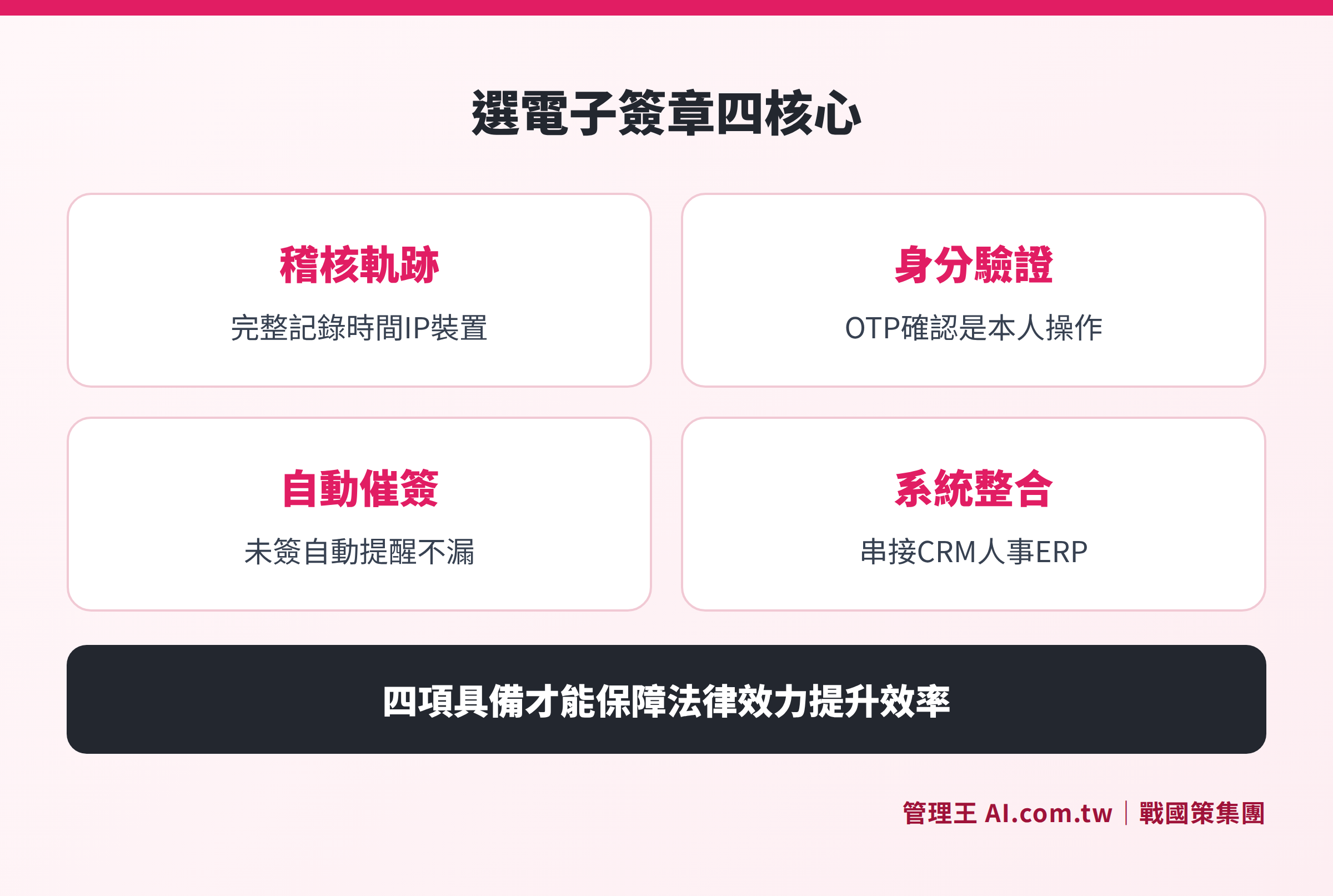
Four Key Considerations: Audit Trails (complete records of every operation), Identity Verification (OTP and multi-factor), Automated Reminders (helps reduce manual follow-ups), System Integration (interconnected with CRM, HR, and ERP)
Completeness of the Audit Trail
This is central to the legal validity of electronic signatures. The system must record the time, IP address, and device used for every step and ensure this record cannot be tampered with. If a dispute arises later, this audit trail serves as the most critical evidence.
Identity Verification Mechanisms
There should be at least an email verification code or SMS OTP. For critical contracts, both verification methods can be enabled simultaneously, allowing the counterpart to pass identification confirmation before signing, greatly reducing the risk of "denying personal signing" disputes.
Automated Reminders and Expiration Alerts
One of the most common issues after sending contracts is "no further communication". The system should have the capability to automatically send reminders after set days, and proactively notify the sender before due dates, allowing the signing process to proceed without relying on manual tracking.
Multi-party Sequential Signing
For agreements involving three or more parties (such as owners, contractors, and guarantors), the system should support sequential notifications, ensuring that the next signer is notified only after the previous one has signed, preventing order confusion or inconsistencies in document versions.
Integration with Other Systems
Using electronic signatures in isolation has limited benefits; with CRM integration, contract statuses can automatically update customer records; with HR integration, signed labor contracts can directly establish employee files; with ERP integration, procurement processes can be automatically triggered after signing procurement contracts. The deeper the integration, the more labor time saved from manual transitions.
Localized Design in Taiwan
Interfaces should be in Traditional Chinese, support sending links through LINE (the most commonly used communication channel in Taiwan), and comply with local business practices, which are key factors influencing employee acceptance and willingness of external customers to cooperate.
For comparisons of the features of various systems, refer to the 2026 Taiwan Electronic Signature System Selection Guide.
How to Use 管理王 for Electronic Signatures
管理王 AI.com.tw's electronic contract and signature system is specially designed for small and medium-sized enterprises in Taiwan, allowing for the entire process from contract dispatch to completion of signing by both parties in as fast as a few minutes. Below is an explanation of the practical operations:
Creating and Sending Contracts
管理王 comes with a built-in library of commonly used contract templates, including labor contracts, procurement contracts, NDA confidentiality agreements, and service contracts. The fields support dynamic input (client name, tax ID, amount, date), allowing for the same template to be applied to different parties without re-typing. After filling in the recipient's email, click send, and the counterpart receives a unique link to sign it on their phone or computer without the need to download an app or register an account. The signing link can also be sent via LINE or SMS, better aligning with how Taiwanese clients prefer to communicate.
Identity Verification and Signing
The system sends a 6-digit verification code to the signer's email or phone (SMS OTP), and the signing is accessible only after the correct code is entered, which is valid for 10 minutes with a maximum of up to 5 attempts. For important contracts, both email and SMS verification can be enabled simultaneously. If signing needs to be restricted to a company's network, an IP whitelist can be set up (supporting single IPs, whole subnets, and wildcards).
Automated Reminders and Expiration Management
After documents are sent out, the system automatically tracks signing status. If not signed within three days, a reminder is automatically sent again, with subsequent reminders every three days for a maximum of three times, ensuring follow-ups do not become harassment. If a signing deadline is set, the system will notify the document creator 7 days, 3 days, and 1 day before the deadline (rather than directly bothering the client), allowing internal personnel to decide whether to continue reminders or extend deadlines. It's clear at the management console where the contract status stands, and who has not yet signed.
Internal Signature Process
Sales who draft contracts do not need to send them out directly but can first follow the internal review process—only after managerial approval can they be sent to clients. Permissions for using official seals will be clearly managed to determine who can upload and seal documents, avoiding situations where irretrievable company seals are used on inappropriate documents.
Contract Archiving and Retrieval
After signing is completed, the system automatically sends both parties a PDF copy and archives it within the contract management module. All contracts are centrally managed, classified by type, allowing specific contracts to be retrieved in seconds instead of searching through a sea of emails. Paper or PDF copies signed elsewhere can also be uploaded for archiving, allowing all contracts, regardless of origin, to be managed in one place.
Deep Integration with Other Modules
管理王's electronic signatures are natively integrated with CRM, HR system, and ERP, requiring no API integration or additional fees: once clients sign sales contracts, customer data in the CRM will update automatically; when employees sign labor contracts, the HR system automatically sets up employee records; once procurement contracts are signed, the ERP procurement process automatically initiates. A free plan is available for perpetual use, allowing you to experience the complete electronic signature functionalities without needing a credit card.
The 戰國策 Group serves over 30,000 enterprises, and 管理王's electronic signature functionality has been designed from day one with Taiwanese business practices in mind (LINE notifications, Traditional Chinese interfaces, compliance with labor law), enabling immediate usability from day one, with high employee acceptance rates.
Try Electronic Signatures for Free; Contracts Completed in Minutes
管理王 consultants will assist you in assessing which contracts are suitable for digitization and in designing internal approval processes, all available for free without needing a credit card.
Free consultation hotline: 0800-003-191
LINE Official Account: @119m
Official website: app.AI.com.tw
Free trial: Apply for 管理王 now
Frequently Asked Questions
Do electronic signatures have legal validity in Taiwan?
Yes. According to Taiwan's Electronic Signature Act (effective on May 15, 2024, under the authority of the Ministry of Digital Development), electronic documents and signatures that comply with regulations are functionally equivalent to physical documents and signatures, and cannot be denied legal validity solely based on their electronic format. Digital signatures issued by government-recognized certificate authorities have even greater legal validity of being "presumed personal signing".
Can someone sign an electronic contract if they don't have an account?
Yes. One of the conveniences of electronic signatures is that signers only need to receive a link and verify through an email or SMS verification code to complete signing in a browser, without needing to apply for an account or install any software beforehand. It can be done using a mobile phone, tablet, or computer, and the signing link can also be sent directly through LINE or SMS.
How long should the audit trail for electronic signatures be retained?
This depends on the type of contract. It is generally recommended to retain ordinary business contracts for at least a few years beyond their expiration; for labor-related documents, it is advisable to keep them for at least 7 years after the employee's departure (according to labor law requirements); and for tax-related certificates, the retention requirement is a minimum of 10 years under the Business Accounting Act. Actual retention periods should be based on the latest announcements from governing authorities.
What if the other party later denies their signature?
The audit trail serves as a crucial basis. A complete audit trail should include: when the notification was received, when the link was opened, from which IP address, what device was used, and which identity verification method was passed. If a digital signature (CA certificate) is used, the Electronic Signature Act further grants a legal effect presuming personal signing, transferring the burden of proof to the denying party.
Are electronic signatures applicable to labor contracts?
Currently, the Labour Standards Act stipulates that labor contracts should be in writing, and electronic documents that comply with the Electronic Signature Act are considered written. Therefore, using electronic signatures for labor contracts is feasible. It is recommended to ensure the system used features complete audit trails and identity verification mechanisms, and to check against the latest announcements from governing authorities.
Source References
- Electronic Signature Act - National Regulations Database (amended on May 15, 2024, governing body: Ministry of Digital Development)
- Electronic Signature Act 2024 Amendment Cheat Sheet - Li Ming Hsun Law Office (query on March 2025)
- Management King's Electronic Contract and Electronic Signature Function Page
- Management King's Contract Management Function Page
This article is for general information only and does not constitute legal advice; actual provisions are based on the latest announcements from the Ministry of Digital Development and relevant governing bodies.