What is an Education and Training System? Overview of Corporate Online Training Platform Features|Recommended Education and Training Systems

An Education and Training System (LMS) allows companies to centrally manage courses, assign required subjects, track attendance, and automatically issue certificates. This article explains six core functions, legal training requirements such as occupational safety and health, a four-stage implementation process, and evaluation criteria for purchasing decisions, as well as the practical operation of 管理王 AI.com.tw's education and training system, suitable for reference by SMEs in Taiwan.
An Education and Training System (also known as LMS, Learning Management System) is a digital platform for companies to centrally manage courses, assign learning tasks, track attendance records, and automatically issue certificates. For SME owners, the most direct value is threefold: first, to unify training materials scattered across Excel, physical sign-in sheets, and Google Drive into one system; second, to free HR from administrative tasks like "urging attendance and tracking course records"; and third, to comply with legal training requirements like the Occupational Safety and Health Education and Training Regulations, so that the company can provide complete records during labor inspections and avoid penalties. An enterprise-level education and training system deeply integrated with human resources can also directly link training effectiveness to performance evaluations and promotion decisions, transforming "talent development" from a slogan into quantifiable management data.
What is an Education and Training System? Core Features at a Glance
In broad terms, an education and training system is a corporate version of an "online learning platform"; however, the main difference from typical consumer MOOC platforms lies in its "managerial perspective": the focus is not just on providing courses for employees, but rather ensuring that the company can assign, track, and audit.
Modern corporate education and training systems typically include the following six core features:
1. Course Catalog Management
Internally recorded instructional videos, external lecturers' presentation PDFs, and online quizzes are all incorporated into a unified course catalog. Employees no longer need to search through Google Drive, internal NAS, or Email attachments; with one account, they can see "what learning resources the company has".
2. Mandatory and Elective Training Assignments
Managers can set "Occupational Safety and Health New Employee Training" as mandatory, set a completion deadline, and automatically send reminders; employees can also choose elective courses, such as "Introduction to Reading Financial Statements", allowing for dual tracks.
3. Attendance Records and Learning Trails
Record attendance and absences for in-person classes; track how long online courses were watched and quiz scores. Complete learning trails allow HR to see who seriously completed the courses and who only clicked on them but left them idle.
4. Automatic Certificate Issuance
After passing exams, the system automatically sends out PDF certificates of completion, which are accumulated in the employees' "training hour records". When labor inspections require confirmation of training records, exporting them is just one click away.
5. Legal Training Compliance Reminders
The system automatically sends reminders for the expiration dates of legal courses such as occupational safety, sexual harassment prevention, and personal data protection. Even if HR leaves or transitions, compliance can still be managed without issues.
6. Instructor and Budget Management
Calculating internal instructor fees, collecting post-training evaluations, and allocating training budgets ensures that every training investment has a record, eliminating the uncertainty of "how much was spent and whether it was useful".
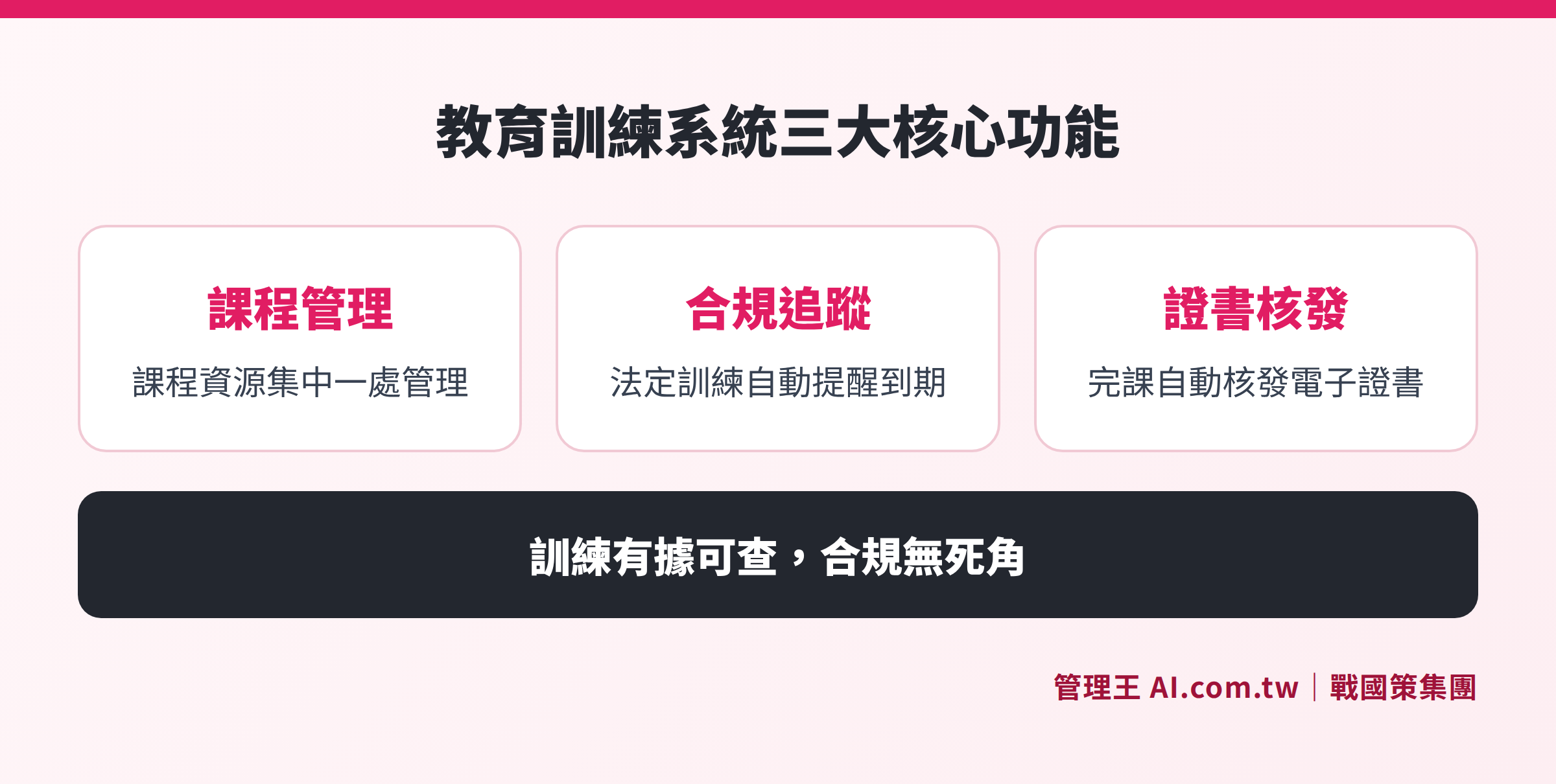
Six functions of the education and training system: course catalog, assignment tracking, attendance records, automatic certificate issuance, compliance reminders, budget management
Legal Requirements in Taiwan: Which Training is Legally Required?
Many SME owners believe that "education and training are optional", but according to the Occupational Safety and Health Education and Training Regulations (National Regulation Database Regulation Code N0060010), employers have a legal obligation regarding "specific education and training". Failure to comply may lead to penalties in accordance with Article 32 of the Occupational Safety and Health Act.
Below are the main legal requirements summarized:
Table: Main Types of Required Training Under the Occupational Safety and Health Education and Training Regulations
| Training Audience | Minimum Hours | Frequency | Regulatory Basis |
|---|---|---|---|
| New Workers (General) | 3 hours or more | Before starting work | Article 17 of Occupational Safety and Health Education and Training Regulations |
| Occupational Safety and Health Supervisors | 6 hours or more | Every 2 years | Article 18 of the same regulations |
| General Employees | 3 hours or more | Every 3 years | Article 18 of the same regulations |
| Special Equipment Operators | 6 hours or more | Every 3 years | Article 18 of the same regulations |
Violations and Penalties: Violating Article 32 of the Occupational Safety and Health Act by failing to provide education and training to workers can subject employers to penalties ranging from NT$30,000 to NT$150,000 (as announced by the Ministry of Labor).
In addition to occupational safety and health, companies must also pay attention to:
- Gender Equality: The Gender Equality in Employment Act requires employers to regularly provide training for sexual harassment prevention.
- Personal Data Protection: The Personal Data Protection Act requires employees who handle personal data to receive training.
- Anti-Bribery Compliance: For publicly listed and foreign enterprises, internal control compliance training is usually mandatory.
Understanding in One Sentence
The core value of an education and training system is not just learning convenience but also transforming the company’s "legal training obligations" from manual tracking to automated system management, providing complete records during labor inspections.
What are the Main Types of Corporate Employee Training?
Before understanding system functions, it is beneficial to clarify the scope of "corporate education and training" to assist in subsequent course planning. In practice, the training needs of SMEs can be broadly categorized into the following three types:
1. Legal Compliance Training
This includes occupational safety and health training, sexual harassment prevention training, personal data protection training, etc., which are courses that employers must regularly conduct as mandated by government regulations. This type of training has specific hour requirements and reporting obligations; failing to comply poses a risk of fines and is the core compliance management scenario for corporate education and training systems.
2. Functional Training (On-the-Job Training)
Designed for employees' core job skills, such as sales techniques training for sales personnel, product knowledge tests for customer service representatives, and standardized operating procedures (SOP) confirmation for factory operators. This type of training directly impacts employee performance and is typically conducted by direct supervisors or internal trainers within the department.
3. Career Development and Leadership Training
This includes training for managerial promotions, cross-department rotation learning, and external training subsidies, which are long-term investments in building the organization's talent pipeline. Medium to large enterprises typically design a "learning passport" system that requires employees to accumulate a certain number of training hours each year, linked to annual promotion evaluations.
4. External Platform Course and Certification Management
Many companies subsidize employees to participate in external training (such as PMP project management certification, Google Analytics certification, online learning platform Hahow courses), and these external learning records should also be managed within the system to give companies a complete picture of each employee's capabilities and provide objective data during performance discussions.
Theattendance and sign-in system and electronic signature center integration allows for attendance confirmation for in-person classes and cost reimbursement for external training, all completed within the same system, saving HR the cost of switching between different tools.
What Issues Can a Corporate Education and Training System Solve?
Before implementing a system, many SMEs usually face the following challenges regarding education and training:
- Course materials scattered across supervisors’ computer hard drives, company NAS, and WhatsApp groups.
- New employees are guided by "veterans", with no systematic record of what was covered and to what extent.
- HR must manually track "how many hours a particular employee has taken this year" by sifting through Emails or asking supervisors.
- Records of mandatory safety and health training are based on paper sign-in sheets, which are frantically organized right before annual labor inspections.
The following are the improvements most commonly reported by companies after implementing a system:
Saves HR Administrative Time: Course assignments, reminders, and record consolidation are automatically managed by the system, allowing HR to shift focus from administrative work to talent strategy planning.
Increases Training Completion Rates: The system automatically sends reminders (via LINE, Email) before deadlines, proving to be more efficient and less prone to oversight than manual reminders.
Enhances New Employee Retention: New employees with a structured 30/60/90 day learning path adapt faster during their first three months compared to those relying solely on verbal instructions, resulting in generally lower turnover rates (according to the latest research from supervisory agencies).
No Pressure for Compliance Audits: Automatic reminders for legal training expiry dates and automatic archiving after training completion mean records can be exported with one click during labor inspections, eliminating the need for manual paper organization.
How to Plan an Effective Employee Training Process?
An effective employee training process typically consists of four stages:
Stage One: Needs Assessment (Training Needs Analysis)
First, confirm: What capabilities is the organization currently lacking? Are there any new regulatory requirements for additional training modules? What skill gaps are indicated in employee performance reports? Only after the inventory can one avoid "training just for the sake of training".
Stage Two: Course Design and Resource Organization
Decide which courses will utilize internal trainers, which will purchase external courses, and which will access third-party platforms (such as Hahow, Udemy). The course length, exam questions, and passing criteria should be predetermined.
Stage Three: Assignment Execution and Tracking
Set mandatory course deadlines via the system, send automatic reminders, and track progress during class. Managers can check the overall completion rates of their department anytime, without needing to wait for HR to manually export reports.
Stage Four: Evaluate Effectiveness and Adjust
Post-training surveys, test scores, and comparisons of performance scores before and after training serve as bases for evaluating whether the training was effective. Data is necessary to judge which types of courses to invest in further and which low-performing training sessions to discontinue.
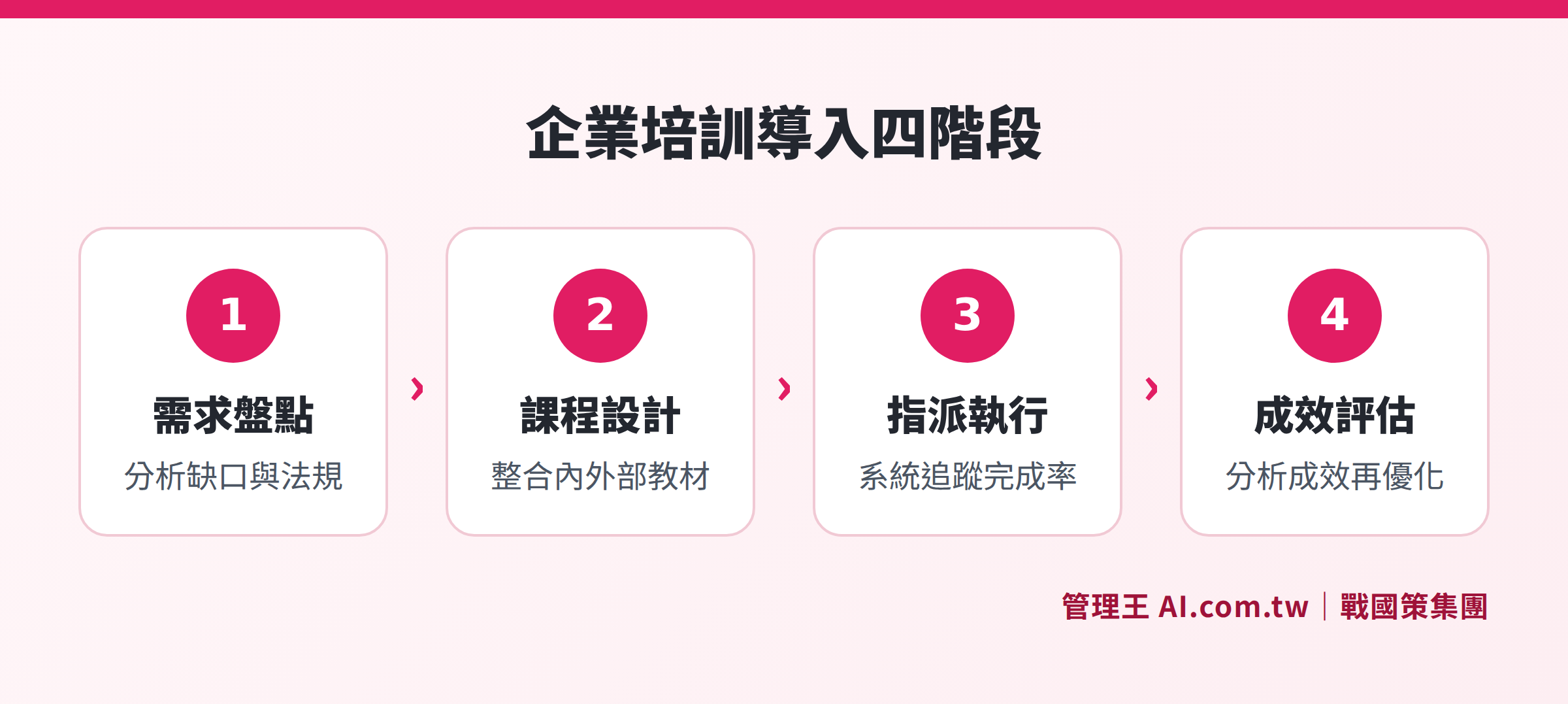
Four steps to implement a corporate education and training system: needs assessment → course design → assignment tracking → effectiveness evaluation
What is the Difference Between an Education and Training System and an Onboarding System?
This is a common point of confusion for business owners. Simply put:
- Onboarding System: Focuses on the "first 90 days" of new employees, helping them quickly integrate into organizational culture, understand company processes, and establish networks.
- Education and Training System (LMS/Training Management System): Covers the continual learning of all employees, including ongoing education, legal compliance training, and skill certification, spanning the entire employment period.
The ideal scenario is for both to be integrated into the same system, allowing new employees to seamlessly transition from onboarding training to long-term capability development paths without needing to switch between different tools.
Table: Comparison of Onboarding System vs Education and Training System Features
| Feature Area | Onboarding System | Education and Training System (LMS) |
|---|---|---|
| Primary Audience | New employees within 90 days | All active employees |
| Timeline | From onboarding to confirmation | Throughout employment |
| Core Functions | Learning maps, mentor matching, challenge assessments | Course catalog, legal training, certificate issuance |
| Regulatory Compliance | No specific regulatory requirements | Legal courses on safety, gender equality, personal data, etc. |
| Effectiveness Measurement | Adaptation surveys, confirmation ratings | Training hours, test scores, performance correlation |
What Evaluation Indicators Should Be Considered When Purchasing an Education and Training System?
Education and training systems on the market range from foreign major brands (SAP SuccessFactors, Cornerstone) to local solutions in Taiwan. When evaluating, it is recommended to consider the following five dimensions:
1. Regulatory Compliance
Does it have built-in templates for Taiwan's occupational safety, gender equality, personal data, and other legal courses? Will the system update to remind of regulatory changes? This directly relates to compliance risk management.
2. Integration Depth
Can the education and training system directly communicate with payroll, performance, and personnel systems? Or does it require API integration and additional fees? A "siloed" system forces HR to maintain employee records across multiple systems, increasing the risk of errors during personnel changes.
3. Employee Usage Threshold
If employees need to download a separate app or create another account and password, the completion rate is typically lower. Systems that integrate LINE notifications and allow direct access via mobile browsers tend to have higher employee acceptance.
4. Localization of Taiwanese Regulations
Foreign LMS systems often do not include reminders for Taiwan's labor regulations. If settings need to be adjusted manually, HR must be familiar with the rules to configure them correctly, raising the risk of errors.
5. Cost Structure Transparency
Some systems have low base costs, but charge separately for each feature module (certificate module, exam module, live class module), significantly exceeding budget after actual use. It is advisable to choose a plan with clear functions and all-inclusive pricing to avoid unexpected costs.
How to Implement Corporate Education and Training with 管理王?
管理王 AI.com.tw Education and Training System is part of the EIP (Enterprise Information Portal) system, integrated natively with personnel, payroll, performance, and other modules without the need for additional API connection fees.
Course creation is as simple as uploading materials: Videos, PDFs, and external links can all be directly added to the course catalog. Records of internal classes and learning from external platforms (Hahow, Udemy, Coursera) can be managed together in one system without maintaining two separate systems.
Assignments and reminders are handled automatically: Once a course is set as mandatory, the system automatically sends LINE notifications to designated employees and reminds them as deadlines approach. Managers can view departmental completion rates in real-time on the management backend, without needing to wait for HR to report.
AI recommends personalized learning paths: The system suggests the most suitable elective courses based on employees' positions, historical test scores, and performance data, transforming learning from "passive response" to "active growth".
Completion certificates are issued automatically: The AI course certificate module automatically generates PDF certificates for employees after they complete courses and pass tests, logging accumulated training hours. During labor inspections, HR can directly export records of employee training completions.
Management of legal training compliance: Before legal courses on occupational safety, gender equality, and personal data reach expiration, the system actively reminds HR to arrange training and records each employee's completion status, helping prevent missed legal obligations due to busyness or personnel transitions.
管理王 offers a free plan for permanent use where teams with fewer than 10 people can use the education and training features for free, evaluating upgrade options once needs have been met. By integrating with the Onboarding System, Performance Management, Payroll System, and AI Knowledge Base, a complete talent development loop from onboarding to departure can be built without needing to integrate multiple tools.
For more information on plans, refer to 管理王 Services or consult free advisory services to assess the most suitable training system structure.
Free Trial of the Corporate Education and Training System
Consultants assist in planning course catalogs, tracking legal compliance, and issuing certificates, enabling SMEs to go live within a day, with a free plan for permanent use.
Free consultation hotline: 0800-003-191
Official LINE account: @119m
Official website: app.AI.com.tw
Free trial: Apply for 管理王 now
Frequently Asked Questions
How many employees does a company need to implement an education and training system?
There is no hard threshold. Typically, under 10 people can manage training with verbal guidance from supervisors; once it exceeds 15 to 20 people, the labor costs for course records and legal compliance tracking significantly increase. If the company has multiple departments or locations, it is advisable to implement a system early to avoid dispersed training records that are difficult to tally.
Can the education and training system manage records for external training (such as external courses and seminars)?
Yes. A good corporate education and training system should support manual import of external learning records, including self-funded participation in seminars, government-subsidized training courses, and externally obtained certifications, allowing the company to maintain a comprehensive view of each employee's complete capabilities.
How long should records of legal occupational safety training (職安衛) be kept?
According to the Occupational Safety and Health Education and Training Regulations, employers should retain labor education and training records for at least 3 years. In practice, to comply with labor inspections and tax declarations, many companies retain them for 5 to 7 years. Using digital systems for management is generally easier for long-term preservation than paper records.
Does the education and training system support online testing and automatic grading?
Yes. Modern LMS systems typically support automatic grading for multiple-choice, true/false, and ranking type questions, with the ability to set passing criteria; those who do not pass must retake the training before being tested again to ensure quality of learning. Test scores are automatically recorded in the employee's learning file.
How long does it typically take for SMEs to implement an education and training system?
For a cloud-based SaaS system, basic setup (creating a course catalog, setting employee accounts, assigning initial mandatory courses) usually takes 1 to 3 business days. The complete content build (including recording instructional videos and designing exam questions) depends on the number of courses, typically requiring 2 to 4 weeks. Compared to building a custom system, the lead time for implementing a SaaS solution is significantly shorter.
Sources
- Occupational Safety and Health Education and Training Regulations—National Regulation Database (Regulation Code N0060010)
- Ministry of Labor Occupational Safety and Health Administration's amended release of certain articles of the Occupational Safety and Health Education and Training Regulations (June 25, 2026)
- 管理王 AI.com.tw Education and Training System Feature Page
This article is for general information and does not constitute legal or labor regulatory advice. Actual training hours, penalties, and reporting requirements are subject to the latest announcements by the Ministry of Labor and the Occupational Safety and Health Administration.