What is an EIP System? Integrating Announcements, Forms, and Approvals for Corporate Portals|Recommendations for EIP Systems

An EIP system (Enterprise Information Portal) integrates announcements, electronic approvals, attendance, and knowledge bases into a single portal, addressing five major pain points faced by SMEs in Taiwan, such as delays in leave requests, announcements getting lost, and having too many accounts. The free plan can be used permanently.
An EIP system (Enterprise Information Portal) is a platform that centralizes a company's internal announcements, electronic approvals, attendance clock-ins, meeting room bookings, knowledge bases, and organizational directories in one place, allowing employees to log in with a single account to handle daily administrative tasks. In simple terms: ERP manages "people, goods, and finance" operational data, while EIP manages "the daily administration and collaboration of employees." SMEs in Taiwan often face issues like leave forms stuck in drawers, important announcements getting lost in LINE groups, and scheduling conflicts for meeting rooms. After implementing an EIP system, the approval process becomes digital, announcements are centrally managed, and operations can be conducted across devices, effectively resolving these daily administrative pain points.
What is an EIP System? From Definition to Core Concepts
The full name of EIP is Enterprise Information Portal. According to Wikipedia, EIP is defined as "a framework that integrates information, personnel, and processes across organizational boundaries, providing a secure unified access point." It has three recognized core characteristics:
1. Single Sign-On (SSO)
Employees need to verify their identity only once to access various interconnected systems, eliminating the need to remember multiple sets of usernames and passwords.
2. Integration Capability
Integrates functions and data from different departments and systems into a unified access interface, allowing employees to complete clock-ins, approvals, and announcements on the same screen.
3. Personalization
The system presents the most relevant information based on the user's department, position, and permissions, showing salespeople pending items for their customers, managers their approval queues, and HR personnel attendance irregularities.
The evolution of EIP has transitioned from static announcement portals in the mid-1990s, through process integration in the 2000s, to modern systems incorporating electronic approvals, mobile operations, and AI knowledge bases, becoming the core infrastructure of digital offices in enterprises.
What are the Differences Between EIP and ERP? A Table to Understand Their Roles
Many people are confused about the differences between EIP and ERP; although both are enterprise information systems, their positioning is entirely different.
Table: Comparison of EIP and ERP Functionality
| Comparison Items | EIP (Enterprise Information Portal) | ERP (Enterprise Resource Planning) |
|---|---|---|
| --- | --- | --- |
| Main Target Users | Daily administration for all employees | Finance, procurement, inventory, production, and other business departments |
| Core Functionality | Approvals, attendance, announcements, knowledge base, collaboration | Orders, inventory, accounting, payroll processing |
| Operational Frequency | Multiple times a day (clock-ins, approvals, checking announcements) | Triggered by business processes (purchasing, invoicing) |
| Main Users | All employees and managers | Specialized personnel in finance, procurement, warehouse management, etc. |
| Data Types | Administrative processes, communication records, documents | Numeric transaction data, accounts |
The best state for both: Integration within the same system. When leave approvals can automatically update payroll calculations and procurement requests can directly convert to ERP purchase orders, administrative efficiency can truly improve. 管理王 AI.com.tw's EIP Enterprise Information Portal and ERP system share the same employee and organizational data, eliminating the need for duplicate data entry.
In a nutshell:
EIP manages daily administrative collaboration among employees, while ERP manages business data; integration of both allows SMEs to achieve seamless administrative operations.
What are the Core Functions of an EIP System? An Analysis of Six Major Modules
Modern EIP systems go beyond just being a bulletin board; the following six major modules cover the most common administrative needs for SMEs in Taiwan:
Electronic Approval and Form Center
Leave, overtime, business trips, reimbursement, supplies requests—various application forms are fully digitized, and the system automatically submits applications according to the company's designated approval process. Managers receive LINE notifications on their mobile phones to approve or reject requests, and applicants can check approval status at any time, eliminating the frustration of "not knowing where it got stuck." The Electronic Approval Center also supports proxy settings and multi-level approvals, ensuring processes aren’t stalled when managers are on business trips.
Attendance Clock-In and Scheduling Management
GPS-based clock-ins and Wi-Fi sensing clock-ins allow field personnel to record attendance on-site. The Attendance clock-in system integrates scheduling tables and shift management, automatically updating attendance records after leave or overtime approvals, directly read for payroll calculations, eliminating the need for HR to manually reconcile.
Meeting Room and Resource Booking
Online booking for meeting rooms, projectors, company vehicles, and other resources, with the system automatically detecting scheduling conflicts and preventing double bookings. No more scenarios of whiteboard registrations leading to conflicts or two groups walking into the same meeting room. Meeting room booking supports additional equipment reservations, handling venue and equipment needs in one go.
Organizational Chart and Employee Directory
Organizational structure presented by department, title, and reporting lines, allowing for quick searches of employee names, revealing their titles, phone numbers, emails, and direct supervisors. New employees can know who to ask questions from day one, instead of always asking HR.
AI Knowledge Base and Company Announcements
Company regulations, SOPs, and product documents uploaded to the AI Knowledge Base can be queried directly in natural language by employees without digging through folders. Important announcements are published on the EIP homepage with tracking for acknowledgments, preventing them from being lost in LINE groups.
Instant Messaging and Online Video Conferencing
Team instant messaging provides departmental groups and cross-department communication channels, integrating online video conferencing. AI automatically organizes meeting minutes and tasks to ensure that decisions made in meetings are tracked.
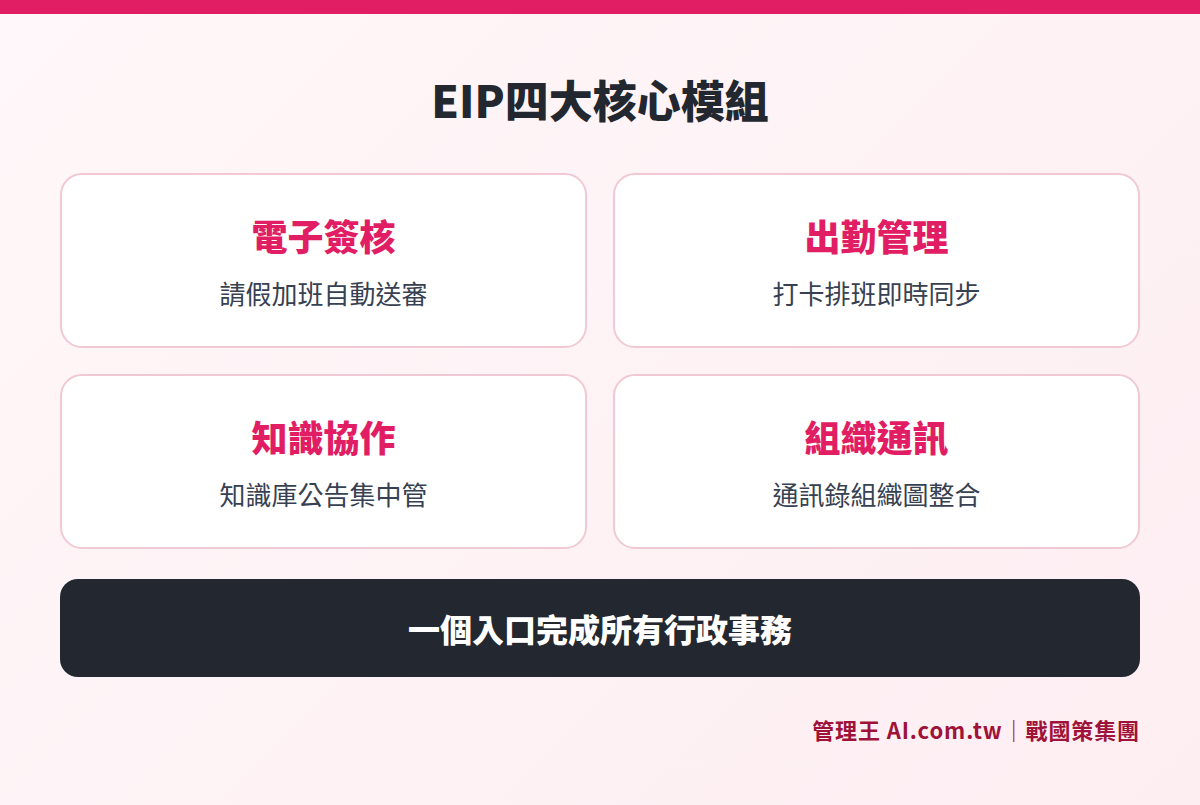
The six core modules of the EIP system: electronic approvals, attendance management, meeting room bookings, organizational directory, AI knowledge base, and instant messaging, all share the same portal.
Why Do Companies Need EIP Systems? Five Administrative Pain Points
For SMEs in Taiwan with more than ten employees, the following five issues almost certainly arise:
Table: Five Major Administrative Pain Points vs. EIP Solutions
| Pain Points | Current Situation Description | EIP Solutions |
|---|---|---|
| --- | --- | --- |
| Paper Approval Delays | Managers on business trips leave reimbursement requests unattended on their desks | Electronic forms automatically submitted based on processes, with LINE notifications for mobile approvals |
| Announcements Get Lost | Important regulations shared in LINE groups are hard to locate the next day | Announcements centralized on the EIP homepage, tracked for acknowledgment, and archived permanently |
| Meeting Room Conflicts | Oral bookings or whiteboard registrations often lead to clash | Online booking automatically checks for conflicts and displays real-time availability |
| Excessive System Accounts | Different systems for clocking in, approvals, and an Excel directory | A single portal integrating all administrative functions, handled through one account |
| Slow Onboarding for New Employees | Unable to find regulations, not knowing whom to ask, and unfamiliar with processes | Organizational charts, knowledge bases, and automated onboarding processes accelerate adjustment |
According to Forrester Research's 2006 survey, 46% of large enterprises have adopted employee portals (Enterprise Portals); modern SaaS EIP systems allow SMEs to enjoy equivalent functionalities at reasonable costs.
How to Choose the Right EIP System for Your Company? Five Evaluation Criteria
The functionality of EIP products on the market varies widely. It is recommended to assess the following five aspects before making a choice:
1. Flexibility of Electronic Approvals
Can form fields and multi-level approval processes be customized? Are there proxy settings, additional approvals, or rejection features? If the approval process is rigid and cannot be modified, any organizational adjustments will require reconfiguration, significantly increasing maintenance costs.
2. Level of Mobility
Can managers approve requests using their mobile devices or LINE instead of only using desktop computers? Managers in SMEs in Taiwan often travel, so mobile approvals are a basic requirement, not just an added bonus.
3. Automated Integration with Attendance and Payroll
Do leave or overtime approvals automatically update attendance records and feed into payroll calculations? Or is manual input required from HR again? Automated integration can eliminate the risk of human transcription errors.
4. Degree of Integration for Knowledge and Collaboration
Are announcements, documents, knowledge bases, and directories centralized on one platform and easily searchable? If knowledge is scattered across Google Drive, LINE groups, and physical folders, the EIP will have no real effect.
5. Permission and Audit Mechanisms
Can employees from different departments only see the data they should? Are approval records traceable and exportable? This affects the company's data security and compliance requirements.
Common Pitfalls:
- An EIP is just a collection of external links, with actual operations conducted in other systems.
- Operational exclusively on desktop; processes halt when managers are on business trips.
- Systems have too many features but lack localization; interfaces are entirely in English, not in compliance with Taiwan regulations (Labor Standards Act, Personal Data Protection Act).
The AI Features of EIP Systems: Differences Between Modern EIP and Traditional Portals
Early EIPs were positioned as "bulletin boards plus system link collections" where employees only saw static announcements and external links after logging in; modern EIPs have significantly evolved, with deep integration of AI becoming a mainstream trend. The following compares the functionalities of traditional EIPs and modern AI EIPs:
Table: Comparing Functions of Traditional EIPs vs. Modern AI EIPs
| Functionality Aspects | Traditional EIP (Before the 2010s) | Modern AI EIP (2020s) |
|---|---|---|
| --- | --- | --- |
| Information Presentation | Static announcements, link collections | Personalized dashboards based on positions |
| Knowledge Queries | Searching keywords to find documents | Natural language questions with real-time responses |
| Meeting Minutes | Manually typed meeting records | AI automatically organizes meeting minutes and tasks |
| Document Management | Folder structure storage | Semantic search across documents |
| Anomaly Detection | HR manually checks attendance anomalies | AI automatically detects anomalies and pushes notifications |
| Resume Screening | HR reviews each application | AI auto-scores and ranks candidates |
The core advantage of modern AI EIP lies in "proactive information push": the system actively pushes the most important information to employees based on dates, positions, and pending statuses, rather than waiting for employees to actively seek it out. When managers open the EIP in the morning, they can directly see the number of documents awaiting signatures, attendance anomalies, and overdue tasks, without needing to click through various functions to understand the situation.
管理王's AI knowledge base allows employees to ask company regulations verbally: by entering "how is annual leave calculated," the system can directly find the corresponding section from the uploaded labor manual instead of dumping a folder for employees to sort through. Coupled with the AI meeting minutes feature, meeting summaries and task lists can be generated within minutes after an online video call and automatically distributed to relevant personnel, ensuring that decisions are truly executed.
How to Use 管理王 EIP? Instructions for Practical Operations
The EIP Enterprise Information Portal provided by 管理王 AI.com.tw integrates modules for approvals, attendance, collaboration, and knowledge management. The following explains daily operational methods:
Employee Operational Workflow:
Clock in using GPS or Wi-Fi when at work; the homepage displays daily tasks, pending announcements, and calendars; when needing to apply for leave or reimbursement, select the appropriate forms and submit; the system automatically processes these based on workflow and sends them to managers for approval; when searching for information, simply ask the AI knowledge base to find relevant regulations.
Manager Operational Workflow:
Managers receive LINE push notifications for pending approvals on their mobile phones, clicking to view form details directly for approval, rejection, or request for additional information; dashboards consolidate team attendance anomalies, missing daily reports, and pending task progress in one view; performance reviews and payroll anomalies are also displayed collectively, eliminating the need to access three different systems.
HR Operational Workflow:
The Onboarding Automation feature automatically assigns onboarding task lists and training courses based on job titles; attendance analysis dashboards show monthly attendance anomaly rankings; payroll calculations read approved leave and overtime records, instantly generating payroll reports without manual reconciliation.
Free Plan Available for Permanent Use: The free plan from 管理王 supports up to 10 members, allowing usage of core EIP functions, making it suitable for small teams just starting out. View Pricing Plans to understand the differences among options.
In addition to EIP, 管理王's platform also includes CRM Customer Management, HR Payroll System, and Task Management, allowing SME owners to manage with one account without needing to purchase multiple software solutions.
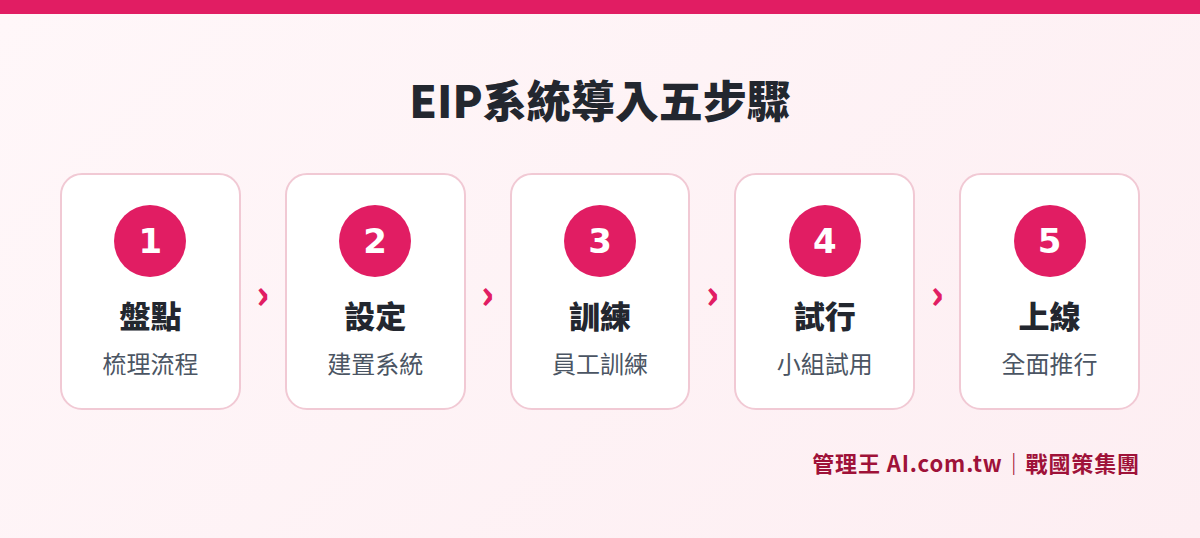
A flowchart of the five steps from assessing needs to EIP system implementation and usage.
Considerations for Implementing an EIP System
When implementing an EIP system, several factors can directly impact effectiveness:
- Clarify Approval Processes First: Before implementation, clearly outline the approval levels and proxy settings for various application forms, allowing the system to set up according to the company's actual conditions.
- Centralize Migration of Announcements and Documents: Upload important announcements and regulations previously scattered across LINE, email, and Google Drive to enable the knowledge base to work effectively.
- Prioritize Employee Training: Training on clocking in and submitting leave requests should come first, with manager approvals following; ensuring the basic processes are functioning before advancing to more complex features.
- Test and Roll Out in Phases: Begin with one department or process to pilot, confirming everything works before rolling out to the entire company.
Common Reasons for EIP Implementation Failures
Failures in EIP implementations often stem from issues with the implementation strategy rather than the system functionality. The most common reasons include:
1. Not addressing the "why use it" question. If employees find paper approvals convenient and do not understand the reason for the change, the system's powerful features may still result in low usage rates. Prior to implementation, it is advisable to communicate the specific benefits of using EIP, such as "no need to wait for managers to return for approvals, as you can also approve online while on business trips," which motivates employee cooperation in the transition.
2. System settings do not reflect actual company processes. If the approval processes set in the system do not match reality, such as needing three levels of approvals for a form but only having two set in the system, employees will revert to using old methods after encountering obstacles. Spending time interviewing department heads beforehand to confirm the approval logic for all form types is key to a successful implementation.
3. No designated internal champion for implementation. EIP implementations require a contact person to answer colleagues' questions, report system issues, and drive the implementation timeline. If this role is vacant, the implementation period often takes three to five times longer than expected. It is recommended to designate an IT or administrative manager as the project leader to work with the EIP vendor's consultants.
If you need assistance with planning the implementation, you can utilize 管理王's free consulting services (available for scheduling after the free trial) to assess suitable options and implementation steps.
Inquire Now About EIP System Implementation Solutions
管理王 consultants provide free assessments to help you plan integration of announcements, electronic approvals, and attendance within the EIP system, fully digitizing administrative processes.
Free consultation hotline: 0800-003-191
Official LINE account: @119m
Official website: app.AI.com.tw
Free trial: Apply for 管理王 now
Frequently Asked Questions
What is the difference between EIP and ERP systems?
ERP (Enterprise Resource Planning) manages enterprise data related to procurement, sales, finance, and production, primarily used by professionals in finance, procurement, warehouse management, etc. EIP (Enterprise Information Portal) manages daily administration and collaboration for all employees, including approvals, attendance, announcements, and knowledge bases. The best state for both is integration within the same system, allowing leave approvals to automatically feed into payroll calculations without repeating manual entry.
How many employees are suitable for implementing an EIP system?
Companies with ten or more employees are very suitable for EIP systems. Once the number exceeds ten, the cost of oral coordination and paper form management quickly rises; implementing EIP can significantly improve processing efficiency for approvals, announcements, and attendance. Smaller teams can also try the free plan as a trial before upgrading as their business grows.
Does the electronic approval within EIP systems have legal effectiveness?
According to Taiwan's Electronic Signature Act, legally compliant electronic signatures hold the same legal weight as handwritten signatures. 管理王’s electronic approval process maintains complete operation records and timestamps, serving as audit evidence. For formally contracted electronic signatures, 管理王 also has integrated digital certificate electronic signature functions that comply with the Electronic Signature Act regulations. For detailed legal implications, it is advisable to consult with a legal professional.
Can managers approve requests on their mobile phones?
Yes. 管理王 EIP sends notifications for pending approvals through LINE and email. Managers can click on the notifications on their mobile devices to directly view form details and approve, reject, or request additional documents without needing to return to their office to access a computer.
Will leave approvals automatically feed into payroll calculations?
Yes. The leave requests approved in 管理王 EIP will automatically write into attendance records, and when payroll calculations are conducted, the data includes already approved leave and overtime records, reducing the risk of payroll calculation errors due to manual inputs.
What are the typical costs associated with an EIP system?
管理王 offers a free plan (up to 10 members, for permanent use) for small enterprises to try. Paid plans start at NT$5,000/month (economic plan for companies with fewer than 30 employees). For detailed plan differences and functionalities, please refer to the pricing plan page, subject to the latest announcements on the official website.
Data Sources
- Wikipedia: Enterprise Information Portal
- Wikipedia: Enterprise portal
- 管理王 AI.com.tw EIP Enterprise Information Portal Functionality Page
- 管理王 AI.com.tw Pricing Plans
- Legality of electronic signatures: The Republic of China's Electronic Signature Act (National Regulations Database https://law.moj.gov.tw)