Recommended Electronic Approval System: 7 Essential Features for Small and Medium Enterprises|Approval System Recommendations
作者:戰國策集團

This article organizes 7 essential features small and medium enterprises should consider when selecting an electronic approval system, including multi-form design, conditional multi-layer approvals, LINE mobile approvals, audit trails, and integration with payroll clocking, along with an evaluation comparison table and suggestions for cloud vs on-premises deployment options.
The electronic approval system allows enterprises to fully digitize internal application processes that require supervisor consent, such as leave requests, overtime, procurement, expense reimbursement, and document approvals, replacing the inefficient model of paper-based forwarding and chasing for signatures. Choosing an electronic approval system suitable for small and medium enterprises focuses not only on "online approvals" but also on whether it supports multi-layer conditional processes, deep integration with clocking payroll, and enables supervisors to approve via LINE with a single click. This article organizes the 7 essential features small and medium enterprises should consider when selecting an electronic approval system, accompanied by an evaluation comparison table to help you make the most suitable decision for your scale among numerous recommended options.
What is the difference between electronic approval and electronic signature?
Many business owners often confuse electronic approvals (e-approval) with electronic signatures (e-signature), but their applicable scenarios and regulatory requirements are entirely different and must be clarified when choosing a system.
Electronic approval refers to the internal authorization approval process within an enterprise, for example, an employee applying for leave or a supervisor approving a purchase order. This type of process does not involve the agreement of external contracting parties and is not mandated by the Electronic Signature Law. It only requires the system to record the identity of the user logging in, the operation time, and the complete record of the approval process for internal management purposes.
Electronic signature is used when both parties need to sign external contracts (service contracts, rental agreements, employment contracts). According to Article 4 of the Electronic Signature Law, if an electronic document requires a signature or seal as stipulated by law, using a digital signature is presumed as a personal signature or seal. Electronic signatures must interface with certificate authorities (CA) registered with the Ministry of Digital Affairs to possess full legal effectiveness.
Table: Comparison of Electronic Approval vs Electronic Signature
| Item | Electronic Approval (Internal) | Electronic Signature (External) |
|---|---|---|
| Applicable Scenarios | Leave requests, overtime, procurement, expense reimbursements | Client contracts, supplier contracts, employment contracts |
| Regulatory Basis | No mandatory external regulations, only internal company policies | Article 4 of the Electronic Signature Law |
| Technical Requirements | Login verification + audit trail recording | Digital certificate (CA) authentication |
| Implementation Difficulty | Lower, SaaS can be implemented quickly | Higher, requires connection to certificate authorities |
| Priority for SMEs | Yes (first address internal process efficiency) | Depends on the frequency of external contracts |
Small and medium enterprises usually start with electronic approval to address the efficiency of daily leave and procurement approvals, then introduce electronic signatures as needed to handle external contracts.
5 Most Common Electronic Approval Applications for SMEs
The electronic approval system can cover the vast majority of "need supervisor's approval" scenarios in enterprises, with the following 5 categories being the most common:
- Human Resource Applications: sick leave, personal leave, marriage leave, overtime applications, compensatory leave, business travel, corresponding with the attendance clocking system that automatically calculates working hours and remaining leave types.
- Expense Procurement: purchase requisition forms, travel reimbursements, expense verification, directly interfacing with the procurement management system to access inventory and supplier data in real-time.
- Document Signing: internal memos, policy updates, preliminary contract reviews, passed through internal levels before being sent to the electronic contract system for formal external signing.
- Payroll Authorization: overtime payment approvals, final settlement confirmations, automatically incorporated into the payroll calculation system to avoid duplicate input and eliminate payroll disputes.
- Performance Processes: KPI goal setting confirmations, performance interview record approvals, with data continuously linked after integration with the performance management system.
One Sentence Summary
The electronic approval system manages internal approval processes while the electronic signature handles external contracts; small and medium enterprises should first introduce electronic approvals to eliminate reliance on paper for leave, procurement, and reimbursements, shortening approval times from days to a few hours.
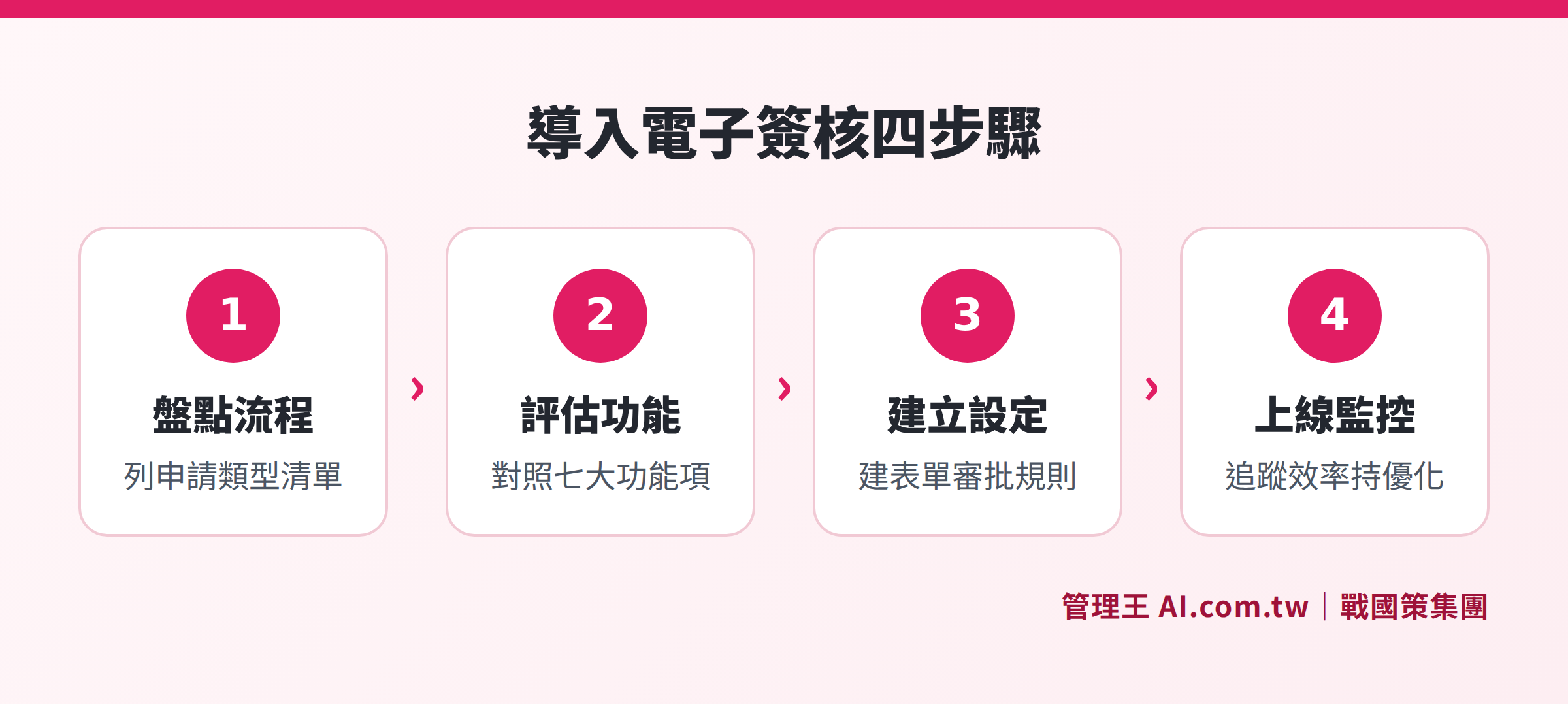
Complete implementation steps from inventorying existing processes, evaluating system features, establishing form settings, to officially launching and monitoring
7 Must-Have Features When Selecting an Electronic Approval System
1. Customizable Multi-Form Design
The system should come with pre-built forms for leave, overtime, business travel, procurement, reimbursements, documents, and also support customizable form fields, including calculation fields, attachment uploads, dropdown menus, and conditional displays (for example, the "attach quotation" field only appears if the requested amount exceeds a certain figure). If the system only provides fixed formats, special requests will require separate Excel sheets, greatly diminishing the e-approval effect.
2. Multi-Layer and Conditional Approval Processes
Support for serial signing (sequential step approvals), joint signing (submitted to multiple supervisors simultaneously, all must agree to be approved), and parallel signing (submitted simultaneously, approval from one person suffices) modes, and automatically assign different approvers based on the amount, application type, or the applicant's position level. For instance, if the procurement amount exceeds a certain threshold, the finance supervisor is automatically added to the approval; if leave exceeds three days, the highest supervisor of the department is added to approve.
3. One-Click Mobile Approval
Supervisors should receive notifications via LINE push, email, or app, without needing to log into a complex backend, allowing them to click a link to approve or return the application directly, while also supporting batch approvals (processing multiple applications at once), enabling them to clear pending approvals during commuting or meeting breaks.
4. Delegation and Timing Control
When supervisors are on business trips or leave, they should be able to designate an agent to receive pending approvals; the system should also set SLA reminders for delays, such as automatically notifying again if not processed within 24 hours, preventing process bottlenecks that affect employee work progress.
5. Complete Audit Trail
Every step recorded with details on who, when, and from which IP the approval was made. The system records the entire process and is tamper-proof. The audit trail is not only a compliance requirement but can also be immediately called upon during labor disputes or audits to clarify responsibility for each checkpoint.
6. Deep Integration with Payroll Clocking
Approved leave or overtime applications should automatically reflect in attendance records, eliminating the need for HR to manually transcribe; when calculating payroll, already approved overtime hours and types of leave should be directly factored in, significantly reducing human error and payroll disputes.
7. Localization and Compliance with Taiwan Regulations
The system interface should be in Traditional Chinese, supporting all leave types stipulated by Taiwan’s Labor Standards Act (annual leave, sick leave, personal leave, marriage leave, bereavement leave, maternity leave, paternity leave, family care leave), and the correct calculation of overtime pay at 1.34 times (for the first two hours on regular days) and 1.67 times (for over two hours on regular days), with the system automatically updating rules when regulations change.
Table: Evaluation of 7 Key Features of Electronic Approval Systems
| Feature Item | Description | Importance for SMEs |
|---|---|---|
| Customizable Multi-Form | Pre-built + customizable forms, flexible fields | ★★★★★ |
| Conditional Multi-Layer Approval | Automatically assigns based on amount, department, position | ★★★★★ |
| Mobile LINE Approval | Supervisor receives LINE notifications for immediate approval | ★★★★★ |
| Delegation and Timeliness Reminders | Business trip delegation + SLA delay notifications | ★★★★ |
| Audit Trail | Complete operation records that cannot be tampered with | ★★★★ |
| Integration with Payroll Clocking | Automatically reflects approvals to eliminate manual transcription | ★★★★★ |
| Taiwan Regulatory Localization | Comprehensive coverage of leave types with correct overtime calculation | ★★★★★ |
Cloud Subscription vs On-Premises Deployment: How Should SMEs Choose?
Electronic approval systems are mainly divided into two deployment methods, each suitable for different scenarios.
Cloud SaaS Subscription requires no server purchase and can be used from a browser; the monthly fee starts low, with system maintenance handled by the vendor; after amendments to the labor law, calculation rules are automatically updated, making it suitable for small and medium enterprises with 10 to 300 employees to go live quickly.
On-Premises Self-Hosted data stays in the company's own data center, allowing for high customization, but requires high upfront investment (hardware procurement, IT maintenance manpower, development costs), suitable for large enterprises or specific industries (like finance, healthcare) with special security compliance requirements.
For small and medium enterprises, cloud SaaS is the preferred choice, offering quick implementation, no IT pressure, and transparent costs. If there are specific needs, local SaaS providers that support custom development can be chosen, for instance, 管理王 offers customizable services at a transparent rate of NT$1,000/hour, balancing flexibility and efficiency.
For detailed implementation planning, refer to the Complete Guide to Online Approval Systems: Digitalizing Approval Processes and Implementation Steps.
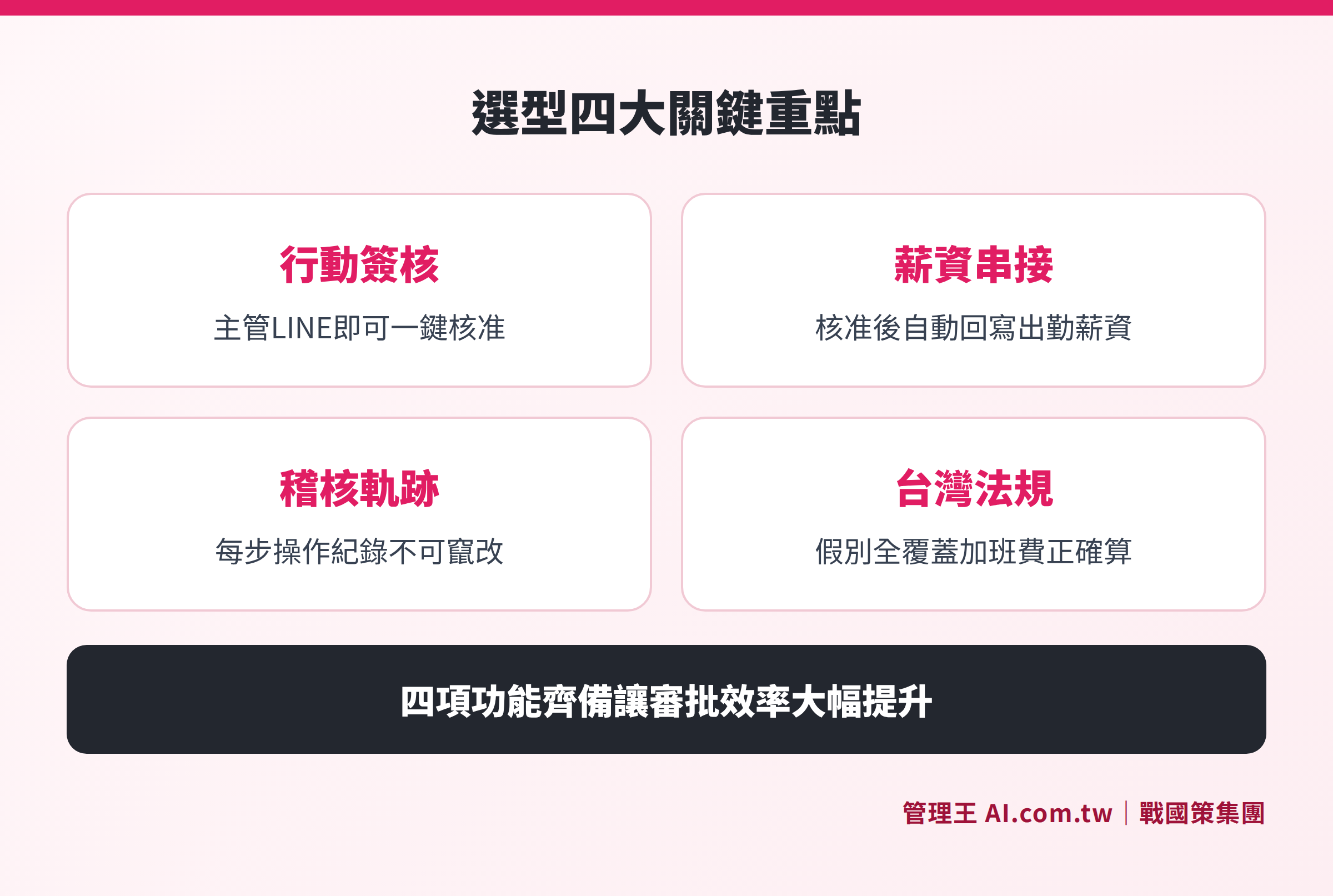
Key explanations of mobile signing, payroll integration, audit trails, and compliance with Taiwan regulations
3 Things to Confirm Before Implementing an Electronic Approval System
First, inventory current processes: List all application types that require supervisor approval, the approval levels for each process, and the current average waiting times. This list is the basis for setting up forms and approval paths; skipping this step often leads to mismatches between system settings and actual needs.
Second, confirm system integration requirements: If the company already has a clocking system or payroll software, the new electronic approval system must be able to integrate with them; otherwise, data will become siloed, and HR will still need to manually transcribe. When selecting, confirm the vendor’s API integration capabilities or native integration methods.
Third, plan employee training for implementation: A great system is ineffective if employees don't use it. Evaluate the system's ease of use for employees (especially those who do not frequently use computers) during selection, and confirm the training content provided by the vendor, whether remote or on-site.
How to Use 管理王 AI.com.tw
管理王's Approval Center covers the 7 features mentioned above, specifically designed for the business habits of small and medium enterprises in Taiwan:
- Six Predefined Forms: Leave, overtime, business travel, procurement, reimbursements, document signing, and also customizable forms to meet the needs of different departments
- Conditional Multi-Layer Processes: Automatically add finance supervisors if amounts exceed thresholds; automatically add the highest supervisor for leaves over three days; supports three modes of serial, joint, and parallel signing
- LINE Mobile Approval: Supervisors can approve directly upon receiving notifications from the LINE Bot without switching systems
- Delegation and SLA: Designate agents during business trips; automatic reminders for processing delays over 24 hours to keep processes flowing
- Full Module Integration: Approved signatures are automatically written into the attendance system and payroll module, eliminating the need for HR to re-enter data, ensuring seamless information flow
- AI Approval Assistant: Summarizes pending items and suggests priorities for approval, allowing supervisors to clear pending tasks during commutes
The free plan can be used permanently, with teams of fewer than 10 people being able to directly enable all basic electronic approval features for free; for advanced AI features and more users, please refer to the service pricing page. The 戰國策 group serves over 30,000 enterprises, and 管理王's HR system covers comprehensive modules for approvals, attendance, payroll, and performance, all integrated under one account, eliminating the need to buy separate tools for each function.
Try the Electronic Approval System for Free Now
管理王 consultants assist in evaluating the most suitable electronic approval setup for small and medium enterprises, covering multi-layer approval processes compliant with Taiwan's labor laws; register for free in 30 seconds to use.
Free consultation hotline: 0800-003-191
LINE official account: @119m
Official website: app.AI.com.tw
Free trial: Apply for 管理王 now
Frequently Asked Questions
Does the electronic approval system need to comply with the Electronic Signature Law?
The internal approval processes for enterprises (leave, procurement, expense reimbursement) fall under internal authorization management and are not mandated by the Electronic Signature Law. It only requires the system to record the identity of the user logging in, the time of operation, and the approval history. If the approval involves external contracts (client contracts, supplier contracts), then compliance with the digital certificate requirements stipulated by the Electronic Signature Law is required, and can be handled separately with an electronic contract system.
Can the electronic approval system completely replace Excel leave forms?
Yes, it can completely replace them. The electronic approval system can not only support online applications and approvals but also automatically calculate the remaining leave days (based on the Labor Standards Act's annual leave regulations) and integrates with the payroll module to calculate deductions, while preserving all application history records, enabling one-click retrieval during year-end declarations and labor inspections, eliminating the time spent on manual Excel organizing and verification.
How long does it take to implement an electronic approval system?
Cloud SaaS solutions typically complete basic settings within one to three working days, including creating forms, setting up approval processes, and importing employee data. If there are complex custom processes (such as multi-layer approvals across companies or special condition routing), it may require longer planning and testing times. 管理王 provides remote implementation training to help enterprises get started quickly.
How can I ensure electronic approval records are valid in labor disputes?
Although internal approvals are not mandated by the Electronic Signature Law, complete system records (user identity, IP address, timestamp, operation details) still hold significant evidentiary value during labor disputes or inspections by the labor authority. It is advisable to choose systems that provide tamper-proof audit trails and store data in Taiwan, ensuring compliance with the Personal Data Protection Act's data sovereignty requirements.
Does the electronic approval system support multi-branch or multi-location management?
Yes. The 管理王 approval center supports multi-branch structures, allowing employees to belong to the main branch while supporting other branches, and automatic routing of cross-branch shift changes and leave applications to соответствовать supervisors; each branch can set different schedules and leave rules, ensuring centralized management without confusion.
Data Sources
- Electronic Signature Law (National Regulations Database), amended on May 15, 2024, governed by the Ministry of Digital Affairs
- Ministry of Digital Affairs Electronic Signature Business Description, checked on November 2026
- 管理王 AI.com.tw Approval Center Feature Page, checked on November 2026
- Complete Guide to Online Approval Systems (管理王 Blog), checked on November 2026