How to Calculate ERP System Costs? Breakdown of Licensing, Implementation, and Maintenance Fees|ERP System Recommendations
ERP system costs are composed of six main items: licensing, implementation consultancy, customization, data migration, training, and annual maintenance. For small and medium enterprises in Taiwan, the first-year costs range from NT$50,000 to NT$2,000,000. This article breaks down each cost item, compares the 5-year costs of cloud vs. one-time purchases, and outlines how to apply for government subsidies.
ERP system costs consist of six main items: "software licensing (or subscription), implementation consultancy, customization development, data migration, training, annual maintenance." The actual expenditure for small and medium enterprises in Taiwan in the first year is approximately NT$50,000 to NT$2,000,000, with differences depending on company size, whether opting for cloud subscription or one-time purchase, and how many core processes need to be integrated. Cloud ERP is priced based on monthly or annual subscriptions, requiring a low initial investment without the need to set up servers; whereas, one-time purchase has high upfront costs, but may result in lower total costs over the long term. Cost transparency is a major pitfall for SME owners—different vendors can quote prices that differ by up to ten times for the same requirements. This article dissects the six main cost items, compares the 5-year costs of cloud vs. one-time purchases, identifies common hidden costs, and shows how to effectively utilize government subsidies, so you are well-informed before requesting quotes.
What Comprises ERP System Costs?
Many business owners, when requesting quotes for the first time, only see the "system pricing" but forget to ask if the implementation consultancy fees are additional, or how much data migration costs. The complete ERP cost should include the following six items:
1. Software Licensing / Subscription Fees
Cloud ERP is billed on a monthly or annual subscription basis, with costs calculated based on "number of users × monthly fees" or "functional modules"; packaged ERP is purchased outright, with pricing based on the number of users and modules.
2. Implementation Consultancy Fees
Consultants assist with requirements gathering, system parameter settings, process planning, and go-live support; this is often the biggest variable influencing quotes. Fees are calculated based on consultant days or hours, where greater complexity leads to higher costs.
3. Customization Development Fees
Standard functions may not fit every company's processes 100%, leading some vendors to offer customization development services, billed by development hours.
4. Data Migration Fees
This involves importing customers, products, opening inventory, and opening accounting data from old ERP, Excel, or inventory systems into the new system; the larger the data volume and the more complex the formats, the higher the fees.
5. Training Fees
Training for employees on system operation before going live—some vendors include this in the implementation fee, while others charge extra.
6. Annual Maintenance Fees / Subscription Fees
After going live, packaged ERP requires annual maintenance payments to the original vendor (typically 15-22% of licensing fees); cloud ERP annual fees already include updates and technical support.
Table: Explanation of the Six Major ERP Cost Items
| Cost Item | Common Range for Cloud ERP | Common Range for Packaged Purchase | Remarks |
|---|---|---|---|
| Software Licensing / Subscription | NT$800–10,000 / month | NT$300,000–1,500,000 (one-time) | Number of users, modules, AI features have the largest impact |
| Implementation Consultancy | NT$30,000–300,000 | NT$200,000–800,000 | Manufacturing processes are complex, leading to higher costs |
| Customization Development | NT$1,000 / hour and up | NT$50,000–600,000 / module | Reduce customization where possible |
| Data Migration | NT$20,000–80,000 | NT$50,000–200,000 | The more historical data, the higher the cost |
| Training | Often included in subscription plans | NT$10,000–50,000 | Remote training is relatively cheaper |
| Annual Maintenance | Included in subscription fees | 15-22% of licensing fees / year | Long-term maintenance costs for packaged purchases can be underestimated |
In a nutshell
ERP costs are not just about "system pricing"; the sum of the six items is the true amount payable.
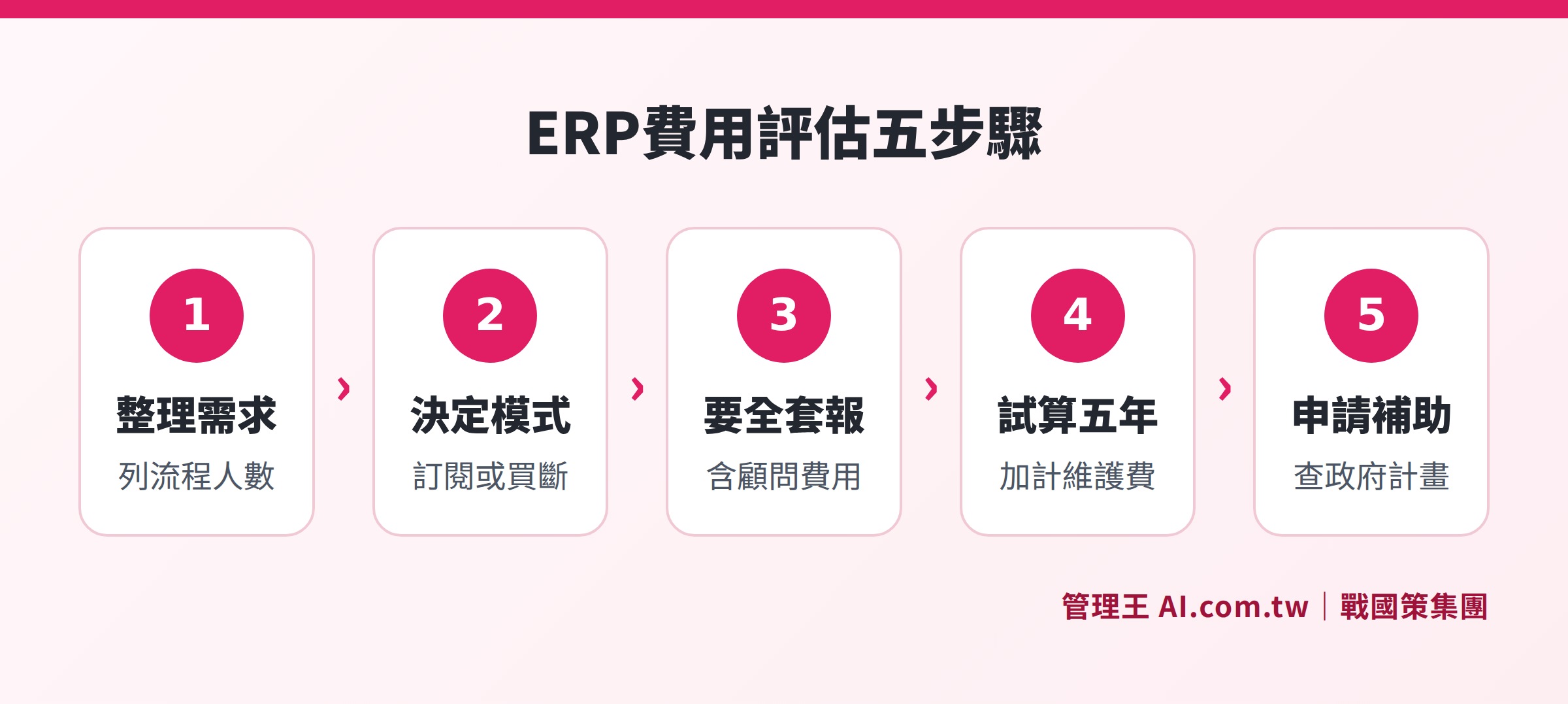
From clarifying needs to calculating the total cost over five years, the ERP cost assessment process
Cloud ERP vs. Packaged Purchase: How to Compare Cost Structures?
The cost differences between cloud ERP and packaged purchases are not simply about "monthly rent vs. one-time purchase"; both are also fundamentally different in terms of implementation speed, maintenance responsibilities, and system upgrade methods.
Cloud ERP (SaaS)
Initial investment is low; accounts can be used immediately after activation, without needing to purchase servers. Costs grow linearly with the number of users, with updates and backups handled by the service provider. Suitable for businesses under 50 people with relatively standard business processes.
Packaged Purchase ERP
High upfront software licensing costs, but the longer the duration and the more users, the lower the average cost per year. Requires purchasing one's own server or setting up a private cloud, with IT maintenance managed in-house. Suitable for enterprises with more complex processes, such as those with manufacturing BOMs or multi-company structures.
Table: Estimated 5-Year Costs for Cloud ERP vs. Packaged Purchase (for a 20-person company)
| Item | Cloud ERP | Packaged Purchase ERP |
|---|---|---|
| Software Costs (5 years) | NT$600,000–1,200,000 | NT$500,000–1,500,000 (one-time) |
| Implementation Consultancy Fees | NT$50,000–200,000 | NT$200,000–800,000 |
| Annual Maintenance Fees (5 years) | Included in subscription fees | NT$300,000–900,000 (15-22% × 5 years) |
| Server / IT Costs | None | NT$100,000–300,000 |
| 5-Year Total Estimate | NT$700,000–1,400,000 | NT$1,100,000–3,500,000 |
| Suitable For | Retailers with 50 or fewer employees | Manufacturing or process-heavy businesses |
For a 20-person company, if the duration is longer (over 5 years) and there are many users, the long-term total ownership costs for a packaged purchase may be comparable to cloud options; however, if the system is only replaced after 2-3 years, the losses for cloud subscriptions are smaller.
How to Evaluate Licensing Fees? Based on Users or Modules?
There are two main billing methods for ERP licensing fees, and different pricing logics can greatly affect companies of various sizes:
Billed by Number of Users
Each employee with an account must pay; costs directly double from 10 to 50 employees. This model is friendly for small companies, but expenses will rapidly increase during expansion.
Billed by Modules
Costs are fixed regardless of the number of users based on selected modules (e.g., inventory management, accounting, payroll). Suitable for companies with clear functional requirements and many users.
Hybrid Billing
Some vendors charge by "base package + additional modules," where the base package includes a fixed number of users, and additional seats must be purchased for exceeding the number.
When requesting quotes, be sure to clarify: "What are my account numbers / module lists / additional charges?" to facilitate accurate cost estimation.
Implementation Consultancy Fees: The Major Variable Affecting Budget
For the same ERP system, quotes from two consultancy firms can vary by three to four times due to factors such as "how many processes need to be modified" and "how complex the requirements are":
The More Processes, The Higher the Cost
Digiitalizing a single process (e.g., just inventory management) may require NT$50,000–150,000 in implementation costs; connecting quotations → orders → procurement → inventory → invoices → payments → accounting in the full process may cost NT$300,000–800,000.
Industry Type Affects Implementation Difficulty
Manufacturing industries require the establishment of BOMs, setting manufacturing order parameters and MRP settings, resulting in significantly higher time and costs compared to trading businesses; groups with foreign currency accounting or multi-company structures will see an additional layer of complexity.
Consultant Model Influences Costs
On-site consultants (requiring travel and accommodation payments) are more expensive than remote consultants; daily billed (approximately NT$8,000–20,000 / day) consultancy fees differ from hourly billing (approximately NT$1,000–2,500 / hour).
When requesting quotes, it’s advisable to require vendors provide a "written requirements specification + detailed implementation hours + phased milestones" to effectively control the uncertainty of consultancy costs.
What Are the Annual Maintenance Fees and Hidden Costs?
Many companies realize in the second or third year that there is still a significant fee to be paid annually. Here's a look at long-term costs that are often overlooked:
Annual Maintenance Fees (Packaged ERP)
The original vendor charges 15%–22% of the licensing fee annually for maintenance, including version updates and technical support. For a system priced at NT$1,000,000, the annual maintenance fee would be approximately NT$150,000–220,000, potentially exceeding the original licensing fee after ten years.
Secondary Customization Costs
Changes in business processes, new report formats, or integration with new third-party platforms may require additional development, with costs billed according to hours.
System Integration Fees
If integration with e-commerce platforms, logistics APIs, or government electronic invoicing is needed, each integration point can cost between NT$50,000–150,000.
Losses Due to Data Inaccuracy
Discrepancies between declared and actual inventory, or miscalculated costs, won't directly show up in system fees but can lead to greater real losses for the company.
Retraining Costs from Staff Turnover
When key operational staff leave, the training costs for newcomers (including hours and possibly consultancy fees) need to be considered in the long term.
How Should SMEs Budget for ERP Costs?
Based on the number of employees and complexity of requirements, the following budgeting strategies are recommended:
10–30 Employees, Relatively Standard Trading Companies
Prioritize opting for cloud subscription-based ERP, with initial investments between NT$50,000–300,000; the key is to clarify processes before implementation to reduce customization needs.
30–100 Employees, Companies with Production Manufacturing
Implementation consultancy fees and BOM setup fees are significant; it’s advisable to budget NT$500,000–1,500,000, and phased implementation (first going live with inventory and sales, then production, and finally finance) can effectively control risks.
Groups with Multiple Companies and Foreign Currency Accounts
Due to complex structures, it is recommended to set aside NT$1,000,000–3,000,000, and request vendors to provide a 5-year total cost of ownership estimation rather than only looking at first-year quotes.
Common Principles for All Sizes
- Request vendors to provide a total quote including consultancy (all-in), not just software costs
- Inquire about annual maintenance rates and convert to 5-year total cost for comparison
- Reduce customization where possible; first go live with standard processes, identify pain points, then decide on customization
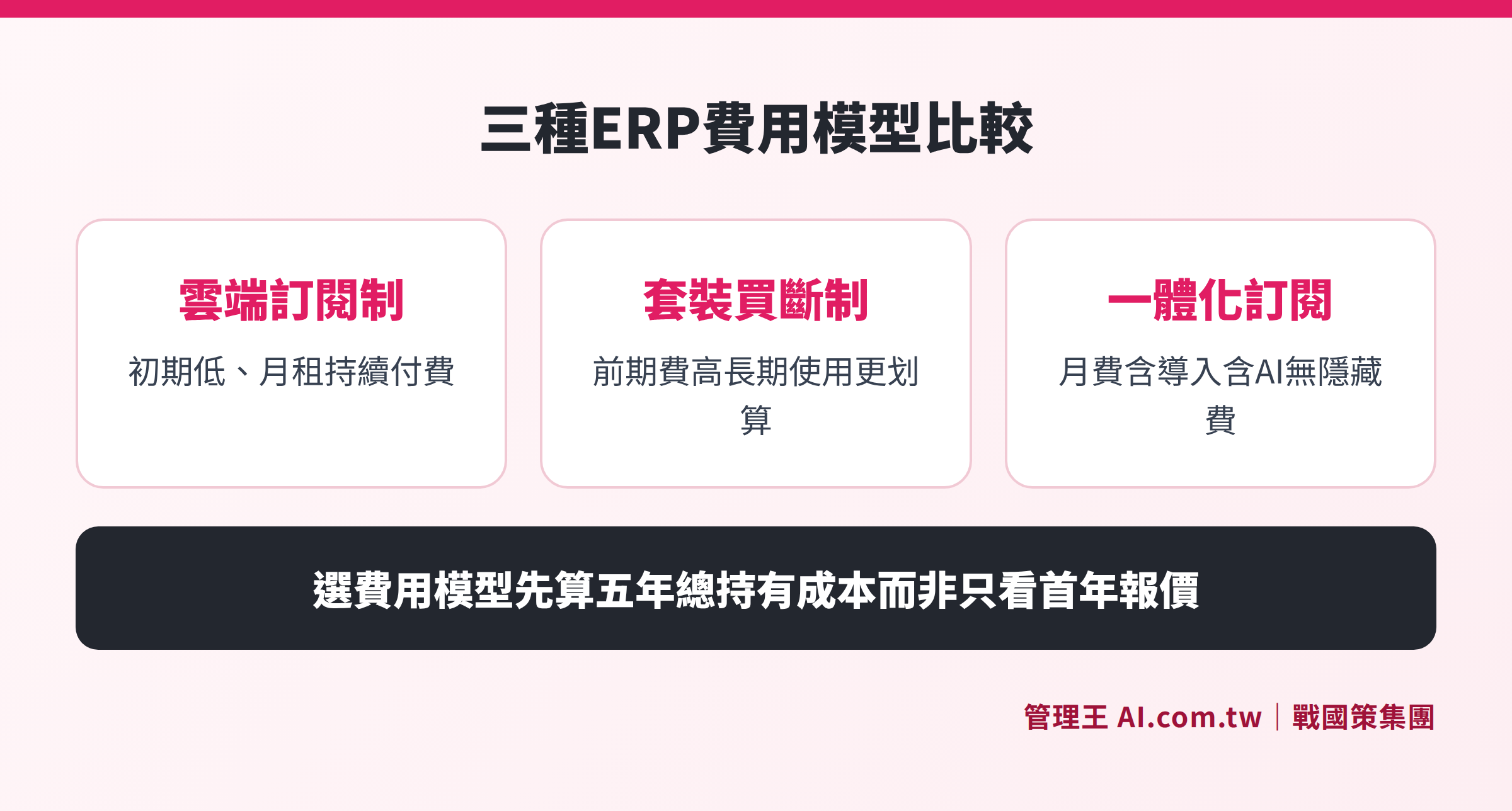
Comparison of cost structures and applicable company sizes for cloud subscriptions, packaged purchases, and all-in-one models
Can Government Subsidies Be Applied?
In Taiwan, there are various government subsidy programs to help small and medium enterprises lower the barriers to ERP implementation:
Ministry of Economic Affairs’ Small and Medium Enterprises Administration “Digital Transformation Strategic Project”
Eligible enterprises that meet SME certification standards can receive subsidies covering software subscription fees and implementation consultancy fees for digital tools like cloud ERP and CRM, with the subsidy proportion potentially reaching a certain percentage of project funds. The actual subsidy amount and requirements are subject to the latest announcements from the authorities, and it is recommended to check the Ministry of Economic Affairs’ Small and Medium Enterprises Administration website for the latest announcements.
Digital Transformation Subsidy for SMEs with Fewer Than 30 Employees
The Ministry of Economic Affairs provides subsidies for implementing digital tools for SMEs with fewer than 30 employees, covering cloud software fees (including ERP system subscription fees) and related training expenses, subject to the latest announcements on maximum subsidy amounts and application processes.
Notes on Applying for Subsidies
- Subsidies are typically available in one to two rounds each year, so it is advisable to prepare application documents 2–3 months in advance
- Enterprises usually need to self-fund a certain proportion, and the subsidy does not cover full costs
- The subsidy system may adjust annually, subject to the latest announcements from the Ministry of Economic Affairs’ Small and Medium Enterprises Administration; this article provides information for reference only
Using 管理王 AI.com.tw
管理王's ERP uses a monthly subscription model with a transparent cost structure:
- Free Plan: Forever free for companies with fewer than 10 users, including basic ERP modules (inventory management, procurement, inventory), suitable for small companies to assess whether the system meets their needs
- Economical Plan: NT$5,000 / month for up to 30 users, including the complete ERP modules (Quoting, Procurement, Inventory, Accounting, Payroll) plus 1,000 AI points
- Business Plan: NT$10,000 / month for up to 60 users, including 8 hours of remote implementation training
- Flagship Plan: NT$19,900 / month, no limit on the number of users, including 16 hours of remote training
- Customization Development: NT$1,000 / hour with transparent pricing, with free consultancy assessment confirming hours in writing before work begins
The unique feature of 管理王 is its clear cost structure: no module add-on fees, no hidden AI additional fees, and all AI functionalities (automated summarization, smart recommendations, natural language questions) are integrated into the subscription plan. If data from an old system needs to be migrated, customer lists, products, opening inventory, and opening accounting can all be imported, with dedicated personnel assisting in data conversion.
戰國策 Group serves over 30,000 enterprises, ensuring compliance with local regulations on electronic invoicing, labor insurance, payroll calculations, etc. Data is stored within Taiwan across dual data centers and meets ISO 27001 standards.
If you want to know the estimated costs for your company to implement an ERP system, you can first try the 管理王 ERP system for free, or refer to the Plans and Pricing page, or directly consult with an advisor to assess your needs.
For more information on selecting ERP systems, you can refer to:
- What is an ERP System? A Comprehensive Guide for SMEs from Inventory to Finance (Theme Overview)
- Recommended ERP for SMEs: A Selection List with Limited Budgets
- Pros and Cons of Cloud ERP: Which Type of Company is Suitable for Subscription Models?
- What Types are there for ERP Systems? Differences Between Cloud, Packaged, and Custom Types
Unclear about ERP costs? Let our advisors help you calculate
Describe your company's headcount and process needs, and 管理王’s advisors will provide free assessments of suitable plans and first-year implementation costs, offering written quotes for comparison.
Free Consultation Hotline: 0800-003-191
LINE Official Account: @119m
Official Website: app.AI.com.tw
Free Trial: Apply for 管理王 now
Frequently Asked Questions
Does ERP system cost have to be hundreds of thousands?
Not necessarily. Traditional large packaged ERPs often range from tens to hundreds of thousands due to extensive consultancy and customization fees. Cloud subscription-based ERPs can have much lower initial investments; small businesses with fewer than 10 employees may even have free options available. The key is to clarify which processes you need before choosing a suitable plan, and not to purchase a system that exceeds your needs for the sake of having a "complete set of functions".
Is a consultancy fee mandatory for implementing ERP?
Cloud ERPs typically offer online training resources, and some standard functions can be set up independently; however, if there are requirements for production manufacturing BOM, multi-currency accounting, or cross-system integration, it’s advisable to engage consultants to avoid configuration errors that may lead to data chaos later on. The cost differences are based on "how much you require consultancy", and it's not mandatory to incur full consultancy fees.
Must annual maintenance fees for ERP be paid?
Packaged purchase ERPs usually require payment of annual maintenance fees (about 15-22% of licensing fees) to benefit from version updates and technical support. If the maintenance fees are not paid, the system will continue to work but cannot be upgraded to newer versions. Cloud subscription ERPs have maintenance fees included in the monthly fees, and if the subscription is stopped, services cease.
Are there government subsidies for ERP implementation costs?
Yes. The Ministry of Economic Affairs' Small and Medium Enterprises Administration has several digital transformation subsidy programs, with coverage typically including cloud ERP subscription fees and implementation consultancy fees. The subsidy amount and application conditions may be adjusted each year, and it is recommended to visit the Ministry of Economic Affairs’ Small and Medium Enterprises Administration website or consult an advisor to confirm the latest announcements.
How to avoid overspending on ERP implementation costs?
Three key points: first, clarify your business processes and data conditions before asking for quotes to reduce back-and-forth costs during the consultant demand interview; second, require vendors to provide a "total quote including consulting" rather than only looking at software fees; third, adopt a phased implementation strategy to first go live with the most critical processes, assess the benefits, and then expand modules to avoid purchasing everything at once but only utilizing 20% functionality.
Data Sources
- How to Evaluate ERP System Prices and Quotes? Price Structures, 4 Paths, and Hidden Costs (Forever Webs) (Retrieved 2026)
- Overview of ERP Prices in Taiwan 2026: Cloud ERP Pricing, Vendor Price Listings (SoftPick) (Retrieved 2026)
- What are the Costs for ERP System Implementation? Pricing Guide 2026 (Youngming Info) (Retrieved 2026)
- ERP Implementation Costs: Why Do Same Requirements Have Quotes That Differ by Ten Times? (Yutuo Technology) (Retrieved 2026)
- Ministry of Economic Affairs’ Small and Medium Enterprises Administration (Government Digital Transformation Subsidy Program, subject to the latest announcements from the website)
- 管理王 AI.com.tw ERP System Features Page (Retrieved November 2026)
- 管理王 AI.com.tw Plans and Pricing (Retrieved November 2026)