What Types of ERP Systems Exist? Differences Among Cloud, Packaged, and Customized Types|ERP System Recommendations
ERP systems are mainly divided into three main types: cloud, packaged, and customized, with significant differences in deployment methods, cost structures, implementation speed, and customization flexibility. This article provides a comprehensive analysis from three perspectives: functionality comparison, business scale selection, and common pitfalls, helping small and medium-sized enterprises in Taiwan find the most suitable ERP solution.
ERP systems are primarily categorized into three types based on "deployment method" and "development model": Cloud ERP (SaaS subscription), Packaged ERP (on-premise license), and Customized ERP (tailor-made development). All three core functions integrate finance, procurement, inventory, and production processes, but they differ significantly in terms of implementation costs, speed of going live, maintenance responsibilities, and flexibility. Choosing the wrong type can lead to overspending or system idling, so understanding the differences among these three types is the most critical decision before implementation.
What Types of ERP Systems Exist? Understand the Three Main Types at a Glance
ERP (Enterprise Resource Planning) is fundamentally about allowing quotations, orders, inventory, and finances to operate on the same set of data, eliminating the need for repetitive data entry and minimizing late-night reconciliations. According to Oracle's definition, an ERP system collects shared transaction data from multiple organizational sources, ensuring data accuracy and completeness through a "single source of truth".
However, despite all being labeled as ERP, products in the market can vary widely in terms of structure and business models, generally divided into the following three categories:
Table: Quick Overview of Three Types of ERP
| Type | Business Model | Deployment Location | Target Users |
|---|---|---|---|
| Cloud ERP | Monthly or annual subscription | Service provider's cloud infrastructure | Small and medium-sized enterprises, startups |
| Packaged ERP | One-time license + annual maintenance fee | On-premise server | Medium and large enterprises |
| Customized ERP | Project-based custom development | On-premise or private cloud | Enterprises with unique processes |
In a nutshell
Cloud ERP is ready to use and the lowest cost; Packaged ERP offers complete functionality but requires a high initial investment; Customized ERP has the highest flexibility but takes the longest time and has the highest budget requirements.
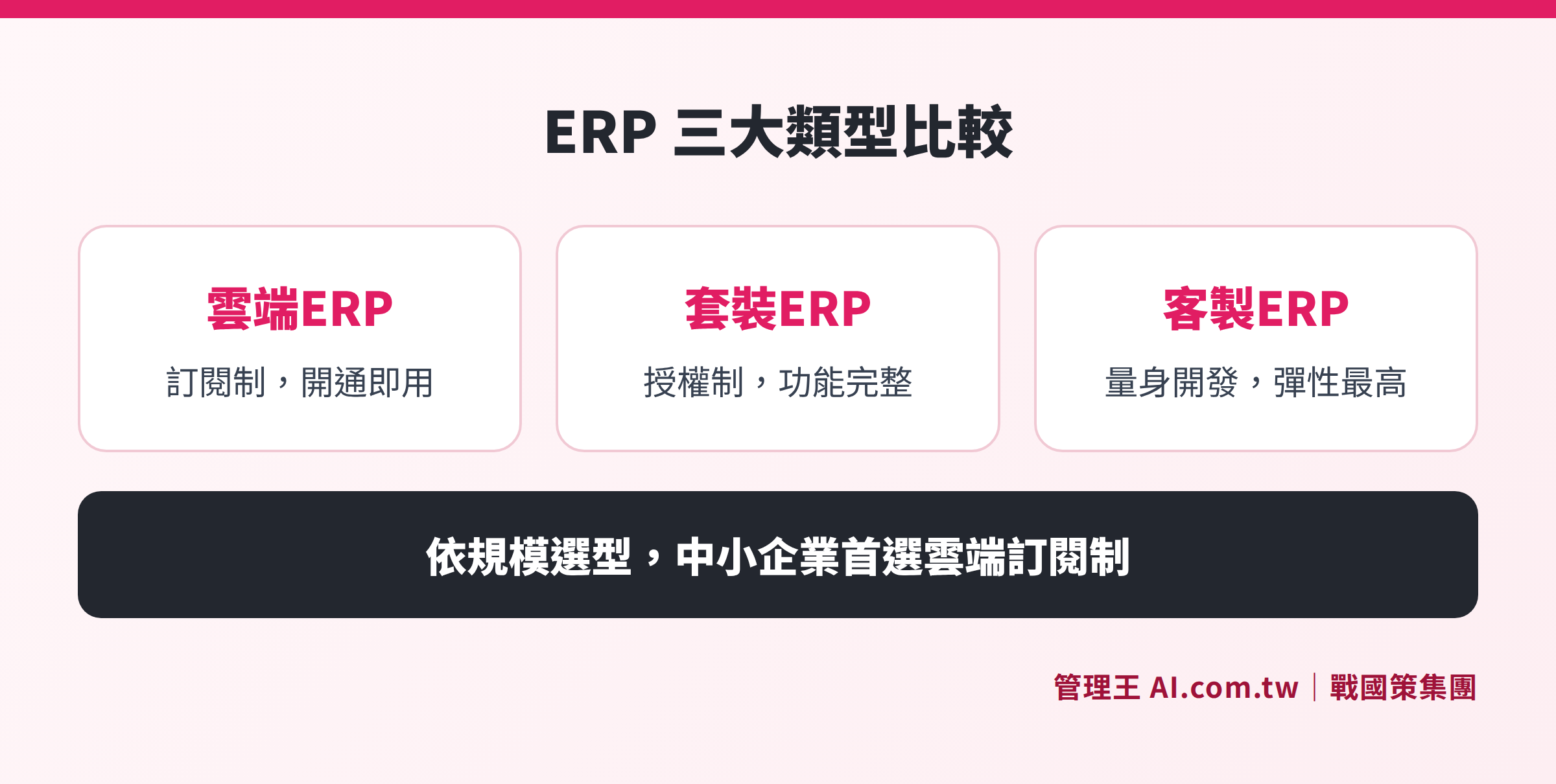
Overview of core features of Cloud ERP, Packaged ERP, and Customized ERP
What is Cloud ERP? Which Type of Enterprise is it Suitable For?
Cloud ERP operates on a SaaS (Software as a Service) model, where the system, servers, and data backups are managed by the service provider, and enterprises only need to pay a monthly or annual fee to access it via a browser.
Main features:
- Low initial costs, no need to purchase servers or IT equipment
- Available for use immediately after activation, fast implementation speed
- Data security updates and version upgrades are managed automatically by the service provider
- Supports remote work, accessible via mobile and tablet
- Frequent feature updates with no additional charges
Suitable for:
- Small and medium-sized enterprises with 10 to 100 employees
- Organizations without dedicated IT personnel
- Owners who prioritize fast implementation and low maintenance burden
- Teams that operate across regions and require remote collaboration
Points to consider:
- Data is stored on the service provider's servers, so it's essential to confirm data sovereignty and backup policies
- Customization flexibility is lower than on-premise systems
- Over time, subscription fees may accumulate to exceed the total cost of a one-time license
Cloud ERP has become the mainstream choice for small and medium-sized enterprises in Taiwan in recent years. It is ready to use, requires no IT maintenance personnel, making it the lowest barrier path for small companies to enter ERP management.
What is Packaged ERP? Characteristics of Large Traditional Systems
Packaged ERP, also known as on-premise ERP or traditional ERP, involves companies purchasing software licenses that are installed on their own servers (or rented dedicated hosts). Providers like 鼎新, SAP Business One, and Oracle NetSuite (on-premise version) fall into this category.
Main features:
- Software licenses are purchased outright or paid annually, with data fully housed in in-house servers
- Complete functional modules that can support complex manufacturing processes (BOM, MRP, quality control)
- High customization flexibility, allowing modifications to underlying code
- Typically requires consulting personnel for implementation, resulting in longer timelines
Suitable for:
- Medium and large enterprises with more than 50 employees and complex processes
- Organizations with a dedicated IT department that can maintain the system
- Companies with strict data sovereignty requirements (e.g., in finance or healthcare)
- Manufacturers located in areas with unstable internet connectivity
Points to consider:
- Initial investment includes licensing fees, server hardware, and consulting fees, typically resulting in a high total
- Upgrading versions can be a significant project, leading to systems remaining on older versions
- IT personnel must be configured to handle maintenance and security
What is Customized ERP? A Tailor-Made System
Customized ERP is developed from scratch by a software company or significantly modified based on existing frameworks to fully align with unique business processes. Some service providers also offer a hybrid approach of "standard ERP plus customized development."
Main features:
- Interfaces, fields, processes, and reports are designed entirely based on requirements
- Can integrate with proprietary equipment (e.g., production machines, automated storage systems)
- All data and code belong to the enterprise after development
- Future modifications will require additional outsourced development
Suitable for:
- Enterprises with highly competitive and differentiated processes (e.g., exclusive processes, special pricing rules)
- Organizations that need to integrate multiple existing systems (ERP, MES, WMS)
- Companies with ample budgets that can withstand longer development cycles
Points to consider:
- Development cycles usually take several months to over a year
- Initial costs and development risks are the highest
- Subsequent modifications and maintenance depend on the original developer with limited bargaining power
- System stability must be ensured through thorough testing
Complete Comparison Table of Three ERP Types
Table: Six Dimensions Comparison of Cloud ERP, Packaged ERP, and Customized ERP
| Comparison Dimension | Cloud ERP | Packaged ERP | Customized ERP |
|---|---|---|---|
| Initial Cost | Low (subscription-based) | Medium to high (license + hardware) | High (project-based development) |
| Implementation Speed | Fast (days to weeks) | Medium (months) | Slow (over six months) |
| Maintenance Responsibility | Provider's responsibility | Self-maintained by enterprise | Responsibility of the enterprise or outsourcing |
| Customization Flexibility | Medium (parameter settings) | High (code modifications allowed) | Highest (fully customized) |
| Long-term Cost | Subscription fees accumulate continuously | Fixed licensing fees + maintenance fees | Modification costs depend on demand |
| Suitable Scale | 10 to 100 people | More than 50 people | No scale limitation, unique processes |
How Do Different Sized Enterprises Choose ERP Types?
Small enterprises with 10 to 30 employees: Cloud ERP is the most pragmatic choice. Ready to use after activation with clear monthly fees, no need for long-term consulting personnel. Start with standard functions to stabilize processes, then evaluate if customization is necessary.
Growth-type small and medium-sized enterprises with 30 to 100 employees: Assess whether Cloud ERP can meet the complexity of existing processes. If there are manufacturing module (BOM, MRP) requirements, confirm whether the cloud version supports them; if needing foreign currencies or consolidated reports for multiple companies, ensure those capabilities are present.
Medium and large enterprises with more than 100 employees: Evaluating Packaged ERP or hybrid cloud solutions is worthwhile. If there are highly confidential processes or unstable network issues at factories, on-premise deployment can better manage risks. An IT team must be established to maintain the system.
Enterprises with highly unique processes: Regardless of scale, if no standard ERP that meets the processes can be found in the market, customized development is meaningful. It is recommended to first use Packaged or Cloud ERP standard functions for 6 to 12 months to clarify which processes genuinely cannot be resolved with existing features before proceeding with targeted customization to avoid developing everything from scratch.
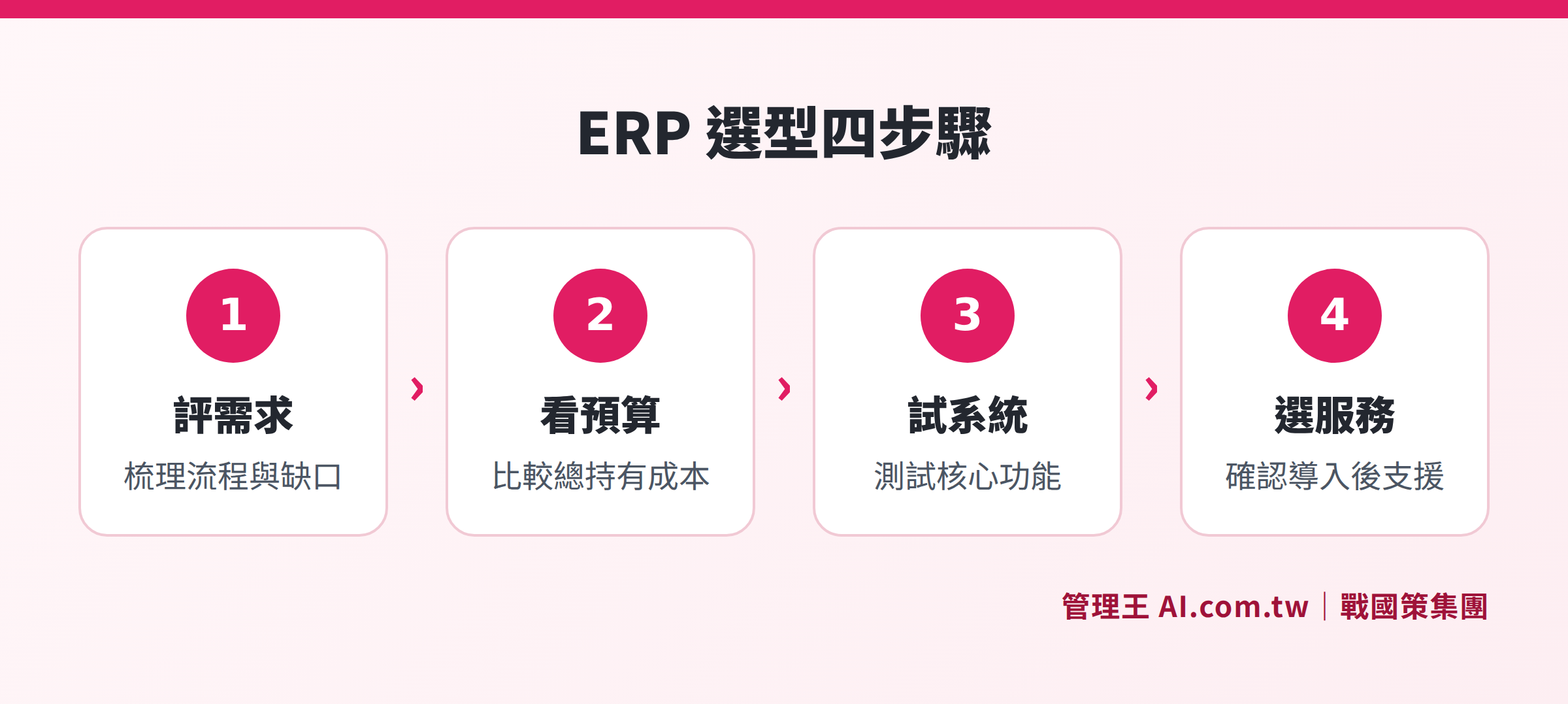
Four steps to choose the most suitable ERP type: assess needs, compare budgets, trial functionalities, and confirm services.
What Common Pitfalls Should Be Noted When Choosing ERP?
Pitfall 1: Buying a comprehensive large ERP but only using 20% of its functionalities.
Large packaged ERPs have many functional modules and complex settings. If a company's processes are relatively simple, implementation often results in only enabling basic modules, leaving other functionalities idle, wasting money with no process improvement. Choosing an ERP should match "the current complexity of processes" rather than "potential future needs".
Pitfall 2: Systems not being interconnected, requiring manual data transfer.
Some enterprises manage inventory, sales, and procurement in one system, CRM in another, and payroll in yet another, relying on Excel for manual data transfer. A truly effective ERP should integrate quotations, orders, procurement, inventory, invoicing, and accounting into one system, requiring data entry only once.
Pitfall 3: Increasing customizations, leading to extra charges for each version upgrade.
After customizing a packaged ERP, modifications often need to be redone during vendor upgrades, continuously incurring costs. Unless processes are genuinely unique, prioritize assessing whether standard functionalities can address the needs before considering customization.
Pitfall 4: Ignoring compatibility with local regulations.
In Taiwan, ERP must natively support electronic invoicing, sales tax filing, labor and health insurance rates, payroll calculations, and other local requirements. When selecting foreign SaaS solutions, it's essential to confirm whether these functionalities are localized; otherwise, additional systems or manual handling may be necessary.
How to Quickly Get Started with Cloud ERP Using 管理王
管理王 AI.com.tw ERP system operates on a cloud subscription model, ready to use without the need for server purchases or long-term consulting personnel.
Actual operation methods:
- Try running processes with the free plan: 管理王 offers a free plan that can be used permanently. Small teams of up to 10 can start with the free version to create a quotation system, procurement management, and inventory management, ensuring the processes run smoothly before upgrading to a paid plan.
- A single system integrates the entire process: After a quotation is finalized, it can be converted to an order with one click. Inventory is automatically deducted once shipped, and payments are automatically recorded in the accounting system without needing to re-enter the same data.
- For manufacturing companies: The manufacturing ERP module supports BOM and material lists, production work orders, and MRP material requirements planning, automatically calculating material usage when creating production orders, deducting raw materials upon issue, and accounting for finished products.
- For companies with overseas business or multiple companies: Foreign currency accounts automatically update exchange rates daily and calculate unrealized exchange differences; group multiple companies can generate consolidated reports with one click without manual integration.
- Payroll linked to attendance: The payroll system directly reads attendance and overtime data, automatically posting them in compliance with Taiwan’s labor insurance premium rates and labor laws.
戰國策 Group serves over 30,000 enterprises, and 管理王's ERP functionality is part of the entire system, with the same account also providing CRM, marketing, customer service, attendance, and other functions without the need to subscribe to multiple software solutions. View plans and pricing.
Try 管理王 Cloud ERP for free, activate in 30 seconds
Consultants will help assess the most suitable ERP type for your company, providing support from process organization to system launch throughout the whole journey, with the free plan being permanently available.
Free consultation hotline: 0800-003-191
Official LINE account: @119m
Official website: app.AI.com.tw
Free trial: Apply for 管理王 now
Frequently Asked Questions
Is Cloud ERP cheaper than Packaged ERP?
In the short term, Cloud ERP has lower initial monthly subscription costs; Packaged ERP requires higher initial investments due to purchasing licenses and servers. However, over the long term, subscription fees for Cloud ERP continue to accumulate, while the costs for Packaged ERP's licensing fees remain fixed. It is recommended to compare the "total cost of ownership over five years" (including licensing fees, hardware, consulting fees, maintenance costs, and upgrade fees) before making decisions rather than just looking at monthly or licensing fees.
How long does it take for Customized ERP to go live?
The development and launch time of Custom ERP depend on the complexity of the requirements, generally longer than Cloud or Packaged ERP development, often taking several months to over a year. Experiences from firms like 鼎新 indicate that schedules depend closely on the complexity of functional requirements, the number of modules, and the level of cooperation from the enterprise. It is advisable to confirm timelines thoroughly with service providers before implementation.
Is Customized ERP suitable for small and medium-sized enterprises?
Most small and medium enterprises with fewer than 50 employees are not recommended to opt for Custom ERP at the outset due to high development costs, long cycles, and the fact that their processes are still forming. It’s suggested to stabilize processes using standard functions from Cloud or Packaged ERP first, clearly identifying which needs cannot be solved with existing features before considering targeted customization.
Is it necessary to integrate CRM with ERP?
Strictly speaking, it is not essential. However, if ERP and CRM are two separate systems with no automatic data integration, data such as sales quotations, orders, and collections still require manual transfer, leading to low reconciliation efficiency. When choosing an ERP, confirming its ability to directly link with front-end business processes (quotations, CRM) and back-end financials is key to enhancing overall efficiency.
What are common ERP vendors in Taiwan?
Common ERP vendors in Taiwan include: the cloud SaaS type 管理王 AI.com.tw; traditional packaged types like 鼎新電腦 (SmartERP, A1 Business Application Cloud); international giants represented in Taiwan such as SAP Business One and Oracle NetSuite; as well as various vertical ERP vendors focusing on manufacturing or distribution. When choosing, it is advisable to evaluate functionality coverage, localization level, customer service support languages, and whether they natively support Taiwan’s electronic invoicing and labor insurance regulations.
Sources
- Oracle Taiwan — Definition of Enterprise Resource Planning (ERP) (Accessed November 2026)
- 鼎新智數部落格 — How to Choose Between On-Premise and Cloud ERP? Must Understand Differences and Customization Conditions Before Selection (Accessed November 2026)
- 管理王 AI.com.tw — ERP Enterprise Resource Planning System Features Page
Further reading:
- What is an ERP system? A Comprehensive Understanding for SMEs from Inventory to Finance|ERP System Recommendations
- Is 鼎新 ERP Suitable for Small Companies? Features, Implementation Thresholds, and Alternative Choices|ERP System Recommendations
- How to Choose an Inventory System? Starting from Inventory Account Discrepancies|ERP System Recommendations