How Much Does FB Advertising Cost Per Day? CPM, CPC, and Budgeting Techniques | Recommended Advertising Tools

FB advertising costs have no fixed price. In the Taiwan market, CPM ranges from NT$50 to NT$400 and CPC ranges from NT$3 to NT$30, depending on the industry and competition level. This article explains the differences between CPM, CPC, and CPA billing models, industry pricing tables, budgeting methods, and the core logic of Meta's bidding system to help small and medium-sized business advertisers better control advertising costs and improve return on investment.
FB advertising operates on a bidding system with no fixed price list. The overall CPM (cost per thousand impressions) in the Taiwan market falls between NT$50 and NT$400, while CPC (cost per click) ranges from NT$3 to NT$30. Actual costs are influenced by factors such as industry type, competition level among target audiences, ad quality scores, and timing of ad placement. To effectively control FB advertising budgets, it is essential to understand Meta's bidding mechanism and grasp the differences among the three billing models, and then set reasonable daily and monthly budget limits based on marketing goals. This article compiles CPM and CPC cost trends across various industries in Taiwan, budgeting guides, key factors affecting costs, and how to use advertising management tools to ensure that every dollar spent is well-invested.
How Does FB Advertising Charge? Comparing CPM, CPC, and CPA Models
FB advertising platform (Meta Ads) offers three main billing options based on advertising campaign goals. Choosing the wrong billing model can lead to a performance gap of over 100% with the same budget.
Table: Comparison of Three FB Advertising Billing Models
| Billing Model | Full Name | Billing Trigger | Suitable Goal | Notes |
|---|---|---|---|---|
| CPM | Cost Per Thousand Impressions | Charged every thousand impressions | Brand exposure, maximizing reach | Impressions do not equate to clicks; requires strong visual content |
| CPC | Cost Per Click | Charged per click | Traffic generation, increasing website visits | Clicks do not equal conversions; must have good landing pages |
| CPA | Cost Per Action | Charged upon achieving specific conversion actions | Lead collection, purchase conversions | Requires installation of Meta Pixel or Conversion API |
The Meta advertising system allows advertisers to set a "bidding limit" or "cost cap," but the actual amount charged is usually lower than the preset limit— the system only charges the minimum amount above the next bidder needed to win, which is the core mechanism of the bidding auction.
In a nutshell
FB advertising cost is not bought; it’s arrived at through bidding: high bids, quality content, and high audience matching must combine to win impressions at the lowest cost.

Decision flow for selecting CPM, CPC, and CPA models according to various marketing goals
FB Advertising Costs in Taiwan: CPM and CPC Reference for Various Industries
As Meta does not disclose fee schedules for different countries or industries, the following data represents market reference values compiled by digital marketing agencies in Taiwan (TingS Advertising, Ad Keen) based on actual operating accounts, and is for budget planning reference only. Actual costs will be based on real-time data from the advertising account's backend.
Table: Reference for FB Advertising Costs by Industry in Taiwan (2025)
| Industry | CPM Reference Range (NT$) | CPC Reference Range (NT$) | Competition Level |
|---|---|---|---|
| Food & Local Businesses | 80 to 180 | 2 to 6 | Low to Medium |
| E-Commerce (Fashion & Beauty) | 120 to 200 | 3 to 8 | Medium |
| E-Commerce (3C & Home Appliances) | 150 to 280 | 5 to 12 | Medium to High |
| Online Courses & Education | 200 to 350 | 8 to 15 | High |
| Medical Beauty & Health/Aesthetics | 200 to 380 | 8 to 20 | High |
| B2B Services | 250 to 400 | 10 to 25 | High |
Some noteworthy cost patterns include:
- Seasonal Fluctuations: During e-commerce festivals like 11/11 and 12/12, or before and after Lunar New Year, CPM across industries can rise by 30% to 50% compared to normal days. It's crucial to plan for important event timelines in advance or raise budgets to respond to competition.
- Lower Rates in Taiwan Compared to Europe and America: The overall CPM in Taiwan is roughly one-third to one-half that of the US market, indicating that the same budget can yield more impressions in the Taiwan market.
- Higher Costs for B2B: B2B audiences are narrower and harder to target, resulting in CPM and CPC typically higher than B2C consumer categories. If the target is small to medium business owners or purchasing managers, it's recommended to run LinkedIn ads alongside.
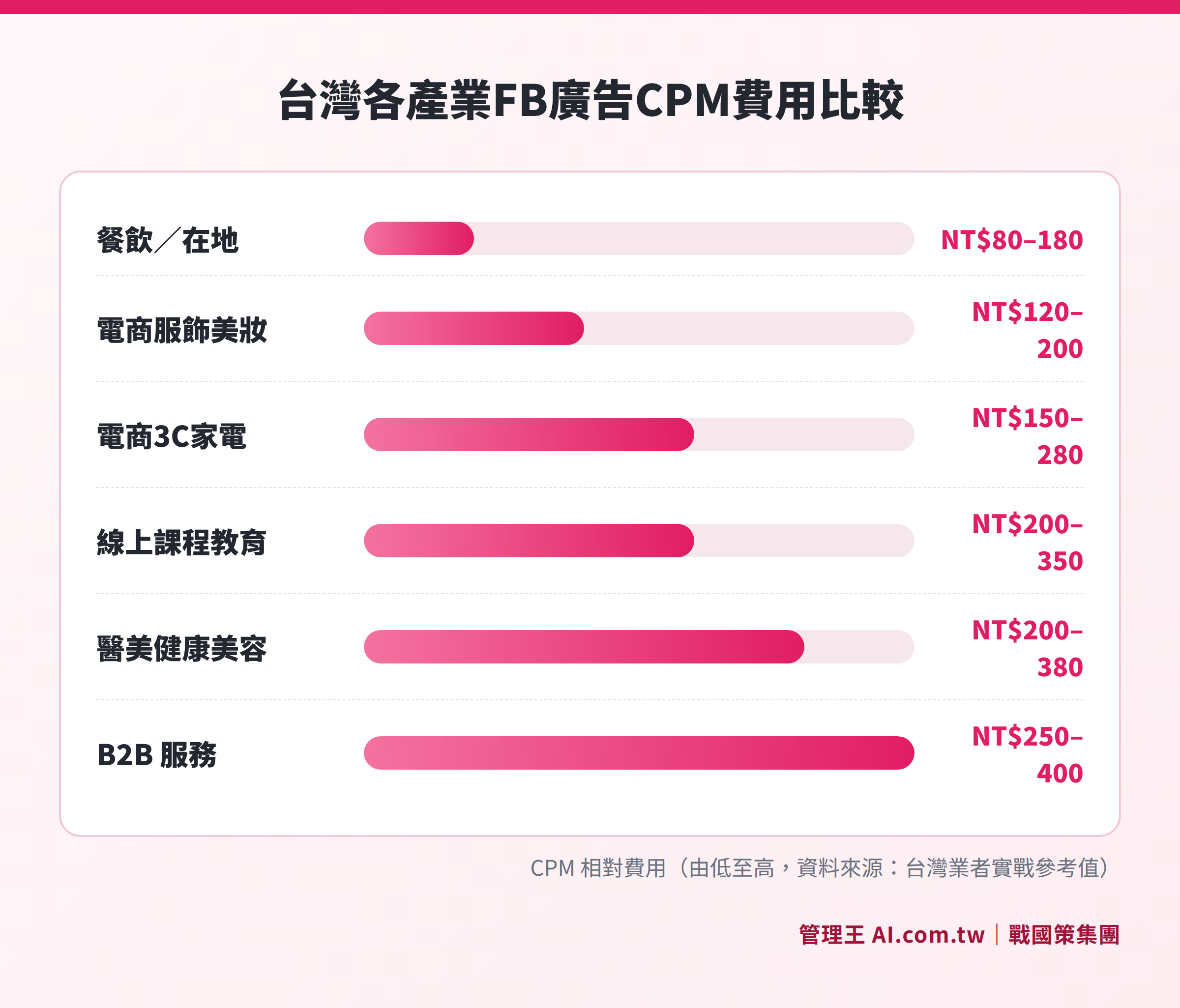
Comparison of FB advertising CPM cost ranges among six major industries in Taiwan; B2B and medical beauty have the highest costs
How Much Does FB Advertising Cost Per Day? Practical Budget Setting Guide
Meta sets a minimum daily budget threshold for advertising campaigns (depending on the billing method), but this threshold is usually too low to gather statistically significant data. Below is a recommended budget reference for the Taiwan market based on different marketing goals:
Table: FB Advertising Daily and Monthly Budget by Goal
| Marketing Goal | Suggested Daily Budget (NT$) | Monthly Budget Equivalent | Description |
|---|---|---|---|
| Brand Exposure | 200 to 500 | 6,000 to 15,000 | Expand reach, no immediate conversion required |
| Website Traffic | 300 to 800 | 9,000 to 24,000 | Charged with CPC, track the quality of clicks |
| Lead Generation | 500 to 1,500 | 15,000 to 45,000 | Form ads that require attractive incentives |
| Sales Conversion | 1,000 to 2,000 | 30,000 to 60,000 | Requires Pixel installation, accumulate sufficient conversion data |
Logic of "Test Period" Budget
When starting to advertise or testing new materials, it’s recommended to set a lower daily budget for 7 to 14 days to gather enough exposure, click, and conversion data, and then decide whether to scale up or halt based on ROAS (return on advertising spend). Ads targeting conversion goals usually need at least 50 conversions for the Meta algorithm to complete the "learning phase" before entering a stable advertising phase.
How to Assess Whether the Budget Is Adequate
Simple calculation formula:
- Monthly Budget ÷ Target CPC = Monthly Clicks
- Monthly Clicks × Conversion Rate = Monthly Conversions
- Conversions × Customer Unit Price = Monthly Revenue from Ads
For example: a monthly budget of NT$30,000, with an average CPC of NT$10, can yield about 3,000 clicks; if the landing page conversion rate is 2%, this results in about 60 orders; if the customer unit price is NT$1,500, the monthly revenue would be about NT$90,000, yielding a ROAS of about 3 times.
Five Key Factors Affecting FB Advertising Costs
Even with a set daily budget of NT$500, different advertisers may see results varying by three to five times. The key factors affecting cost efficiency include:
1. Competition Level of Target Audience
The more advertisers are targeting the same audience, the more intense the bidding, leading to higher CPMs. Common high-competition audiences include: females aged 18 to 35 (key e-commerce demographic), business owners (B2B), and specific interest categories (like fitness, medical beauty). Narrowing down the audience or using Lookalike Audiences can sometimes lower CPM, as fewer competitors will bid.
2. Ad Quality Score
Meta's ad backend provides ratings for each ad's "Quality Ranking," "Engagement Rate Ranking," and "Conversion Rate Ranking." The higher the quality score, the greater the bidding advantage given by the system, meaning that the same bid can win more impression opportunities, resulting in a lower actual CPM. Ways to improve quality scores include: using high-resolution images or videos, crafting copy that addresses audience pain points, and having clear CTAs (calls to action).
3. Type of Ad Material
Video ads typically have higher CPMs than image ads, but the completion rates (Video View Rates) lead to higher brand recall. Ads in Stories and Reels typically have lower CPMs and can serve as low-cost options for additional reach. Carousel ads are suitable for eCommerce to show multiple products, often yielding higher CTRs (click-through rates) than single images.
4. Bidding Strategy Settings
Meta provides three main types of bidding strategies (as per the Meta Business Help Center):
- Spend-based: System allocates budget based on maximum volume or value, without setting cost targets, suitable for advertisers with limited budgets looking to maximize results.
- Goal-based: Cost cap (the system allows average cost to approach your target value) or minimum ROAS (the system ensures ad returns meet the set threshold).
- Manual Bidding: Bid caps, where the advertiser sets the maximum bid for each auction, suitable for those with clear targets for cost per acquisition.
New accounts or advertising campaigns should start with the "Spend-based" approach to allow the Meta algorithm to collect data, switching to cost cap mode for precise cost control after the learning period concludes.
5. Ad Scheduling and Competitive Time Slots
Advertising costs significantly rise during e-commerce festivals and holidays. In certain industries, ads during specific time frames (e.g., before lunch or dinner for the food sector) see high engagement but also high competition. By utilizing ad scheduling, ads can be run only during active periods of the target audience to enhance budget efficiency.
Meta Ad Bidding Mechanism: Why High Bids Don’t Guarantee Wins?
Understanding Meta's bidding mechanism allows advertisers to secure better placements at lower costs. According to the Meta Business Help Center, each ad impression opportunity is a "bidding auction" where winning depends not only on the bid amount but on a combined score of three factors:
- Advertiser Bid: Your set maximum bid or cost goal.
- Estimated Action Rates: Meta estimates how likely it is that your ad will lead your target audience to take the desired action (click, purchase, fill out forms) based on historical data.
- Ad Quality: Meta assesses the ad's relevance, user feedback (hiding ads, negative feedback), and other signals.
The combined score determines which ad wins the impression opportunity, but the actual amount charged is just "slightly above what the next highest bidder would need." This means a high-quality, highly relevant ad can win multiple impressions at a lower cost, even with a bid below competitors. In other words, optimizing ad quality equates to lowering advertising costs.
Three Practical Practices to Avoid Wasting Advertising Costs
- Regularly Deactivate Low-Quality Ads: Ads with low-quality scores won’t be prioritized even if their budget increases; they just waste budget.
- A/B Test Materials: Run two different versions of the material simultaneously and let the data determine which version to continue, gradually phasing out ineffective ads.
- Avoid "Ad Fatigue": Audiences seeing the same ad repeatedly will have declining engagement rates, leading to lower quality scores and higher CPMs. It’s recommended to refresh the material every 2 to 4 weeks.
Manage Multi-Platform Advertising Budgets with 管理王 AI.com.tw
FB advertising usually represents only part of the overall marketing budget, which also includes Google Ads, Instagram, TikTok, and LINE ads. Logging into each platform's backend to view data makes it difficult to comprehensively assess "where every dollar is most effectively spent."
管理王 AI.com.tw Advertising Management integrates Google Ads, FB and IG Ads, TikTok Ads, and LINE advertising into a single dashboard. Key features include:
Unified Dashboard across Multiple Platforms
One-stop comparison of spending, clicks, conversions, ROAS, and CPA across platforms, eliminating the need to manually log into each backend to record numbers in Excel. Marketers can instantly identify which platform is profitable and which is burning money.
Smart Budget Redistribution
The system can automatically reallocate the budget from platforms with low ROAS to those with high ROAS to ensure limited marketing funds flow to the best-performing channels, and set budget overspend alerts to avoid uncontrolled expenditure without detection.
True Revenue Attribution
Automatic generation of conversion attribution analysis through UTM links distinguishes first-touch and last-touch contributions, ensuring that bosses see not just click numbers, but the actual revenue generated by ads.
Connecting CRM for Complete ROI Visibility
Leads generated from ads automatically enter the CRM system for sales follow-up, and when reports of closure come in, the system automatically calculates each ad's true LTV and ROI. This number is crucial to understand whether advertising costs are expenses or investments, which cannot be figured out based solely on the advertising platform’s backend.
Material Testing and Management
Built-in A/B ad version testing and centralized material library for unified management of images, videos, and copy across platforms, allowing the marketing team to quickly identify the most converting versions and replicate successful material across all platforms to amplify effectiveness.
戰國策 Group serves over 30,000 businesses, and 管理王 AI.com.tw offers a free plan for permanent use, allowing trial of the advertising management module without binding to a credit card. To integrate FB advertising, Google Ads, and CRM data, you can upgrade to the economical plan (NT$5,000/month).
For related topics, refer to: Complete Guide to Advertising Management: FB, Google, and LINE Multi-Platform Effect Tracking, How to Calculate Google Advertising Costs? What Can a Monthly Budget of NT$10,000 Achieve?. If you need to integrate social scheduling management for organic post planning or optimize ad landing pages using Landing Page tools, you can operate from the same management account.
How to Set Advertising Budgets Without Waste?
Free consultation with 管理王 advertising consultants to assist in evaluating multi-platform advertising budget allocations and tracking true ROAS, ensuring every dollar of ad spend is well-invested.
Free Consultation Hotline: 0800-003-191
LINE Official Account: @119m
Official Site: app.AI.com.tw
Free Trial: Apply for 管理王 now
Frequently Asked Questions
How much does FB advertising cost per day at minimum?
The minimum daily budget for Meta advertising campaigns depends on the billing method; click-based campaigns have a minimum around NT$50, but this amount is too low to acquire meaningful data. In practice, it’s recommended that brand exposure campaigns prepare at least NT$200 to NT$500 as a daily budget, while conversion-targeted campaigns suggest NT$1,000 and above for sufficient "learning space" for the algorithm.
Which is more cost-effective, CPM or CPC?
This depends on your marketing goals. If the goal is brand exposure or retargeting, CPM billing allows you to maximize impressions for a fixed cost; if the goal is traffic generation or lead collection, CPC billing allows better control over "cost per click," avoiding waste on ad impressions without interactions. It's recommended to test both methods and decide on long-term strategies based on ROAS.
Why did my FB advertising costs suddenly increase?
Common reasons may include: (1) Competitors launching large-scale campaigns simultaneously (e.g., e-commerce festivals, holidays) leading to intense bidding; (2) Audience experiencing "ad fatigue," leading to decreased interaction rates, prompting Meta to lower ad quality scores and increasing bid costs; (3) Decline in quality of ad material or misalignment with audience; (4) The account or campaign entering a new "learning phase," causing temporary fluctuations in costs. It’s advisable to regularly monitor quality rankings and refresh material every 2 to 4 weeks.
How much should SMEs budget monthly for FB advertising?
There are no standard answers, but based on the Taiwan market, a monthly budget of NT$8,000 to NT$15,000 is a starting point to build preliminary audience data; NT$30,000 to NT$60,000 can begin running a complete brand exposure and conversion funnel; over NT$100,000 is necessary for sufficiently detailed targeting across multiple platforms and audience segments. If the budget is limited, it's advisable to focus on a single platform and goal, optimizing ROAS to a positive value before expanding the budget.
Can I avoid setting a daily cap for FB advertising?
Not recommended. Meta allows setting a "lifetime budget" for campaigns, where the system flexibly allocates daily spending over the campaign period. However, regardless of the method, it is crucial to set budget caps to prevent the system from rapidly depleting budgets during peak competition periods. By using 管理王 advertising management, cross-platform budget overspend alerts can be set up to notify immediately when any platform's ad expenditure exceeds normal levels.