What is Field Management? Understanding Business Visits, Check-ins, and Reporting All at Once|Recommended Field Management Systems

Field management leverages GPS-based check-ins, structured visit records, and real-time CRM synchronization, allowing supervisors to monitor field personnel dynamics throughout the day from the office. This article covers the six major functions of field management systems, Labor Standards Act work hour calculation regulations, anti-timecard punching mechanisms, and a five-step SOP for implementation to help SMEs establish legal and efficient field management practices.
Field management refers to a set of management mechanisms that companies use for employees (such as sales representatives, technical service personnel, collectors, security personnel, and real estate agents) who need to perform work outside the company's premises, utilizing digital tools for itinerary planning, GPS-based check-ins, visit records, and performance tracking. The core purpose is to allow supervisors to grasp the dynamics of field personnel in real time, ensure visit quality, and legally record working hours. According to the Ministry of Labor's amended "Guidelines for Labor Time Worked Outside Business Premises" in 2017, attendance records for field sales representatives can be kept through various methods such as phone, mobile check-ins, GPS recording, client signatures, or communication software. Enterprises must record daily working hours and calculate overtime pay in accordance with the Labor Standards Act. After implementing a field management system, HR can significantly reduce the time taken to settle hours worked at the end of the month from several days to a much shorter period, transforming the previously "untraceable" field sales into "real-time visible", which protects employee labor rights and enhances overall company operational efficiency.
What is Field Management? What Types of Jobs is it Applicable To?
"Field Work" generally refers to employees executing their duties outside the employer-designated business premises. Common types of fieldwork in Taiwan include:
- Field Sales: Insurance agents, real estate brokers, pharmaceutical sales representatives, technology AE, etc., whose working hours primarily align with customer schedules.
- Technical Service Fieldwork: Maintenance engineers, installation technicians, equipment inspectors who go to the client site based on work orders.
- Logistics and Collection Fieldwork: Freight drivers, couriers, collection specialists who complete multi-stop tasks according to a route.
- Audit and Store Visit Fieldwork: Supervisors of chain brands, franchise auditors, food safety inspectors, who move between multiple locations for inspection.
- Direct Sales and Community Services: Direct sales personnel, social workers, and visiting staff, who go to personal residences or communities to provide services as scheduled.
In Summary
Field Management = A digital management system that allows supervisors in the office to see "where field personnel are, what they have done, and how much time they spent".
The common characteristics of these jobs are that employees are mostly not on company premises, making it difficult for supervisors to directly oversee them, and traditional sign-in books are often ineffective, leading to frequent disputes over overtime calculations. A field management system is a tool designed to address these pain points.
From a business management perspective, fieldwork brings three major challenges: first, insufficient visibility, as supervisors do not know where sales representatives are, who they have visited, or what results were achieved; second, difficulties in recording working hours, since both normal working hours and overtime for field personnel must be recorded according to law, but traditional tools cannot adapt to the field context; third, information silos, where visit records from sales representatives are disconnected from CRM data in the office, leading to delays in updates on client statuses needed during meetings.
What are the Core Functions of Field Management Systems?
A complete field management system typically covers the following six modules:
Table: Overview of Core Functions of Field Management Systems
| Function Module | Specific Purpose | Problems Solved |
|---|---|---|
| Itinerary Pre-planning and Route Optimization | Sales set a list of client visits in advance; the system generates the most time-efficient route based on geographic location. | Sales waste transportation time running around. |
| GPS Location Check-in | Automatically detects position upon arrival at the client site, takes photos as evidence, and records timestamps. | Fake visits, false reporting of trips, timecard punching. |
| Structured Visit Records | Records who was met, what was discussed, next steps, and can attach quotes and on-site photos. | Oral reporting leads to scattered information that is difficult to track. |
| Real-time CRM Synchronization | Visit records are directly written back to client profiles, allowing supervisors to view frontline dynamics in real time. | Sales have to return to the office to update, leading to significant delays. |
| Visit SOP and Material Checklist | Sets standardized checklists for each visit to ensure interview quality. | Less experienced sales do not know what to ask. |
| Expense Reimbursement and Map Tracking | Fuel and meal expenses are automatically recorded based on actual itineraries, allowing supervisors to view tracked routes. | Reimbursement matching is time-consuming, and data can easily be falsified. |
A complete field management system should be able to integrate these modules closely with the company's HR payroll, CRM, and task management systems, automating data flow and reducing manual comparison time costs. When purchasing a field management system, focus on: whether check-in verification is rigorous enough (can it prevent timecard punching), whether visit records are structured (can they be turned into customer assets), and whether it is connected to the payroll system (can it automatically calculate overtime pay); lacking any of these will significantly reduce the effectiveness of the implementation.
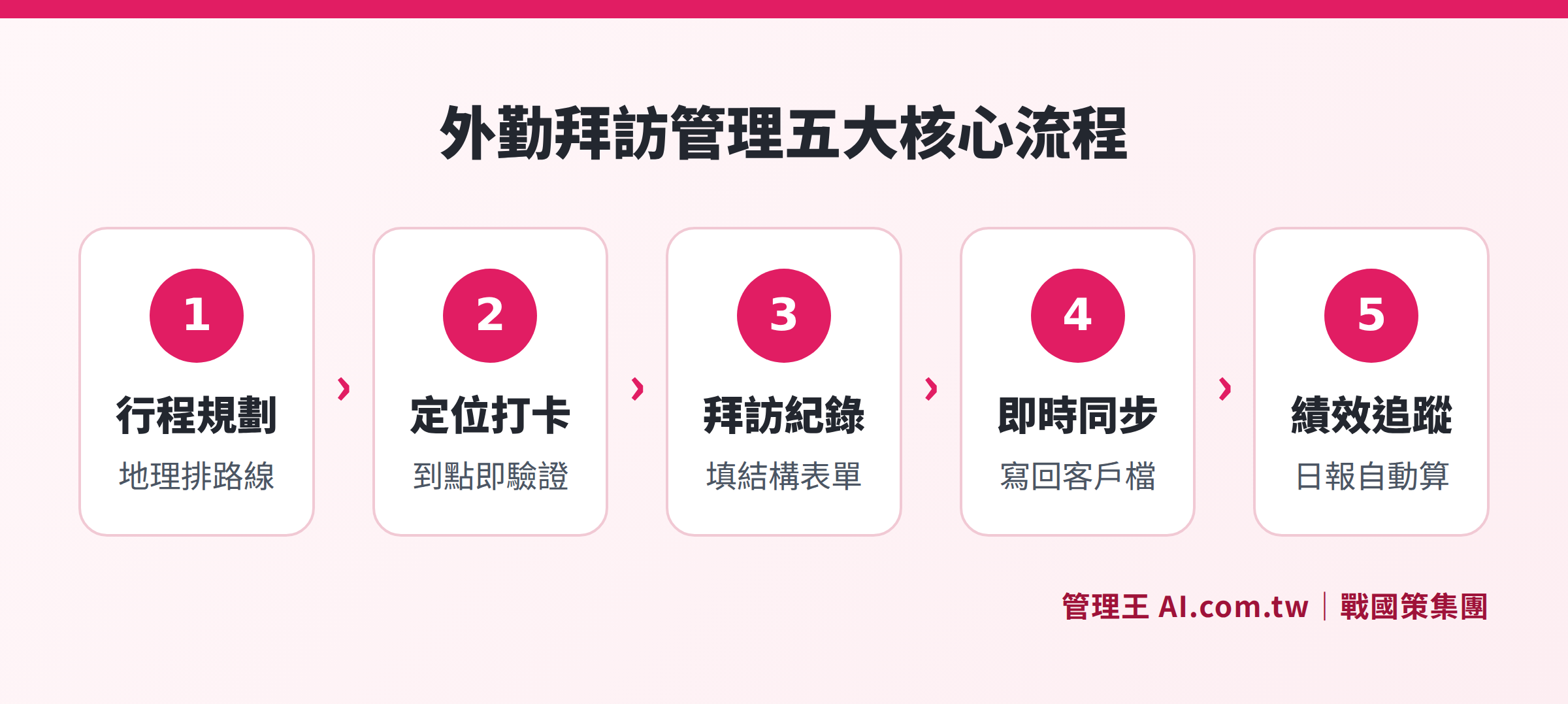
The complete field management process from itinerary planning, GPS check-ins, visit records to CRM synchronization.
How to Conduct Field Check-ins? GPS Positioning and Anti-Timecard Punching Mechanisms
Field employee check-ins are the most frequently asked questions in field management. Traditional fingerprint machines are only suitable for fixed locations, rendering them ineffective for field personnel. Modern field management systems offer various verification methods:
Comparison of Five Check-in Methods
- GPS Location Check-in: Employees arrive at the client site; the phone automatically detects GPS coordinates, typically with an error margin of less than 20 meters, making it most suitable for field sales.
- WiFi Limited Check-in: Check-in is only possible when connected to specific WiFi, suitable for companies with fixed office locations across multiple branches.
- IP Limited Check-in: Operations restricted to specific IP ranges, suitable for office staff.
- Facial Recognition Check-in: Paired with AI judgment to confirm the identity of the person checking in, suitable for high-security environments.
- NFC/QR Code Check-in: Scan on-site labels to check in, suitable for manufacturing production lines or fixed inspection points.
Design of Anti-Timecard Punching Mechanisms
While it is difficult to completely eliminate the issue of timecard punching in field management, costs can be significantly raised through "multi-factor verification + AI anomaly detection". The system simultaneously requires GPS coordinates + facial recognition, making it hard for others to meet two conditions at once; AI automatically flags anomalies (e.g., checking in at precisely the same time every day for 30 consecutive days), notifying supervisors for review.
According to the Ministry of Labor's "Guidelines for Labor Time Worked Outside Business Premises", attendance records for field employees are not limited to traditional sign-in books; GPS recorders, mobile check-ins, client signatures, and communication software records can all serve as legal attendance proof and must be available for labor inspections with written records presented.
How Are Working Hours for Field Personnel Calculated According to the Law?
According to the Labor Standards Act and the Ministry of Labor's guidelines, there are key regulations regarding the calculation of working hours for field personnel:
Recognition of Normal Working Hours: Due to the nature of work, it is difficult for field sales representatives to precisely calculate working hours, and their "normal working hours per day are based on the start and end times specified in the labor contract". Companies should clearly state the normal working start and end times for field personnel in their written labor contracts and work rules.
Table: Standards for Calculating Overtime Pay for Field Personnel (Based on Article 24 of the Labor Standards Act)
| Overtime Type | Hours | Calculation Multiple | Description |
|---|---|---|---|
| Weekday Overtime | First 2 Hours | 1.34 Times | For the first and second hours after normal working hours. |
| Weekday Overtime | Third to Fourth Hours | 1.67 Times | For the third and fourth hours after normal working hours. |
| Rest Day Overtime | First 2 Hours | 1.34 Times | For the first two hours of work on that day. |
| Rest Day Overtime | Third to Eighth Hours | 1.67 Times | For the third to eighth hours of work on that day. |
| Rest Day Overtime | Ninth to Twelfth Hours | 2.67 Times | For the ninth to twelfth hours of work on that day. |
(This article provides general information and does not constitute legal or tax advice; actual outcomes are subject to the latest announcements from the Ministry of Labor.)
Obligation to Record Working Hours: Employers are required to record the normal working hours of field personnel daily; in the event of overtime, they must record the start and end times of the tasks assigned. After completing overtime work, field sales representatives should report their start and end times via telephone, communication software, or the system, which employers will then record, maintaining a complete audit log.
In practice, the most common violation by companies is that field sales personnel "are actually working overtime" but the company does not recognize it or calculate overtime pay, facing the risk of having to pay wages retroactively and fines if employees complain or labor inspections occur. The digital recording capabilities of a field management system are critical tools for resolving such compliance issues.
How Can Field Management Improve the Quality of Business Visits and Closing Rates?
Field management is not just about "monitoring where people are"; more importantly, it enhances the business value of every outing:
Before the Visit: The system automatically arranges the best visit order based on the client's last interaction time, outstanding follow-up items, and geographic location, allowing sales to know which clients to visit and what route to take without manual planning. Paired with a CRM system, they can quickly view the client's transaction history, previous proposal details, and pending confirmations before heading out.
During the Visit: After GPS check-in on their mobile phone, the system automatically presents the SOP Checklist for the visit: mandatory questions, confirmation items, and material checklist. Before concluding a visit, they fill in structured records on their mobile, including feedback from decision-makers, next steps, quoted amounts, and can attach on-site photos and client signatures.
After the Visit: Records are instantly synchronized with the CRM client profile, allowing supervisors in the office to see the latest updates without having to wait for sales to return to the office for meetings. The sales daily report automatically compiles the number of visits, transaction amounts, and next follow-up tasks for that day, enabling supervisors to grasp team performance in one minute.
Five Steps to Implement a Field Management System
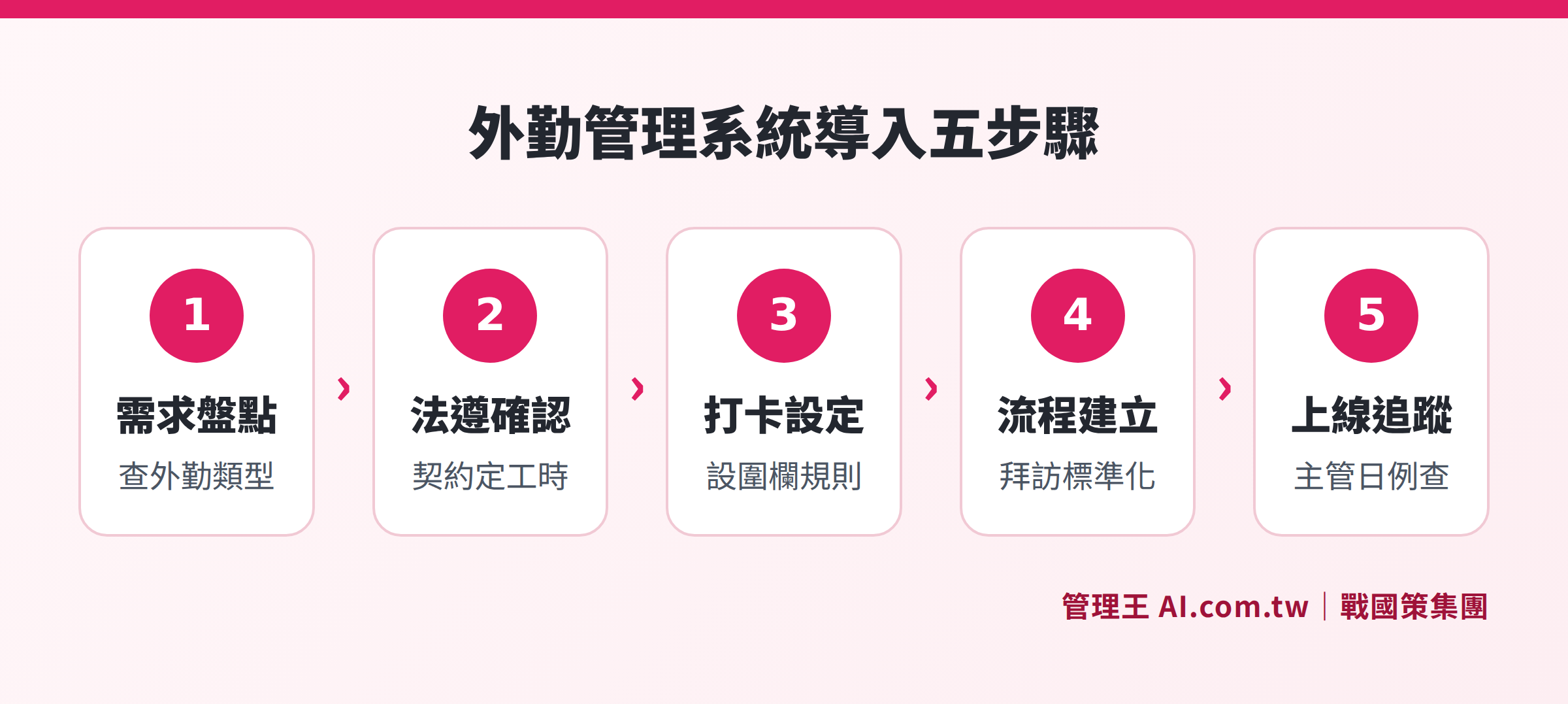
Five key steps from needs assessment to online operation for implementing a field management system.
Step 1: Assess Field Work Types and Existing Pain Points
First, confirm the company's field scenarios: is it purely sales visits, technical service dispatch, multi-point inspections, or a hybrid model? The functional priorities vary across different scenarios. Also, record existing pain points: is it a serious issue of fake visits, difficulty in reviewing distributed visit records, or frequent disputes over overtime pay?
Step 2: Confirm Legal Compliance Requirements
Refer to the Ministry of Labor guidelines to verify that the labor contracts for the company's field personnel specify normal working hours, overtime application procedures, and methods for recording working hours. These must be confirmed in writing before implementing digital tools; the tools are merely supportive, while the legal obligations remain with the employer.
Step 3: Set Check-in Rules and GPS Geofencing
Set verification methods based on different field types: GPS location for sales personnel, QR codes for store visit personnel, client site GPS geofences for technical personnel. It is suggested to set the GPS geofence within a radius of 100-200 meters from the client address for balancing accuracy and operational flexibility.
Step 4: Establish Visit SOPs and Recording Templates
Standardize the visit process of senior sales personnel with better performance into a checklist, allowing less experienced sales to maintain the same quality of visits. Record templates should include: visit purpose, decision-maker level met, consensus reached, next steps and timelines, and opportunities value updates.
Step 5: Supervisors Perform 5-Minute Daily Follow-up
The system automatically generates daily field reports; supervisors need only check for exceptions: sales who did not visit as planned, abnormal GPS detections, or personnel who did not check in on time. Coupled with task management to assign follow-up tasks, ensuring every opportunity has a next action.
How to Manage Field Management with 管理王?
管理王 AI.com.tw's field visit management feature integrates itinerary planning, GPS check-ins, visit records, CRM synchronization, and expense reimbursements, designed as a one-stop solution for SMEs in Taiwan.
Actual Operating Process: Sales start the 管理王 App in the morning to view the pre-planned visit route for the day; after arriving at the client site, they check in with a tap, with GPS automatically recording position and time; during the visit, they confirm each item according to the SOP Checklist and fill out records on their mobile before concluding, requesting a client electronic signature; records are instantly synchronized to CRM, allowing supervisors in the backend to see the latest frontline status.
Field check-in data is directly integrated with the payroll management system, so at the end of the month, overtime pay is automatically calculated according to Article 24 of the Labor Standards Act, eliminating the need for HR to manually verify attendance records; performance management modules can set individual sales KPIs such as visit volume, closing rates, and customer coverage, providing objective data for bonus calculations. Overtime applications are completed through the approval center for electronic signatures, retaining an audit log throughout to meet labor regulation requirements.
管理王's free plan can be used permanently, allowing teams of 10 or fewer to fully experience field management features; the 戰國策 Group has serviced over 30,000 enterprises and is familiar with field management practices for SMEs in Taiwan, offering consultants who assist companies from needs assessment to complete onboarding. For companies requiring customized development (such as special dispatch processes or integration with existing ERP systems), 管理王 offers transparent pricing for custom services at NT$1,000 per hour, commencing work only after written quotes are confirmed. Please see the service plan page for detailed features and pricing.
Free Trial of Field Management, Activate in 30 Seconds
Management consultants assist you in establishing GPS check-ins, visit SOPs, and compliant working hour processes; the free plan is usable permanently, providing immediate access to the full-featured field management system.
Free consultation hotline: 0800-003-191
LINE Official Account: @119m
Official Website: app.AI.com.tw
Free trial: Apply for 管理王 now
Frequently Asked Questions
What is the difference between Field Management Systems and general check-in systems?
General check-in systems only record the time employees are "at the company" and cannot track employee activities outside of the company. The core of field management systems is in GPS positioning, visit itinerary management, and client interaction logging, allowing the company to grasp the full scope of field personnel's work without needing to increase management staff.
What are the legal requirements for the working hour records of field personnel?
According to the Ministry of Labor's "Guidelines for Labor Time Worked Outside Business Premises" (revised in 2017), employers must record the normal working hours of field personnel daily; in the event of overtime, they must also document the start and end times of assigned work. Attendance recording methods are not limited to traditional sign-in books; GPS records, mobile check-ins, client signatures, and communication software records are all legal, but written records must be provided for labor inspections.
How can we prevent field sales from falsely reporting visit counts?
The key to preventing timecard punching lies in "multi-factor verification + on-site evidence." GPS positioning ensures that employees are within the client address range, photos document the on-site visit, and client electronic signatures confirm the visit's authenticity. AI anomaly detection can flag unreasonable behavior patterns, such as checking in at far-apart locations on the same day or having overly regular check-in times. 管理王's field system supports threefold verification of GPS + photo + client signature, allowing supervisors to review past routes through map playback to ensure the day's route was reasonable.
How should overtime pay for field personnel be calculated?
According to Article 24 of the Labor Standards Act, weekday overtime pay is calculated as: The first two hours at 1.34 times the regular hourly wage, and the third to fourth hours at 1.67 times. For work on rest days, the first two hours are at 1.34 times, the third to eighth hours at 1.67 times, and the ninth to twelfth hours at 2.67 times. The field management system must accurately record the actual start and end times of work each day to serve as the basis for calculating overtime pay. It is recommended that overtime applications be paired with electronic signatures to avoid legal risks of "employees actually working overtime without company recognition."
What size companies are suitable for field management systems?
Field management systems have no minimum scale; even small business teams of 5 are suitable. With fewer people, management costs are low, and the system's benefits (eliminating fake visits, automating working hour calculations, and structuring client records) can be even more significant. 管理王 offers a free plan for teams of up to 10 people for permanent use, allowing them to initially try out the full features for free before considering upgrading to a paid plan.
Sources
- Guidelines for Labor Time Worked Outside Business Premises (Revised November 30, 2017) — Ministry of Labor Labor Law Inquiry System
- Article 24 of the Labor Standards Act (Wages for Extended Working Hours) — National Regulations Database, Ministry of Justice
- Management王 AI.com.tw Field Visit Management Feature Page — 戰國策 Group
This article provides general information and does not constitute legal or labor law opinions; actual outcomes are subject to the latest announcements from the Ministry of Labor.