Is Permanent Free Accounting Software Usable? The Hidden Costs of Free Versions|Recommended Accounting Systems

The real cost of "permanent free" accounting software is not just the $0 monthly fee. This article breaks down the additional handling required for electronic invoices, the transfer costs of locked data, the manual duplicate entry caused by integration gaps, and the risks of lacking customer service, helping SMEs determine whether the free version is compliant enough and when to upgrade to a paid version.
"Permanent free accounting software" frequently appears in search results, but many SMEs discover after a few months: free doesn’t always mean saving money. True "permanent free" usually only allows basic bookkeeping, and features like electronic invoice integration, profit and loss statements, multi-user collaboration, and data export almost always require an upgrade. More importantly, Taiwan's Commercial Accounting Act has clear regulations on the format of accounting books, double-entry bookkeeping, and documentation retention; if the software does not support these, businesses may face difficulties in tax filing or audit risks. This article dissects the four hidden costs of free versions, explaining what scale of businesses is suitable to continue using the free version and under what circumstances they should upgrade to a paid version, helping you find the best balance between saving money and compliance.
What is "Permanent Free" Accounting Software?
“Permanent free” refers to accounting software solutions that can be used continuously without a trial period and do not require a credit card to sign up. There are three common models in the market:
- Feature-limited version: Only retains the most basic income and expense recording, with advanced features like profit and loss statements, balance sheets, and invoice management requiring payment to unlock.
- User limit version: The free version is limited to 1 to 3 users, requiring an upgrade if the number exceeds this.
- Transaction volume limit version: Only a fixed number of vouchers or invoices can be created each month, easily reached during busy times.
The commonality among these three models is that the free version does not include customer service, does not guarantee data backup, and does not provide training for imports. When the system encounters errors or requires customization, businesses are left to figure it out on their own or spend extra to hire external consultants.
One Sentence Summary
“Permanent free” means zero software licensing fees, but electronic invoices, integration, customer service, data transfer, etc., may incur additional costs.
Regulatory Requirements for Accounting Software in Taiwan
Before assessing any accounting software, it is vital to understand the basic regulatory requirements in Taiwan to determine if a "free version" is sufficient.
Fundamentals of the Commercial Accounting Act
According to the Commercial Accounting Act, Taiwanese businesses must:
- Use double-entry bookkeeping (debit and credit entries), and cannot use single-entry bookkeeping or cash accounting.
- Bookkeeping must have documentary support, and entries must be completed within two months after the transaction occurs.
- Accounting documents (invoices, receipts, etc.) must be retained for 5 years.
- Accounting books (journals, ledgers) and financial statements must be kept for 10 years.
- Companies must regularly produce profit and loss statements, balance sheets, and cash flow statements.
Many simplified free software versions do not support complete double-entry bookkeeping and the three primary financial statements, which means that the books cannot be handed directly to accountants or auditors.
Regulatory Requirements for Electronic Invoice Integration
The electronic invoice system promoted by the Ministry of Finance requires businesses to declare through the Ministry of Finance’s electronic invoice integration service platform (einvoice.nat.gov.tw). B2B invoices must be uploaded within 7 calendar days of issuance; B2C (cash register invoices) must be uploaded within 2 calendar days. Failure to upload as mandated may result in fines under the Tax Collection Act.
If free accounting software does not integrate with the electronic invoice platform, businesses must additionally use the Ministry of Finance’s free "Electronic Invoice Value-Added Center" service or outsource invoice issuance to a third-party service, incurring additional costs and operational complexity.
Table: Key Provisions of the Commercial Accounting Act
| Regulatory Item | Regulatory Basis | Requirement |
|---|---|---|
| Bookkeeping Method | Article 15 of the Commercial Accounting Act | Double-entry bookkeeping (debit and credit) |
| Entry Deadline | Article 9 of the Commercial Accounting Act | Complete within two months post-transaction |
| Document Retention | Article 38 of the Commercial Accounting Act | 5 years |
| Book Retention | Article 38 of the Commercial Accounting Act | 10 years (including financial statements) |
| Financial Statements | Article 28 of the Commercial Accounting Act | Profit and loss statement, balance sheet, cash flow statement |
Functional Limitations of Permanent Free Versions
Here are common differences in core functions between the free version and the mid-tier paid version:
Table: Comparison of Free Version vs Paid Version Features
| Feature Item | Typical Free Version | Mid-tier Paid Version |
|---|---|---|
| Double-entry bookkeeping (complete entries) | Usually available (but with a simple interface) | Available, includes customizable accounts |
| Profit & Loss / Balance Sheet | Functionality limited or requires payment | Complete three primary statements |
| Electronic invoice integration | Usually not available or requires an add-on | Integrated with Taiwan's electronic invoice platform |
| Invoice OCR automatic recognition | None | Available |
| Automatic bank statement import | None | Available |
| Multiple companies / departments | None | Available |
| Number of users | 1 to 3 | Varies by plan |
| Data export (Excel / PDF) | Limited or incomplete | Complete export |
| Customer support | None or community forums | Phone / LINE / Email |
| API integration | None | Available |
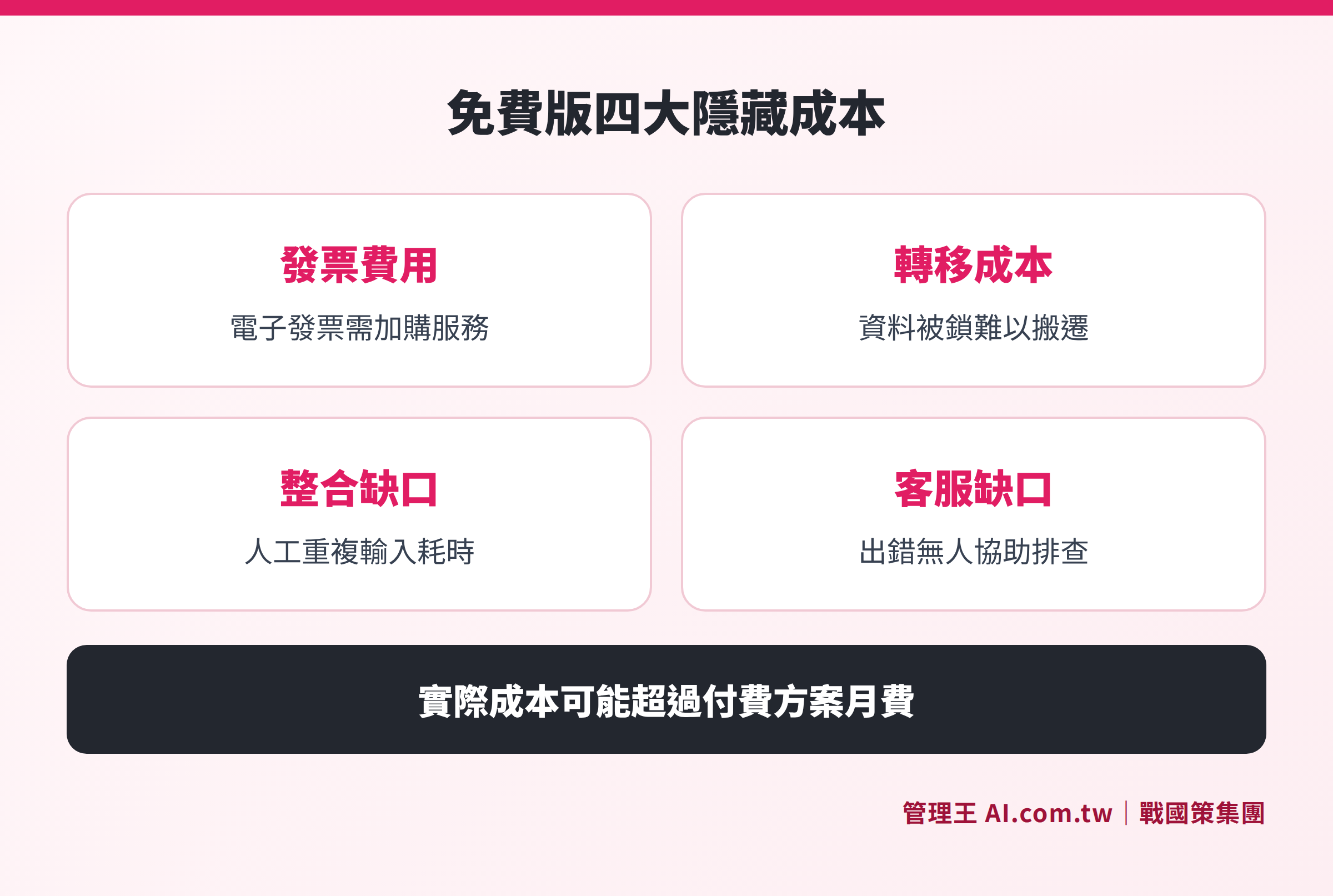
While free accounting software seems like a cost-saving option, the actual costs from electronic invoices, integration, transfer, and customer service may surpass those of paid plans.
The Four Hidden Costs of the Free Version
After understanding the functional limitations, let’s look at the four types of hidden costs most often encountered in practice.
1. Additional Handling Required for Electronic Invoices
The Ministry of Finance's electronic invoice integration service platform (available for free application) primarily supports the declaration and storage of B2B invoices, but if businesses need to issue B2C cash register invoices or integrate with POS systems, they must use a value-added service center approved by the Ministry of Finance. The value-added centers are qualified by the Ministry of Finance, with different charging methods among providers (please consult each provider for the latest quotes), and this cost is often entirely omitted in the advertisements for free accounting software.
2. Data is Locked, High Transfer Costs
Most free accounting software does not provide complete data export functionality or can only export to CSV rather than comprehensive entry formats. When business growth necessitates an upgrade, past accounting data may need to be reorganized, potentially requiring hiring external consultants to assist with data cleaning and migration, with labor costs depending on the complexity of the accounts.
3. Integration Gaps Require Manual Patching
The free version usually does not provide APIs or module integrations. Quotation sheets, purchase orders, payroll, and POS cannot automatically convert to vouchers, meaning that while sales colleagues complete orders in CRM, financial personnel still need to manually re-enter them. This "double entry" issue can accumulate dozens of hours of manual labor each month as business volume grows, representing the most concealed costs.
4. Mistakes Are on You, Consultant Fees Are Extra
Free version software typically does not offer phone or LINE customer service; when encountering issues like incorrect accounting subject settings, mismatches with firm formats, or inability to export tax data, users can only rely on community forums for answers or pay consulting fees for external handling.
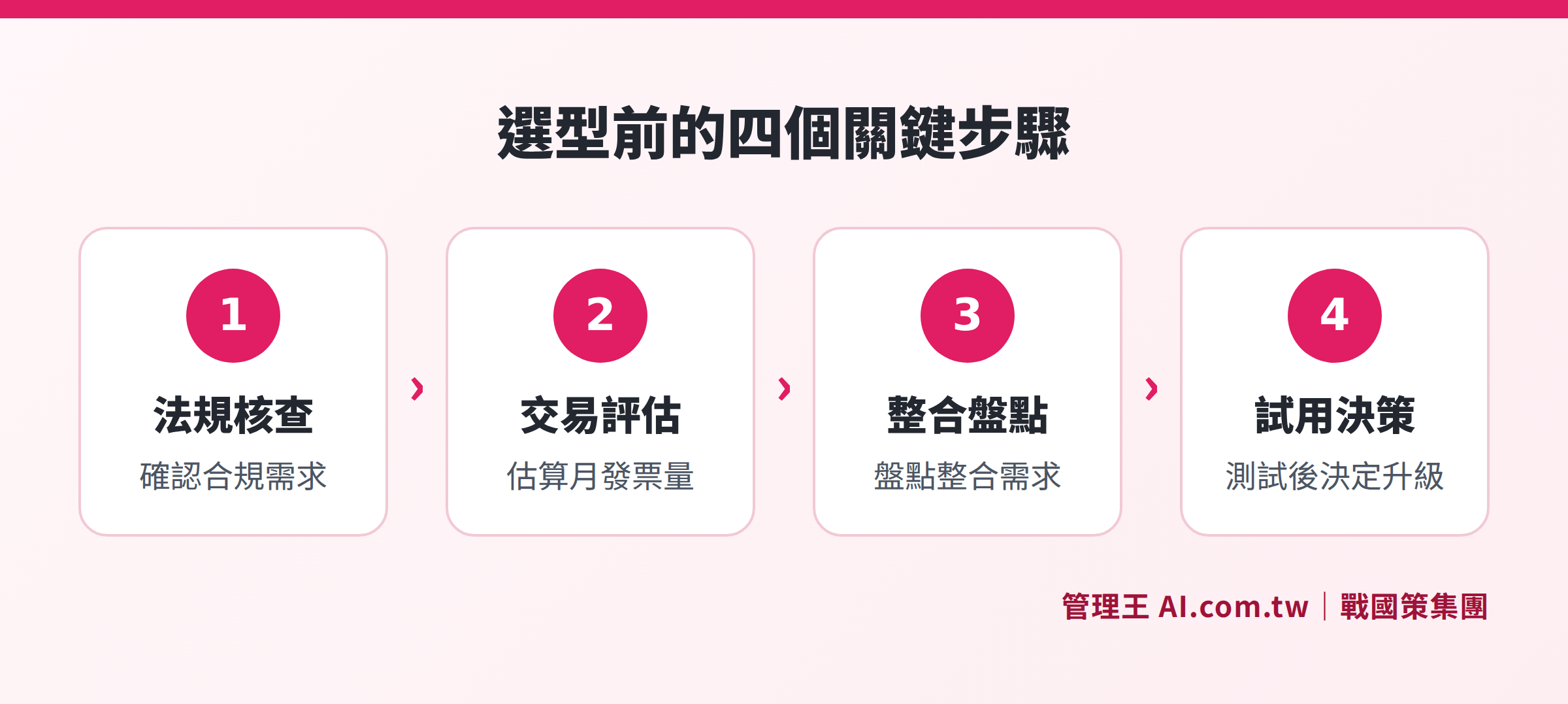
Choose suitable accounting software solutions based on business scale and compliance needs.
When Is It Reasonable to Continue Using the Free Version?
The following four scenarios provide a rationale for using the permanent free version:
Table: Scenarios Suitable or Not Suitable for the Free Version
| Scenario | Recommendation | Reason |
|---|---|---|
| 1-person studio, monthly income below 100,000 | Suitable for free version | Low transaction volume, few invoices, low manual patching costs |
| 2 to 5 people, need B2C invoice | Consider upgrading to paid version | Increased complexity of electronic invoice integration |
| Have payroll, procurement, inventory processes | Recommend upgrading to paid version | Multiple integration gaps, high manual patching costs |
| Managing multiple companies or departments | Must use paid version | Free version offers almost no support |
| Need firm accounting format (Dingxin, Wenzhong, etc.) | Recommend upgrading to paid version | Export format compatibility is key |
| Planning rapid expansion within a year | Recommend upgrading to paid version | High data migration costs, early integration is cost-effective |
Common Triggers for Upgrading from the Free Version
Based on the actual situations of SMEs in Taiwan, the following moments are typically turning points for upgrading from the free version to a paid one:
- More than 5 employees: After dividing accounting processes, the user limit of the free version becomes a bottleneck.
- Monthly invoice count exceeds 50: The importance of electronic invoice integration significantly increases.
- Began needing payroll for employees: Integrating payroll with accounting can save significant manual labor.
- Began needing procurement and inventory management: Requires system integration for three-way reconciliation (orders, receipts, invoices).
- Facing the first audit or inspection: This is when it becomes apparent that the book format of the free version does not meet requirements, and the cost of remedying it is higher.
How to Choose an Accounting System? A Complete Guide for SMEs provides a more detailed system selection process, and is recommended for complementary reading.
How to Use Management King
Management King's AI.com.tw accounting system offers a free plan that can be used permanently, with core functions including voucher input, invoice OCR, profit and loss statements, etc., suitable for newly established businesses to familiarize themselves with the system. As business growth requires electronic invoice integration, multi-company management, or full module integration, they can directly upgrade plans, retaining all historical accounting data without the need for migration.
Specific function descriptions are as follows:
- Invoice OCR input in three seconds: Take a photo or upload an invoice, and the AI automatically identifies the buyer, seller, amount, and uniform invoice number, completing the entry in about three seconds, greatly reducing manual entry time.
- All modules automatically convert vouchers: Procurement system payments, sales quote successful completions, payroll system settlements, all automatically convert into accounting vouchers, requiring no manual re-entry by financial personnel.
- One-click output of three major statements: Profit and loss statements, balance sheets, and cash flow statements can be produced anytime, with format support compatible with commonly used systems in accounting firms (Dingxin, Wenzhong, Zhenghang, etc.).
- Multiple companies and cost centers: Manage multiple companies or branches under a single account, supporting consolidated statements and independent profit and loss calculations for departments.
- Integrated approval processes: Vouchers, payment requests, and procurement payments undergo online approval, allowing supervisors to sign off via mobile, with a complete audit log kept for record.
The 戰國策 group serves over 30,000 enterprises, and Management King's accounting module is designed according to Taiwan's Commercial Accounting Act and electronic invoice regulations, with data stored in local data centers in Taiwan (ISO 27001 compliant).
If you are comparing options from different brands, you can refer to the accounting system brand comparison article to understand the functionalities and pricing differences publicly disclosed on each official website.
For more details on the plans, please see the Management King pricing page.
Want to confirm if your accounting processes are compliant?
Management King consultants offer free consultations to help you assess the functional gaps of your current accounting system and identify the most suitable upgrade timing for SMEs.
Free consultation hotline: 0800-003-191
LINE Official Account: @119m
Official website: app.AI.com.tw
Free trial: Apply for Management King now
Frequently Asked Questions
Is permanent free accounting software legal?
Legality depends on whether the software's functions comply with Taiwanese regulations. The key points are: does the software support double-entry bookkeeping (debit and credit entries), can it produce the three major financial statements required by the Commercial Accounting Act, and does it support electronic invoice integration? If the free version only offers simple journal entries and does not fully meet regulatory requirements, businesses still need to supplement it themselves, or they may encounter problems during audits.
Can free accounting software issue electronic invoices?
Most free versions do not include electronic invoice integration features. Businesses need to separately apply to the Ministry of Finance’s electronic invoice integration service platform or delegate approved value-added service centers to issue invoices. If the software does not support electronic invoices at all, then the accounting system and billing system are separate, requiring manual maintenance of data consistency between the two systems.
If accounting data is stored in free software, can it be transferred later?
This is the most commonly overlooked risk of free versions. Before choosing software, it is recommended to confirm whether it allows exporting past entries, client, and vendor data in complete formats (Excel or standard CSV). If the export functionality is limited, future migration may require manually reorganizing the accounts, which is time-consuming and labor-intensive.
Can Management King's free plan be used forever?
Yes, Management King's free plan has no usage time limit and supports up to 10 members. Core features such as bookkeeping, invoice OCR, and more can be continuously used; some advanced functions (such as AI high-volume analysis and multi-company reports) will require an upgrade to a paid plan after the trial period. For detailed feature comparisons, please refer to the official pricing page.
Does a one-person company really need paid accounting software?
If the business is simple (primarily cash income, few invoices, no receivables or payables management needs), the free version is usually sufficient. When the business involves multiple B2B invoices, procurement payment processes, or exceeds 3 employees, the benefits of upgrading to a paid version typically outweigh monthly expenses, especially when considering the time costs of manual patching.
Data Sources
- Commercial Accounting Act, National Regulations Database, Ministry of Justice
- Ministry of Finance Electronic Invoice Integration Service Platform, Ministry of Finance
- Implementation Guidelines for Electronic Invoices, Ministry of Finance, 2026 query
- Management King AI.com.tw Accounting System Features Page, Management King Official Website
This article is for general information only and does not constitute legal or tax advice; refer to the latest announcements from the competent authorities.