Must-Read Before Choosing a Free Appointment System: 5 Hidden Limitations of Free Plans|Recommended Appointment Systems
作者:戰國策集團
This article summarizes the 5 hidden limitations of free appointment systems: monthly booking limits, blocked payment features, branding tags, limited automated reminders, and compliance risks with Taiwan's personal data laws when using overseas systems. It also includes a comparison chart of mainstream tools and circumstances for upgrading, assisting service industry owners in Taiwan to choose the right tools and avoid pitfalls.
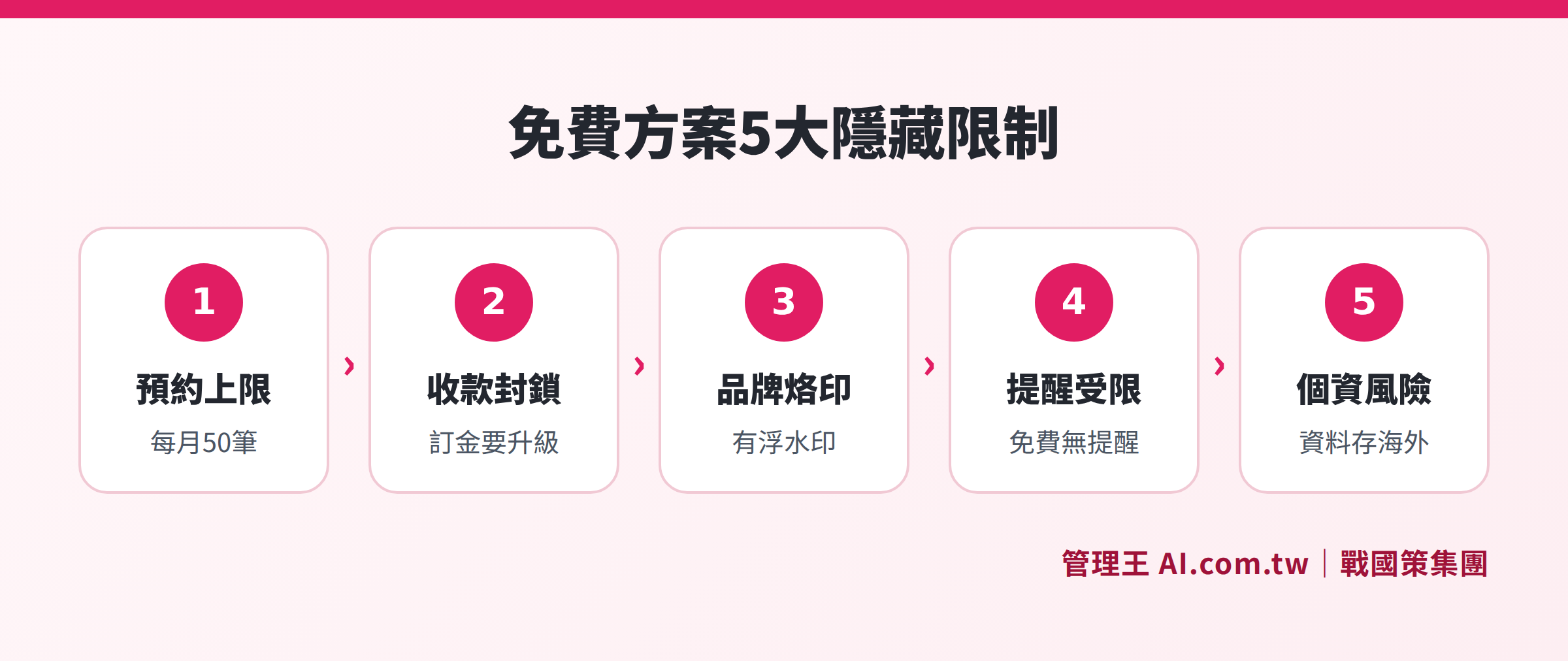
Free appointment systems seem costless, but you must clearly understand their hidden limitations before use. The so-called "free plan" essentially allows you to trial core features and upgrade as your business grows. The five common hidden limitations are: monthly booking limits, online payment and deposit blocked in the paid version, third-party branding tags on public booking pages, SMS or LINE automated reminders requiring additional payments, and compliance risks with Taiwan's personal data laws when using overseas systems. Understanding these five points will help you choose the right tools before your business volume increases and avoid the rush to change systems during busy times.
How Free is a Free Plan?
Free appointment systems generally adopt a "freemium" business model: the free version provides basic features to allow users to experience core processes and then encourages growth-demanding users to upgrade through feature walls or usage limits.
This model is entirely reasonable for the platform provider and provides real value for users — but the problem is that many limitations are written in small print on the feature comparison pages, making it difficult for business owners to notice before going live. Only when customers start complaining about failed bookings do they realize they have already exceeded the limit.
In One Sentence
The "free" in free appointment systems is meant for trial use; once you hit booking limits, need for payments, or personal data compliance, you must upgrade — and by then, you may already be reliant and hard to change.
The following five limitations are the key points that service industry owners need to confirm before choosing tools.
Hidden Limitation One: Monthly Booking Limits
Most overseas free appointment tools set limits on the number of bookings accepted per month. For example, SimplyBook.me allows only 50 bookings per month in the free plan (according to publicly available information on their website as of November 2026). For a studio serving only 2 clients per day and operating 5 days a week, 50 bookings might last several weeks; but for a beauty salon with 3 technicians, it could easily generate 10 to 15 bookings a day, reaching the limit in half a week.
Once the limit is reached, the system usually reacts in two ways: either automatically closing the booking access for the month, and customers seeing "Booking is paused" when clicking the link; or allowing continued bookings but not sending confirmation notifications, leading customers to believe their bookings were successful while receiving no confirmation, resulting in no-shows or repeated inquiries. Both situations directly harm customer experience, and owners often do not notice immediately.
Questions to Ask Before Choosing a System: What is the monthly limit in the free version? How does the booking page display after exceeding the limit? Is there an excess notification?
Hidden Limitation Two: Online Payment and Deposit Features Blocked
One of the primary motivations for many service providers to adopt appointment systems is to collect deposits during bookings to reduce "no-show rates." However, this feature is usually locked in most free plans.
For instance, Calendly's free version (Basic plan) does not support payment functionality; you must upgrade to at least the Standard plan (approximately USD 10 per month) to integrate payment processing (according to Calendly's official website as of November 2026). Some platforms do allow payments in the free version but only support PayPal or Stripe, not local Taiwanese payment processors like Green World or Neweb Pay, making payment processes cumbersome for domestic customers, and even requiring applicants for overseas payment accounts.
For service providers in Taiwan, a booking system without a deposit feature is almost equivalent to just a "scheduling calendar," unable to effectively reduce no-show rates and failing to complete the payment loop within the booking process.
Questions to Ask Before Choosing a System: Does the free version support online deposit collection? Does it support local Taiwanese payment processing (Green World, Neweb)? Are the handling fees a fixed percentage or additional charges?
Details explaining the five hidden limitations: booking limits, payment blocks, branding tags, reminder restrictions, and data risk
Hidden Limitation Three: Branding Tags Indicating “Not Your Own System”
Many free appointment tools add statements like “Powered by XXX” or “Book with XXX” at the bottom of your public booking page (i.e., branding tags or watermarks). If businesses wish to remove this branding, they usually need to upgrade to a paid plan. For example, both Calendly and Setmore require paid versions to remove brand indicators (according to their official websites as of November 2026).
From a customer perception perspective, the impact of branding tags varies by industry:
- Services that emphasize privacy, such as beauty, medical aesthetics, or psychological counseling: Customers may have concerns about data security upon seeing third-party platform names.
- Higher-end brand positioning entities: The presence of a logo from an unknown system on public booking pages may not align with brand image.
- B2B services for corporate clients: Partners seeing a third-party platform on the booking page may seem unprofessional.
Moreover, some platforms also include system advertisements or marketing messages in reservation confirmation emails that are sent in the business's name but whose content the business cannot control.
Hidden Limitation Four: Automated Reminder Functionality is Limited
Automated reminders are one of the key features of appointment systems to decrease no-shows — the system automatically sends a confirmation notice after the appointment is established and a reminder 24 hours before the appointment. However, in free plans, this feature is often subject to the following limitations:
- Email reminders are generally available, but SMS reminders incur costs: SMS reminders are highly effective among Taiwanese users, but most overseas platforms only provide Email in the free version, requiring upgrades for SMS or LINE reminders.
- Number or frequency of reminders may be limited: The free version may have limits on the number of reminders that can be sent per month.
- Customization of reminder content is restricted: Free versions generally can only use system default templates without the ability to adjust reminder content for different service types.
In the Taiwanese market, LINE is the primary channel through which customers habitually receive business messages. If the system cannot integrate with a LINE official account for sending reminders, operators often need to manually supplement notifications, increasing labor costs.
Hidden Limitation Five: Personal Data Law Risks with Data Stored Overseas
When using overseas free appointment systems, customers' personal data such as names, phone numbers, and booking records are generally stored on overseas servers by default (often in the United States or Europe). This raises issues regarding legal responsibilities in Taiwan.
Article 8 of Taiwan's Personal Data Protection Act stipulates that when collecting personal data, businesses must inform the data subjects of the purpose of collection, the types of data, the duration of data use, the region, the subjects, and the methods, as well as their rights to query, request corrections, or deletions. Article 27 requires businesses to take appropriate security measures to prevent unauthorized access, tampering, damage, loss, or leakage of personal data.
The core issue is: choosing an overseas free system does not exempt businesses from their own obligations to protect personal data. If a data breach occurs in the system, customers may still seek compensation from businesses under personal data laws. When using free overseas systems, businesses typically:
- Cannot confirm the precise locations of data storage or if the servers comply with Taiwanese regulations.
- Cannot obtain IS0 27001 or other cybersecurity certification documents from system providers (free users usually cannot obtain written contracts or service level guarantees).
- Cannot confirm if the system provider will use data for advertising or third-party analysis.
Questions to Ask Before Choosing a System: In which region is the data stored? Is there an ISO 27001 certification? Is there a written Data Processing Agreement (DPA) provided?
Comparison of Mainstream Free Appointment Tool Features
The following summarizes the core limitations of common free appointment tools (based on publicly available information on respective platform official sites as of November 2026; based on free plans):
Table: Comparison of Mainstream Free Appointment Systems (Free Plans)
| Tool | Monthly Booking Limit | Online Payment | Branding Tag | SMS Reminder | Data Storage Location |
|---|---|---|---|---|---|
| Calendly | No limit (but only 1 type of event) | Not supported | Yes | Not supported | USA |
| SimplyBook.me | 50 bookings | Partially supported | Yes | Not supported | EU |
| Setmore | No limit | Only Square | Yes (paid to remove) | Not supported | USA |
| 管理王(免費方案) | No limit | Supports Taiwanese payment processing | No (your brand) | LINE integration | Taiwan dual data centers |
Data explanation: "Partially supported" means that it can be tested in the free version but requires a third-party paid account; Management King's free plan is permanently free for accounts under 10 users, and advanced AI features are point-based; the comparisons above are based on publicly available plan pages and subject to the latest announcements from regulatory authorities or platforms.
Four Business Scenarios Where Free Plans Fall Short
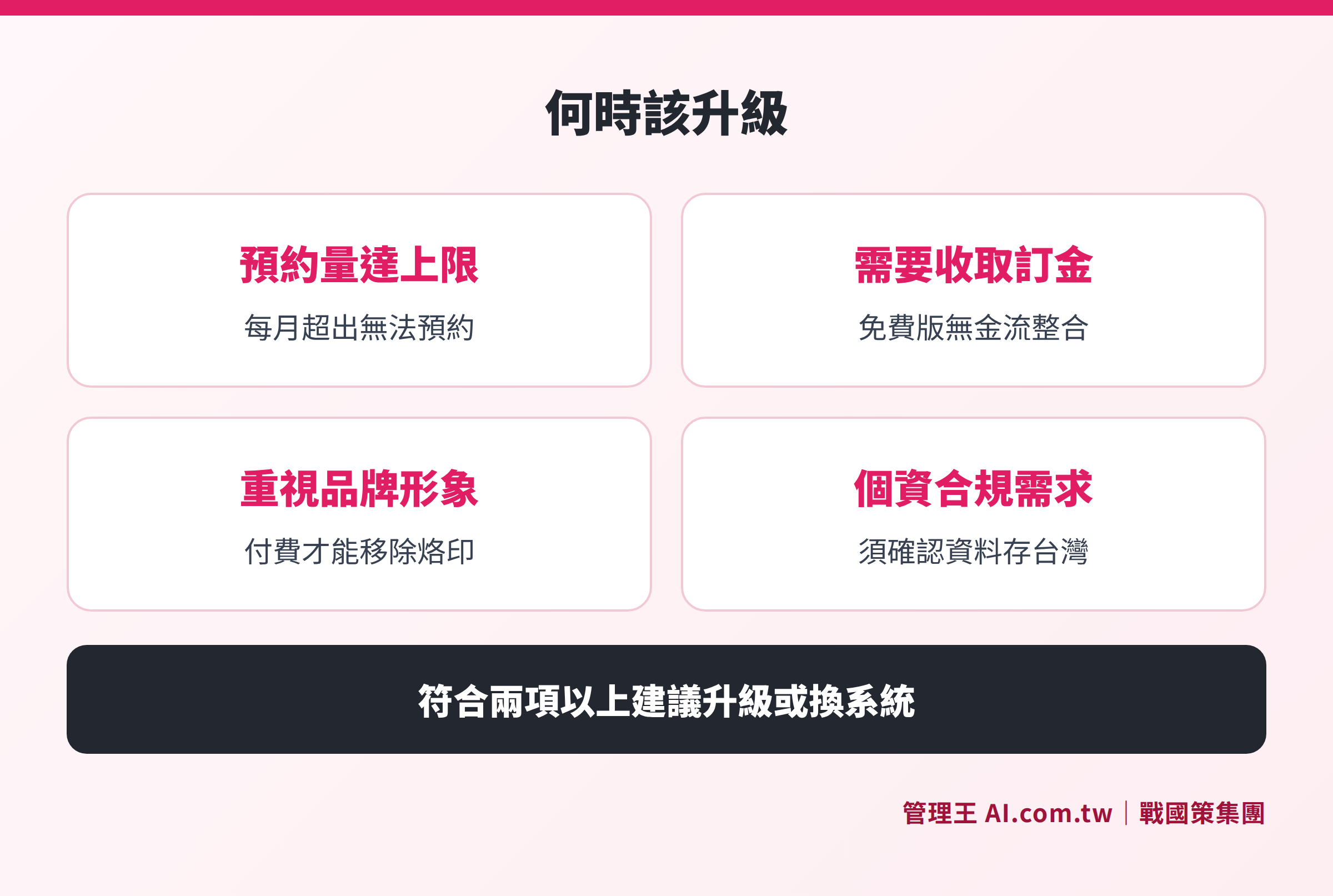
To determine whether an upgrade is necessary, consider the following four scenarios:
Table: Business Scenarios Requiring Upgrade from Free Plans
| Scenario | Problems Encountered in Free Plan | Recommended Action |
|---|---|---|
| Bookings exceed 50 per month | Booking access forcibly closed, customers complain | Upgrade or change plans immediately |
| Need to collect deposits or final payments | No online payment, requires manual follow-up | Choose a system supporting Taiwanese payment processing |
| Customer complaints about unprofessional booking page | Branding tags do not match your image | Pay to remove tags or switch platforms |
| Customer data must comply with personal data law scrutiny | Cannot confirm data storage location and security | Prioritize choosing systems storing data in Taiwan |
High booking volume, need for deposits, emphasis on image, and compliance, four scenarios explaining when to upgrade to paid or change systems
How to Use Management King's Appointment System
Management King's appointment system free plan can be used permanently, with no duration limit for accounts under 10 users and no monthly booking limit. Here are some key operations:
Public Booking Page Settings
In the "Appointment System" module, create a public booking page to set the available booking slots for each service provider, the duration of each item, and pricing. The page presents your brand, without third-party watermarks.
Online Deposits and Automated Reminders
Supports online deposit payments, integrating with local Taiwanese payment processors like Green World and Neweb; it automatically sends LINE confirmation notifications after booking confirmation and automatically reminds 24 hours before the appointment, reducing no-show rates. Once set up, everything operates automatically without human intervention.
Integration with CRM and Marketing Modules
Booking data integrates with the CRM system, automatically creating customer records for each booking. After the appointment, it can trigger marketing automation to send thank-you messages for visits or reminders for follow-up appointments. The membership point system can also automatically accumulate points after bookings, increasing return visit rates.
Data Sovereignty
All data is stored in Taiwan data centers (dual machine room backup, compliant with ISO 27001), meeting the requirements of Taiwan's Personal Data Protection Act, with written data processing explanations available for regulatory audits.
Furthermore, Management King's AI customer service system can automatically respond to appointment inquiries outside business hours, reducing manpower spending. Management King's pricing plans are based on a monthly fee, starting from NT$5,000/month, suitable for service providers with larger business volumes or those needing advanced AI features.
The 戰國策 group serves over 30,000 enterprises, with 管理王 AI.com.tw designed for small and medium enterprises in Taiwan, featuring a Traditional Chinese interface and native LINE notifications, usable within a day of going live. If you have questions regarding feature settings, you can call our free consultation hotline; the Taiwanese consulting team is available Monday to Friday from 9:00 AM to 6:00 PM.
For a complete introduction to appointment systems, please refer to: Complete Guide to Online Appointment Systems.
Free Consultation for Appointment System Clients
Assistance in evaluating whether a free plan meets your business volume, collection, and personal data needs, and recommending the most suitable appointment system settings based on your industry.
Free consultation hotline: 0800-003-191
LINE official account: @119m
Official website: app.AI.com.tw
Free trial: Apply for Management King's service now
Frequently Asked Questions
Does a Free Appointment System Always Have a Booking Limit?
Not necessarily, but most mainstream overseas tools do have restrictions. Calendly's free version has no booking limit but only opens 1 type of booking event; SimplyBook.me's free version has a monthly limit of 50 bookings. Management King's free plan has no booking limit, based on what is publicly available on their website, with rates subject to updates.
Do Taiwanese Users Using Overseas Free Appointment Systems Bear Personal Data Law Responsibilities?
Yes. Article 27 of Taiwan's Personal Data Protection Act stipulates that non-public entities holding personal data records must take appropriate security measures. Choosing a third-party system does not exempt businesses from their obligations. It's recommended to confirm whether the system provider offers a Data Processing Agreement (DPA) and security certification documents or prioritize selecting systems that store data in Taiwan.
What Practical Impact Do Branding Tags Have on Customers?
There are mainly two impacts: one is that customers seeing unfamiliar third-party brand names on booking pages or confirmation emails may raise concerns about data usage; the other is damage to the image of high-end service industries. This issue is particularly significant for industries sensitive to customer privacy (e.g., psychological counseling, medical aesthetics, legal advice).
Does the Free Appointment System Support LINE Notifications?
Most overseas systems in the free version only support Email notifications and do not support LINE notifications; some systems may allow limited integration through Zapier but require additional setup and costs. Management King's appointment system natively integrates with LINE, requiring no additional connections, automatically sending LINE confirmations and reminders after bookings.
When Should One Upgrade from a Free to a Paid Appointment System?
If any of the following situations arise, consider upgrading or changing systems: (1) Monthly booking volume exceeds the free version's limit, (2) Business requires collecting deposits during bookings, (3) Customers or partners react negatively to branding tags, (4) Businesses need to explain data storage locations and security measures to customers. Management King's free plan has a higher applicability in most of these scenarios and can be evaluated through a trial.
Sources
- Full text of Taiwan's Personal Data Protection Act (National Regulations Database)
- Calendly's official plan page (as of November 2026)
- SimplyBook.me official free plan details (as of November 2026)
- Management King's appointment system features page
- Management King's pricing plan page
This article serves as general information and does not constitute legal or tax advice; actual regulations are subject to the latest announcements from regulatory authorities.