Can Free Electronic Signature Systems Be Used? Cost Structure and Differences with Paid Versions|Signature System Recommendations
作者:戰國策集團

Free electronic signature systems can be practically used, with 管理王 offering a permanent free plan for up to 10 users, covering six types of forms including leave, overtime, and procurement. This article summarizes the cost structure, limitations of the free version, and the timing for paid upgrades, along with a description of the legal validity under the Electronic Signature Act.
Free electronic signature systems can indeed be practically used, but the thresholds set by different vendors vary. The most common triggers for fees are: exceeding the free user limit, activating advanced AI features, and multi-level approval processes across departments. 管理王's free plan is limited to businesses with 10 or fewer users, allowing permanent usage for electronic signatures related to leave, overtime, procurement, expenses, and documents without needing to bind a credit card; only when there are more than 11 users or if more AI points are needed must an upgrade to a paid plan be made. According to Article 4 of Taiwan's Electronic Signature Act, electronic documents and signatures that comply with legal requirements are functionally equivalent to physical documents, having the same legal effect, allowing businesses to implement them with confidence.
What Can Free Electronic Signature Systems Do? Clarifying Function Boundaries
Most electronic signature systems in the market with free plans typically cover the following core functions:
- Basic forms: daily applications such as leave, overtime, business trips, expense reimbursements
- Single or double-layer approvals: a linear approval process where employees submit to direct supervisors for approval
- Mobile device notifications: reminders for pending signatures sent via LINE or app push notifications
- Basic audit records: records of who signed and when
Features that go beyond the free scope have different thresholds set by vendors, commonly including paid-only items like conditional multi-level approvals (automatic additional signatures based on amounts), AI auto-summary for pending items, batch signing, proxy signing SLA timelines, cross-system automatic data writing (e.g., automatic deduction of leave days after signing for leave), and detailed monthly efficiency reports.
Understanding which level of functionality you need is the first step in determining whether the free version is sufficient. For small businesses with fewer than 10 users and single supervisor approvals, the free plan is usually adequate; mid-sized companies with multi-department and multi-level approval needs generally require the paid version.
Three Major Triggers for Fees: Exceeding User Count, Feature Upgrades, AI Enhancements
In a nutshell
The three main limitations of free electronic signature systems: user limit, tiered advanced features, AI point cap; exceeding any of these requires considering an upgrade to a paid version.
Condition One: Number of members exceeds the free limit
Most SaaS subscriptions for electronic signatures charge based on "number of members." Free plans typically have a limit of 5 to 10 users. When the company's employees exceed 11, an upgrade or purchasing per-user authorization is required, increasing overall costs.
Condition Two: Need for advanced approval processes
Cross-department approvals (e.g., automatic forwarding for secondary approval if procurement amounts exceed a threshold), parallel signatures (multiple supervisors approving simultaneously), and conditional routing fall under advanced process design, most of which are paid features. Free versions typically only support linear single-level approvals.
Condition Three: Consumption of AI feature credits
Next-generation electronic signatures integrate AI features like auto-summary and intelligent prioritization, which are charged based on points. Free plans usually provide a one-time trial point allocation, after which fees for replenishment or subscription upgrades are required.
Supplement: Implementation and customization costs
In addition to monthly fees, two hidden costs need to be considered: one is the labor hours for implementation setup (internal IT personnel or external consultants assisting in process establishment), and the second is customization development costs (additional development required for non-standard processes). Some vendors include training in their paid plans (such as 管理王's business plan including 8 hours of remote training), which can lower implementation barriers; customization development is commonly billed at an hourly rate, with 管理王's transparent pricing set at 1,000 TWD per hour, starting work only after providing a written quote, allowing companies to budget in advance.
Cost Structure of Electronic Signature Systems: Four Common Charging Models
The pricing methods for electronic signature systems in the market are generally divided into the following four types:
Table: Comparison of Four Electronic Signature Charging Models
| Charging Model | Description | Suitable for | Notes |
|---|---|---|---|
| Subscription (User Count Based) | Charged monthly or yearly based on member count | Small to medium enterprises with stable number of members | Costs grow linearly with increasing headcount |
| Feature Tiering System | Free / Advanced / Enterprise packages | Businesses that require phased implementation | Cannot revert back to free version once upgraded |
| Single Form Billing | Separate subscriptions for each type of form | Businesses only needing specific forms | Costs accumulate significantly for multiple form needs |
| Subscription + AI Point System | Base subscription fee plus AI points | Businesses needing AI assistance | AI usage must be estimated to avoid overages |
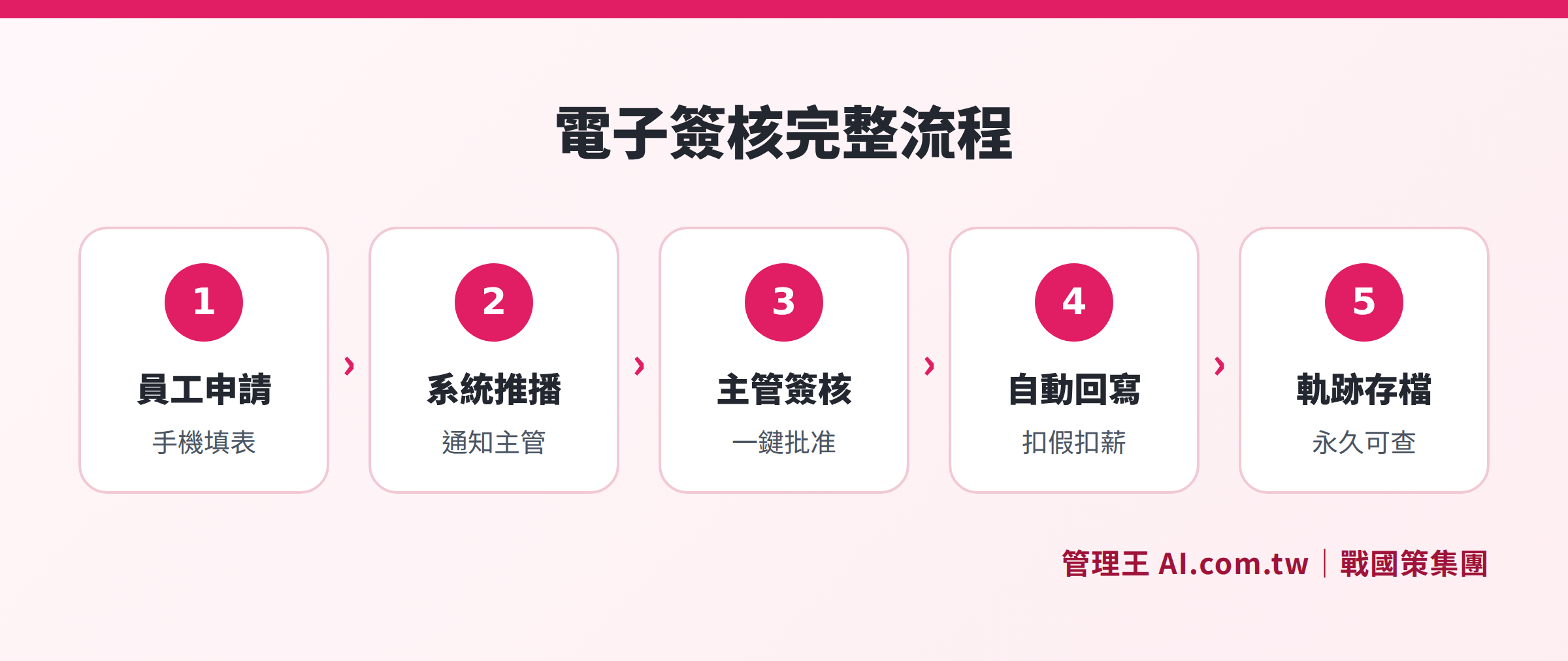
Five-step flowchart: Employee applies via mobile → System pushes to supervisor → Supervisor signs with one-click on LINE → Data automatically updates leave salary → Audit traces permanently archived
管理王 Free Plan vs. Paid Version: A Complete Comparison of Costs and Features
管理王 AI.com.tw Signature Center follows a subscription model combined with AI points. Below is a detailed comparison of each plan (based on official website public information, see service plan page):
Table: Cost Comparison of 管理王 Signature Center Plans
| Plan | Monthly Fee (TWD) | Member Limit | AI Points | Suitable Scale |
|---|---|---|---|---|
| Free Plan | 0 | 10 users | One-time allocation | Small businesses with 1 to 10 users |
| Economy Plan | 5,000 TWD | 30 users | 1,000 points/month | Growing businesses with 11 to 30 users |
| Business Plan | 10,000 TWD | 60 users | 3,000 points/month | Medium enterprises with 31 to 60 users |
| Flagship Plan | 19,900 TWD | Unlimited | 10,000 points/month | Large and medium enterprises with over 60 users |
The Business and Flagship plans also include remote implementation training (8 and 16 hours, respectively) to assist companies in getting up and running quickly. Annual payment plans allow 14 months of service for the cost of 12 months (equivalent to a 14% discount). If only specific feature modules are needed, there is also an option to choose individual feature plans at 1,000 TWD per month. When standard features do not meet needs, additional custom development can be commissioned at a rate of 1,000 TWD per hour.
The core difference between the free plan and paid versions is not the presence or absence of features but the consumption limits and AI points available. The free plan allows permanent use of electronic signatures for six preset forms: leave, overtime, procurement, expenses, and documents, as well as support for multi-level approval setups; the AI assistant summary feature will need to be upgraded for replenishment once the one-time points are exhausted.
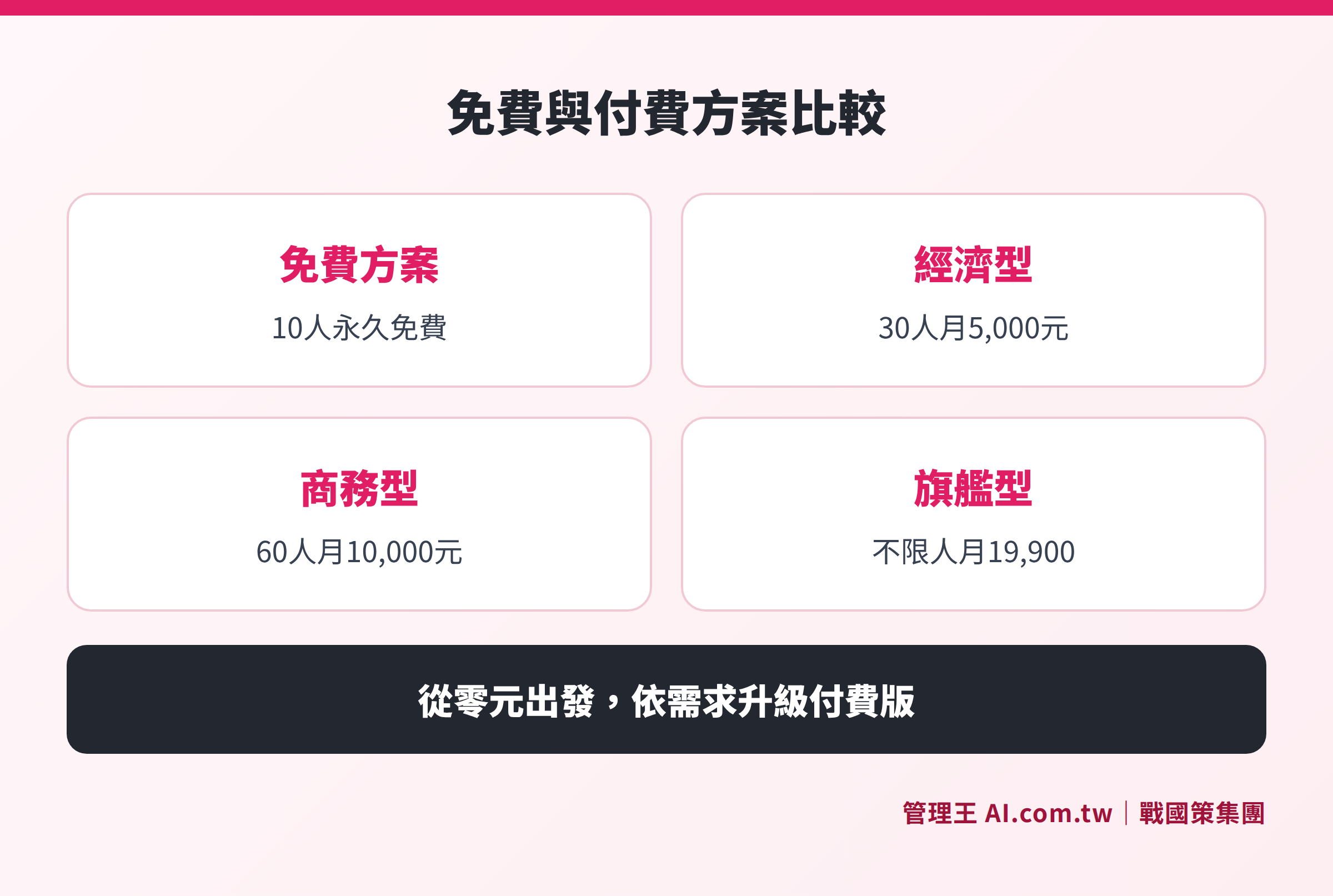
Four cards: Free is limited to 10 users permanently, the paid version unlocks unlimited members, the Business version adds monthly AI points, and the Flagship version includes implementation training
Do Electronic Signatures Have Legal Validity? Analysis of Taiwan's Electronic Signature Act
One of the first questions many companies have before implementing electronic signatures is: "Is this legally valid?" The answer is yes, but with certain prerequisites.
Taiwan's Electronic Signature Act (amended on May 15, 2024) clearly stipulates:
Article 4 (Principle of Equivalent Legal Effect): Electronic documents and electronic signatures that meet legal requirements are functionally equivalent to physical documents and signatures and cannot have their legal validity denied solely because of their electronic form.
Article 5 (Scope of Application): For matters that are required by law or regulations to be signed or stamped, electronic signatures may be used. For matters that are required by law to be in writing, if the content can be fully presented and extracted for verification, electronic documents may be used.
Article 6 (Presumption of Validity for Digital Signatures): Electronic documents signed using digital signatures, with certificates issued by legally authorized certificate authorities, are presumed to be signed or stamped personally as long as the certificates are valid within the effective period.
In practice, internal approval processes such as leave requests and procurement approvals within companies can meet the requirements of the Electronic Signature Act as long as the identities of signers are confirmed (account and password login plus operation records), which ensures legal validity. For external contracts (such as supplier contracts, employee labor contracts), it is recommended to use electronic contracts and signature functions with certificates from certification authorities for enhanced legal protection.
> This article is for general information only and does not constitute legal advice; actual legal standards shall be based on the latest announcements from the competent authority.
When is the Free Plan Not Sufficient? Three Clear Signals for Upgrading to Paid
After understanding the cost structure, businesses also need to know "when to upgrade." The following three signals suggest seriously considering a paid plan:
Signal One: Employee count exceeds 10
The free plan has a member limit of 10; once the 11th employee joins, system functionalities cannot be accessed, requiring an upgrade.
Signal Two: Frequent bottlenecks in approval processes
If the number of pending signatures piles up for more than a day when a supervisor is on a business trip, the need for proxy signing functions has emerged; if signing for a month’s worth of documents has to wait until the end of the month, it also shows a lack of timely control. These are all advanced features of the Business plan or above.
Signal Three: One-time AI points are exhausted
The AI assistant can automatically summarize pending items and suggest priority orders, which is especially effective for managers overseeing multiple departments. When the one-time points are exhausted, the AI functionality suspends, requiring the supervisor to manually review each item, significantly reducing efficiency, which is the most direct signal to upgrade.
How to Start Free Electronic Signatures with 管理王
The 管理王 Signature Center free plan can be used permanently. Here is a step-by-step process for companies with fewer than 10 users to get started:
- Register for free at app.ai.com.tw, completing in 30 seconds without a credit card requirement
- Establish organizational structure: set departments and positions, determine the approval paths for each type of application
- Enable preset forms: six forms for leave, overtime, business trips, procurement, expense reimbursement, and document signing are ready to use
- Set up LINE notifications: after binding employees and supervisors with LINE, all pending signature notifications will be sent directly to LINE without needing to open the app
- Run a test for a leave application: confirm that the process works normally before promoting it to all staff
The signature center is natively integrated with the payroll system, attendance clock-in system, and HR system. Once a leave application is approved, it automatically deducts vacation days, and approved overtime is automatically calculated into salaries without manual input. Paired with the contract management feature, labor contracts can also be electronically signed and archived within the same system.
戰國策 Group serves over 30,000 businesses, and 管理王’s signature function takes into account Taiwan’s business practices (Traditional Chinese interface, LINE integration, compliance with the Labor Standards Act). The consulting team provides free consultations at 0800-003-191, assisting in assessing whether the free plan meets needs or planning upgrade timelines.
Calculate Your Signature Solution Costs
Consultants are available to evaluate whether the free plan meets your needs or to plan the timeline for upgrading to a paid plan, offering 30 minutes of free consultation.
Free Consultation Hotline: 0800-003-191
LINE Official Account: @119m
Official Website: app.AI.com.tw
Free Trial: Apply for 管理王 now
Frequently Asked Questions
Is the legal validity of the free electronic signature system the same as the paid version?
Yes, the legal validity is guaranteed by the Electronic Signature Act, regardless of whether it is free or paid. The key lies in whether the system records a complete audit trail (when, who, what IP was used), and whether it can be retrieved for verification afterward. Both the free and paid versions of 管理王 have complete audit records, ensuring the same legal validity.
Can the free plan set up multi-level approvals?
The 管理王 free plan supports multi-level approval setups, specifying different approvers by department or job level. Conditional routing (e.g., automatic additional signatures if procurement amounts exceed specific thresholds) can also be set up. The primary limitations are the user count cap of 10 and the AI assistant features using one-time points.
Can I downgrade to the free plan after upgrading to a paid version?
Yes, you can stop the subscription and revert to the free plan. However, note that accounts of members exceeding the free plan's limit of 10 users will not be able to continue using the system, so it's advisable to confirm long-term needs before upgrading. No data will be lost, and past audit records remain accessible.
Does the electronic signature system require software installation?
管理王 employs responsive web design, accessible directly via browsers on desktops and mobile devices without any software installation required. Both iOS and Android support PWA (adding to the home screen from the browser), and LINE Bots also offer quick inquiries and operations without needing to download a dedicated app.
If I upgrade after trying the free plan, will my data remain?
Yes. 管理王 uses a single account system, and all form designs, approval process settings, and historical signature records created during the free plan period will be retained after upgrading, requiring no reconfiguration.
Data Sources
- Electronic Signature Act (amended on May 15, 2024), National Regulations Database, Ministry of Justice
- 管理王 AI.com.tw Signature Center Feature Page, consulted November 2026
- 管理王 AI.com.tw Service Plan Pricing, consulted November 2026
This article is for general information only and does not constitute legal or tax advice; actual standards should be based on the latest announcements from the competent authorities.