Is a Free Clock-In System Enough? Common Limitations of Free Versions and When to Upgrade|Clock-In System Recommendations

A free clock-in system is generally sufficient for small teams, but significant limitations arise when teams exceed 10 people or require payroll integration or multi-store management. This article outlines five major limitations, compliance requirements of labor laws, and upgrade triggers to help you make the most informed decision.
A free clock-in system is generally enough for small teams of five to ten people: basic clocking in and out, leave requests, and attendance reports can all be covered. However, once you exceed this threshold or require automatic payroll integration, multi-store management, or external location tracking, the limitations of the free version will cost you significant time at the end of each month to manually fill in gaps. More importantly, according to Taiwan's Labor Standards Act, Article 30, employers must record employee attendance daily, down to the minute, and retain records for five years; violators can be fined up to NT$450,000. If the free system imposes restrictions on data retention or export functions, it may create compliance lapses. This article summarizes the five common limitations of free clock-in systems, five triggers for payment upgrades, and how to legally manage attendance using 戰國策's free plan, helping you make a well-informed decision before spending any money.
What Can a Free Clock-In System Do?
Most free clock-in systems on the market can provide the following core functionalities:
- Clocking In and Out: Various methods such as mobile app, web, QR code, etc.
- Leave Requests: Basic processes for employee submission and supervisor approval
- Attendance Reports: Monthly attendance statistics that can be exported to Excel or CSV
- Basic Anomaly Notifications: Automatic notifications for tardiness or absenteeism to management
These functions can indeed meet the daily needs of small startups with fewer employees and simple schedules. The issue lies not in whether "there are functions," but in how many hidden ceilings the free version has set, which you will discover as your business grows.
The business logic of free plans is to allow businesses to get started first and then attract upgrades through advanced features. Therefore, free versions generally do not limit basic clocking functionalities, but most feature a paywall on functionalities that generate more business value from attendance data. Understanding this logic enables you to anticipate which needs must be addressed with the paid version before usage.
In a Nutshell
A free clock-in system is suitable for startups with fewer than 10 people and simple scheduling; once payroll integration, multiple locations, or labor inspections are needed, it is advisable to consider paid plans.
Common Limitations of Free Versions
1. Person Limit
The vast majority of free clock-in systems have a limit on the number of users, commonly set at 10 people. Once you exceed this limit and continue using the free version, some systems will stop allowing new members to clock in, or will require you to upgrade to continue maintaining complete records. If your company is growing, this threshold will be quickly encountered.
2. No Payroll System Integration
Free versions typically do not provide an API or native integration with payroll systems. At the end of each month, you will still need to manually download attendance reports and reconcile overtime pay and absentee deductions before inputting them into payroll software, which is not only time-consuming but also prone to human errors in calculations.
3. Limitations on Multiple Locations and Field Scenarios
Most free plans only support single location clocking in. If you have multiple branches, sales staff making visits, or employees providing support across locations, the GPS tracking and IP restrictions of the free version will either be absent or available for only a few days. This makes it difficult to manage clock-in issues effectively.
4. Advanced Reports and Data Queries
Labor law requires employers to retain attendance records for five years (details in the next section). Common limitations for free versions include: retaining historical data for only three months to one year, inability to generate complete monthly PDFs with one click, or lack of support for cross-department analysis. These could leave you unprepared during labor inspections.
5. Customer Support and SLA
Free users typically can only submit issues via email, with response times ranging from a few days to a week. If you encounter a system error that prevents employees from clocking in on that day, you may not receive support within the business day.
Table: Comparison of Core Features between Free and Paid Versions
| Feature | Free Version | Paid Version |
|---|---|---|
| ------------------ | ------------------ | ------------------ |
| Person Limit | Typically 10 people | Depends on the plan, can be unlimited |
| Multiple Locations / Multiple Points | Most do not support | Supported |
| Payroll System Integration | Not supported | Supported |
| GPS Field Clock-In | Trial or not supported | Supported |
| Historical Data Retention | 3 months to 1 year | 5 years or more |
| One-Click PDF Export | Limited | Supported |
| Customer Response Speed | Email, several days | Phone / Instant Messaging |
| AI Anomaly Detection | Not supported | Supported in some plans |
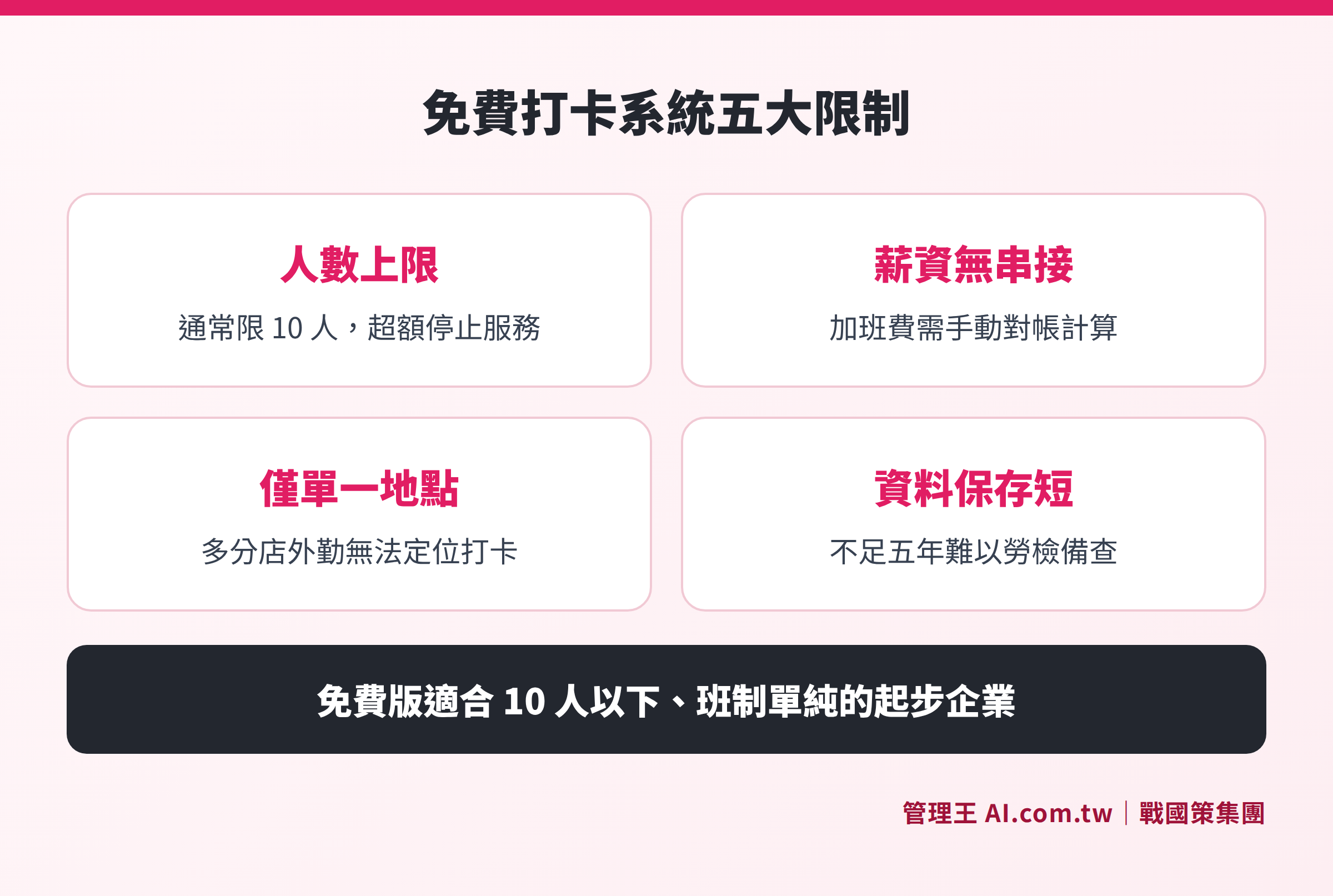
Five Major Limitations: Comparison of Person Limit, Payroll Integration, Multiple Locations, Advanced Reports, and Customer Support
Obligation of Attendance Records According to Labor Standards Act: What You Must Know
Whether you use a free or paid system, the obligations of Taiwan's Labor Standards Act regarding attendance record-keeping for employers remain the same.
According to Article 30, Sections 5 and 6 of the Labor Standards Act (effective from July 31, 2024):
- Employers must maintain records of labor attendance and retain them for five years
- Attendance records must be recorded daily down to the minute
- Employers may not refuse when laborers request copies of attendance records
Penalties for Violations (Article 79 of the Labor Standards Act):
Table: Overview of Penalties for Attendance Record Violations
| Violation Type | Legal Basis | Penalty Amount |
|---|---|---|
| ---------------------------- | -------------- | ------------------------- |
| Failure to maintain attendance records or retain for 5 years | Section 2, Article 79 | NT$90,000 to NT$450,000 |
| Failure to record daily down to the minute or refusal to provide copies | Section 1, Article 79 | NT$20,000 to NT$1,000,000 |
The authorities may increase the fines to up to half of the statutory maximum depending on the size of the business, the number of violations, or the severity of the violations. Additionally, the names of the violating businesses and responsible persons may be made public.
According to the Labor Department’s official explanations, even if the company’s work rules state that employees do not need to clock in, the employer still has the obligation to record each employee's attendance. In other words, "we do not clock in" cannot be used as a reason for not maintaining attendance records.
A free clock-in system that only retains data for three months or cannot export complete records may expose you to compliance risks.
Five Upgrade Signals to Consider Paying
Understanding where the limitations lie, the next step is to determine whether you have reached a critical point for upgrading. Any of the following five signals indicate that reassessing is worthwhile:
Signal One: Number of Employees Exceeds 10
When the free version's person limit approaches, forcing you to continue using it with limited functionality or manage two systems to save money will incur error costs. Some companies may attempt to split employees into multiple accounts for "separate management," but this will make it more complicated when reconciling attendance data at the end of the month.
Signal Two: Manual Calculation of Overtime Pay Needed Each Month
According to Article 24 of the Labor Standards Act, overtime pay involves complex multiplier calculations (1.34 times for the first two hours of weekday overtime, 1.67 times for the next two hours). If the attendance system cannot calculate automatically and directly integrate with payroll, the manual reconciliation at the end of the month will be a continuous hidden cost.
Signal Three: Field Staff or Multiple Stores
The attendance of sales staff, security personnel, and delivery staff cannot be authenticated by office IP or Wi-Fi; GPS clocking in and location proofs are required. Overtime calculations for multi-store staff supporting across locations also need to be systematized. If your employees work at different locations every day or have personnel who need to record visits to multiple stores, a free system will hardly be able to meet this need.
Signal Four: Previous Attendance Disputes or Employee Complaints
If previous unclear attendance records have led to disputes with employees or if you worry about incomplete records during labor inspections, this is a clear sign that the system needs upgrading. A complete audit log and one-click PDF export are essential tools for resolving disputes and compliance checks.
Signal Five: The Company Needs to Integrate HR or Payroll Systems
If you are considering implementing a payroll or HR system, the automatic flow of attendance data will save a significant amount of time spent entering data repeatedly. The limitations of the free version APIs will become a barrier for integration. If there are plans to manage scheduling, leave requests, payroll, and performance simultaneously in the future, the ability of the attendance system to natively integrate with these modules is a critical factor during the selection process.
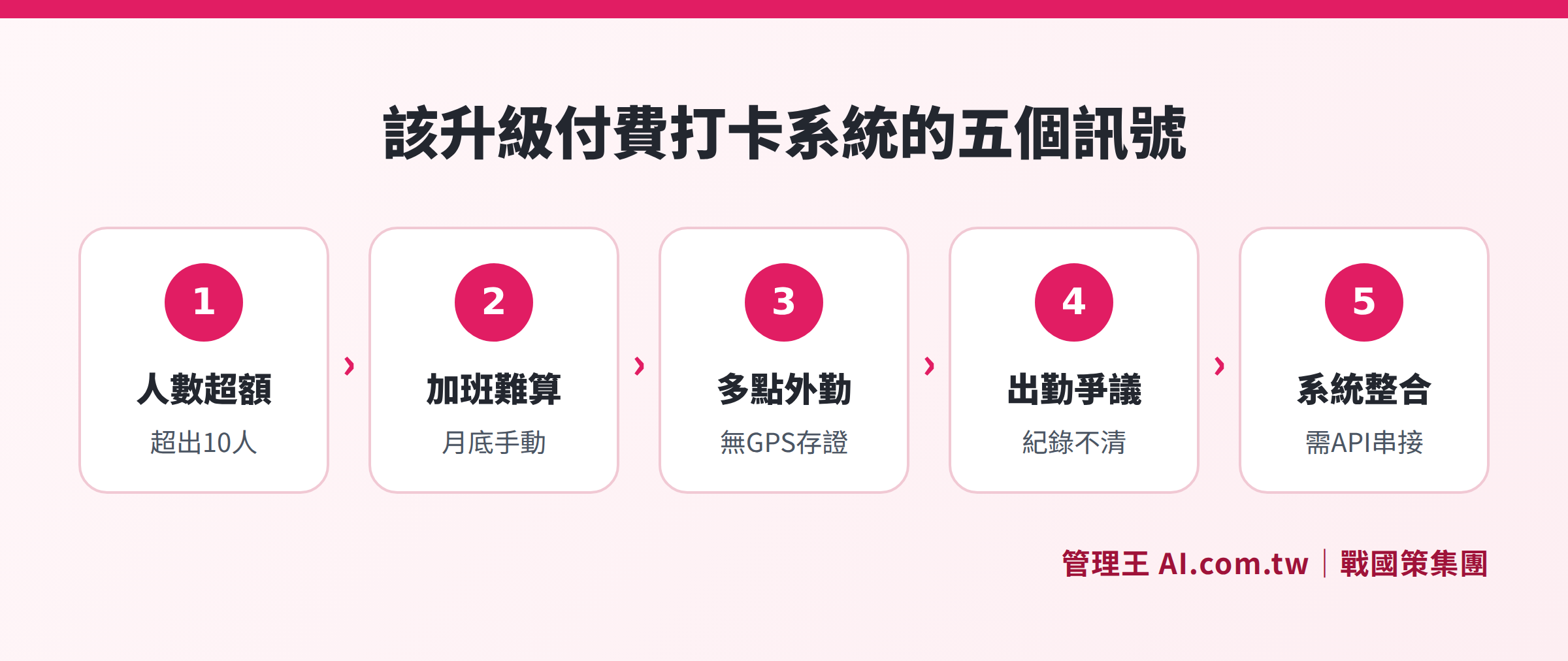
Five Key Signals for Upgrading to a Paid Clock-In System
How to Use 戰國策
The clock-in system from 戰國策 AI.com.tw offers a permanently free plan, allowing teams with fewer than 10 people to use basic clocking features indefinitely without any trial periods.
The free plan includes:
- GPS / IP / Wi-Fi triple verification for clocking in to prevent proxy clock-ins
- Electronic leave applications and supervisor sign-offs
- Daily down-to-the-minute attendance records, compliant with Article 30 of the Labor Standards Act
- One-click export of monthly attendance details for labor inspection compliance
To access the features that require a paid upgrade:
- Multi-store cross-point clocking and cross-store overtime calculations
- Automatic integration with the payroll system, allowing attendance data to flow directly into payroll processing
- Attendance analytics rankings: multi-dimensional reports on tardiness, early leaves, and absenteeism
- Shift scheduling integration to automatically mark abnormal hours
- AI anomaly detection for clocking and instant notifications to supervisors
The biggest difference between 戰國策 and other simple clock-in tools is the integration of electronic sign-off, shift management, and payroll calculation, eliminating the need for employees to copy and paste attendance data across systems, allowing for direct circulation within the same account.
Pricing details:
- Free plan: NT$0, indefinitely for under 10 people
- Economical plan: NT$5,000/month, for under 30 people
- Business plan: NT$10,000/month, for under 60 people
- Flagship plan: NT$19,900/month, unlimited headcount
For detailed features and comparisons of plans, see the service plan details of 戰國策.
If you want to understand the complete logic of choosing a clock-in system, refer to the comprehensive guide to clock-in systems; if you want to compare mobile apps, check out clock-in app recommendations.
Try 戰國策's Clock-In System for Free
Consultants will help assess whether the free version meets your attendance management and compliance requirements with labor laws, free perpetually for up to 10 people.
Free consultation hotline: 0800-003-191
LINE Official Account: @119m
Official Website: app.AI.com.tw
Free trial: Apply for 戰國策 now
Frequently Asked Questions
Does the free clock-in system comply with Taiwan's labor laws?
Compliance depends on the system functionality, not on whether it is "free" or "paid." The key is whether the system can record daily attendance down to the minute, retain data for five years, and provide mechanisms for employees to request copies. 戰國策's free plan meets these three requirements, but if the free system you use only retains short-term data or cannot export complete records, it may not comply with Article 30 of the Labor Standards Act.
Is the free version sufficient for companies with fewer than 10 people?
If the scheduling is simple (fixed hours from 9 AM to 6 PM, without field work or multiple branches), the free plan is usually enough for fewer than 10 people. However, if you implement shift work, have field staff, or anticipate exceeding 10 people within a year, it is advisable to plan for a paid version in advance to avoid the hassle of data migration.
Can the free clock-in system prevent proxy clock-ins?
Most basic free systems cannot effectively prevent proxy clock-ins due to the lack of GPS verification or facial recognition. 戰國策's free plan provides GPS + IP + Wi-Fi triple verification, significantly raising the cost of proxy clock-ins; AI anomaly detection (for example, clocking in accurately to the second for consecutive days) is an advanced function of the paid plans.
What attendance data needs to be provided during labor inspections?
According to Article 30 of the Labor Standards Act, labor inspection personnel may request employers to provide records of labor attendance. Records must cover daily attendance times (to the minute), continuous historical data for five years, and records of employee requests for copies. 戰國策 supports one-click PDF export of monthly attendance details, fully compliant with audit requirements. For details, refer to the compliance features descriptions in the clock-in system comparison.
Will my previous free data still be available after upgrading to a paid plan?
Yes. 戰國策's free and paid plans use the same account; historical data will be fully retained after the upgrade, without needing to re-enter or import. Employee accounts, clock-in settings, and attendance records will all continue.
Data Sources
- Article 30 of the Labor Standards Act — Labor Department Labor Law Query System
- Article 79 of the Labor Standards Act — Labor Department Labor Law Query System
- Do employers still have to record labor attendance when their work rules stipulate that employees do not need to clock in? — Labor Department
This article is for informational purposes only and does not constitute legal or tax advice; please refer to the latest announcements from the authorities.