Are Free Online Store Platforms Really Free? Commission, Features, and Switching Costs|Recommended Online Store Platforms
作者:戰國策集團

Free online store platforms primarily waive monthly fees, but processing fees for each transaction still apply (credit card fees typically range from 2% to 3.5%). Some platforms charge a commission on sales as well. WACA does not charge commissions, while Shopify Taiwan has an additional 2% fee for third-party payments. Free plans commonly have limits on the number of products, restricted marketing features, and hidden costs associated with switching platforms, such as data migration and SEO losses. It is advisable to choose a platform early on and calculate the annual total cost of monthly fees and processing fees before making a decision.
Are free online store platforms really free? The answer is: monthly fees can be zero, but you still have to pay processing fees, be limited by the number of features, and bear the costs of switching platforms in the future. The "free plan" of mainstream online store platforms in Taiwan (such as WACA and Shopify) mainly waives the monthly fee, but each order still incurs processing fees, typically 2% to 3.5% per credit card transaction. Some platforms charge a "platform commission" on the order amount, while others clearly do not. A true cost assessment requires evaluating monthly fees, processing fees, business costs from feature limitations, and the hidden costs of switching platforms together to find the best choice for you.
What Does “Free” Really Mean with Free Online Store Platforms?
Online store platforms in Taiwan typically use “free” to attract beginners, but this “free” usually refers only to the monthly fee, not the total cost of running your store.
Free often includes:
- Zero monthly platform fees, no credit card required
- Basic product listing functions
- Shopping cart and checkout pages
- Integration with specific payment and logistics services
Free often does not include:
- Processing fees: Charged per transaction by payment processors, usually 2% to 3.5% for credit cards
- Platform commissions (some platforms have this, some do not)
- Advanced marketing features (membership tiers, discount codes, EDMs, etc.)
- Items exceeding the product limit
- Technical support and consulting services
This distinction is important. "Not paying monthly" and "not spending money to run a store" are two different things. Sellers should evaluate their estimated monthly transaction amounts multiplied by the processing rates to calculate the actual monthly operating cost, then compare it with the costs of paid plans.
In a nutshell
“Free online store” typically only waives monthly fees; the real costs arise from processing fees, opportunity costs of feature limitations, and future switching costs.
Processing Fees: The Most Easily Overlooked Hidden Cost
Every bit of income earned from your store must first subtract the processing fees to reflect your actual earnings. This rate might seem small, but it adds up significantly, especially as sales grow.
Looking at the typical credit card processing rates in Taiwan, there can be substantial differences between platforms and plans:
Table: WACA PayNow Credit Card Processing Fees for Each Plan (as of November 2025 according to WACA's website)
| Plan | Monthly Fee (Annual Payment) | Credit Card Processing Fee | ATM Virtual Account Fee |
|---|---|---|---|
| Starter Plan | NT$0 | 3.5% | NT$20 per transaction |
| Business Growth Plan | NT$3,099 | 2.1% | NT$17 per transaction |
| Advanced Navigation Plan | NT$5,399 | 2% | NT$17 per transaction |
| Omni-Channel Flagship Plan | NT$8,099 | 2% | NT$17 per transaction |
Note: WACA’s official page states that these rates are "limited time promotional processing fees," and the actual rates are subject to the latest announcements on the official website. WACA itself does not take transaction commissions; the processing fees are charged by the payment provider (PayNow).
Assuming an NT$100,000 monthly sales calculation:
- WACA Starter Plan (3.5%): Approx. NT$3,500 monthly processing fees
- WACA Business Plan (2.1%): Approx. NT$2,100 monthly processing fees—saving NT$1,400 but incurs NT$3,099 in monthly fees
The difference in rates may not seem significant at first, but the impact magnifies as sales scale increases. It is essential to estimate your own monthly transaction amounts when choosing a plan to determine if upgrading is cost-effective.
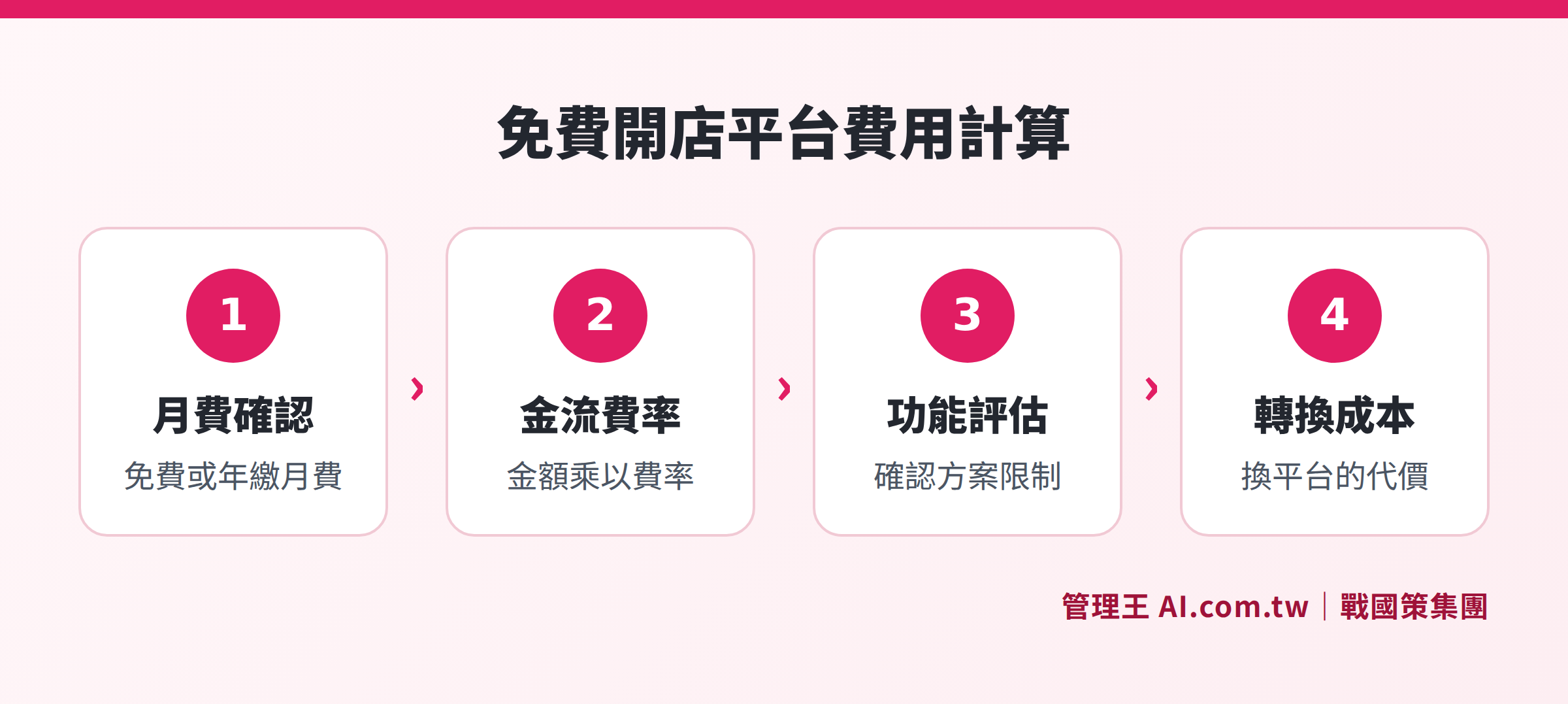
Calculate real store costs in three steps: Monthly fee plus processing fees plus feature costs
What is Platform Commission? Explanation of Fee Structures Across Platforms
“Platform commission” refers to an additional fee charged by the platform on the order amount, apart from processing fees. This is a separate charge from the fees taken by payment processors, which many beginners may confuse.
WACA: Clearly Does Not Charge Commissions
WACA’s official website clearly states that "WACA does not charge commissions"; all plans (including the free Starter Plan) do not require payment of platform commissions, only the processing fees charged by the payment provider will be deducted from each order. This makes the fee structure relatively transparent; sellers can simply estimate each cost by multiplying "transaction amount × processing fee rate".
Shopify: Additional Fees for Third-party Payment Services in Taiwan
Shopify offers its own Shopify Payments in some regions globally, allowing users to enjoy zero platform commission. However, Shopify Payments is not supported in Taiwan; sellers in Taiwan must integrate with third-party payment services (like ECPay, Neweb Payment), which adds extra third-party payment service fees on top of processing fees:
- Basic Plan (NT$690/month, annual payment): Additional 2% third-party payment fee
- Grow Plan (NT$1,850/month, annual payment): Additional 1% third-party payment fee
- Advanced Plan (NT$11,500/month, annual payment): Additional 0.6% third-party payment fee
For instance, in the Basic Plan, the actual transaction cost for Taiwanese sellers is: payment processor fees (approximately 2.45% for ECPay credit card) plus Shopify’s 2%, totaling about 4.45%. Although the monthly fee is only NT$690, the cost per transaction is relatively high, and the disparity becomes more pronounced with larger monthly sales.
All rates are based on official website information as of November 2025 and are subject to the latest announcements from regulatory authorities and platforms.
Free Plan Feature Limitations: How Long Can 30 Products Last?
The most common limitation of free plans is the cap on the number of products. For example, the product limit for the WACA Starter Plan is 30 products, 10 categories, and 3 coupon sets. Additionally, WACA's Starter Plan stipulates that if the account is inactive for 30 days, it will be closed; if you are just testing the market and do not use it for a while, your account risks being closed.
Table: Comparison of Common Feature Limitations
| Feature | WACA Starter Plan (NT$0) | WACA Business Growth Plan (NT$3,099/month) | WACA Advanced Navigation Plan (NT$5,399/month) |
|---|---|---|---|
| Product Quantity | 30 | 2,000 | 6,000 |
| Category Limit | 10 | 200 | 400 |
| Coupon Sets | 3 | 30 | 40 |
| Membership Community Login | No | Yes (Google/LINE/FB) | Yes |
| Email Marketing | No | Yes | Yes |
| Abandoned Cart Notifications | No | Yes | Yes |
| Membership Tiering | No | No | Yes |
| Cash Points | No | No | Yes |
| Promotional Revenue Management | No | Yes (20 sets) | Yes (100 sets) |
Is 30 Products Enough?
Thirty products may be sufficient for beginners just starting out and selling a few items, but as business grows and more products need to be listed, upgrading to a paid plan becomes necessary. This is a common business strategy of platforms—"using feature limitations to drive upgrades"—where you are allowed to start for free, but must pay when you show performance.
Marketing Features are Generally Locked in Paid Plans
In-depth marketing tools such as newsletters, membership tiers, loyalty points, and influencer revenue sharing are usually not provided or are heavily limited in the free plans across all platforms. This means you can run a store and sell products with a free plan, but to "truly manage" brand members and repeat purchase cycles, you often need to upgrade to a paid plan to use the complete tools.
If your goal is simply to sell a few items occasionally, a free plan might be sufficient; however, if you intend to systematically manage an e-commerce brand, it is advisable to include marketing features in your selection criteria from the start.
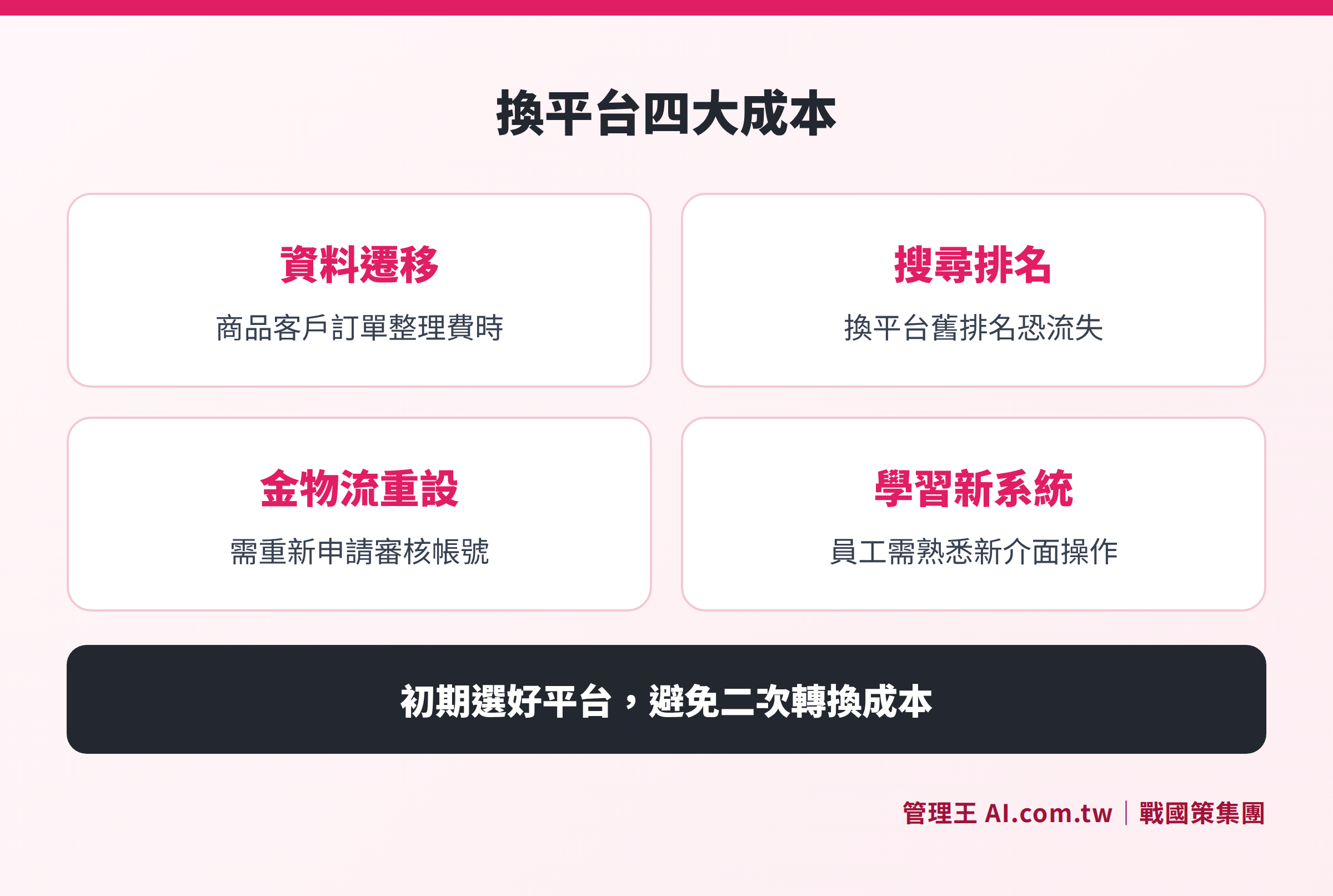
Four aspects explaining the hidden costs of switching platforms: data migration, SEO reconstruction, reapplying for payment channels, and retraining employees
The Real Costs of Switching Platforms
Many sellers focus solely on "how much to spend per month" when choosing an online store platform but neglect to calculate "how much it will cost in the future if they need to switch platforms.” Switching costs are often the most underestimated factor in long-term choices.
Data Migration: Labor Time Costs
Product data, customer lists, order records can usually be exported to CSV, but different platforms have different formats, so importing into a new platform often requires reorganizing column mappings, which can consume significant manpower for small to medium-sized enterprises that lack technical staff.
SEO and URL Traffic Loss
If you use a subdomain provided by the platform (e.g., yourstore.someplatform.com), the accumulated search rankings and backlinks will not automatically transfer when you switch platforms. If you have your own independent domain, you will need to correctly set up 301 redirects during the transition to guide traffic to the new platform; otherwise, past SEO efforts may be partially lost.
Reapplying for Payment Channels
Each platform requires you to reapply for business accounts for payment and logistics integrations. The qualification for credit card payments depends on the processing company's review timeline, and this gap can affect normal order processing. Logistics settings (like connecting to pickup stores, contracts with delivery services such as Black Cat) also need to be configured on the new platform.
Time for Employees to Familiarize with the New System
After changing systems, all users need to get used to the new interface operation: product listing staff, order processing staff, customer service representatives are all affected. During this adjustment period, operational efficiency may decline and error rates could temporarily increase.
Overall Assessment
If you just want to test the waters and validate market viability, testing with a free plan is reasonable. However, once you decide to seriously invest in e-commerce operations, it is advisable to select a long-term viable platform from the outset and incorporate switching costs into your decision-making to avoid paying a higher price to restart later.
Calculating the Assessment of “Real Costs”
Before choosing an online store platform, it is advisable to estimate the annual operating costs using the following method:
Annual Store Cost = Monthly Fee × 12 + Estimated Annual Transaction Amount × Processing Fee Rate + Estimated Annual Transaction Amount × Platform Commission Rate
Taking an example of NT$100,000 monthly sales (assuming 100% credit card payments):
Table: Cost Estimation Comparison of Each Plan (Monthly Sales NT$100,000, based on 100% credit card payments, with rates as per official website from November 2025)
| Plan Scenario | Monthly Fee (Annual Payment) | Estimated Monthly Processing Fees | Estimated Annual Cost |
|---|---|---|---|
| WACA Starter Plan | NT$0 | NT$3,500 (3.5%) | ~NT$42,000 |
| WACA Business Growth Plan | NT$3,099 | NT$2,100 (2.1%) | ~NT$62,388 |
| Shopify Basic (Taiwan) | NT$690 | NT$4,450 (processing about 2.45% + platform 2%) | ~NT$61,680 |
| Management King Free Plan | NT$0 | According to payment provider rates | Based on payment provider rates |
Note: The table above provides estimates and does not represent the final costs; actual costs are subject to the latest announcements from each platform and payment provider. The processing rates for Management King vary based on the chosen payment provider (Neweb, ECPay, ZhiFuTong, etc.), and the Management King platform itself does not charge transaction commissions. As monthly sales amounts increase, the differences brought by processing fee disparities will become more significant.
How to Set Up an Online Store with Management King?
Management King AI.com.tw Online Store System offers a free plan for permanent use, integrating popular payment solutions in Taiwan: payment integrations with Neweb Payment, ECPay, ZhiFuTong, LINE Pay, and logistics connections with Black Cat, Hsinchu, 7-11, and FamilyMart.
Product and Order Management
Product upload supports specifications, inventory, and image management, combined with AI automatic background removal and description generation, saving a significant amount of manual listing time. Order statuses from awaiting shipment, shipped, to returns are clearly controlled, providing one-stop management for the entire store's daily operations.
Built-in Marketing Tools, No need for Additional Plugins
Coupons and Discount Codes, free shipping over a certain amount, limited-time flash sales, and Member Loyalty Points can all be managed under the same account without needing to attach additional third-party marketing plugins. The Marketing Automation feature can set up automatic reminders for abandoned carts, bringing back visitors who were one step away from checkout to increase conversion rates.
Seamlessly Integrated with Backend Systems, Automatic Data Flow
This is a core advantage of Management King compared to pure e-commerce platforms: orders can automatically post to the report and analytics system, customer data syncs automatically to CRM, and inventory updates in real time without manual input. For small to medium-sized enterprises managing multiple business processes simultaneously, this integration significantly reduces the burden of reconciliation and cross-system operations.
Transparent Fee Structure
Management King’s service plans: Free Plan NT$0 (10 members, permanent use), Economic Plan NT$5,000/month (30 members), Business Plan NT$10,000/month (60 members), Flagship Plan NT$19,900/month (unlimited members), annual payment allows 14 months for the price of 12. The platform does not charge transaction commissions; processing fees are based on the rates of the selected payment provider. If there are special feature needs, the customized development rate is NT$1,000/hour, and work begins after written quotation confirmation, with transparent costs.
Transnational Strategy Group has served over 30,000 enterprises, and Management King has continued to update since 2000, taking local laws like Taiwan's labor standards, electronic invoicing, and personal data regulations into account in its design, eliminating the need for additional plugin solutions.
For more information related to online stores, you can refer to:
- Comprehensive Guide to Online Stores: From Choosing a Platform and Payment Integration to First Order
- Recommended Online Store Platforms: Costs, Features, and Difficulty Most Important to Beginners
- Comparison of Online Store Platforms: Public Information on Major Brand Commissions and Monthly Fees
- How Much Does It Cost to Start an Online Store? Monthly Fees, Processing Fees, and Logistics Calculations
Free Consultation on Management King's Store Plans
Consultants will explain the features of the free plan, processing rates, and timely upgrades, clearing up the true costs of starting a store in 30 minutes.
Free consultation hotline: 0800-003-191
LINE Official Account: @119m
Official Website: app.AI.com.tw
Free Trial: Apply for Management King Now
Frequently Asked Questions
Do free online store platforms have to charge processing fees?
Yes. Regardless of which platform you choose, if it accepts credit card, ATM, or mobile payments, you need to integrate payment services, which will charge fees based on transaction amounts. This fee is not a platform fee but charged by the payment service provider. Credit card transactions typically incur fees of 2% to 3.5%, and virtual account (ATM transfers) usually have a fixed fee of NT$17 to 20 per transaction. “No platform commissions” does not mean there are no costs per transaction; it simply means no additional commission is charged by the platform, but the processing fee still exists.
Can the free plan be used long-term?
It depends on the platform's regulations. Some platforms have requirements for account activity in free plans (for example, WACA's Starter Plan will close the account if not logged in for 30 days); some platforms, like Management King, offer a free plan that is permanently usable, but AI features have a one-time point limit, beyond which you need to upgrade or purchase value-added services. It is advisable to carefully confirm the usage conditions and account validity regulations of the free plans before making a selection.
Is it troublesome to switch online store platforms? What do I mainly need to handle?
The primary tasks in switching platforms include four parts: 1. exporting and importing product data and customer lists in CSV format (requiring manual adjustment of column mappings); 2. reapplying for payment and logistics accounts with service providers; 3. setting up URL redirections (if SEO considerations apply, a 301 redirection must be set); 4. allowing employees to familiarize themselves with the new system's interface operation. These tasks usually do not incur additional costs but require manpower and time; during the transition, normal operational efficiency may be affected.
At what annual sales figure does it become more cost-effective to upgrade to a paid plan?
Taking WACA as an example, the free version has a credit card rate of 3.5%, while the business growth version has a 2.1% rate, a difference of 1.4 percentage points; the annual fee for the business plan is about NT$37,188 (NT$3,099 × 12). If your annual sales exceed approximately NT$265,600 (NT$37,188 ÷ 1.4%), the savings on processing fees from the business plan will cover the upgrade costs. For practical evaluation, please calculate the latest rates based on each platform's official website; if the rates are adjusted, the break-even point will also change.
Can the costs of an online store platform be declared as expenses?
The monthly fees and processing fees for online store platforms qualify as business expenses. According to relevant income tax regulations in the Republic of China, qualifying expenses can be claimed for deductions. For specific declaration methods and proof requirements, it is advisable to confirm with your accountant or tax consultant, based on the latest regulations from the Ministry of Finance and the National Taxation Bureau.
Sources
- WACA Plans and Pricing (Official): WACA Starter Plan free plan features, payment processing rates for each plan, commission-free clarification (as of November 2025)
- Shopify Taiwan Pricing Page (Official): Monthly fees and third-party payment rates for Shopify Basic, Grow, and Advanced plans (as of November 2025)
- Management King AI.com.tw Plans and Pricing (Official): Management King free plan, monthly fees for each subscription plan (as of November 2025)
- Management King Online Store System Features Page (Official): Payment and logistics integration explanations, AI functions, local features (as of November 2025)
This article is for general information only and does not constitute legal or tax advice; rates and plan specifications are subject to the latest announcements from the respective platforms.