Is the Free POS System Really Free? Costs of Hardware, Payment Processing, and Invoices|Recommended POS Systems

While the software licensing fee for a free POS system is zero, the real costs are in hardware procurement, payment processing fees (about 2.75% for credit cards), annual fees for the electronic invoice value-added center, and upgrade fees for features that are not available in the free version. This article dissects four major cost items depending on official rates, providing merchants with numerical references before selection.
The "free" in "free POS systems" almost universally refers to zero software licensing fees, not the total costs required to implement a fully operational POS environment. To make a checkout counter functional, at least four types of additional expenses must be considered: hardware procurement or leasing, payment processing fees for each transaction, annual fees for the electronic invoice value-added center, and monthly fees for advanced features not available in the free version. For Taiwanese merchants planning to implement a POS system, clarifying the billing logic for each type of expense in advance allows for a data-backed comparison between "free POS with hardware" and "paid integrated solutions". This article dissects the complete cost structure of free POS systems based on regulations from the Ministry of Finance regarding electronic invoices and the public rates published by ECPay, organizing specific numbers for payment processing fees and electronic invoice annual fees, helping owners calculate their costs before making decisions.
What Does "Free" Really Mean? Software Fees Don’t Equal Total Costs
In the Taiwanese market, common "free POS systems" can be broadly categorized into three models:
First: Permanently free basic version, which offers core functions such as checkout, product management, and simple daily reports without monthly fees, but upgrades are required for features like multi-store management, advanced reports, API integration, and CRM functionality for members. Loyverse is a typical example, with a comprehensive introduction provided in the article Limitations of Loyverse Free POS Features.
Second: Free trial period, requiring upgrade to a paid plan after a 30 or 60-day trial to continue using saved data and settings. If an adequate plan assessment is not made during the trial period, the cost of migration thereafter could be quite high.
Third: Hardware-bound free software, where merchants purchase a designated POS terminal to get free software licensing; however, if hardware needs to be changed later, the existing software data may not be usable or may incur migration fees.
No matter the model, hardware, payment processing, and invoice fees are unavoidable real costs, which are explained one by one below.
In a nutshell
The "free" in free POS systems only means software fees are zero; hardware, payment processing fees, and electronic invoice annual fees are three other major costs that must be factored in before selecting a system.
Hardware Costs: One-Time Investments Cannot Be Ignored
Implementing a POS system in a physical store incurs the most direct and one-time cost of hardware. Even if choosing a "software POS solution" that does not lock users into hardware, the following equipment still needs to be purchased to operate normally:
- Tablet or POS terminal: Serving as the checkout interface, this can be an iPad or Android tablet with a stand, or a dedicated all-in-one POS machine; the thermal performance and durability of an all-in-one machine usually surpass that of general consumer tablets.
- Thermal receipt printer: For printing customer receipts or closing shift summaries, must support USB or network interfaces; stores in Taiwan usually select 80mm paper width models.
- Cash drawer: For storing cash, commonly opened with a printer’s command, and counted during shift changes.
- Barcode scanner: To quickly read EAN-13 barcodes during product checkout, which is essential in retail to avoid service bottlenecks.
- EDC card reader: For bank payment processing, reading credit cards’ magnetic stripes, chips, and contactless (NFC); some solutions can manage these through a single POS software.
- Customer Display: Used in chain stores or where customer amount confirmation is needed, not essential but increases customer trust.
Taking ECPay’s public POS equipment combinations from their official website as an example (including system setup fee NT$3,600 and installation fee NT$2,000, excluding tax):
Table: ECPay POS Hardware Equipment Package Prices (based on official website, queried in 2025)
| Plan | Specification | Price (excluding tax) |
|---|---|---|
| Tablet Touch Cash Register AOBX | 8-inch handheld touch device + 1D scanner + small cash drawer | NT$32,400 |
| Desktop POS Machine PO6N | Desktop POS main unit + 1D scanner + small cash drawer | NT$46,400 |
| Handheld Touch Cash Register AOWX | 6-inch handheld touch device (without peripherals) | NT$19,100 |
Data source: ECPay official website, queried in 2025. If assembling on your own (using an existing tablet with third-party printers), hardware costs may be lower, but compatibility must be assessed, and it does not include installation services and subsequent hardware warranties.
To learn more about POS hardware procurement details, refer to What POS Equipment to Buy? List of Main Unit, Scanners, Invoice Printer Equipment.
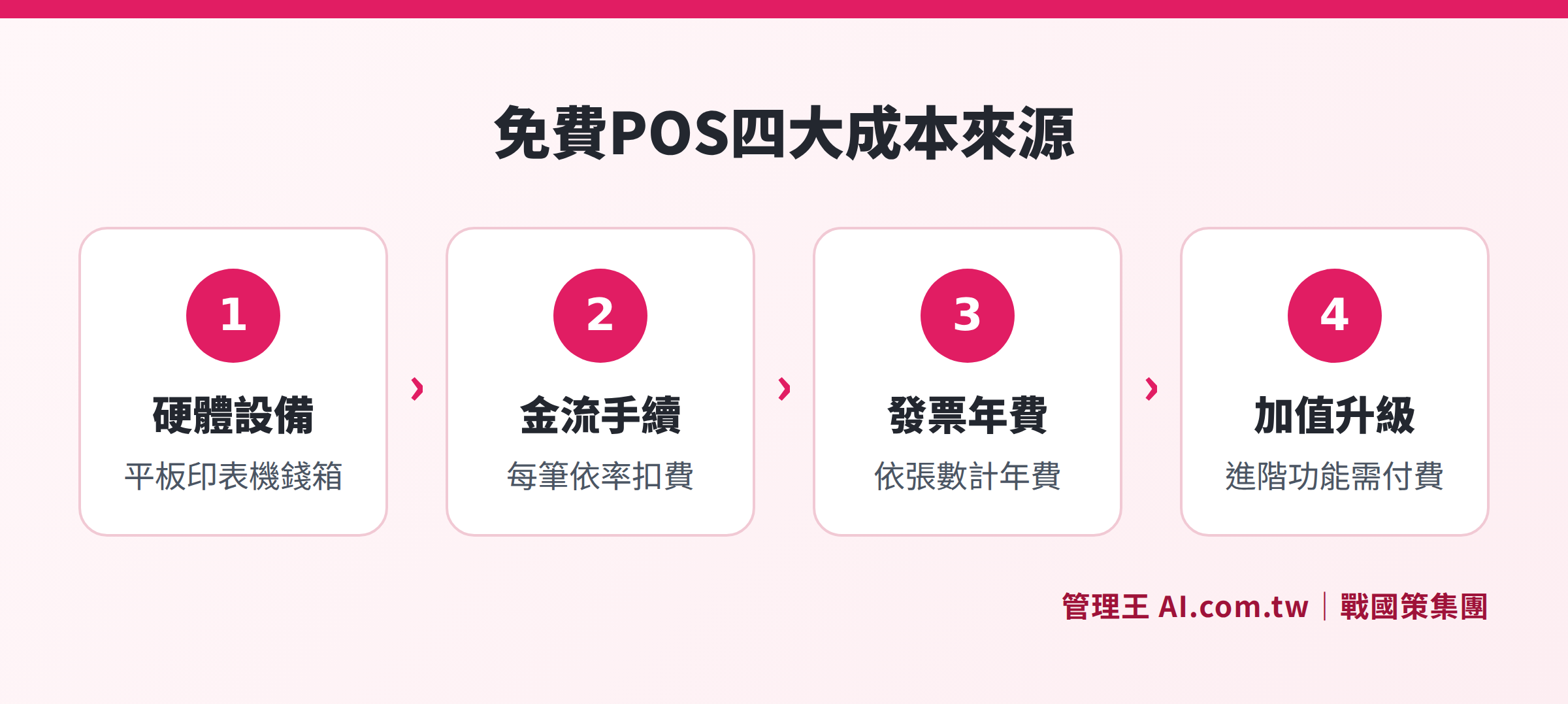
Aside from software fees, hardware equipment, payment processing fees, electronic invoice costs, and upgrade feature costs are the four significant actual costs.
Payment Processing Fees: Costs Deducted with Every Transaction
Transaction fees for credit cards and mobile payments are the long-term costs that POS merchants tend to underestimate — because they aren't one-time expenses, but are deducted based on the percentage of each transaction amount, accumulating to a substantial total.
In Taiwan, the collection fees are charged by the acquiring bank or a third-party payment provider, and rates vary depending on the payment method, merchant type, and monthly transaction volume negotiations. Below are ECPay’s publicly disclosed standard seller rates (excluding tax):
Table: Common Payment Method Transaction Fee Rates (ECPay Standard Seller, excluding tax, queried in 2025)
| Payment Method | Rate | Notes |
|---|---|---|
| Domestic Credit Card | 2.75% | Minimum NT$5 per transaction |
| Apple Pay | 2.75% | Minimum NT$5 per transaction |
| UnionPay Card | 2.75% | Minimum NT$5 per transaction |
| ATM Virtual Account | 1.0% | Minimum NT$15 per transaction |
| Convenience Store Code | NT$31/transaction | Fixed fee |
| Convenience Store Barcode | NT$16/transaction | Fixed fee |
LINE Pay’s official page states that the merchant transaction fee is 3% (excluding tax); according to Jkopay’s official website, it is 2.5%. Actual rates depend on the merchant's application qualifications, monthly transaction volume, and negotiation results with banks, based on the latest announcements by respective institutions.
For example, a small retail shop processing NT$100,000 in credit card transactions monthly incurs about NT$2,750 in monthly fees, totaling about NT$33,000 annually. This cost would occur every year, regardless of whether the POS software is free. If simultaneously adopting LINE Pay (3%), consideration should be given to whether the cost of fees is worthwhile with high-priced items draining the transactions.
Another point to note is that regarding credit card transaction fees: according to general contract specifications by Taiwanese credit card acquiring banks, merchants are generally prohibited from requiring cardholders to bear processing fees (i.e., prohibiting "surcharges" on card payments); merchants should absorb these fees as operating costs or factor them into pricing.
Electronic Invoice Costs: Annual Costs for Issuing Invoices
According to regulations from the Ministry of Finance, companies and organizations in Taiwan must issue a unified invoice for goods or services sold, regardless of business volume. Using electronic invoices in a physical store necessitates the issuance through the Ministry of Finance’s approved "electronic invoice value-added service center" — this service is not free, and merchants must pay application setup fees and annual service fees.
For example, using the plans published on ECPay's official website (excluding tax):
Table: ECPay Electronic Invoice Rates (queried in 2025)
| Plan | Annual Fee | Description |
|---|---|---|
| First year discount for new users (20,000 invoices/year) | NT$0 | Promotion valid until 2026/12/31 |
| 5,000 invoices/year | NT$3,600 | New users incur one-time setup fee of NT$3,600 |
| 20,000 invoices/year | NT$6,000 | |
| 120,000 invoices/year | NT$12,000 |
Additionally incurred costs for value-added services: SMS notifications NT$1.5 each, and multimedia printed invoices at convenience stores NT$20 each.
Estimated modeling of electronic invoice costs: A store issuing about 400 invoices monthly would select the 5,000 invoices per year plan at an annual fee of NT$3,600; including the one-time setup fee of NT$3,600 for new users, the total for the first year would be NT$7,200. If exceeding the planned invoice cap, the plan would have to be upgraded, adjusted according to the latest announcements from regulatory authorities.
It's worth noting that "free POS software" typically does not include electronic invoice service fees — merchants must still apply to the value-added center separately, and the fees are calculated independently. Some POS solutions claiming to "include electronic invoices" might have pre-applied for a value-added center account and passed on the charges or handled fees after reaching a certain transaction volume threshold; therefore, verification during selection is essential.
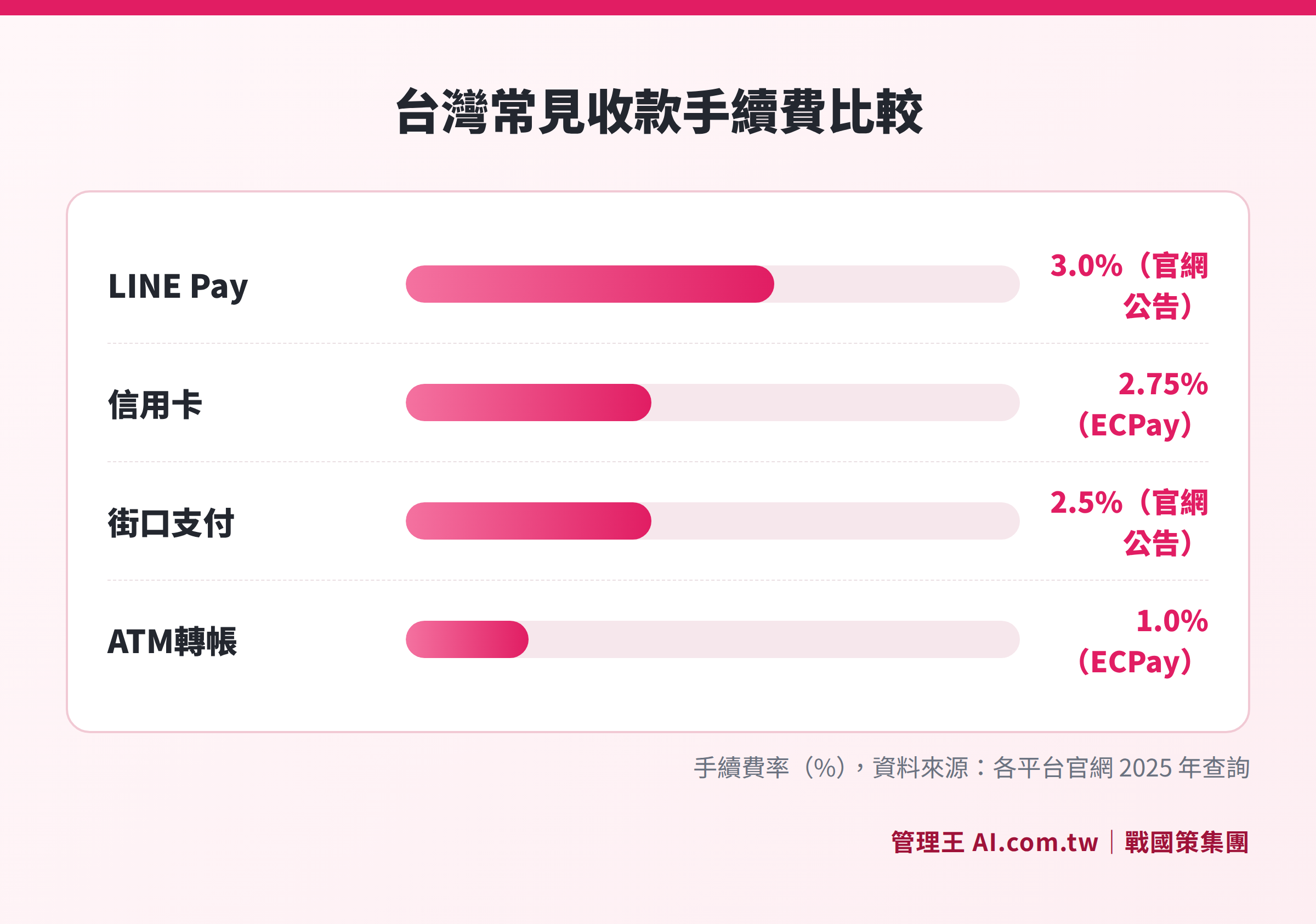
LINE Pay 3%, Credit Cards 2.75%, Jkopay 2.5%, ATM Transfers 1%, rate differences affect annual costs
Value-added Features Fee: Things the "Free Version" Can’t Do
Most free POS software has limitations on the following functionalities, which require upgrading to a paid plan to unlock:
- Multi-store centralized management: Requires synching product pricing and centralized visibility of reports across multiple locations; usually only available in paid advanced versions, while the free version supports only a single store.
- Loyalty points and CRM integration: CRM features such as customer points accumulation, membership grading, birthday notifications, and RFM analysis often have functional or data limits in most free versions.
- Multi-location inventory management: Separately managing warehouse and store inventories, inventory transfers, and low stock alerts typically require an upgrade.
- API integration or custom reports: Automatically syncing purchases and sales inventory with financial systems and e-commerce platforms incurs additional fees; free version export formats are often limited as well.
- Technical support services: Free versions typically offer only self-help documentation, with no phone or real-time customer support; resolving checkout crashes or data anomalies can take undetermined time.
Different vendors have varying limitations on free versions; it is crucial to confirm whether the free version meets current needs before selection, especially considering growth needs in the next six months to avoid forced upgrades with problematic data migrations later.
What Are Your Total Annual Expenses? Cost Item Summary
Merchants choosing to use "free POS software" still face the following fixed and variable costs:
- One-time costs: Hardware procurement (the cost of the complete POS equipment package varies based on specifications, as referenced above), plus electronic invoice system setup fee NT$3,600 (as per ECPay example's new user one-time payment).
- Annual payment processing costs: Based on transaction volume and payment method, credit card rate of 2.75% (ECPay standard seller); actual fees should be determined as per the latest announcements by respective institutions.
- Annual electronic invoice fee: Starting at NT$3,600 for the 5,000 invoices/year plan (first-year promotional fee for new users as per ECPay's official website).
- Upgrade fees for value-added features: Depending on the vendor's plans, monthly fees range from several hundred to several thousand NT$.
The above figures are based on publicly available information; actual costs may vary depending on merchant negotiations and selected plans, so it is recommended to confirm the latest quotes directly with service providers.
Using 管理王: Lightweight Hardware, Stress-free Invoicing, Integrated Features
管理王 AI.com.tw POS cash register system is an integrated solution called "Software POS + Cloud Backend", requiring only a tablet or computer, along with a printer and cash drawer to go live, without needing to purchase expensive dedicated POS terminals, thereby reducing one-time hardware investments.
In terms of electronic invoice integration, 管理王 integrates with Bluefin's ezPay electronic invoice to automatically issue electronic invoices during checkout, saving the costs and maintenance steps of having to set up another system; invoice data is uploaded in real time to the Ministry of Finance’s electronic invoice integration service platform, complying with Taiwan's tax regulations.
Regarding payment integration, 管理王 supports card readers from Bluefin, Fubon, E.Sun and other providers, along with supporting contactless payments like EasyCard and iCash, enabling one device to handle multiple payment methods without needing to set up separate terminals.
Integrating to reduce duplicate costs: The POS cash register system is natively integrated with 管理王’s inventory management system, CRM customer relationship management, loyalty points, and accounting system, ensuring that each sale is immediately deducted from inventory, and member points are instantly accumulated; vouchers are automatically entered into accounts with no need for additional API integration fees or manual data synchronization across multiple backends.
The free plan can be used permanently, encompassing core functions of POS cash register (checkout, inventory deduction, EDC integration); advanced features like multi-store consolidation and AI analysis are available for upgrade based on pricing options.
To first understand the complete POS selection logic, refer to How to Select a POS System?; if you need to know which hardware combinations are most suitable, refer to What POS Equipment to Buy? Equipment Checklist. The 戰國策 group has served over 30,000 enterprises, and 管理王 AI.com.tw has a local consulting team in Taiwan for assistance.
Free Consultation for POS Implementation Cost Assessment
Consultants will assist in estimating hardware, payment processing fees, and annual electronic invoice costs so you can clarify total costs before implementation; the free plan can be used permanently.
Free consultation hotline: 0800-003-191
Official LINE account: @119m
Official website: app.AI.com.tw
Free trial: Apply for 管理王 now
Frequently Asked Questions
Do free POS systems have to be used with designated hardware?
Not necessarily. Some free POS software can be installed on general iPads or Android tablets, used with commercially available thermal printers, without needing to purchase dedicated POS terminals. However, when using non-designated hardware, electronic invoice functions, and EDC card reader integration may require additional settings or may not be supported; merchants should confirm the hardware compatibility list with vendors before selection to avoid discovering later that equipment cannot be used.
Must electronic invoices be applied through a value-added center?
Yes. According to the Ministry of Finance regulations, merchants must issue electronic invoices through government-recognized electronic invoice value-added service centers (such as ECPay and Bluefin ezPay); the value-added centers are responsible for uploading invoice data to the Ministry of Finance’s "electronic invoice integration service platform" and maintaining it as required. Merchants cannot independently establish systems as alternatives but must apply for accounts from recognized value-added centers.
Can credit card transaction fees be borne by consumers?
According to the general contract specifications by Taiwanese credit card acquiring banks, merchants cannot require cardholders to bear these transaction fees (i.e., prohibiting "surcharges" on card payments). Merchants should take these fees as operating costs to absorb themselves or consider them in overall pricing; if there are questions about contract terms, it is recommended to confirm the latest regulations directly with the acquiring bank.
What are the main differences between free POS and paid POS?
The main differences lie in the functional range and integration depth. Free versions generally offer basic checkout, product management, and simple reporting without features like multi-store centralized management, advanced CRM, AI analysis, API integration, or automated financial integration. Paid plans often provide complete functionality through subscription models along with dedicated customer service support. Merchants should assess their current and future core needs over the next six months before deciding whether to start with a free version or directly choose an integrated solution.
Before implementing a POS system, what cost is most likely to be overlooked?
The most commonly underestimated cost is the long-term accumulation of payment processing fees. Hardware costs are one-time investments that are easily recognized visually; however, payment processing fees deduct from each transaction, and many owners realize at year-end reconciliation that this cost far exceeds expectations. It is recommended to estimate average monthly card swiping amounts and the ratio of each payment method, then multiply by corresponding rates to calculate the true annual costs.
Sources
- ECPay Electronic Invoice Fee Description (queried in 2025)
- ECPay Payment Processing Fee Description (queried in 2025)
- LINE Pay Merchant Service Fee Page (queried in 2025)
- Jkopay Merchant Application Page (queried in 2025)
- Ministry of Finance Electronic Invoice Implementation Regulations (National Regulations Database)