How to Calculate Google Ads Costs? What Can You Do with a Monthly Budget of 10,000? | Recommended Advertising Tools

Google Ads costs are calculated based on CPC (Cost Per Click), with CPC in various industries in Taiwan ranging from NT$5 to NT$250. A monthly budget of NT$10,000 can yield about 1,000 clicks in the food and beverage industry, but only about 83 in the medical industry. This article summarizes a comparison chart of three billing methods, CPC rates across various industries, the ROAS calculation formula, and an introduction to the cross-platform integration features of 管理王 ad management.
Google Ads costs vary depending on the billing method: search ads adopt CPC (Cost Per Click), with each click in the Taiwan market costing around NT$5 to 150, varying greatly depending on the level of industry competition; display ads are billed via CPM (Cost Per Mille), costing approximately NT$15 to 80 for every thousand impressions. A monthly budget of NT$10,000 can yield about 500 to 2,000 clicks in less competitive local service industries, but only 60 to 100 clicks in high-competition sectors like finance and law. Google Ads uses "daily budget × 30.4" as the monthly limit, with daily spending capped at no more than twice the daily budget, ensuring that total monthly spending does not exceed 30.4 times the daily budget, which allows advertisers to effectively manage expenses.
How to Calculate Google Ads Costs? Comparison of Three Billing Methods
Google Ads has three main billing models, corresponding to different advertising objectives:
Table: Comparison of Three Billing Methods in Google Ads
| Billing Method | Full Name | Billing Trigger | Suitable Objective |
|---|---|---|---|
| CPC | Cost Per Click | Charged only when someone clicks the ad | Traffic, conversion, sales |
| CPM | Cost Per Mille | Charged when the ad is shown 1,000 times | Brand exposure, awareness enhancement |
| CPA | Cost Per Acquisition | Charged only when specific conversion actions are completed | Lead generation, purchase conversion |
CPC (Cost Per Click) is the most common billing method for search ads, where charges only occur after a user clicks the ad, and impressions are not billed. According to Google Ads official guidelines, the system uses a "second-price auction" mechanism, where the actual CPC is usually lower than the highest bid set by the advertiser. The calculation formula is: total ad spending ÷ number of clicks = average CPC.
CPM (Cost Per Mille) is mainly used for multimedia display ads (Google Display Network), charging based on the number of ad impressions, regardless of whether users click. It's suitable for brand awareness building or retargeting, but forecasting conversion rates can be more challenging.
Target CPA / Target ROAS are smart bidding strategies where the system automatically adjusts each bid based on historical data, keeping the average conversion cost or ad return on ad spend (ROAS) near the set targets. It requires accumulating sufficient conversion data (at least 30 conversions within 30 days is recommended) to function effectively.
What Are the CPC Rates of Google Ads in the Taiwanese Market?
The level of competition varies significantly across different industries. Below is a summary of the common search ad CPC reference range for various industries in Taiwan:
Table: Reference Range of Google Ads CPC across Various Industries in Taiwan (2026)
| Industry | CPC Range (NT$) | Competition Level |
|---|---|---|
| Local Food and Beverage, Cafes | 5 to 20 | Low to Medium |
| Beauty, Hairdressing, Nail Art | 8 to 35 | Medium |
| Retail, E-commerce | 10 to 40 | Medium |
| Education, Tutoring | 20 to 60 | Medium to High |
| Interior Design, Decoration | 30 to 80 | Medium to High |
| Real Estate, Housing Agents | 40 to 120 | High |
| Medical, Aesthetic Clinics | 60 to 150 | High |
| Finance, Insurance | 80 to 250 | Very High |
| Legal Services | 80 to 200 | Very High |
The above figures are for market observation reference. Actual CPC depends on multiple factors including ad quality score, geographic location, competitors' bids, and ad scheduling.
Understanding in One Sentence
Google Ads costs = Number of clicks × Cost per Click (CPC); the higher the budget and the higher the quality score, the better the cost-effectiveness of the advertising.
How Much Traffic Can Be Purchased with a Monthly Budget of 10,000?
According to Google Ads official guidelines, the method for setting a monthly budget is: Monthly Budget ÷ 30.4 = Daily Budget. For example, with a monthly budget of NT$10,000, the daily budget is approximately NT$329. The system will utilize more on days with better traffic and less on poor traffic days, but the total monthly spending will not exceed NT$10,000.
Considering different industry CPCs, the estimated number of clicks that a monthly budget of NT$10,000 can yield is as follows:
- Local Food and Beverage (CPC NT$10): Approximately 1,000 clicks
- Beauty and Hairdressing (CPC NT$20): Approximately 500 clicks
- Education and Tutoring (CPC NT$50): Approximately 200 clicks
- Real Estate (CPC NT$100): Approximately 100 clicks
- Medical Clinics (CPC NT$120): Approximately 83 clicks
Clicking does not equate to conversion. The average conversion rate (CVR) for general search ads is about 2% to 5%. With 200 clicks and a 3% CVR, approximately 6 inquiries or orders can be generated each month. To improve conversion efficiency, the relevancy of the Landing Page and the advertising material is equally crucial.
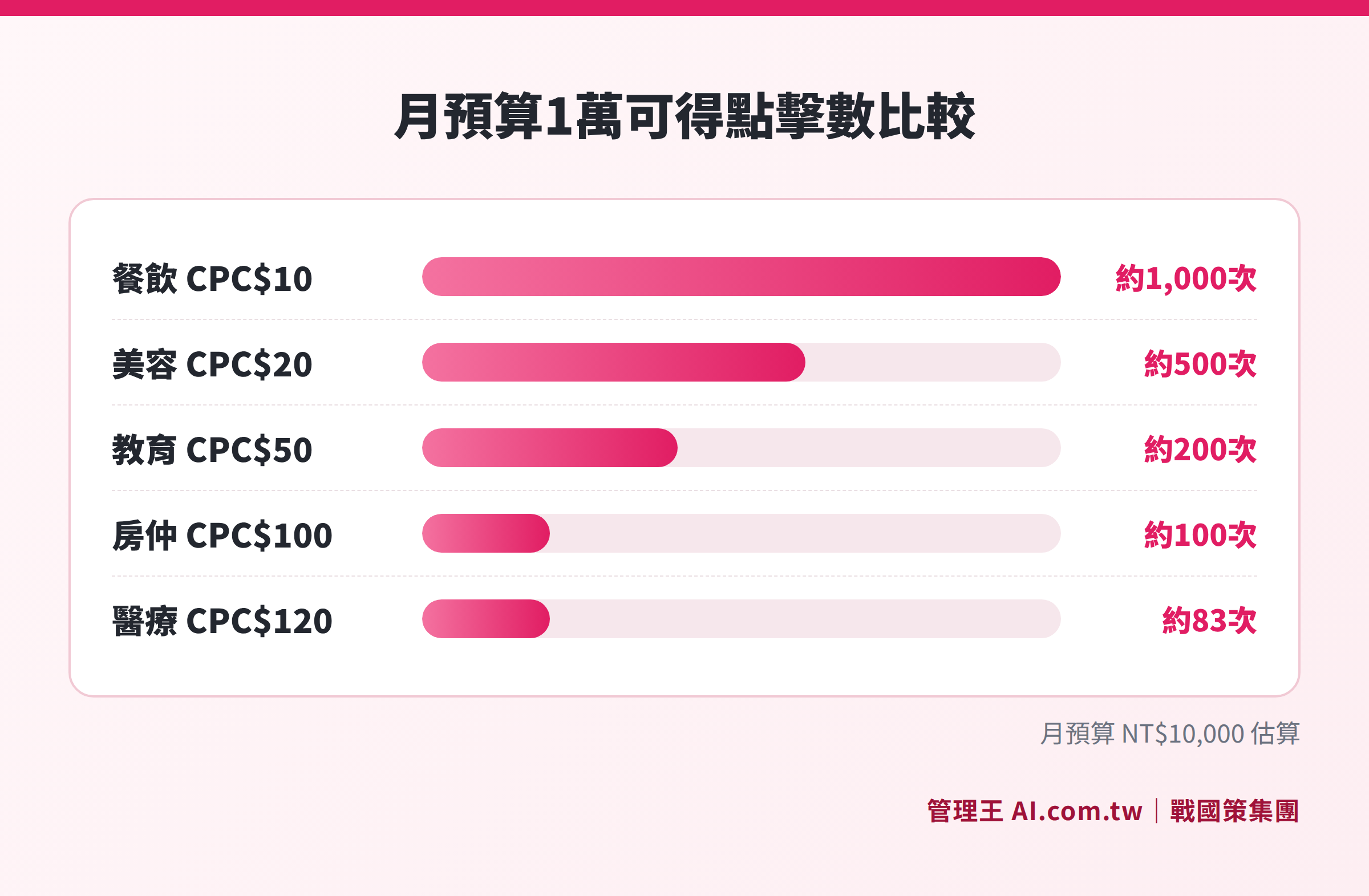
Comparison of number of clicks obtained with a monthly budget of NT$10,000 under different industry CPC scenarios
Formula for Calculating Advertising Costs: From Budget to ROAS
To systematically evaluate ad effectiveness, here is a commonly used calculation chain:
- Daily Budget: Monthly Budget ÷ 30.4
- Estimated Number of Clicks: Monthly Budget ÷ Average CPC
- Number of Conversions: Number of Clicks × Conversion Rate (CVR)
- Cost Per Conversion (CPA): Monthly Budget ÷ Number of Conversions
- Return on Ad Spend (ROAS): Total Revenue Generated by Ads ÷ Ad Spend
For example: Monthly budget NT$10,000, average CPC NT$20, total 500 clicks; if the conversion rate is 3%, it generates 15 orders; with an average order value of NT$2,000, total revenue is NT$30,000; ROAS = 30,000 ÷ 10,000 = 3 (meaning for every NT$1 spent, NT$3 is recovered).
Small and medium-sized enterprises are advised to first set a target CPA and then backtrack the required budget: Target Monthly Conversions × Acceptable CPA = Suggested Monthly Budget. If the target is 20 inquiries per month and willing to spend NT$600 per inquiry, then the monthly budget should be at least NT$12,000.
Recommended Budget Allocation Ratio
There is no universal formula for advertising expense allocation, but common practices for small and medium-sized businesses can be divided into three phases:
Testing Phase (First 1 to 2 Months): Allocate 70% of the monthly budget to 1 to 2 known core keyword ads with search volume, and 30% for testing different ad materials (titles, descriptions, landing pages). The focus is not on expanding coverage, but rather on identifying which combinations yield the lowest CPA.
Optimization Phase (Months 3 to 4): Based on testing data, allocate 80% of the budget on verified high ROAS ad campaigns, 10% on retargeting ads (for users who visited the website but did not convert), and 10% for testing new ad types (such as display ads or video ads).
Growth Phase (From Month 5 onwards): Once sufficient conversion data has been accumulated, smart bidding strategies like "Target ROAS" or "Target CPA" can be activated, allowing the Google system to automatically optimize each bid and gradually improve overall ad efficiency.
Hidden Costs Beyond Advertising Expenses
When assessing the true cost of Google Ads, the following items should also be included in budget planning:
- Landing Page Production and Optimization: The effectiveness of ads is directly related to Landing Page conversion capability. If there is no dedicated ad landing page, it is recommended to use a Landing Page drag-and-drop maker to quickly create one without needing assistance from engineers.
- Ad Material Production: The creation of images, videos, and text requires time and resources. The AI Copywriter can assist in quickly generating drafts of ad copy.
- Management Service Fees: If entrusting external ad agencies, the standard practice is 10% to 20% of the ad costs, meaning for a monthly budget of NT$10,000, an additional NT$1,000 to NT$2,000 management fee is required.
- Tracking and Analysis Tools: Google Analytics 4 is free, but setting up conversion tracking, UTM tagging, and interpreting reports all require time costs or outsourcing fees.
Five Key Factors Affecting Google Ads Costs
Google Ads uses a bidding auction mechanism, and the following five factors directly impact your actual ad costs:
1. Quality Score: Rated from 1 to 10, composed of three components: estimated ad click-through rate, ad relevance, and landing page experience. A higher quality score allows for better ad positioning at lower bids, effectively reducing CPC.
2. Keyword Competition Level: The more advertisers bidding on the same keyword, the higher the bid. Long-tail keywords (e.g., "all-you-can-eat Japanese cuisine recommendations in Taipei's Eastern District") generally face less competition compared to short-tail keywords (e.g., "Taipei restaurant"), resulting in a lower CPC.
3. Ad Scheduling: Times when consumers are more active (like weekday afternoons or weekends) see more competitive bids, usually resulting in higher costs. You can use "Bid Adjustments" to save costs during lower-competition times or increase bids in high-conversion times.
4. Geographic Location: Competition levels are higher in metropolitan areas (especially in Taipei City) compared to rural areas, thus leading to higher CPC. If your business scope is concentrated, narrowing the geographic targeting can reduce costs.
5. Device Type: Mobile device search volumes are high, but conversion rates can sometimes be lower than on desktops. Device bid adjustments (± percentage) can be set according to the characteristics of the product.
Common Budget Mistakes Made by Beginners
Many small business owners venturing into Google Ads for the first time often fall into the following traps:
- Using Broad Keywords Without Negative Keywords: A broad term like "interior design" may match unrelated searches like "entrance requirements for interior design" or "interior designer salary", wasting budget.
- Landing Page Mismatch with Search Intent: If a user searches for "Taipei interior design quotes" but lands on the company homepage instead of a quote request page, it severely lowers conversion rates.
- Incomplete Installation of Tracking Codes: Without conversion tracking set up, the system cannot optimize; spending money without understanding which keywords are profitable.
- Too Scattered Budget: A monthly budget of NT$10,000 spread across 10 ad campaigns results in each group having only NT$30 a day, which fails to generate enough learning data for system optimization.
How to Manage Advertising with 管理王?
管理王 AI.com.tw ad management integrates Google Ads, Facebook, Instagram, TikTok, and LINE ads into a single dashboard, solving the hassle of switching between various platform backends.
Unified monitoring across multiple platforms: Real-time comparison of spending, clicks, conversions, and ROAS across platforms on a single screen allows you to easily see which channels are profitable and which are not.
Smart Budget Redistribution: The system can automatically reallocate budgets from low-ROAS platforms to high-ROAS platforms, ensuring that limited marketing expenses continue to flow to the most effective channels. Combined with budget overspend alerts, it prevents uncontrolled advertising costs.
Automatic UTM generation and attribution analysis: Each ad link automatically carries UTM parameters, and the system supports first touch, last touch, and linear attribution models, accurately reflecting each ad campaign's contribution ratio.
Connect CRM to view real ROI: Ad-generated leads are automatically entered into the CRM system for follow-up lists. After business transactions, the system records this backflow, calculating the true LTV and ROI of each ad, giving the owner a view of actual revenue instead of just click counts.
Along with social scheduling management, Landing Page creation, and AI Copywriting, you can complete the full loop of "ad publishing → leads into CRM → sales follow-up → ROI calculation" within the same system, no longer needing multiple tools pieced together.
A free plan can be used permanently, with no credit card required; register in 30 seconds to try the ad management module. For detailed plans and pricing, please visit app.ai.com.tw/pricing.
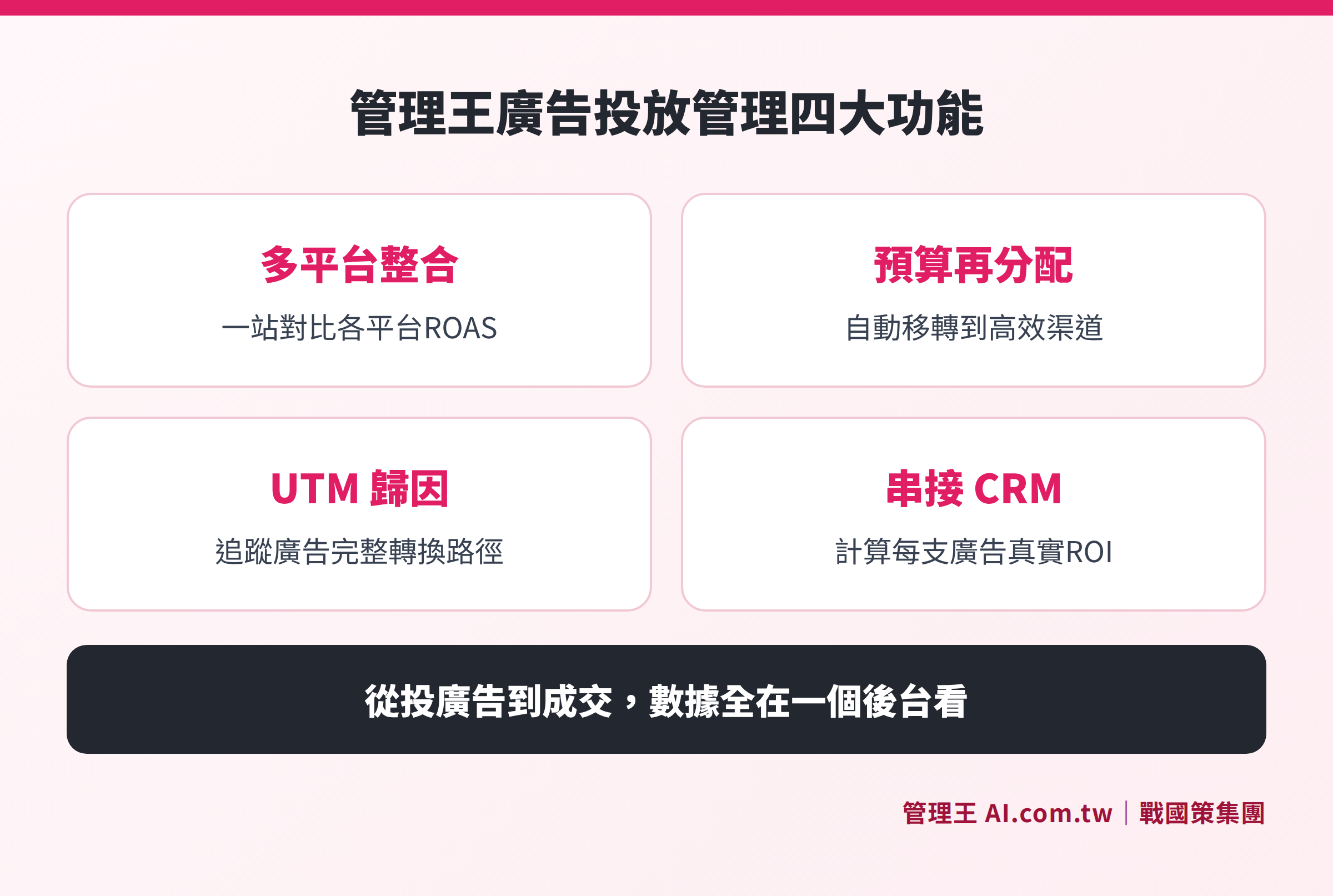
Core functions of 管理王 advertising management: multi-platform integration, budget redistribution, UTM attribution, CRM connection
Spending on Ads but Not Seeing Results?
Consultants can assist you in building cross-platform ad tracking, calculating the ROAS and true ROI for every single penny spent, with free consultations available immediately.
Free consultation hotline: 0800-003-191
LINE official account: @119m
Official website: app.AI.com.tw
Free trial: Apply for 管理王 now
Frequently Asked Questions
Is there a minimum budget limit for Google Ads?
Google Ads does not set a minimum monthly budget limit; the daily budget can be set as low as NT$1. However, an excessively low budget (e.g., below NT$100 daily) might result in ads being exposed only briefly during a few time slots each day, leading to insufficient bidding data, making it hard for the system to optimize using smart bidding strategies. Generally, a budget of at least NT$5,000 to NT$8,000 is recommended as a testing budget to accumulate meaningful data within 2 to 4 weeks.
How are Google Ads costs billed, and when are payments deducted?
Google Ads operates on a post-payment basis, with automatic deductions occurring when the billing amount reaches the "payment threshold" or at the end of the month (whichever comes first). The initial threshold for new accounts is usually NT$500, which will increase gradually based on payment history. A "manual payment (prepay)" option is also available, where funds are deposited before consumption.
If CPC bids are higher, does that mean better ad ranking?
Not necessarily. Google Ads determines the order of ads based on "Ad Rank" rather than just the bid amount. Ad Rank = Highest Bid × Quality Score (1 to 10) + other factors. An ad with a quality score of 8 and a bid of NT$30 may appear before an ad with a quality score of 3 and a bid of NT$50, and have an actual CPC that is lower. Therefore, improving the quality score (enhancing ad relevance, optimizing landing pages) is one of the most effective strategies to reduce advertising costs.
Is a budget of 10,000 really insufficient for running Google Ads?
Whether NT$10,000 is sufficient depends on the industry's CPC and target conversion volume. In less competitive local service industries (CPC NT$10 to 20), a monthly budget of NT$10,000 can generate 500 to 1,000 clicks, with a conversion rate of 3% resulting in roughly 15 to 30 inquiries, which is beneficial for small operators. However, in high CPC industries like medical and finance, NT$10,000 may only yield 60 to 100 clicks, recommending an assessment of increasing the budget first or accumulating traffic organically via SEO before pairing with ads.
How to track the true effectiveness of Google Ads?
Tracking true effectiveness requires the installation of Google Ads conversion tracking codes or Google Tag Manager and setting up conversion events such as "form submissions," "click-to-call," "add to cart," and "complete order." It is also recommended to simultaneously set up Google Analytics 4, combining UTM parameters to track the complete path of each advertising campaign. If using 管理王 advertising management, the system has built-in UTM generation and cross-platform attribution, allowing you to view the true conversion path of each ad directly in the 管理王 backend without switching multiple backends.
Data Sources
- Introduction to Average Daily Budget in Google Ads (Google Official Explanation) (Checked November 2026)
- Google Ads Bidding Explanation: Cost Per Click (CPC) (Google Official Explanation) (Checked November 2026)
- 管理王 AI.com.tw Ad Management Function Page (Checked November 2026)
- How to Manage Ads? Cross-Platform Advertising Effect Tracking | 管理王 (Checked November 2026)