What is a Booking System? Essential Features and Purchasing Points for Homestays and Hotels|Booking System Recommendations
A booking system integrates room management, OTA cross-platform synchronization, automated payments, and check-in notifications, helping homestays, small hotels, and villa operators say goodbye to manual reconciliation, effectively avoid overbooking, and understand the operational efficiency of each room through data.
A booking system (English: Property Management System, abbreviated as PMS) is a software platform used by the hospitality industry to manage orders, room statuses, financial flows, housekeeping, and operational reports in a unified manner. For small and medium-sized accommodation providers such as homestays, small hotels, villas, and hostels, a good booking system can replace manual Excel scheduling, reduce time spent reconciling with various booking platforms, and effectively avoid overbooking through cross-platform room status synchronization. The features and pricing of booking systems on the market vary widely, so it is essential to fully assess your room types, OTA integration needs, and backend integration capabilities before purchasing. This article explains the core functions of booking systems, OTA integration mechanisms, purchasing points, and recommendations for implementation for small and medium-sized accommodation providers in Taiwan, based on homestay regulations.
What is a Booking System? From PMS to One-stop Hospitality Management
The English term "Property Management System" (PMS) originated from the hotel industry and was initially used by large chain hotels to manage room statuses (Available / Occupied / Dirty / Out of Order) as a backend system. With the popularization of cloud technology, modern booking systems have evolved into comprehensive platforms that integrate online booking pages, OTA channels, payment processing, check-in notifications, housekeeping dispatch, and night audit reports.
For small and medium-sized accommodation providers in Taiwan, booking systems mainly address three pain points:
- Time-consuming manual reconciliation: Each platform like Booking.com, Airbnb, and Agoda has its own backend, and checking room statuses daily is one of the most time-consuming tasks for the staff on duty.
- Risk of overbooking: The same room could be booked on different platforms simultaneously, leading to compensation for cancellations and customer complaints.
- Scattered data: Orders on one platform, payments in another book, and customer lists on LINE groups prevent effective return rate analysis.
Understand Booking Systems in One Sentence
Booking system = OTA integration + real-time room status + automated payments + check-in notifications, allowing even individuals running homestays to manage accommodations with data rather than intuition.
Regulations for Taiwan's Accommodation Industry: Key Points for Homestays and Hotel Management Rules
Before purchasing a booking system, clarify your type of accommodation and regulatory framework, as the regulations for homestays (Homestay Management Measures) and hotels (Hotel Management Regulations) differ, affecting system requirements.
According to the regulations announced by the Tourism Bureau of the Ministry of Transportation and Communications, the Homestay Management Measures (National Regulations Database, Regulation Code K0110012):
- The number of homestay guest rooms is generally limited to 8 rooms, with a total building area not exceeding 240 square meters; in specific areas (mountainous townships, islands, indigenous regions, etc.), it can be expanded to 15 rooms and 400 square meters.
- Homestays must be personally operated by the land or building owner and cannot operate multiple homestays at different locations.
- Compulsory liability insurance: each incident's personal injury liability limit is NT$2 million, with a maximum limit of NT$10 million per incident.
According to the Hotel Management Regulations (Regulation Code K0110014):
- Hotels must apply for a hotel business registration certificate from the county or city government and meet the facility standards for reception lobbies, guest rooms, and bathrooms.
- Compulsory liability insurance: each incident's personal injury limit is NT$3 million, with a maximum of NT$15 million per incident.
Understanding the regulatory context, homestay operators typically prefer systems that are "lightweight and easy to use, with OTA integration and self-check-in"; hotel operators place more emphasis on "flexibility in multi-room pricing, night audit reports, and staff scheduling integration."
Six Core Functions of Booking Systems
A complete booking system should include the following six functional modules; missing any of them could lead to management loopholes during peak seasons:
1. Room Type and Multi-level Pricing Management
Room types such as double rooms, family rooms, and entire house rentals should be freely set and support weekdays pricing, holidays pricing, long weekends pricing, and peak season pricing tiered settings. Quality systems can automatically apply high prices during peak seasons and flexibly launch promotional plans during off-peak seasons, eliminating the need for manual nightly price adjustments.
2. Real-time Room Status Calendar
Visual color coding (available/booked/in-use) indicates the day's status, easily grasped by on-duty staff. It also provides your own official website's online booking page, allowing customers to check availability and book online instantly, reducing calls back and forth for confirmations.
3. OTA Cross-platform Room Status Synchronization
This is the core function to avoid overbooking. The system uses a Channel Manager mechanism to link and update the room status across platforms such as Booking.com, Airbnb, and Agoda: whenever a transaction occurs on any channel, the room is immediately locked and synchronized with other platforms.
4. Payment and Check-in Automation
Online collection of deposits, phased collection of remaining payments, check-in instructions, access codes, or room card OTPs are automatically sent to customers' LINE or email. This is particularly suitable for unmanned homestays or self-check-in operational models.
5. Housekeeping Scheduling and Night Audit Reports
Housekeeping assignments, nightly reconciliation (Revenue Audit), occupancy rates, and RevPAR (revenue per available room) reports help operators grasp the operating efficiency of each room and night through data.
6. Integration with CRM, Accounting, and Employee Systems
Booking revenue is automatically recorded, return customer data accumulates automatically in CRM, and employee scheduling aligns with peak check-in times, achieving true "one-stop" operation rather than isolated systems.
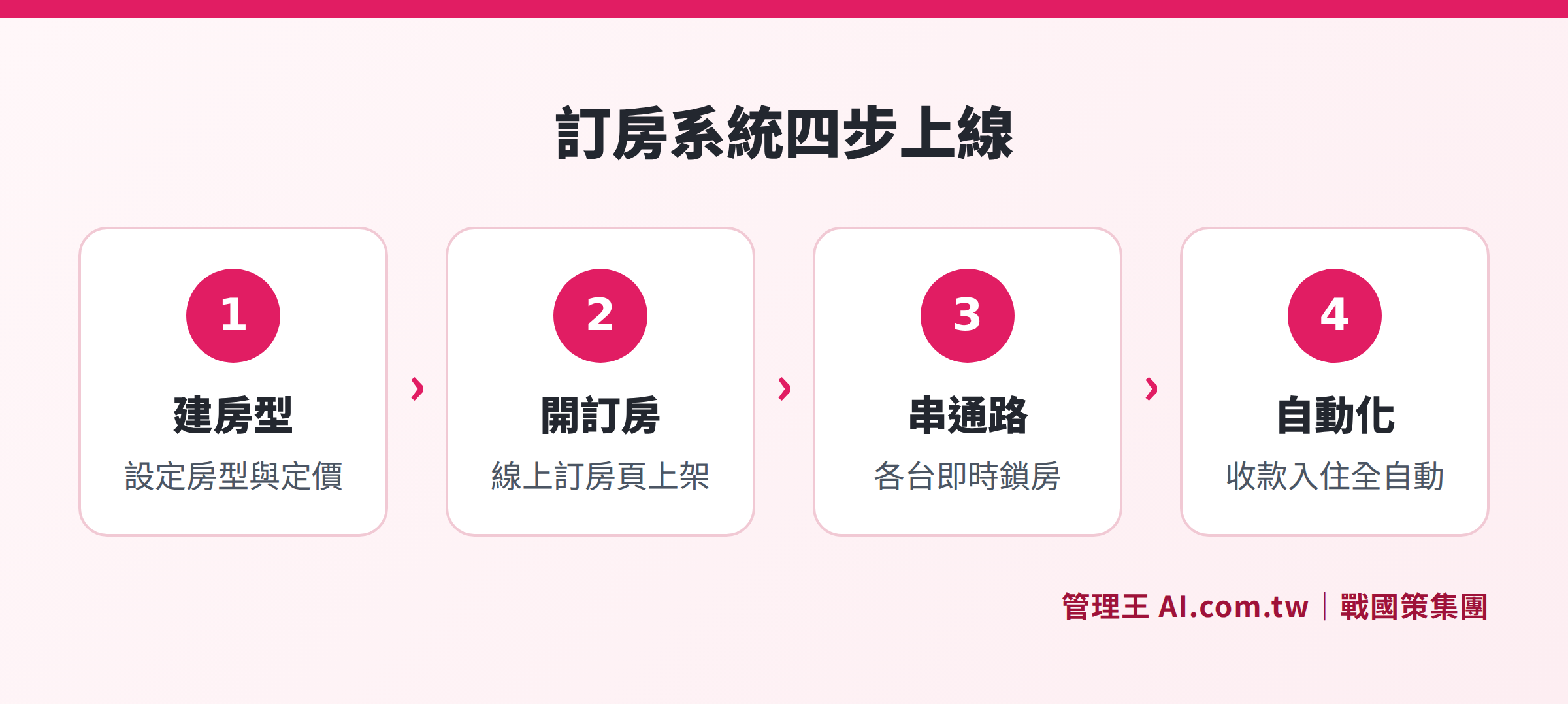
A complete implementation flow from establishing room type pricing, setting OTA integration, launching online booking pages, to payment automation and report analysis
OTA Cross-platform Integration: Fundamental Solution to Overbooking
OTA (Online Travel Agency) is one of the major sources of orders for Taiwan's accommodation industry, with Booking.com, Airbnb, and Agoda being the three most common platforms in the market.
Table: Comparison of Three Major OTA Platforms
| OTA Platform | Main Clientele | Commission Range | Suitable Business Types |
|---|---|---|---|
| Booking.com | Mainly international travelers | About 15-18% | Hotels, hostels, business travel |
| Airbnb | Experience-seeking travelers | About 3% (host) + service fee | Homestays, villas, unique accommodations |
| Agoda | Mainly Asian travelers | About 18-25% | Hotels, budget accommodations |
(Source: Partner terms from each platform's official website; actual rates depend on contracted plans, subject to announcements from supervisory authorities and official websites of each platform)
Operators without integrated booking systems usually adopt a "manual update room status" strategy: they individually close rooms in each platform's backend, which is time-consuming and labor-intensive, and prone to omissions. Once full occupancy occurs in peak seasons, forgetting to close one platform could lead to overbooking, necessitating compensation to customers, resulting in an immeasurable loss of reputation.
After integrating with a Channel Manager, any transaction on one channel triggers a lock on all platforms, and the entire process is completed automatically without manual operations from the staff on duty.
How Channel Manager Works
A Channel Manager is the core engine of the booking system, connecting in real-time with various OTAs via APIs, pushing the same set of room status data to multiple platforms. The specific operation is as follows:
- Real-time inventory synchronization: The system maintains a "main inventory pool" from which each OTA draws rooms; once a transaction occurs, the room is deducted from the pool, and other platforms automatically update the remaining room count.
- Cross-channel pricing management: Different channels can be set with different pricing strategies (e.g., increasing prices on Booking.com to absorb commission), or unified pricing can be set for the system to apply automatically, flexibly responding to commission differences across platforms.
- Unified management of order aggregation: All OTA orders are imported into the same backend page, allowing front desk staff to view the status of all orders, check-in lists, and payment situations without switching between platform accounts.
A system without Channel Manager integration can only perform "single channel management," which cannot fundamentally solve the overbooking issue; a system equipped with Channel Manager integration is a truly multi-channel booking management platform.
How Should Homestays, Small Hotels, and Villas Choose Booking Systems?
Different business types have varying functional needs for booking systems:
Table: Key Considerations for Different Accommodation Types When Purchasing Booking Systems
| Business Type | Room Scale | Most Important Functions | Secondary Functions |
|---|---|---|---|
| Homestay (Owner-occupied) | 2–8 rooms | Self-check-in automation, OTA integration | Simple housekeeping, LINE notifications |
| Small Hotel | 10–50 rooms | Multi-level pricing, night audit reports | Employee scheduling, POS integration |
| Villa/Entire House | 1–5 houses | Whole house calendar, installment payment for deposits | Marketing activities, member return visits |
| Youth Hostel | Bed-based | Bed management, splitting multi-person rooms | Dormitory floor management, guest registration |
Homestay operators (limited to 8 rooms by regulation) usually prioritize "ease of use" and "LINE/Email automated notifications"; the lighter and simpler the system, the better; hotel operators pay more attention to "RevPAR reports," "multi-account assignments," and the depth of "integration with existing POS systems."
Special Considerations for Homestay Implementation
Homestay operators, limited by the Homestay Management Measures to personally manage properties, usually operate as individuals or couples. This means the system's learning curve must be short; thus, it is recommended to prioritize:
- Complete self-check-in module: Includes automatic generation of access codes and OTPs, so hosts don't need to be onsite.
- LINE notification integration: Automatic push notifications for booking confirmations, check-in notifications, and thank-you messages after checkout to customers' LINE.
- Intuitive room status calendar: The interface should allow non-IT background operators to easily grasp the status of available rooms and check-ins, minimizing the learning barriers.
Special Considerations for Hotels and Business Travel Implementation
Hotel operators have more complex needs: front desk staff working shifts need to operate under separate accounts, night audit reports must comply with commercial accounting regulations, and invoices need to connect with electronic invoice systems. When purchasing, it is essential to confirm:
- Multi-account permission control: Different access permissions for front desk staff, housekeeping, and management to avoid data confusion.
- Night Audit function: Automatic generation of audit reports daily to ensure financial management complies with regulations.
- POS integration: Restaurants or other consumption items in the hotel can be merged into one bill for a one-stop entry.
Comparison of Booking System Costs and Plans
The costs for implementing a booking system are mainly divided into three categories: monthly subscription (cloud systems are mainstream), commission per order (used by some platforms), and one-time purchase (traditional standalone version with high future upgrade costs).
For small and medium-sized accommodation providers in Taiwan, monthly subscription cloud systems are the mainstream choice, requiring no self-built servers, continual system updates and maintenance, with a transparent and easy-to-budget cost structure. For instance, Management King AI.com.tw includes the booking system in all subscription plans, with no extra charges for Channel Manager fees or OTA integration purchases:
Table: Management King's Booking System Plan Cost Comparison
| Plan | Monthly Fee | Member Limit | AI Points/Month | Suitable Accommodation Scale |
|---|---|---|---|---|
| Free Plan | Permanently Free | 10 people | One-time quota | 1–3 rooms, trial experience |
| Economy | NT$5,000 | 30 people | 1,000 points | 5–15 rooms |
| Business | NT$10,000 | 60 people | 3,000 points | 15–30 rooms |
| Flagship | NT$19,900 | Unlimited | 10,000 points | Large hotels, chain brands |
(Annual payments can be used for an additional 2 months; customized features NT$1,000/hour, with a written quote provided before work begins; based on the latest announcements from app.ai.com.tw/pricing)
Taking a single-room homestay or villa operator as an example, using the free plan can accomplish basic booking management and OTA integration; if AI analysis reports and multi-channel marketing automation are needed, upgrading to the Economy Plan will significantly enhance operational efficiency, with no additional hidden costs.
Five Key Points for Purchasing a Booking System
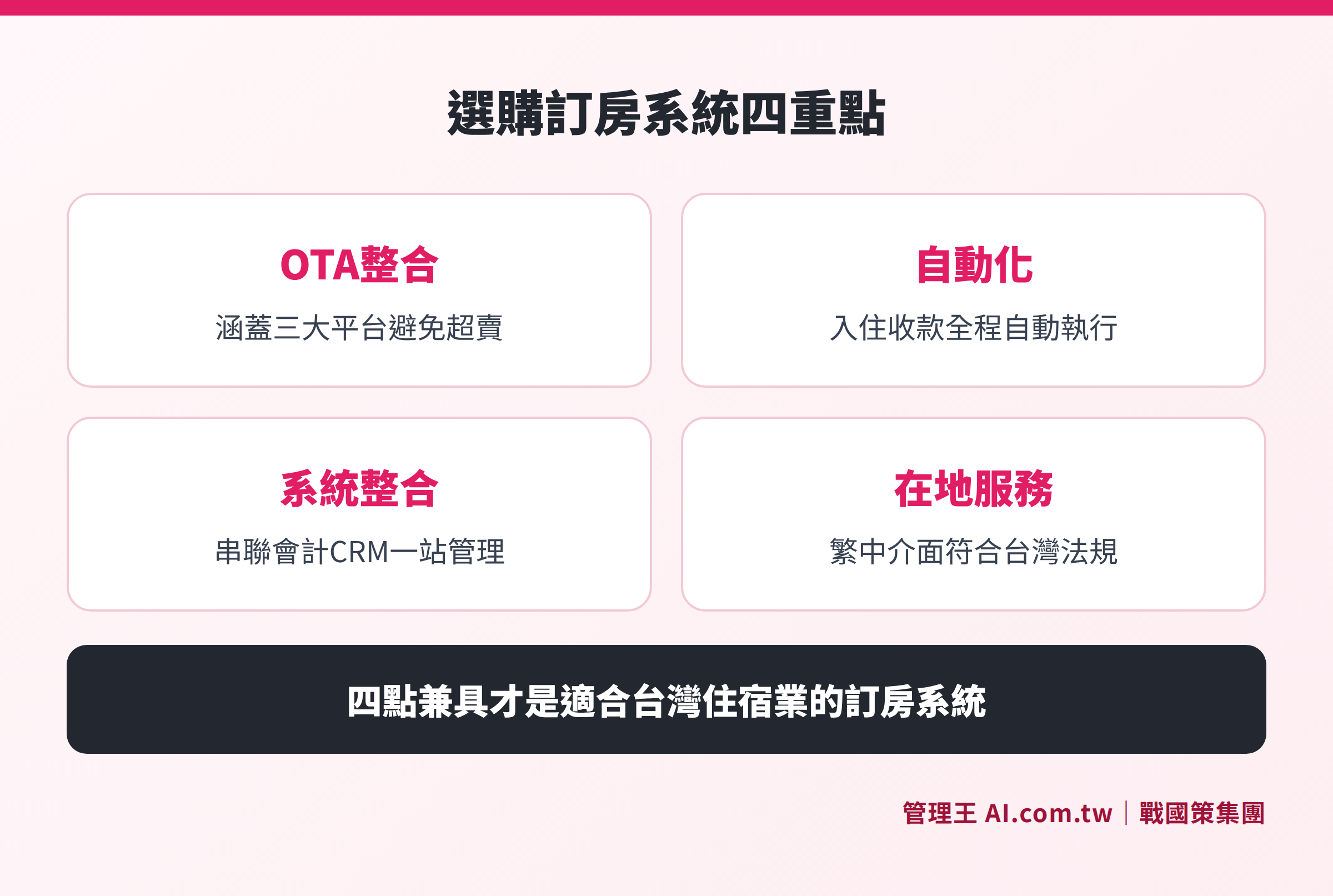
When purchasing a booking system, evaluate the breadth of OTA integration, level of automation, reporting capabilities, and support for local services in Taiwan.
Referencing the following checklist before purchasing can significantly reduce the risk of regret after implementation:
1. Breadth of OTA Integration
Does it cover Booking.com, Airbnb, and Agoda? Taiwanese operators should also check for support for KKday, EZTravel, Hotels.com. Foreign systems often miss local Taiwanese platforms.
2. Level of Automation
Are check-in notifications, payment reminders, and housekeeping assignment fully automated? The level of automation directly impacts the extent of labor cost savings.
3. System Integration Capability
Can booking revenues automatically connect to the accounting system? Can customer data automatically feed into the CRM to establish return visit records? Isolated booking systems can only solve front desk issues, while integrated systems can address the entire process.
4. Compliance with Local Regulations and Traditional Chinese Interface
Are invoicing, privacy law opt-in fields, and labor law-related settings compliant with Taiwan regulations? When using foreign SaaS, it is common to encounter issues such as "requiring manual organization of invoices after exporting accounts."
5. Transparency of Cost Structure
Are additional costs beyond the monthly fee for OTA integration, customer number limits, and customer service fees clearly stated? Are there significant functional limitations to evaluate with the "free plan"?
How to Use the Management King Booking System
The booking system of Management King AI.com.tw is a one-stop hospitality management platform (PMS) designed specifically for homestays, youth hostels, small hotels, and villas in Taiwan, integrated into a marketing system module. The main operational process is as follows:
- Create Room Types and Pricing Rules: Add room types like double rooms, family rooms, and entire houses in the backend, set weekday, holiday, long weekend, and peak season pricing across four tiers, and the system automatically applies the corresponding prices.
- Launch the Online Booking Page: The system provides a booking page that can be bound to your own domain, allowing customers to check availability, fill in their check-in information, and pay deposits online without needing to make calls back and forth.
- Set up OTA Synchronization: Connect with major OTAs like Booking.com, Airbnb, and Agoda, automatically locking rooms once a transaction occurs on any channel, thoroughly eliminating the risk of overbooking.
- Automate the Check-in Process: Check-in confirmation emails, access codes, and room card OTPs are sent automatically based on timing, allowing unmanned homestays to operate without personnel on standby.
- View Operational Reports: Occupancy rates, RevPAR, Average Revenue Per Room, and repeat customer rates are automatically compiled into a BI dashboard daily, enabling operators to make data-driven decisions.
- Integrate Accounting and CRM: Booking revenue is automatically recorded, customer data is automatically updated in CRM records, quickly identifying returning customers and pushing more precise offers.
The Management King free plan is permanently available, suitable for new homestay operators to become familiar with system processes; operators with higher demands for OTA integration and AI analysis can upgrade to either the Economy Plan (NT$5,000/month) or Business Plan (NT$10,000/month). The Zhan Guo Ce Group services over 30,000 enterprises, and the booking system features page can schedule complimentary assessments of implementation feasibility.
If you are also considering simultaneously introducing the table reservation system (suitable for homestays with a restaurant), ordering system (for online menu ordering), or loyalty points system (to enhance return rates), Management King offers native integration within the same account without separate integration fees or API connections.
Free Booking System Consultant Assessment
Management King's consultants assist homestays and hotels in quickly launching booking systems, OTA integration, self-check-in, and report analysis all in one go, with immediate free trials available.
Free consultation hotline: 0800-003-191
LINE Official Account: @119m
Official Website: app.AI.com.tw
Free Trial: Apply for Management King Now
Frequently Asked Questions
What is the difference between a booking system and a general appointment system?
Appointment systems are usually suitable for service-based bookings (such as beauty salons, clinics, teaching), emphasizing time slot management; booking systems are specifically designed for the hospitality industry, additionally equipped with features unique to accommodations such as "continuous multi-day occupancy," "room inventory management," "night audit reports," and "OTA cross-platform synchronization," with different usage scenarios for both.
Is it necessary for a homestay with only 3 to 5 rooms to implement a booking system?
Yes. Even with fewer rooms, if multiple OTAs (such as Airbnb and Booking.com) are simultaneously listed, the risk of manually updating room statuses is higher. The OTA synchronization feature of booking systems is particularly suitable for small homestays: the savings from overbooking compensation and confirmation phone calls often exceed the monthly fee of the system.
Can the booking system automatically issue electronic invoices?
The booking system of Management King integrates with accounting systems, allowing booking revenue to be automatically recorded, with electronic invoices connecting to the Ministry of Finance's electronic invoice system. It is recommended to consult with a consultant for the actual setup to ensure compliance with the latest implementation measures for electronic invoicing.
How long does it take to implement a booking system?
For simple homestay scenarios (establishing room types, setting up OTA integrations, launching online booking pages), basic online operations can usually be completed within 1 to 3 days; if the hotel scenario involves migrating data from existing systems or custom processes, the required time is longer. Management King offers free initial assessments to assist in planning a reasonable implementation timeline.
Can homestays without IT personnel operate it themselves?
Yes. Management King uses a Traditional Chinese interface, designed considering the usage habits of small and medium-sized operators in Taiwan (LINE notification integration, quick operations that don’t require typing), combined with free support at 0800, most homestay operators can operate daily after basic training. The AI customer service feature can also assist in handling common customer inquiries, reducing personnel on duty pressure.
How is customer data security ensured in the booking system?
Protecting customer personal data (name, contact information, stay records) is a compliance obligation that homestay and hotel operators cannot ignore, regulated by Taiwan's Personal Data Protection Act. Management King's data is stored in the Zhan Guo Ce Group's Taiwan data center (with dual machine room backup), using HTTPS/TLS 1.3 for encrypted transmission, a complete audit log records all operations, and supports detailed access permissions set by department. For more details on data security, refer to Management King's data security and protection page.
Data Sources
- Tourism Bureau of the Ministry of Transportation and Communications, "Homestay Management Measures", National Regulations Database, Regulation Code K0110012: https://law.moj.gov.tw/LawClass/LawAll.aspx?pcode=K0110012
- Tourism Bureau of the Ministry of Transportation and Communications, "Hotel Management Regulations", National Regulations Database, Regulation Code K0110014: https://law.moj.gov.tw/LawClass/LawAll.aspx?pcode=K0110014
- Tourism Bureau of the Ministry of Transportation and Communications, Tourism Statistics Inquiry Network, Accommodation Industry Statistics: https://admin.taiwan.net.tw/businessinfo/FilePage?a=14640
- Management King AI.com.tw booking system features page: https://app.ai.com.tw/features/hotel-booking
- Management King AI.com.tw service plan pricing: https://app.ai.com.tw/pricing
This article is for general information only and does not constitute legal or tax advice; actual guidelines are subject to the latest announcements from regulatory authorities.