Comparison of Inline Reservation Systems and Other Solutions: Costs, Features, and Suitable Store Types|Reservation System Recommendations

Comparing the fee structures, core features, and suitable store types of the inline reservation system with EZTABLE, VibeAI, Eatsy, and 管理王 based on publicly available information from each company's official website, helping restaurant owners in Taiwan choose the most suitable online reservation system.
The inline reservation system is the most widely used online reservation SaaS in the restaurant market in Taiwan, with over 8,000 restaurants using it, and more than 90% of the restaurants selected by the Taiwan Michelin Guide use inline. However, high "recognition" does not mean "suitable for all businesses" — restaurants of different sizes and customer bases have different functional needs regarding reservation systems, budget considerations, and data ownership. This article compares the fee structures, core features, and suitable store types of mainstream reservation solutions including inline, EZTABLE, VibeAI, Eatsy, and 管理王 based on publicly available information from each official website (as of November 2026) to provide restaurant owners with a clear basis for comparison.
What is the Inline Reservation System?
Inline was founded by a Taiwanese team in 2016 and is positioned as a "restaurant-side operational reservation SaaS": restaurants subscribe to the inline system to manage orders from various channels (official website, Facebook, Instagram, Google Maps, OpenTable, phone) within their own environments while also handling waitlist management, CRM, and analytics reports.
The main difference from consumer exploration platforms like EZTABLE is that the traffic for inline primarily comes from the restaurant's own channels rather than from searches by members on the inline platform itself. In 2024, inline established a strategic partnership with OpenTable, a subsidiary of Booking Holdings, allowing Taiwanese restaurants to simultaneously receive reservations from international travelers using OpenTable, which is a significant value addition for the tourism and high-end restaurant sectors.
In Summary
Inline is a backend tool for restaurants to "manage their own orders," while EZTABLE is an exploratory service for consumers to "find restaurants" on a platform; the two business models are fundamentally different.
Overview of Core Inline Features
According to the official inline website (restaurant.inline.app), the main features include:
- Unified Reservation Dashboard: Integrates orders from official websites, FB, IG, Google Maps, OpenTable, and phone, centralizing all orders for easy management, avoiding cross-platform reconciliation chaos.
- Seating Map and Table Status Management: Real-time visibility of each table's status on iPad or tablet, supports VIP zone settings, and allows customization of seating maps according to venue layout.
- Waitlist Management: Supports various check-in methods (self-service via iPad, QR code scanning, kiosk machine), the system automatically sorts the waitlist order, can use SMS to notify customers of their progress, and owners can remotely monitor the number of people waiting.
- Online Deposit Collection: During reservation, guests can be asked to prepay a deposit via credit card to reduce the No-Show rate; the system tracks payment status in real time.
- Customer CRM: Accumulates each customer's reservation record, preferred seating, past consumption, cancellation frequency, etc., allowing for targeted marketing or VIP privileges.
- Automatic Confirmation and Reminders: Automatically sends SMS or LINE confirmations when bookings are established and reminds customers again before eating, reducing the chances of forgetfulness.
- Centralized Management for Multiple Stores: Chain brands can manage multiple branches from a single backend, allowing the headquarters to see the real-time reservation distribution of each store.
- Inline AI Assistant: Launched in 2025, this LINE-based AI customer service allows consumers to inquire about availability and complete bookings using natural language without needing to visit the official website or call.
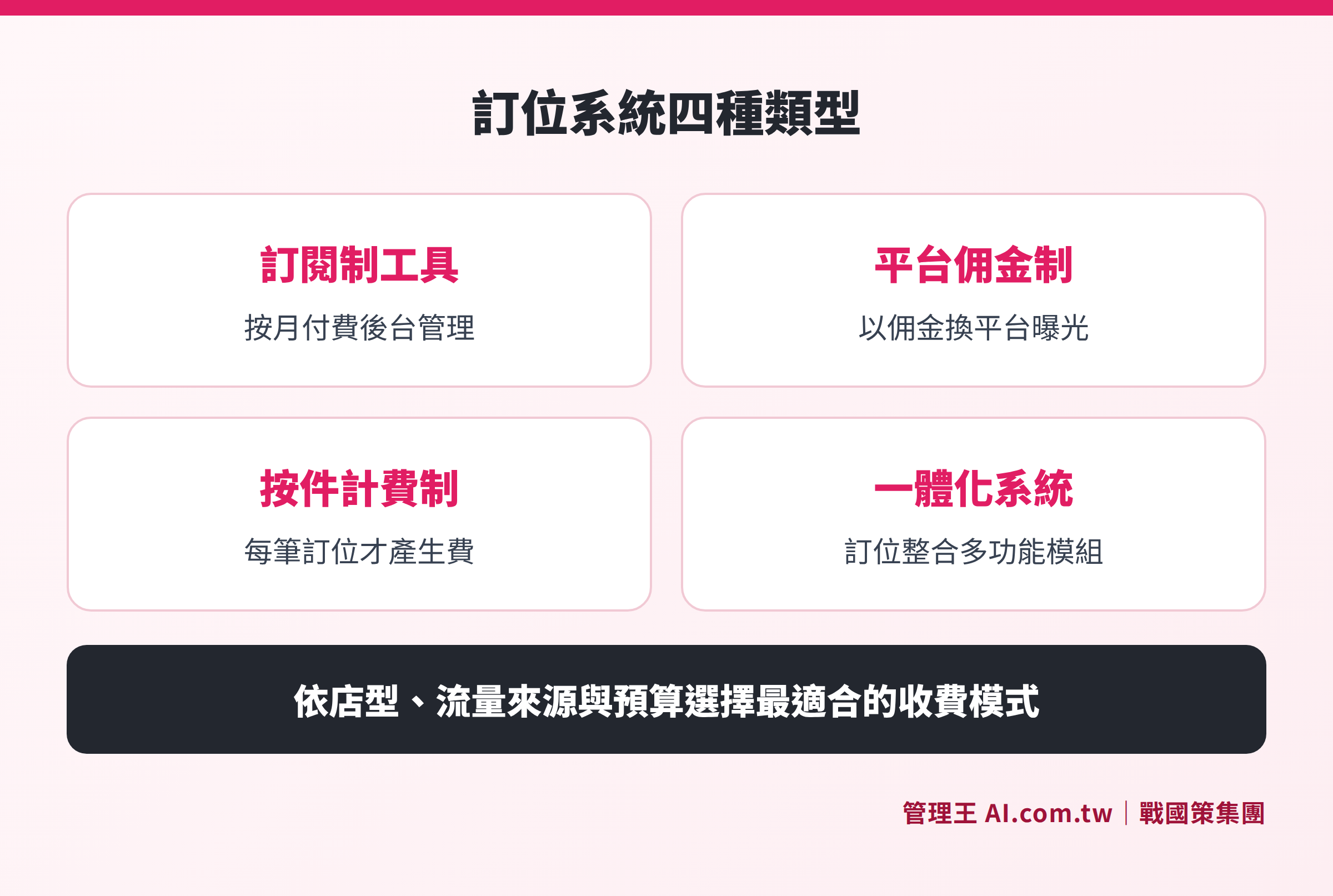
Summary of positioning and core differences of six mainstream reservation solutions based on publicly available information
Inline Pricing Method
According to the information published on the official inline website, inline does not disclose fixed pricing on its site, and inquiries about fees need to be made through their sales representatives. The official website offers a 14-day free trial, allowing restaurants to evaluate whether the features meet their needs before deciding to purchase the正式方案.
Since the official pricing is not publicly available, this article does not cite third-party estimated figures and recommends applying for a trial directly through the inline official website and asking for a written quote from sales, then comparing it with other solutions.
Feature Comparison of Six Mainstream Reservation Solutions
Table: Core Feature Comparison of Various Reservation Systems (based on publicly available information, November 2026)
| Feature Item | Inline | EZTABLE | VibeAI | Eatsy | 管理王 |
|---|---|---|---|---|---|
| --- | --- | --- | --- | --- | --- |
| Online Reservation Page | Yes | Yes (Platform) | Yes | Yes | Yes |
| Waitlist Management | Yes | No | No | No | No |
| Deposit Collection | Yes | Yes (Prepaid) | No | Yes | Yes |
| SMS / LINE Reminders | Yes | Yes | Yes (LINE) | No | Yes |
| Customer CRM | Yes | Yes (Platform) | Yes | No | Yes |
| Multi-Store Management | Yes | Yes | No | No | Yes |
| Google Maps Integration | Yes | Yes | No | No | Yes |
| Data Ownership | Partial Sharing | Partial Sharing | Owned by Restaurant | Owned by Restaurant | Owned by Restaurant |
| POS Integration | Limited to Selected Vendors | No | No | No | Native Integration |
| Free Plan | No (14-Day Trial) | No | Yes | Yes | Yes (Permanent) |
Pricing Models and Cost Structures
Each solution adopts different pricing logic, resulting in significant differences in total cost of ownership (TCO) for restaurants:
Table: Cost Models of Each Reservation Solution (Based on Publicly Available Information, November 2026)
| Plan | Billing Model | Officially Disclosed Costs | Notes |
|---|---|---|---|
| --- | --- | --- | --- |
| Inline | Monthly Subscription + Overage Fee | Not Publicly Disclosed (Inquiry Required) | 14-Day Free Trial |
| EZTABLE | Platform Commission | Not Publicly Disclosed (Inquiry Required) | Revenue mainly from prepaid deposits |
| VibeAI | Monthly Subscription | NT$0 / NT$49 / NT$399 / NT$799 | According to plans disclosed on official site |
| Eatsy | Pay-per-Reservation | NT$3 / per reservation (Deposit NT$5 / per reservation) | No monthly fee or contract |
| 管理王 | Monthly Subscription | Free / NT$5,000 / NT$10,000 / NT$19,900 | Reservation is one of 100+ features |
VibeAI: Monthly plans start from NT$0 (core reservation functionality), with the NT$399 Light plan adding LINE automatic reminders, and the NT$799 Professional plan unlocking advanced analytics and marketing tools, based on publicly available information from the official website (vibeaico.com).
Eatsy: No monthly fee, NT$3 per reservation, with an additional NT$5 for the deposit, suitable for businesses with significant seasonal demand or in testing phases, based on publicly available information from Eatsy’s official website (partners.eatsy.tech).
管理王: Reservation functionality is included within the overall plan, with a permanently available free plan. The economic type is NT$5,000/month (30-person limit), business type is NT$10,000/month (60-person limit, includes 8-hour remote training), and flagship type is NT$19,900/month (no limit on members). All plans also include CRM, accounting, human resources, customer service, and more than 100 other functions, according to 管理王 pricing page.
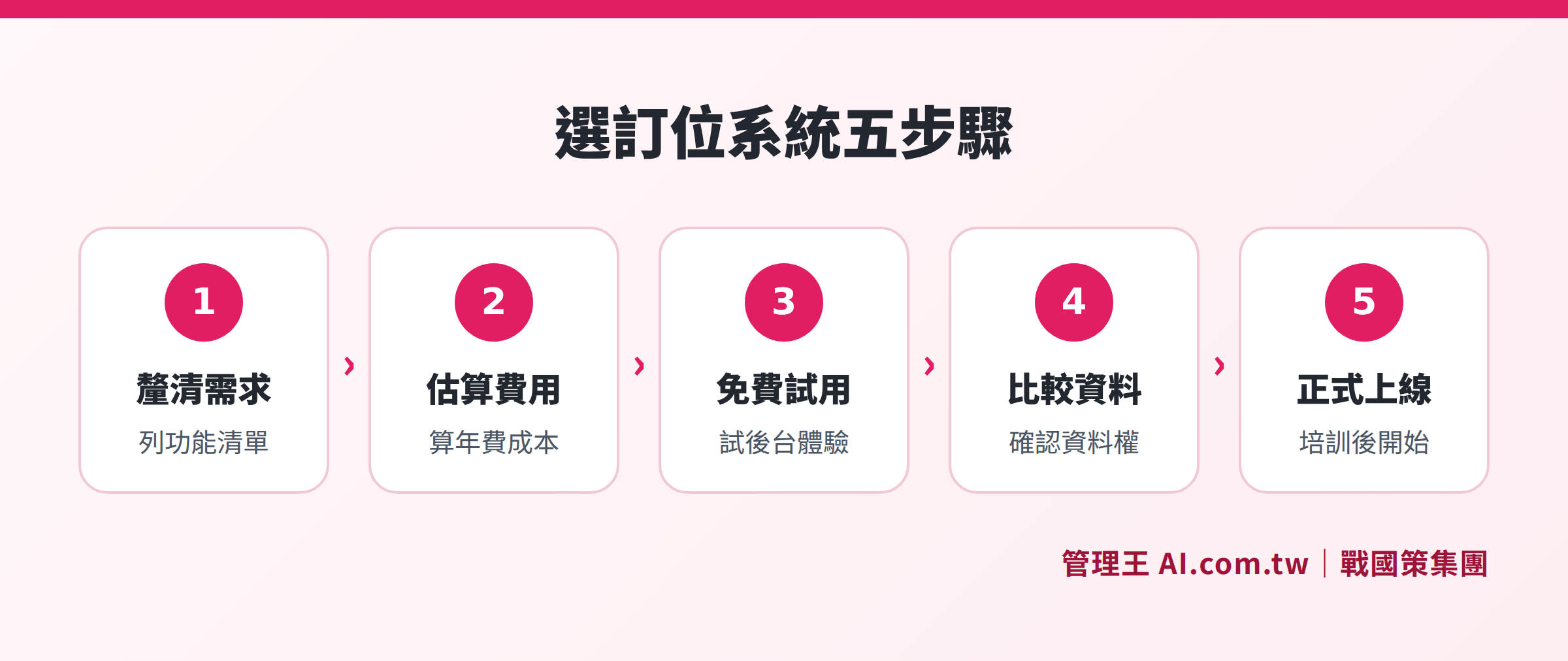
Five-step process from clarifying needs to implementation and launch
Three Key Questions Before Implementation
Before selecting a reservation system, it is advisable to clarify the following three questions, as the answers will directly determine which type of solution is most suitable for you:
1. Where does my reservation traffic mainly come from?
If the clientele mainly consists of return customers (relying on word-of-mouth, LINE, and private fan groups), choosing a "tool-based" system (inline, VibeAI, 管理王) is sufficient, as it is lower in cost and the data is entirely owned by the restaurant. If it is a new opening without traffic, "platform-based" systems (EZTABLE) provide platform exposure, trading commission for traffic enhancement.
2. How many reservations do I typically have each month?
For small restaurants with fewer reservations (under 50/month), solutions like Eatsy that charge per booking or the free basic plan of VibeAI are far more cost-effective than a monthly subscription. For businesses with stable and higher volumes (over 200 bookings/month), the cost per reservation of subscription-based models becomes lower, and the backend features are more complete.
3. What related systems will I need to integrate in the future?
If you only need pure reservation functionality, most tools can meet the requirements. However, if you hope to integrate reservation data with CRM, membership points, POS, or marketing promotions in the future, consider selecting systems that natively integrate these functions (like 管理王) to save on API connection costs and avoid creating data silos later on.
Which Store Types Are Suitable?
Suitable Scenarios for Inline
- Mid to high-end, fine dining: Inline's high penetration in Michelin restaurants in Taiwan indicates that similar competing restaurants commonly use it, making consumers familiar with the reservation process.
- Tourist landmark restaurants looking to connect with international customers through OpenTable: Businesses with a high number of business or foreign travelers can benefit from the international visibility provided by the collaboration with Booking Holdings.
- Complex waitlist management scenarios: Popular restaurants with large queues (e.g., well-known eateries next to night markets, popular cafes on weekends) can effectively utilize inline's waitlist module.
- Chain multi-stores: A unified dashboard allows headquarters to monitor real-time reservation statuses across different outlets.
Suitable Scenarios for EZTABLE
- Hoping to drive customer traffic through the platform: EZTABLE has accumulated a significant member base over the years, which can benefit new establishments lacking self-generated traffic.
- Accepting commission for exposure: EZTABLE's prepayment commission allows restaurants to exchange revenue for platform traffic, suitable for restaurants that internalize customer acquisition costs within the reservation process.
Suitable Scenarios for VibeAI
- Small to medium independent restaurants, cafes: The free or low-cost plan is sufficient to handle tens to hundreds of reservations each month.
- Businesses that mainly communicate with customers through LINE: VibeAI is built on LINE's native architecture, allowing consumers to complete reservations without needing to download an app.
Suitable Scenarios for Eatsy
- Businesses with significant seasonal fluctuations: Only pay during peak seasons when usage is high, with no fixed monthly costs.
- Small restaurants just starting out and wanting to test reservation system effectiveness: Low entry barriers with no contracts required.
Suitable Scenarios for 管理王 Reservation System
- Restaurants needing integration of reservations with CRM, point collection, POS, and LINE marketing: One account can handle reservations, member point collection, electronic invoices, and performance analysis without needing to connect multiple systems.
- Chain brands or businesses planning to expand to multiple stores: Unified backend management of reservations and member data across various locations.
- Businesses that prioritize complete ownership of customer data: Customer lists managed by 管理王 are fully owned by the store and not shared with third-party platforms.
Manage Reservations with 管理王 AI.com.tw
The 管理王 Reservation System is a feature of the 管理王 AI.com.tw marketing system, natively integrated with the CRM, membership points, POS system, and ordering system under the same account, without needing to set up extra APIs or pay integration fees.
Core Operational Workflow:
- Create a public reservation page in the backend, which can be linked to your own domain, accepting online bookings 24 hours a day.
- Set the number of seats and available resources (private rooms, specific table types, service staff) for each time slot, with the system automatically preventing double bookings at the same time.
- Once a reservation is established, the system automatically sends out LINE, SMS, or Email confirmations, and a reminder 24 hours before dining.
- After a reservation is completed, customer data is automatically imported into the CRM for accumulating consumption records for later marketing segmentation.
- The store manager can easily view daily and future reservation distributions in the backend to arrange supplies and staffing.
Advanced features include: VIP customer priority seating, online deposit collection to filter casual bookings, Google My Business integration to convert search traffic directly into reservations, and unified backend management for multiple stores.
The free plan is permanently usable, with core reservation functions included; if advanced AI analysis and automatic marketing triggers are needed, plans can be upgraded to the economic type (NT$5,000 / month) or higher.
Related feature pages: 管理王 Reservation System, Membership Points, CRM System
Further Reading: Complete Guide to Restaurant Reservation Systems: Features, Costs, and Implementation Steps|Recommended Restaurant Reservation Systems: Compare These 8 Features Before Choosing
Free Trial for 管理王 Reservation System
Free consulting to help assess functional needs. Reservation integrates with CRM, membership points, and POS; 30 seconds for free registration, no credit card required.
Free consultation hotline: 0800-003-191
LINE Official Account: @119m
Official Website: app.AI.com.tw
Free Trial: Apply for 管理王 now
Frequently Asked Questions
What is the cost of the Inline Reservation System?
Inline does not currently disclose a fixed pricing on its official website; pricing inquiries must be made after applying for a trial through their sales representatives. The official website offers a 14-day free trial period for evaluation. It is recommended that restaurants prepare their estimated monthly reservation numbers, check-in feature needs, and multi-store requirements beforehand as a basis for inquiries and comparisons.
Which is more suitable, Inline or EZTABLE?
The two have different business logic: inline is a backend management tool subscribed by restaurants, where they use their own traffic for taking orders; EZTABLE is a consumer exploration platform where restaurants gain exposure on the platform, exchanging commission for traffic that the platform brings. If the restaurant already has a stable customer base or self-generated online traffic, inline offers stronger operational control; if the restaurant is newly opened and lacks self-generated traffic, EZTABLE's platform exposure can accelerate early reservation volume.
Do small independent restaurants need to spend a lot to implement a reservation system?
No, they do not. VibeAI offers a free plan (core reservation and customer list management), Eatsy charges per reservation at NT$3, and 管理王 also provides a permanently free plan. Small restaurants can start with free or low-cost plans and evaluate the impact on their reservation numbers and No-Show rates before considering an upgrade.
Who owns the customer data in a reservation system?
This is an important difference between the various solutions. Inline and EZTABLE, being consumer exploration platforms, retain customer data, which restaurants can see but cannot fully take with them; VibeAI, Eatsy, 管理王, and similar tool-based systems allow restaurants to fully own their customer data, accessible for marketing or CRM analysis anytime. Restaurants that focus on long-term brand management should assess if data ownership aligns with their needs.
Can a reservation system reduce No-Show rates?
Two key mechanisms effectively reduce No-Show rates: automatic reminders (SMS/LINE notifications 24 hours and 1 hour before the reservation) and deposit collection (asking for a certain amount to be paid at the time of booking). Most mainstream solutions support automatic reminders; deposit collection features are provided by inline, 管理王, and Eatsy.
Data Sources
- Inline Official Website (restaurant.inline.app)|Reservation System Feature Introduction, November 2026
- VibeAI Official Website (vibeaico.com)|Plan Costs and Feature Descriptions, November 2026
- Eatsy Official Partner Website (partners.eatsy.tech)|Pay-per-Reservation Plan Description, November 2026
- 管理王 AI.com.tw Official Website (app.ai.com.tw)|Reservation System Feature Page and Pricing Plans, November 2026
- 管理王 Reservation System Feature Page: https://app.ai.com.tw/features/table-booking
- 管理王 Pricing Plans: https://app.ai.com.tw/pricing