What is an Inventory Management System? A Complete Guide for SMEs Upgrading from Excel|Recommended Inventory Management Systems
An inventory management system is a key tool for SMEs to upgrade from Excel, enabling real-time tracking of multi-warehouse inventory, automatic restock alerts, support for FIFO costing, and integration of procurement, sales, and accounting processes. This article covers system definitions, core features, ABC classification, industry differences, and purchasing guides, recommending suitable inventory solutions for Taiwanese SMEs.
An Inventory Management System is a digital tool used by businesses to track product purchases, shipments, transfers, inventory counts, and levels in real-time. The simplest definition is: it allows owners and warehouse personnel to know at any time what is in the warehouse, how much is left, and when to reorder, without relying on employee memory or searching through Excel. For Taiwanese SMEs, inventory management systems address two fundamental pain points: customers cannot place orders when items are out of stock, and slow-moving items tie up cash. This article covers everything from system definitions, core features, costing methods, ABC classification, industry differences to purchasing guides, serving as a complete reference for SME owners to upgrade from Excel to systematic management, while also explaining how to quickly launch the inventory module through 管理王 AI.com.tw.
What is an Inventory Management System? Core Definition and Features
An inventory management system is a software platform used to record, track, and analyze all inventory (products, raw materials, semi-finished goods, consumables). Its core tasks encompass three levels:
- Visualization: At any time, one can check every item’s location in the warehouse, how much quantity there is, and the cost
- Automation: Automatic alerts when stock falls below safety levels, automatically generating restock purchase orders, FIFO operates on a first-in, first-out basis
- Integration: Integrates with procurement, sales, accounting, and POS, enabling stock numbers to flow automatically through the entire supply chain, eliminating the need for manual transcription
The traditional approach involves using Excel or paper records, which has issues such as multiple people editing simultaneously causing conflicts, lack of real-time synchronization, and no automatic alert mechanisms. When a business has multiple warehouses, multiple sales channels, or monthly product types exceeding a hundred, the limitations of Excel quickly become apparent.
What is the difference between a Sales and Inventory System and an Inventory Management System?
These two terms are often used interchangeably in the Taiwanese SME market. "Sales and Inventory" emphasizes process aspects — managing the quantities and values of procurement, sales, and inventory; "Inventory Management System" focuses on real-time status of inventory. Modern systems often cover both: from placing purchase orders, receiving inventory, picking shipments, handling returns, inter-warehouse transfers, to year-end stock counts, providing a comprehensive management solution. When selecting a system, there is no need to get caught up in names; the key is whether the system can cover your core operational processes.
What is the relationship between Inventory Management and ERP?
ERP systems (Enterprise Resource Planning) are complete platforms that integrate procurement, inventory, production, sales, and finance, with inventory management being one of its sub-modules. For smaller companies, starting with a sales and inventory module can be beneficial, gradually expanding to procurement, accounting, production, and other functions without needing to implement a complete ERP at once. Choosing a platform that natively integrates with ERP will facilitate future expansions without the need to rebuild systems.
Five Major Pain Points of Using Excel for Inventory Management
Many Taiwanese SMEs initially use Excel for inventory management, but as business scales up, the following pain points become more evident:
1. Version Confusion, Inconsistent Data
Multiple people updating the same Excel sheet simultaneously can lead to overwriting each other’s records. Warehouse supervisors and stores maintain separate sheets, often leading to discrepancies in inventory numbers, consuming a lot of time during weekly reconciliations.
2. No Real-Time Synchronization
Excel is a "recording tool" and not a "real-time system". When sales staff ask, "Is this item in stock?", they need to wait for warehouse personnel to dig up data, which may already be outdated by a day or even a week.
3. No Automatic Alerts
Without proactive reminders, stock may reach zero, typically realized only after days of customer waiting, or even losing orders. Transitioning between peak and off-peak seasons makes inventory management even more challenging.
4. Time-Consuming Inventory Checks
Each month-end inventory requires manually comparing Excel numbers to actual warehouse counts. One discrepancy might take several hours to trace back, and version issues might make it impossible to identify the source.
5. Inability to Integrate with Accounting
Excel inventory tracks separate from the accounting system, requiring manual entry of sales and inventory data into accounting at month-end, which is prone to errors and inefficient, and does not provide real-time insights into how inventory costs impact gross profits.
In a nutshell
The core value of an inventory management system: transforming "warehouse transparency" from knowing at the end of the month to knowing at any time, allowing replenishment before stocks run out.
What Are the Core Features of an Inventory Management System?
The following are features that a complete inventory management system should possess, which can serve as a checklist during selection:
Table: Core Features of Inventory Management System
| Function Category | Specific Function Description | Main Problems Solved |
|---|---|---|
| Product Master Data Management | Consolidated maintenance of product names, barcodes, specifications, costs, selling prices, and suppliers | Product data scattered across multiple locations |
| Warehouse In-Out Management | Electronic processing of purchase orders, sales orders, return orders, and transfer orders | Incomplete change records make tracking difficult |
| Multi-Warehouse Management | Independent management of main warehouse, branch warehouses, and online warehouses, with cross-warehouse real-time synchronization | Inability to get an overview of inventory across multiple locations |
| Safety Stock Alerts | Automatic notifications when stock is low, and generation of restock purchase orders | Only discovering stock issues too late |
| Expiration Date and Batch Number Management | FIFO management, full tracking of batch numbers, and recall queries | Difficult to manage expiration risks for food and pharmaceuticals |
| Inventory Counting Management | Online inventory counting, with the system automatically comparing accounting discrepancies | End-of-month inventory counts consuming large amounts of manpower |
| Sales and Inventory Reports | Turnover rates, gross profit margins, ABC analysis, and inventory reports for each warehouse | Owner unable to quantify inventory health |
| Online and Offline Integration | Real-time synchronization with POS systems, e-commerce platforms, and ordering systems | Overselling and inventory inconsistencies across multiple channels |
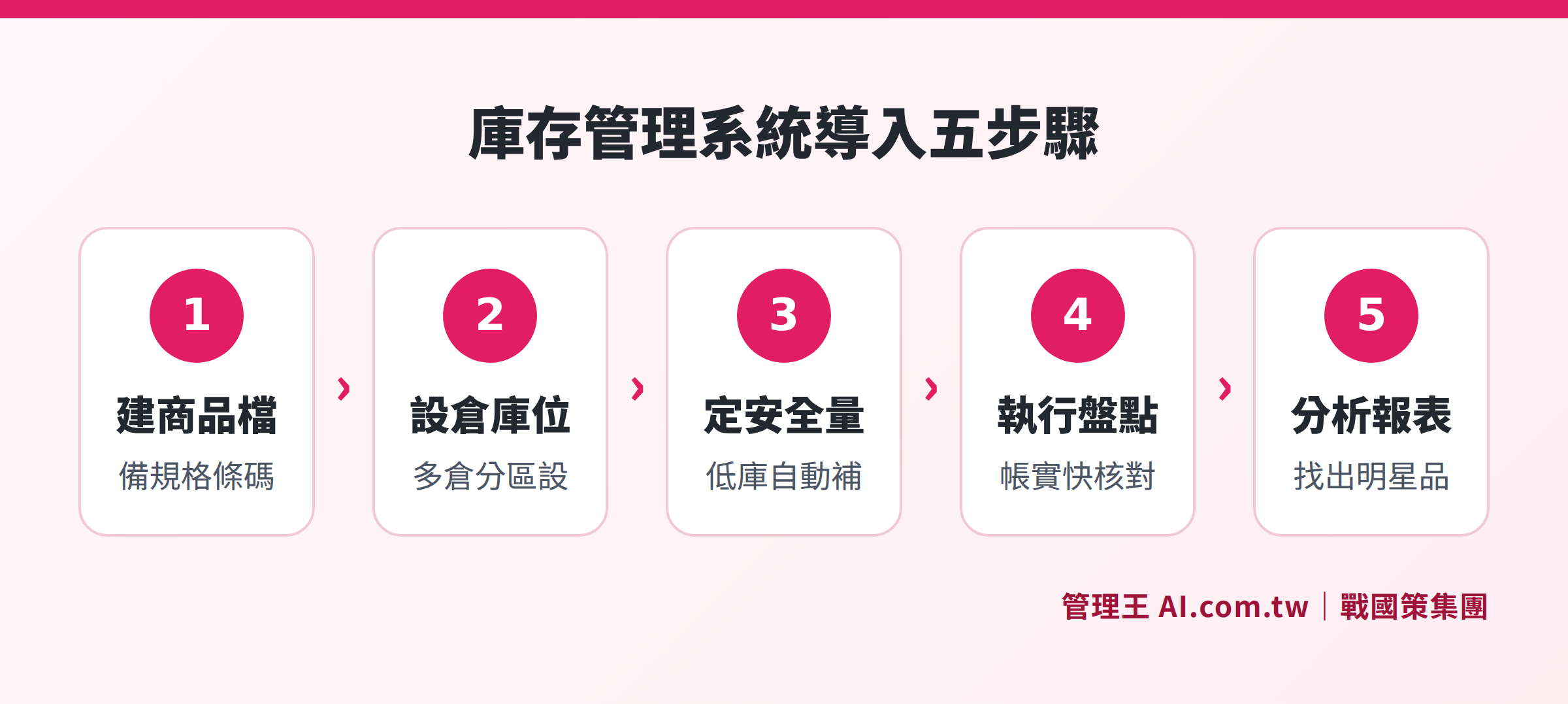
Establish product master data, set up warehouse zones, set safety stock levels, execute initial inventory counting, analyze reports to identify star products
Inventory Valuation Methods: How to Choose Between FIFO and Weighted Average?
The inventory valuation method affects the stock amounts and cost of goods sold reported in financial statements, as well as income tax filings. According to the Ministry of Finance's tax portal, the legally acceptable inventory valuation methods for Taiwanese companies include:
- Specific Identification Method: Independently track and calculate costs for each batch of products, suitable for high-value, limited-item categories (such as jewelry or custom machinery)
- First-In, First-Out Method (FIFO): The oldest inventory is accounted for as the cost of goods sold, reflecting the latest procurement prices on the books
- Weighted Average Method: Sum all purchase costs for the period and divide by total quantity to get the weighted average unit cost at the end of the month
- Moving Average Method: Recalculates the weighted average cost immediately after each purchase, giving the most real-time figures but requiring the greatest computational effort
Table: Comparison of Inventory Valuation Methods
| Method | Calculation Logic | Optimal Situations | Main Features |
|---|---|---|---|
| First-In, First-Out (FIFO) | Cost of the oldest purchases is recognized first as cost of goods sold | Food, pharmaceuticals, fast-moving consumer goods | Inventory closely aligns with market price, higher profits in inflationary environments |
| Weighted Average Method | Calculates average unit cost at the end of the month | General retail and wholesale industries | Simple calculations, relatively stable gross profit numbers |
| Moving Average Method | Recalculates average cost immediately after each purchase | Manufacturing industries with frequent purchases | Real-time reflection of cost, but requires substantial computation |
| Specific Identification Method | Establishes separate cost records for each batch of goods | High-value, limited item categories | Highest accuracy, but high management operational costs |
Regulatory Highlights: According to the Ministry of Finance, within the same accounting year, the same type of inventory cannot use different valuation methods mid-year. If a change in method is necessary, since May 27, 2009, there is no need to report it in advance to the tax authorities, but handling of the initial and ending numbers must still be compliant. Actual tax treatment follows the latest announcements from the Ministry of Finance and relevant authorities.
ABC Classification: Making Inventory Management More Efficient
ABC classification analysis is a method of categorizing inventory by importance, based on the Pareto principle (80/20 rule): a small number of items contribute to the majority of revenue, so management resources should be focused on these key items.
- A items (Critical Few): About 10–20% of items contribute to 70–80% of total revenue. They require strict inventory control, with the highest frequency of stock checks (recommended weekly or monthly), and safety stock settings should be conservative.
- B items (Generally Important): About 30% of items contribute to 15–20% of total revenue. Regular management is sufficient, with monthly inventory checks, and safety stock can be set moderately.
- C items (Many with Low Contribution): About 50–60% of items contribute only 5–10% of total revenue. Bulk purchases can be adopted, and management frequency can be reduced (quarterly inventory checks) to avoid wasting excessive manpower on low-value items.
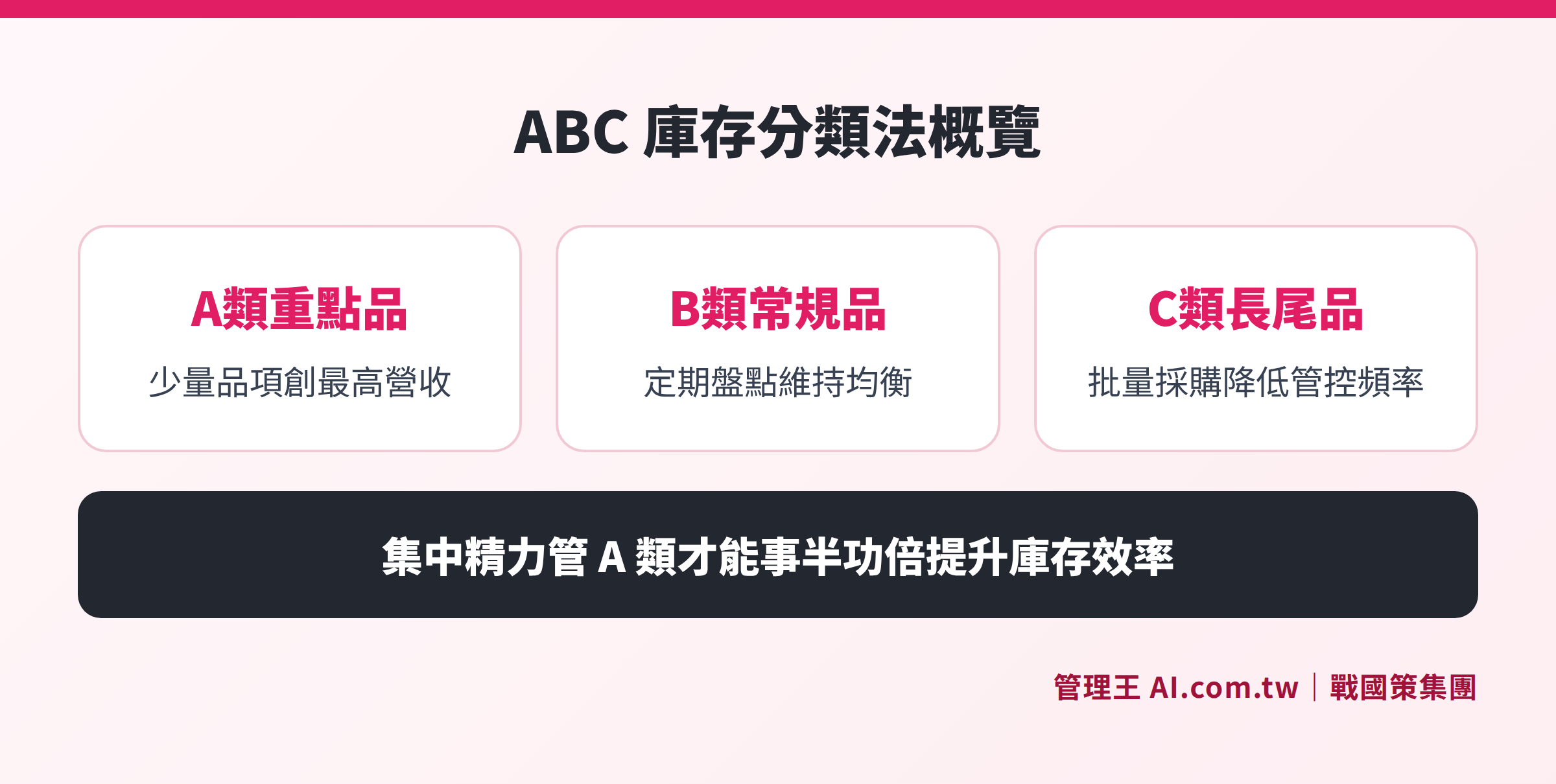
A items generating the highest revenue require strict control, B items are tracked periodically, and C items can be bulk-purchased to reduce management costs
Through ABC analysis, owners can focus their limited attention on the products that truly influence performance. 管理王's reporting and analytics feature can automatically calculate the sales share of each product, helping you quickly complete ABC classification without manually organizing in Excel.
Key Differences in Implementing Inventory Management Systems Across Industries
Inventory management systems are not a one-size-fits-all solution; different industries have different core demands:
Retail (including E-commerce)
The focus is on real-time synchronization of online and offline inventory. When one item is sold online, the physical warehouse must be instantly reduced; when a product is sold out, it must automatically be removed from the shelves to avoid overselling and customer complaints. Integration with POS systems and online store systems is necessary for unified multi-channel inventory management.
Wholesale Trade
The focus is on inter-warehouse transfers and procurement management. When large orders come in, the system must quickly confirm available stock across warehouses, allocate shipping orders reasonably, and track in-transit inventory (quantities ordered but not yet received) to prevent duplicate orders.
Manufacturing
In addition to finished goods inventory, there is also a need to manage raw materials, components, and semi-finished products. It requires integration with production modules to calculate raw material usage for each production order, automatically deducting from material stock and tracking production progress’s impact on finished goods inventory.
Food Service
Effective management of ingredient expiration dates is key, with FIFO being a mandatory requirement. Expired ingredients not only represent cost losses but also involve food safety regulatory risks. The system must automatically remind managers before ingredients expire and support batch tracing to ensure that older stock is used first.
Beauty Industry, Clinics, SPA
Consumables management is essential: how much consumable is used per service (such as chemicals, skincare products, disposable items) is automatically deducted from inventory by the system. Month-end reconciliations can directly query consumable consumption for each service item without manual recording.
Six Key Questions for Owners to Ask Before Choosing an Inventory Management System
Before purchasing an inventory management system, it’s advisable to confirm the following questions to ensure the system truly meets your business needs:
- How many warehouses does it support? Only a single warehouse function or real-time synchronization across multiple warehouses?
- Can it integrate with existing POS or e-commerce platforms? What are the additional costs for integration?
- Is there mobile support? Can warehouse staff quickly handle inventory in and out, and scan barcodes using their mobile or tablet?
- Are the costing methods compliant? Does it support FIFO and weighted average methods per the Ministry of Finance regulations?
- How deep are the reports? Can it automatically generate inventory turnover rates, ABC analysis, and gross profit margins for each product?
- What is its future expansion capability? Can it natively integrate with procurement, finance, and CRM, avoiding future data silos?
Use 管理王 AI.com.tw for Inventory Management
管理王 AI.com.tw’s inventory management (sales and inventory) module is a one-stop solution designed for Taiwan’s retail, wholesale, manufacturing, food service, and beauty industries, with main functions including:
Consolidated Product Master Data Creation: Manage product names, specifications, barcodes, costs, selling prices, and suppliers in one place; support barcode scanning for speedy inventory handling; new product listings, price changes, and supplier changes can all be done on one page without having to reference multiple Excel sheets.
Real-Time Synchronization Across Multiple Warehouses: Total warehouses, branch warehouses, online warehouses, and consignment warehouses are managed independently yet clearly visible. Purchase orders, sales orders, return orders, and transfer orders are handled seamlessly; any inventory changes at any location update numbers in real-time across the company, eliminating the issue of asking at retail locations, "Is this one still in stock?" and headquarters not knowing.
Automatic Safety Stock Alerts: Set safety stock levels and reorder points for each item; when below the alert level, the system automatically notifies and generates purchase orders, transforming "only realizing stock issues when it’s almost out" into proactive alerts for restocking before running out, allowing full control over seasonal inventory adjustments.
Expiration Date and Batch Number Traceability: Supports expiration management and FIFO for food, pharmaceuticals, and cosmetics, with full tracking of batch and serial numbers. If suppliers notify defects, it can quickly identify which batches were sold to whom, minimizing recall risks.
Inventory Counting and Sales and Inventory Reports: Month-end, quarter-end, and sample counts can all be conducted online, with the system automatically comparing accounting discrepancies and generating discrepancy reports. Inventory turnover rates, gross profit margins for each product, and ABC classification are automatically generated, along with the reporting and analytics function to identify star products contributing to 80% of revenue.
Seamless Integration of Online and Offline Inventory: Integrates POS, e-commerce, and ordering systems, with online and offline inventories synchronized in real-time, automatically removing sold-out products from shelves to eliminate overselling and customer complaints.
管理王's inventory management is natively integrated with procurement management, accounting systems, and quotation systems, avoiding additional API integrations or costs. This is particularly important for resource-limited SMEs: one system handles everything from inquiry, ordering, receiving, shipping, to financial reconciliations, with data flowing automatically throughout the process.
A free plan is available for unlimited use, allowing you to try out full features without needing a credit card upfront. For more AI usage and additional members, you can upgrade to the Economic (NT$5,000/month), Business (NT$10,000/month), or Flagship (NT$19,900/month) plans. Current pricing can be found on the service plans page.
The 戰國策 Group services over 30,000 businesses, and the management module was designed with Taiwanese business practices in mind — offering a Traditional Chinese interface, LINE notifications, compliance with business accounting laws and electronic invoicing standards — with the goal of enabling warehouse staff to start using it on day one without a lengthy system implementation period.
Interested in implementing an inventory management system? Free Consultation
Fill out the consultation form, and our consultants will help you evaluate suitable sales and inventory solutions, explain the functional structure, implementation timeline, and costs, all for free without pressure.
Free consultation hotline: 0800-003-191
LINE Official Account: @119m
Official Website: app.AI.com.tw
Free Trial: Apply now for 管理王
Frequently Asked Questions
Must an Inventory Management System be used with ERP?
Not necessarily. Smaller retailers can meet daily needs with just the sales and inventory functions, without needing to implement a complete ERP system all at once. However, it is advisable to choose a platform that can natively integrate with ERP, as business complexities arise and integrated management of procurement, production, and finance becomes necessary; you can expand directly without rebuilding data structures or incurring additional integration fees.
Can inventory management systems automatically execute FIFO?
Yes. Modern inventory management systems (including 管理王) support batch and expiration date management, and during inventory execution, the system can be set to prioritize shipping according to the earliest receipt date or earliest expiration date, complying with the FIFO costing method recognized by the Ministry of Finance. Food, pharmaceutical, and cosmetic businesses are advised to activate this feature, which also helps mitigate the risk of financial losses from expired products.
How does multi-warehouse management operate?
In the system, establish independent stock and storage accounts for each warehouse (main warehouse, branch warehouse, online warehouse). Each purchase, shipment, and transfer is assigned to the corresponding warehouse; any inventory changes in any warehouse instantly update the overall accounting inventory number. Managers can view the real-time status of stock across all warehouses on one screen and can also generate transfer orders directly in the system to move goods between different warehouses, with complete records available for review.
How should safety stock levels be set?
The logic for calculating safety stock is: average daily sales × lead time for replenishment × safety factor. For example, if an item has an average sale of 10 units per day, the supplier needs 7 days to replenish, and a safety factor of 1.5 is set, the safety stock would be approximately 105 units. Actual settings may be adjusted according to product seasonality (differences between peak and off-peak seasons), or the system can automatically suggest reorder points based on historical sales data, eliminating the need for manual calculations each time.
How long does it take to implement an inventory management system?
The implementation time varies based on business scale, product variety, and existing data volume, making it difficult to provide a one-size-fits-all answer. 管理王 is designed to enable warehouse personnel to perform basic inventory operations on day one using a responsive web interface supported by barcode scanning; establishing complete product master data and process settings usually takes a few days to weeks, depending on the complexity of product types. Plans above the business tier include remote implementation training to help shorten preparation time.
Data Sources
- Ministry of Finance Tax Portal - Profit-Seeking Enterprise Inventory Valuation Method FAQs (National Tax Bureau of the Ministry of Finance)
- Ministry of Finance Tax Portal - How to Choose an Appropriate Inventory Valuation Method (National Tax Bureau of the Ministry of Finance)
- 管理王 AI.com.tw Inventory Management Feature Page (Management Wang Official Page, queried October 2026)
- 管理王 AI.com.tw Service Plans and Pricing (Management Wang Official Page, queried October 2026)
This article is for general informational purposes only and does not constitute legal or tax advice; please refer to the latest announcements from the Ministry of Finance and relevant authorities for actual practice.