What is a Knowledge Management System? Complete Steps for Enterprises to Build a Knowledge Base | Recommended Knowledge Management Systems

A Knowledge Management System (KMS) is a digital tool for enterprises to centrally store and share organizational knowledge, helping to address issues like knowledge gaps, slow onboarding of new employees, and scattered documents. This article covers definitions, functions, implementation steps, and industry applications, along with practical operations of 管理王 AI knowledge base.
A Knowledge Management System (KMS) is a digital tool that helps enterprises systematically collect, organize, store, share, and apply organizational knowledge. In simple terms, it is about consolidating the "company know-how" scattered in employees' minds, documents, emails, and chat records, making it easily accessible for anyone at any time. According to international standard ISO 30401:2018 (Taiwan's equivalent is CNS 30401), the core of a Knowledge Management System lies in "creating value through knowledge," covering three main aspects: organizational culture, processes, and technology. For small and medium enterprises in Taiwan, the most direct benefits of implementing a Knowledge Management System include reducing repetitive inquiries from colleagues, shortening the onboarding time for newcomers, and avoiding knowledge gaps caused by the departure of key employees. Modern AI knowledge bases can even allow employees to ask questions in plain language, with the system automatically finding answers from documents, significantly reducing management costs.
What is a Knowledge Management System? Definition and Core Concepts
Knowledge Management Systems are integrated solutions that combine technology, processes, and culture to enable effective preservation and circulation of both explicit knowledge (documents, SOPs, regulations) and tacit knowledge (professional judgment, customer insights) within an organization.
According to ISO 30401:2018, a Knowledge Management System must have the following characteristics:
- Knowledge is intangible and created by people: Technology is merely a medium; culture is fundamental
- Must serve organizational goals and strategies: Not just to build a system for the sake of building
- Covers the complete knowledge life cycle: From knowledge generation, recording, sharing, to updating
In a nutshell
A Knowledge Management System is a company's "intellectual asset bank" — storing knowledge for everyone in the company to withdraw.
Knowledge management is typically divided into two main types:
Table: Comparison of Explicit Knowledge vs Tacit Knowledge
| Type | Content Examples | Management Methods |
|---|---|---|
| Explicit Knowledge | SOP documents, product specifications, regulatory texts, training materials | Document library, Wiki, knowledge base systems |
| Tacit Knowledge | Negotiation skills, customer preferences, problem-solving experiences | Mentorship, community discussions, recorded videos |
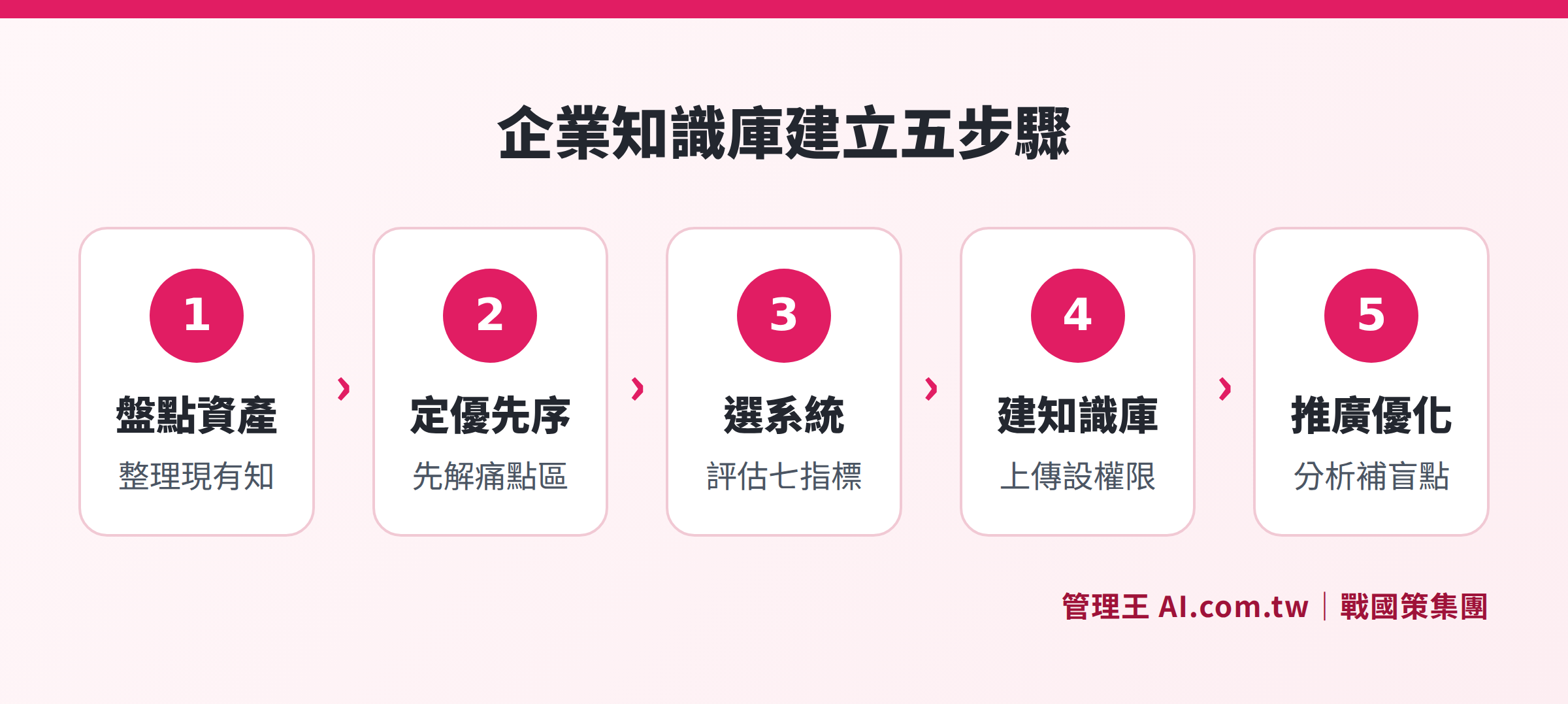
From inventorying knowledge assets to continuous optimization, five implementation steps
Why Do Enterprises Need Knowledge Management Systems? Four Core Pain Points
Many small and medium enterprises in Taiwan face the following issues, which are typical symptoms of not having a Knowledge Management System:
1. Knowledge concentrated in a few individuals
When core employees leave, the years of accumulated customer relationships, handling processes, and technical know-how go with them. Losing customers when sales personnel leave is one of the most common pain points for Taiwanese enterprises.
2. Long onboarding time for new employees
New employees need to spend a lot of time asking seniors, sifting through old emails, and searching for scattered documents. Without a systematic knowledge base, onboarding can often take longer than expected.
3. Repeatedly answering the same questions
Supervisors and senior employees waste a lot of time daily answering repetitive questions like “How do I do this process?” or “What’s the situation with that customer?” instead of focusing on high-value work.
4. Dificulty in locating scattered documents
Company documents are spread across cloud drives, email inboxes, LINE groups, and colleagues' computers, making them hard to find when needed, with outdated and new versions mixed together, causing operational errors.
According to a survey by the Taiwan Ministry of Economic Affairs (MOEA) on corporate knowledge management, small and medium enterprises in Taiwan commonly face challenges related to a lack of a knowledge-sharing culture, which is a key factor affecting the effectiveness of knowledge management.
Seven Core Functions of a Knowledge Management System
A complete Knowledge Management System should have the following core functions:
1. Multi-source document integration
Supports importing PDF, Word, Excel, PowerPoint, Markdown, plain text, and web links, storing them in a unified, quantifiable manner so that various formats of data can be understood and searched by AI.
2. Precise Q&A in natural language
Employees can ask questions in plain language, such as “What is our refund policy?” or “How do we handle equipment Y malfunction?”, with the system finding and citing answers from company documents, no longer limited to keyword searches.
3. Source traceability and verifiability
Each AI answer is accompanied by the source document and paragraph, which employees can click to verify, preventing the system from generating answers out of thin air and aligning with corporate internal control audits.
4. Tiered access control
Financial documents can only be accessed by the finance department, while customer data is visible only to sales staff. Access rights are defined by roles, protecting sensitive information while promoting knowledge sharing.
5. Content governance and blind spot analysis
Automatic marking of documents not updated for over a year and producing reports on the most frequently asked questions by employees helps managers identify training and documentation blind spots.
6. Accelerated customer service and onboarding
The customer service robot shares the same knowledge base backend, providing consistent answers for internal and external use; new employees can ask AI first instead of approaching colleagues one by one, significantly shortening the onboarding exploration period.
7. Integration with existing systems
Can integrate with CRM, task management, HR systems, etc., making knowledge management not an isolated function, but embedded in daily workflows.
Complete Steps for Enterprises to Build a Knowledge Base
Building a corporate Knowledge Management System is not an overnight process; here are five effective practical stages:
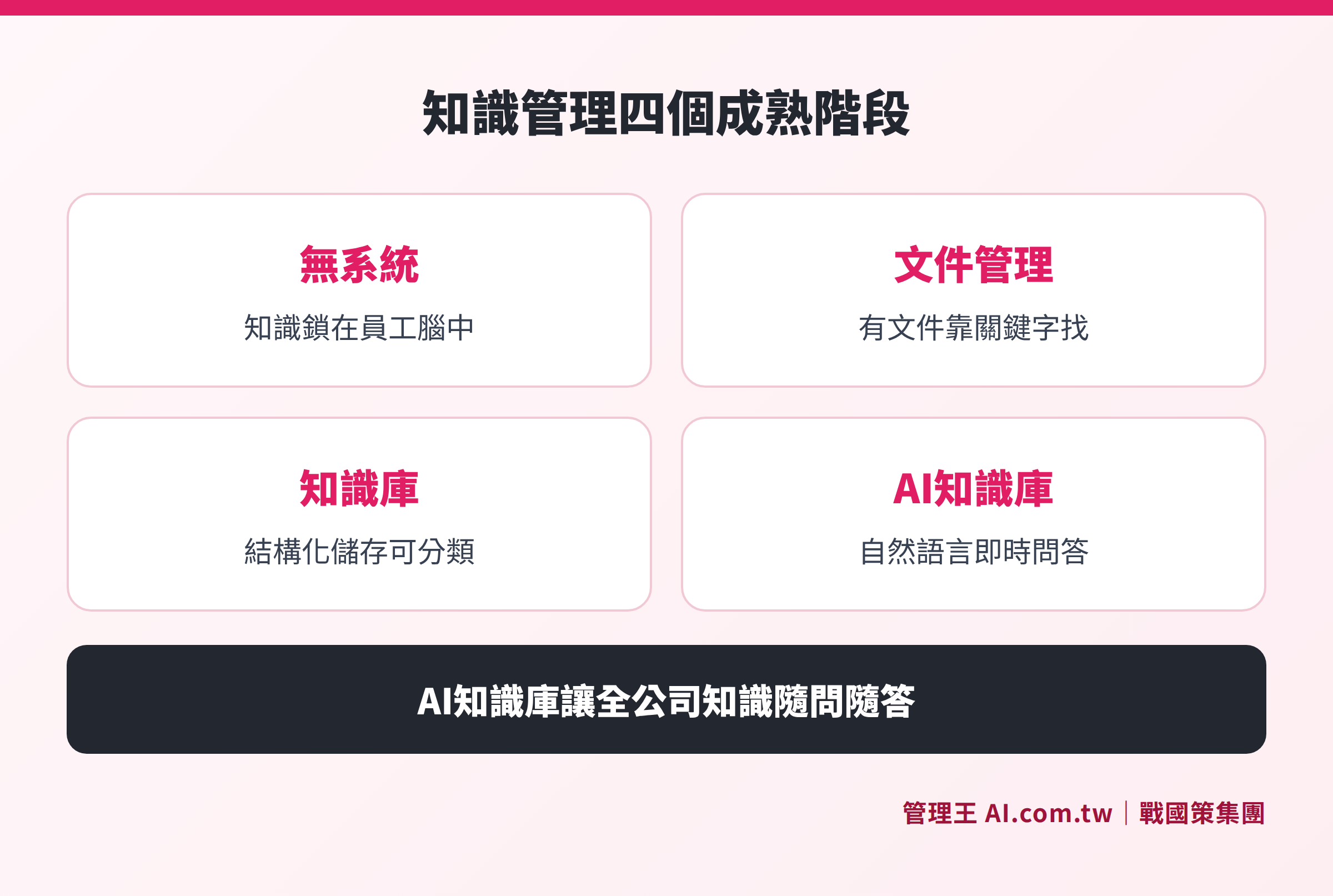
Comparison of four maturity levels from non-systematic to AI intelligent knowledge base
Step 1: Inventory Knowledge Assets
List the company’s existing knowledge assets categorized as:
- Operational processes: SOPs, operation manuals, standard regulations
- Customer relationships: customer files, contract templates, pricing rules
- Product services: product specifications, technical documents, FAQs
- Talent development: training materials, assessment standards
Step 2: Determine Priority Scope for Implementation
It is recommended to start with areas that have the most significant pain points and the highest return on investment, such as customer service FAQs (immediately reducing repeated inquiries), new employee onboarding documents (shortening startup time), or sales scripts (improving conversion rates).
Step 3: Choose a Suitable System
When selecting a Knowledge Management System, evaluate the following key indicators:
Table: Evaluation Indicators for Selecting Knowledge Management Systems
| Evaluation Aspect | Importance | Assessment Focus |
|---|---|---|
| Integration Capability | High | Can the system connect with existing CRM, ERP, HR, etc.? |
| AI Q&A Quality | High | Understanding ability in traditional Chinese, accuracy of answers, source citations |
| Access Control | High | Does it support role-based access? |
| Data Security | High | Location of data storage, compliance with personal data protection laws |
| Ease of Use | Moderate | Usable without requiring training |
| Pricing Model | Moderate | Pay-per-use or fixed monthly fee to avoid runaway bills |
| Localization Support | Moderate | Traditional Chinese interface, adaptations for Taiwanese regulations |
Step 4: Establish Document Upload and Maintenance Process
The quality of the knowledge base depends on the completeness and frequency of document updates. It is recommended to:
- Designate a "Knowledge Management Officer" in each department
- Define document naming conventions and update cycles
- Utilize the system’s expiration reminder function for regular maintenance
Step 5: Promote Usage and Continuous Optimization
In the early stages of implementation, it is essential to consciously promote the habit of "ask AI before asking people" among employees. This can be achieved by analyzing the most frequently asked questions and continuously supplementing the knowledge base content.
Differences Between Knowledge Management Systems and Traditional Document Management
Many enterprises believe that organizing data folders in a cloud drive equates to doing knowledge management, but these two are fundamentally different:
Table: Comparison of Knowledge Management System vs Traditional Document Management
| Comparison Aspect | Traditional Document Management (e.g., Cloud Drive) | AI Knowledge Management System |
|---|---|---|
| Search Method | Need to know the correct file name or folder location | Semantic search using natural language |
| Answer Quality | Self-read and comprehend after locating a document | Directly provides answers and sources |
| Maintenance Cost | Manual organization, easily chaotic | Automatically marks outdated documents, analyzes blind spots |
| Integration Level | Isolated system, requires switching apps | Integrates with CRM, tasks, customer service systems |
| Access Control | Folder-level, crude | Role-based, detailed control |
| Assistance for New Employees | Finding documents themselves and asking others | AI provides direct answers, quick onboarding |
Cost and Benefits of Implementing a Knowledge Management System
Cost Assessment for Implementation
The pricing models for Knowledge Management Systems available in the Taiwanese market include the following types:
- Subscription Model (Monthly Fee): A fixed monthly fee, suitable for small and medium enterprises with predictable budgets
- Pay-per-Use Model: Charges based on the number of AI queries or storage amount, lower costs when usage is low
- One-time Purchase: A traditional software procurement method, high initial cost but more economical in the long run
Consider the company's size, expected number of users, and the complexity of the knowledge base when choosing.
Benefits of Implementation
Based on research underpinning ISO 30401 standards, the main benefits of implementing a Knowledge Management System include:
- Enhanced Decision-Making Speed: Employees find necessary information faster, leading to more informed decision-making
- Stable Knowledge Transfer: Reduces the risk of knowledge gaps due to personnel changes
- Consistent Service Quality: Customer service and sales use the same knowledge base, ensuring unified external messaging
- Smooth Cross-Department Collaboration: Knowledge no longer resides in silos, forming a collective asset for the organization
- Accelerated New Employee Training: A structured knowledge base significantly shortens onboarding time
How to Use 管理王 AI Knowledge Base
管理王 AI.com.tw's AI knowledge base is a corporate knowledge management solution designed specifically for small and medium enterprises in Taiwan, built into the 管理王 integrated system, requiring no additional subscription or API integration.
Practical Operation Process:
- Upload Documents: Supports PDF, Word, Excel, PowerPoint, Markdown, and web links, with the system automatically storing them in a quantifiable manner
- Set Permissions: Define access rights based on department roles, isolating financial documents and customer data accordingly
- Employees Ask AI Directly: In the workflow, click "AI help me find" and ask questions in plain language
- Verify Sources: Each answer includes referenced paragraphs, which employees can click to verify
- Continuous Reinforcement: The system automatically analyzes the most frequently asked questions, allowing managers to regularly supplement blind spots
Compared to standalone AI knowledge base tools on the market, 管理王's AI knowledge base is natively integrated with CRM system, task management, AI customer service, employee training, and HR system. Data flows naturally without needing to use APIs or pay integration fees. The free plan can be used indefinitely, and the AI functionality also includes one-time credits, suitable for enterprises looking to evaluate benefits first.
管理王 is crafted based on the practical experience of 戰國策 Group serving over 30,000 enterprises, storing data in Taiwan's data centers, and meeting personal data protection and data sovereignty requirements. For detailed features, refer to 管理王 AI knowledge base feature page or service plan pricing.
Common Reasons for Failure in Knowledge Management System Implementation and Solutions
Understanding common failure reasons can help increase the success rate of implementation:
1. Lack of Support from Management
Knowledge management is a cultural shift, and if supervisors do not lead by example, employees will not proactively contribute knowledge. Solution: Integrate knowledge contributions into performance assessments, with supervisors leading the usage.
2. Poor Document Quality
No matter how good the system is, if the uploaded documents are outdated or incomplete, the quality of AI answers will also suffer. Solution: Conduct a document cleanup before implementation and establish a regular update mechanism.
3. Employee Resistance to Use
Using the system can seem more "troublesome" than just asking someone. Initial resistance can be high. Solution: Choose a user-friendly system, along with incentive mechanisms to show users the immediate benefits.
4. Technical Island Issues
If the knowledge base cannot integrate with other work systems, employees have to switch between multiple apps. Solution: Prioritize systems that can integrate with existing tools or adopt an all-in-one solution that offers full module integration.
Knowledge Management Application Scenarios Across Different Industries
Knowledge Management Systems are not only suitable for the tech industry; they have specific application value across various sectors:
Manufacturing and Factories: After uploading ISO documents, equipment operation SOPs, and troubleshooting manuals to the knowledge base, frontline employees can directly ask AI when facing issues without waiting for supervisors. 管理王's manufacturing management feature can integrate with the knowledge base to significantly enhance problem-solving speed on production lines.
Service and Retail: Store staff frequently change, and a knowledge management system can organize service standards, product knowledge, and promotional rules into a searchable knowledge base, drastically shortening new employee training cycles while maintaining consistent service quality. Employee training features combined with the knowledge base yield even better results.
Professional Services (Law, Accounting, Consulting): Customer cases, compliance standards, and standard document templates are all high-value knowledge assets. Establishing a knowledge base categorized by case types allows each consultant to quickly retrieve experiences from previous cases, improving service quality and mitigating the risk of losing know-how when senior staff leave.
E-commerce and Marketing Companies: Product copy guidelines, brand image guidelines, advertisement specifications, and pricing rules need to be quickly accessible to the whole team. CloudDrive combined with an AI knowledge base brings together management of marketing materials and knowledge queries in one stop.
Customer Service Centers: Customer service personnel deal with many repetitive questions daily. By organizing frequent queries, return policies, and product specifications into a knowledge base, AI customer service can automatically answer most inquiries, allowing customer service personnel to focus on complex cases, significantly improving overall service efficiency.
Want to establish a corporate AI knowledge base? Free Consultation Available
Tell us your industry and scale, and our consultants will assist in planning the most suitable knowledge management system, with a quick 30-minute assessment, no obligation to purchase.
Free consultation hotline: 0800-003-191
LINE Official Account: @119m
Official Website: app.AI.com.tw
Free Trial: Apply for 管理王 now
Frequently Asked Questions
What size of enterprise is suitable for implementing a Knowledge Management System?
As long as a company has more than 5 employees and a demand for knowledge transfer, it can start establishing a basic knowledge management mechanism. Small companies with fewer than 10 employees can start with a free plan, organizing the most common FAQs and standard operating procedures; as the company grows, the scope and complexity of the knowledge base can be progressively expanded. The key is not the scale but the need to have a "systematic flow of knowledge".
What is the difference between an AI knowledge base and a typical document management system (like Google Drive, SharePoint)?
The core difference lies in whether it can directly answer questions. Google Drive is a file repository where you need to know where to look to find something; the AI knowledge base, on the other hand, acts like an assistant who understands the company's operations. If you ask about the “refund process,” it directly tells you the answer and cites the source, eliminating the need to sift through documents. Furthermore, the AI knowledge base provides semantic search capabilities (finding similar meanings), reminders for outdated documents, and employee inquiry analysis, making it an advanced upgrade over conventional document management.
How can an enterprise maintain its knowledge base to ensure effectiveness?
Effective knowledge base maintenance requires three mechanisms: regular review (quarterly or annually checking whether key documents are outdated), immediate update triggers (updating relevant documents immediately when processes or products change), and filling in blind spots (analyzing questions frequently asked by employees that have no answers and proactively supplementing those). It is recommended to designate a "Knowledge Management Officer" in each department responsible for the quality of that department's knowledge base, alongside utilizing the system's automatic expiration reminder feature to reduce maintenance burdens.
How can employees' knowledge (tacit knowledge) be included in the knowledge base?
Digitizing tacit knowledge is the biggest challenge in knowledge management. Practical methods include: having senior staff record how-to operation videos for upload, organizing successful cases from customer service or sales into standardized documents, conducting "knowledge extraction meetings" after each project to document lessons learned, and encouraging employees to correct and add accurate information during AI queries. 管理王 AI knowledge base supports uploading various formats, such as videos and documents, allowing gradual digitization of tacit knowledge.
How is data security ensured in a Knowledge Management System?
When purchasing a Knowledge Management System, data security should be a key consideration: data storage location (whether it is within Taiwan), compliance with personal data protection laws, access control mechanisms (whether role-based access is supported), backup mechanisms, and whether data will be used for training AI models. According to the Personal Data Protection Act, enterprises are responsible for safeguarding the personal data they handle. Selecting a system that stores data in Taiwan and complies with ISO 27001 can reduce compliance risks.
Data Sources
- ISO 30401:2018 Knowledge Management Systems — Requirements (International Organization for Standardization, International Standard for Knowledge Management Systems)
- Taiwan CNS 30401 Knowledge Management System Standard (Bureau of Standards, Metrology and Inspection, Ministry of Economic Affairs, adopting standard in November 2025)
- Ministry of Economic Affairs Industrial Bureau Knowledge Management Digital Application Assessment Tool (MyMKC Knowledge Management Community, corporate knowledge management capability evaluation framework)
- Personal Data Protection Act (National Regulations Database, basis for data security compliance)