What are the Differences Between KPI and OKR? Which One Should You Choose and Can They Be Used Together|Performance Management System Recommendations

KPI focuses on top-down quantitative assessments linked to rewards and penalties, while OKR emphasizes self-set quarterly challenge goals that are intentionally decoupled from compensation. This article outlines five key differences, their applicable contexts, and how small and medium-sized enterprises can use both tools collaboratively according to functional division.
KPI (Key Performance Indicators) and OKR (Objectives and Key Results) are the two most common performance management tools in enterprises, often causing managers and HR to fall into the dilemma of "which one should we choose?" KPI emphasizes top-down quantitative assessments directly linked to rewards and penalties; in contrast, OKR emphasizes self-set challenging goals, adjusted quarterly, without direct ties to compensation. The two are not opposing but serve as tools suitable for different contexts. This article explains the core differences between KPI and OKR, their applicable scenarios based on official definitions and practical comparisons, and how small and medium-sized enterprises in Taiwan can enable both tools to work together within the same system, ensuring that performance management is truly implemented rather than merely superficial. Whether you are a startup founder encountering performance management tools for the first time or an HR manager evaluating a transition from KPI to OKR, this article will help clarify the logic of your choices.
What is KPI? From "Indicators" to "Assessment Tools"
KPI stands for Key Performance Indicators, a quantifiable system used to evaluate the degree of achievement of objectives. It was first proposed by management theorist Peter Drucker in 1954 in his concept of Management by Objectives (MBO), which later evolved into the KPI framework widely adopted by modern enterprises.
The core logic of KPI is "You cannot manage what you cannot measure," breaking down corporate objectives into quantifiable indicators so that managers can objectively assess the performance of each employee. Common KPIs include sales achievement rates, customer satisfaction (CSAT), production yields, attendance rates, and project completion timelines.
Three Main Characteristics of KPI:
- Top-down distribution: Company goals → Department indicators → Individual KPI, decomposed layer by layer
- Linked to rewards and penalties: Directly impacts year-end bonuses, salary adjustments, and promotions
- Emphasizes result quantification: Each indicator has a clear numerical target
In Summary
KPI is "What numbers do I help the company achieve?" and evaluates results; OKR is "What goals do both the company and I want to achieve?" focusing on direction and process.
What is OKR? From "Objectives" to "Challenge Framework"
OKR stands for Objectives and Key Results. It was improved by Intel CEO Andy Grove in the 1990s based on MBO, then introduced to Google by venture capitalist John Doerr, leading to widespread adoption by tech companies such as Google, LinkedIn, and Spotify.
Each set of OKR contains two components:
- Objective: Describes "Where do we want to go?" usually expressed as an inspiring qualitative description, for example, "Become the most trusted partner for customer after-sales service"
- Key Results: Describes "How do we know we’ve arrived?" consisting of 2 to 4 quantifiable milestones, for example, "Increase customer satisfaction from 72% to 90%"
OKR encourages the setting of "stretch goals," with conventional advice stating that achieving 60% to 70% completion is considered a success, as overly easy objectives cannot drive breakthrough growth.
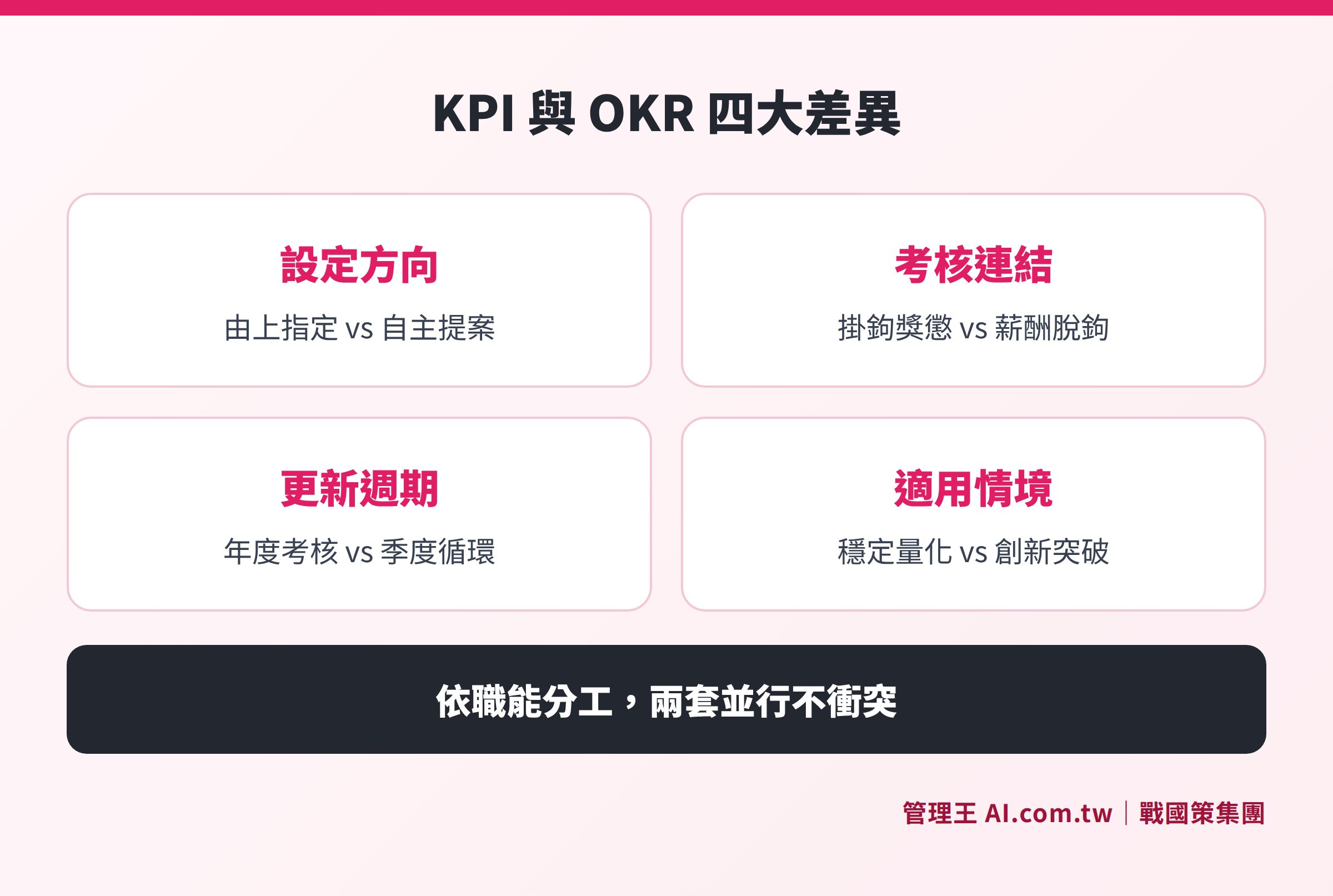
KPI emphasizes results and assessments, while OKR emphasizes objectives and motivation. The two differ in direction, cycles, connections to rewards and challenges.
Five Key Differences Between KPI and OKR
Below are the five most critical aspects comparing the two tools:
Table: Core Differences Between KPI and OKR
| Comparison Aspect | KPI | OKR |
|---|---|---|
| Goal Setting Method | Top-down, indicators assigned by managers | Bottom-up discussion, proposals from employees |
| Cycle | Usually annual, some monthly | Usually quarterly, rolling adjustments each season |
| Relation to Performance Compensation | Directly linked to year-end bonuses, salary adjustments | Intentionally separated from compensation |
| Degree of Challenge | Tends towards achievable conservative goals | Encourages setting challenging objectives with a 70% completion rate |
| Suitable Work Types | Predictive (work with clear processes) | Exploratory (work requiring innovation and experimentation) |
The two tools are not inherently better or worse; the key lies in their appropriate contexts. KPI is suitable for daily operational indicators requiring stable monitoring; OKR is suitable for strategic objectives needing guidance and innovative breakthroughs.
In What Situations Should KPI Be Chosen? Five Typical Scenarios
The following situations are particularly suitable for using KPI as the main performance tool:
- Stable and Clear Workflows: Metrics for production line workers, the number of new customers acquired by sales, average response time in customer service — these indicators have clear calculation formulas, making KPI capable of objective assessment.
- Need for Clear Assessment Basis: In organizations where culture leans towards performance reward and punishment, KPI can provide an objective basis recognized by both employees and management, reducing subjective disputes during year-end evaluations.
- Multiple Locations or Large Teams: Chain stores need to compare the performance of each location, and KPI can provide consistent measurement standards across locations.
- Compliance Indicators for External Regulations: For example, financial report timeliness adherence rates, and compliance rates with labor laws, indicators with clear regulatory requirements are inherently suitable for KPI management.
- Core Business Indicators of Startups: Even startups using OKR still require KPI tracking for core business indicators such as financial health and customer retention.
In What Situations Should OKR Be Chosen? Four Typical Scenarios
The following situations are particularly suitable for introducing OKR:
- Departments Needing Innovative Breakthroughs: R&D, product, and marketing departments face high uncertainty in their work, and the challenge goal framework of OKR can stimulate proactive thinking rather than just stopping after meeting the minimum KPI standards.
- Organizations Undergoing Rapid Transformation: When company strategies change frequently, annual KPI often fails to keep pace with market changes, and OKR's quarterly cycle allows for more flexible goal setting.
- Teams Primarily Comprising Knowledge Workers: Work that cannot be purely quantified (like design, strategy, research) requires OKR's qualitative goals paired with quantifiable key results to fully assess contributions.
- Desire to Enhance Employee Proactivity: OKR allows employees to participate in goal setting, enhancing their sense of ownership. Studies show that employees involved in goal setting are significantly more engaged than those who are instructed without input (Source: "Measure What Matters", John Doerr, 2018).
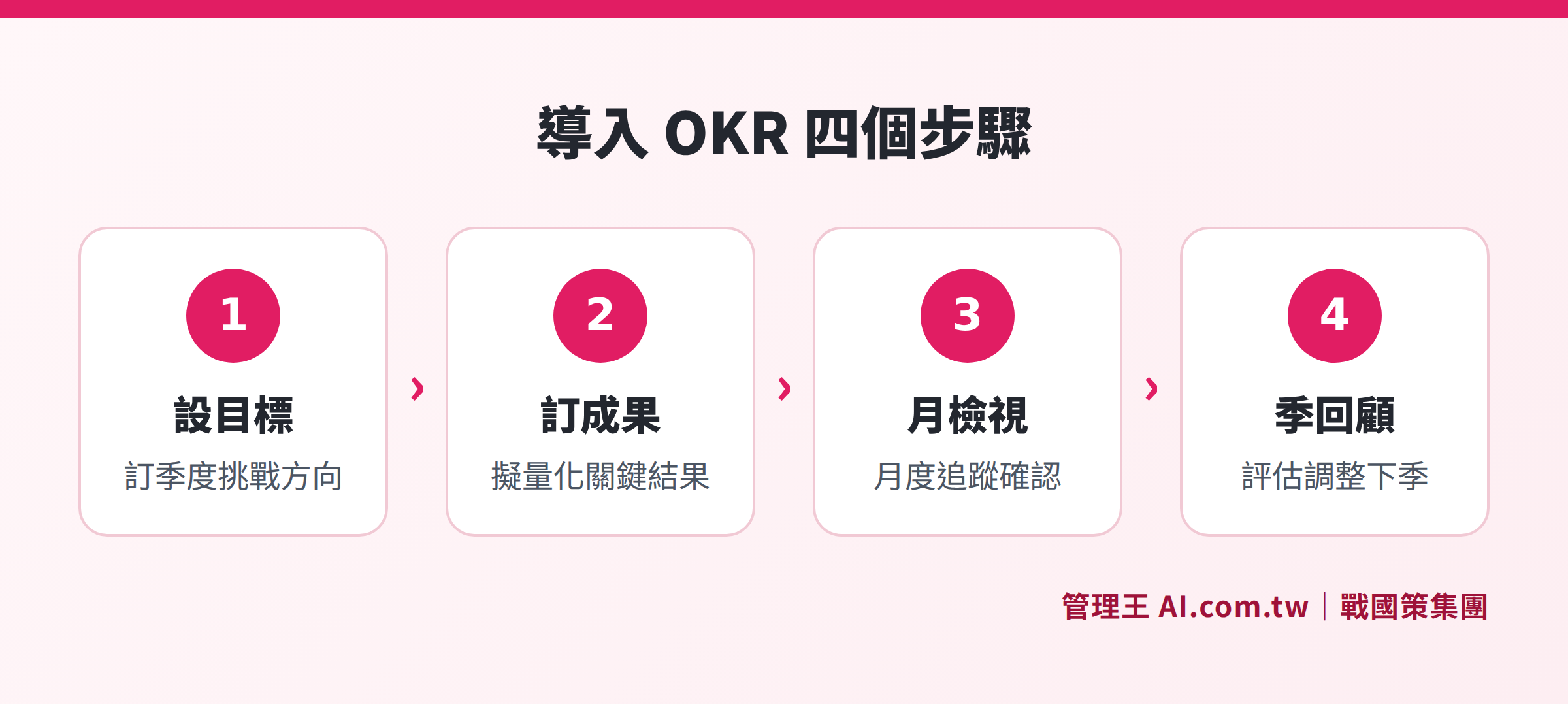
From setting challenging goals, breaking down key results, quarterly check-ins, to outcome reviews, gradually build an OKR culture.
Can KPI and OKR Be Used Together? The Key is "Do Not Mix Up"
This is the most common confusion in practice. Theoretically, the same organization can operate KPI and OKR simultaneously, but the key premise is that each system must play its own role, without mixing them up.
An article in Manager Today pointed out that the most common failure in using OKR and KPI together is treating OKR as "fancy KPI" and directly linking the completion rates of OKR to rewards and penalties. This undermines the core spirit of OKR, which encourages challenging goals — employees would set OKRs that are easily achieved (like "60 points to pass") to secure bonuses, turning OKR into another set of conservative KPIs.
A feasible approach to using them together: based on functional divisions
Table: Recommended Tools for Each Functional Department
| Function / Department | Recommended Main Tool | Description |
|---|---|---|
| Sales | Mainly KPI | Performance figures, number of customers developed, and closing rates have clear calculation methods |
| Manufacturing | Mainly KPI | Yield rate, machine utilization rate, delivery accuracy are suitable for quantitative assessment |
| HR / Administration | Mainly KPI | Attendance compliance, payroll timeliness, etc., have clear regulatory standards |
| R&D / Product | Mainly OKR | Innovative work is hard to quantify purely and needs challenging objectives |
| Marketing / Branding | Mainly OKR | Strategic goals (brand awareness, content quality) are more suitable for OKR |
| Senior Management | Mainly OKR | Strategic direction leading, tracking core business indicators through KPI |
Another approach is "OKR sets the direction, KPI measures the baseline": Use OKR to set quarterly challenge objectives for departments while retaining a few core KPI "health indicators" (such as client turnover rate not exceeding 5%, maintaining positive cash flow) to ensure that breakthrough efforts do not neglect the fundamentals.
How to Do It with 管理王: Collaborating KPI and OKR in the Same System
管理王 AI.com.tw's performance management module simultaneously supports KPI goal setting and OKR mode, allowing both tools to operate departmentally within the same account without the need for additional third-party integration.
Main Features:
- KPI Goal Setting: Each employee has five to eight key indicators set quarterly by managers, with clear goals and weights presented, so employees know the standards by which they are measured from the start.
- OKR Mode: Supports qualitative goals alongside quantitative key results, without limiting key results to purely quantifiable KPIs.
- Monthly Reviews and 360° Mutual Evaluations: Managers write comments at the end of the month with real-time feedback from employees, and quarterly mutual evaluations incorporate supervisors, peers, subordinates, and self-evaluations.
- Hierarchical Goal Auto-linking: Company goals break down into departmental and personal objectives, making it clear how daily work aligns with company strategy.
- AI Performance Analysis: Input questions (like "Why did this employee's performance decline in Q2"), and AI automatically deduces reasons based on KPI achievement rates and mutual evaluation data.
- Calibration Meetings: Assist departments in aligning scoring standards, ensuring that performance scores are truly comparable across teams.
Task Management module integrates natively with performance management, allowing daily task progress of employees to directly reflect in KPI achievement rates without manual report consolidation. Coupling with the Sales Target module, sales department KPIs and OKRs can be tracked on one screen.
The free plan can be used permanently, and small and medium enterprises with fewer than 10 people can initially use the free plan to establish a KPI framework before upgrading after confirming suitability. See pricing plan for details.
Additionally, the Approval Center supports electronic performance interview record verification, and the payroll calculation system can directly connect KPI achievement rates for performance bonus calculations, eliminating the need for HR to copy and paste data between multiple systems.
For more articles on the same topic, see: Performance management is not just about scoring: the cycle from KPI, OKR to interviews to understand the complete performance management cycle structure.
You can also complement this with the Report Analysis module, allowing managers to see real-time KPI achievement statuses of various departments on the Business Decision Dashboard.
Enable KPI and OKR to Collaborate in the Same System
管理王 consultants assist you in designing a performance management framework suitable for small and medium enterprises in Taiwan, offering free consultations and a 30-second trial of all functions.
Free consultation hotline: 0800-003-191
Official LINE account: @119m
Official website: app.AI.com.tw
Free trial: Apply for management 王 now
Frequently Asked Questions
Which is more suitable for small and medium enterprises in Taiwan, KPI or OKR?
It is generally recommended for small and medium enterprises in Taiwan to start with KPI because it is directly linked to compensation and rewards, providing immediate behavioral guidance to employees, with clear calculation methods and fewer disputes. Once organizational culture matures and employees have a foundational understanding of goal management, OKR can be gradually introduced for innovative functions like R&D and marketing, allowing both to run in parallel. If OKR is implemented in full from the start, it often falls flat due to employees' unfamiliarity with the framework, and managers not knowing how to set stretch goals.
Must OKR be decoupled from compensation?
The original design of OKR intentionally avoids direct ties to compensation in order to allow employees to set challenging goals without fear of failure. If the completion rates of OKRs are directly converted into bonuses, employees tend to set conservative objectives to ensure they are achieved, and OKR simply becomes "KPI with a different format." The recommended approach is to use OKR to track direction and growth while defining the performance evaluation basis with KPI, allowing each system to play its own role.
What should be the length of the OKR cycle?
The most common cycle in the industry is quarterly (every three months), consistent with companies that adopt OKR like Google and LinkedIn. A quarterly cycle is short enough to respond to market changes and adjust goals in a timely manner yet long enough for key results to have sufficient execution time. Annual OKRs can be used to set the overall direction for the company, while quarterly OKRs are suitable for specific execution planning. It is advised to do a monthly check-in to confirm progress isn't deviating.
How to set "good OKRs"?
Good Objectives should possess three qualities: Inspiration (inviting excitement), Clarity (no ambiguity), and measurable progress within the quarter. Good Key Results should be quantifiable (having specific numbers), verifiable (clear on whether they are achieved), and challenging (designed to achieve a completion rate of 60% to 70%). A common mistake is treating a task list (e.g., "complete development of Feature A") as Key Results, while the correct KR should express the outcome (e.g., "User activation rate for new features reaches 40%").
What performance management system should be chosen?
When selecting a performance management system, it is advisable to confirm four key points: (1) whether it supports both KPI and OKR modes without needing to purchase additional third-party tools; (2) whether it integrates with the payroll calculation system, allowing KPI achievement rates to directly influence performance bonus calculations; (3) whether it supports 360° multifunctional mutual evaluation, providing a more objective basis than single manager assessments; (4) whether it has historical performance tracking to support a comprehensive data foundation for annual promotion reviews.
Sources
- What is KPI? How does it differ from OKR? Examples and Illustrations: Advantages and Disadvantages of Two Major Performance Management Systems|Manager Today (Accessed 2024)
- Why Can't OKR and KPI Be Used Together?|Manager Today (Accessed 2024)
- What is OKR? How does it differ from KPI? Understand the OKR goal management method used by Google and LinkedIn at once|Manager Today (Accessed 2024)
- Management King AI.com.tw Performance Management Feature Page (Accessed November 2026)