What is a Landing Page? Structure and Practices for High Conversion Landing Pages | Recommended One-Page Websites
A Landing Page is an independent page designed specifically for advertising traffic, removing the navigation bar and retaining only one CTA. This article covers the 7 key structural elements, three types of lead collection / click-through / direct sales, industry conversion rate benchmarks, and six common mistakes made by small and medium-sized enterprises in Taiwan, explaining how to quickly create a high-conversion one-page sales page using 管理王's drag-and-drop tool.
A Landing Page is an independent webpage designed for a single marketing goal, where visitors "land" after clicking through from advertisements, social media posts, or newsletters. Differing fundamentally from a website homepage, a Landing Page removes navigation bars, sidebars, and all distracting links, focusing solely on one goal: to get visitors to fill out forms, try out products, or make purchases. Many small and medium-sized enterprises in Taiwan invest their advertising budget into Google or Facebook, but let clicks go to a generic homepage, equivalent to pouring paid traffic into a leaky bucket—since the homepage has too many menus and links, visitors easily wander off. A Landing Page is precisely the tool that plugs this hole, ensuring that every dollar spent on advertising targets a clear conversion outcome, rather than letting visitors search for a "Contact Us" button. High-conversion Landing Pages are not driven by visuals but by the synergy of structure, copy, and tracking data.
What is a Landing Page? How Does it Differ from a Website Homepage?
Landing Page is commonly translated as "landing page", "destination page", or "one-page sales page"; all three terms refer to the same thing. Broadly defined: any page that visitors reach through ads or links counts. In marketing practice, it specifically refers to an independent page with a "single objective, single call to action (CTA)", fundamentally differing from a multi-page browsing structure of a website.
Table: Comparison of Landing Page, Website Homepage, and Blog Article
| Item | Landing Page | Website Homepage | Blog Article |
|---|---|---|---|
| Core Purpose | Single conversion (form filling / trial / purchase) | Brand awareness / multi-page navigation | Content education / SEO ranking |
| Navigation Bar | None or minimal | Complete menu | Complete menu |
| Number of CTAs | 1, focused | Multiple, scattered attention | 1 to 3 |
| Best Traffic Sources | Paid ads, newsletters | Direct traffic, brand searches | Organic search |
| Primary Evaluation Metrics | Conversion rate (CVR) | Bounce rate, dwell time | Organic traffic, reading completion rate |
The core logic is Message Match: if the ad copy says, "Get your free ERP assessment report", the first line of the Landing Page headline should echo the same text. Visitors must be able to quickly confirm, "I found the right page", so they won’t immediately close it. The larger the discrepancy between the ad copy and the Landing Page headline, the quicker visitors will bounce away, resulting in greater waste of ad spend.
Understand in One Sentence
A Landing Page is an independent page designed for a single advertising goal, removing all distracting links, allowing visitors to do just one thing: fill a form, try something, or make a purchase.
7 Key Structural Elements of a High-Conversion Landing Page
A successful Landing Page is not reliant on visual appeal but on persuasive structure. Here are the seven essential elements recognized by marketers:
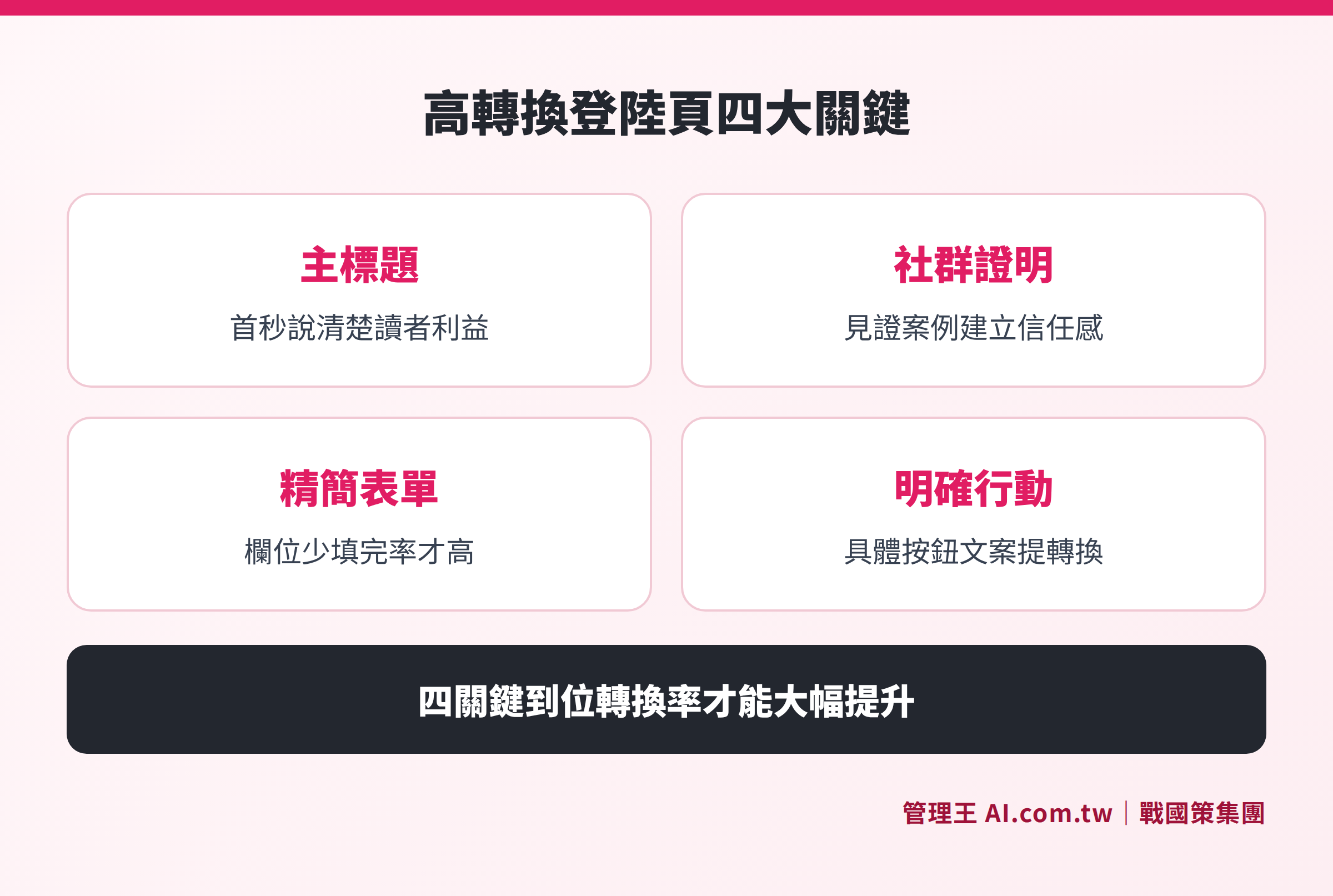
Illustration of the four essential elements: main headline, social proof, streamlined form, clear call to action
1. Main Headline
Answering "What is this? What’s in it for me?" with a maximum of 15 words, using language that speaks to the reader's pain points rather than marketing jargon. For example, "Create a sales page that converts in 30 minutes" is far more compelling than "Providing the best web solutions".
2. Subheadline and Hero Visual
The subheadline supplements the main headline with details, while the hero visual uses actual product images or usage scenarios, which establish trust more than abstract diagrams.
3. Unique Selling Proposition (USP)
List 3 to 5 core benefits, each focusing on "the impact on the customer", rather than the product features themselves. For instance, "Direct access to the business list" is more persuasive than "Built-in form system".
4. Social Proof
Testimonials, the number of businesses using the service, media coverage, or ratings. When visitors see authentic social proof in places they hesitate the most (near the CTA button), the decision rate significantly increases.
5. Call to Action (CTA)
Button copy should be specific; "Try for free for 30 days" converts better than "Submit now". The button color should contrast with the page background to naturally draw attention; place it at the top, middle, and bottom of the page.
6. Streamlined Form Design
The fewer form fields, the better. Research shows that forms with three fields convert around 10.1%, while forms with nine fields convert about 3.6%—each extra field drives away potential clients. Only ask for the information you truly need.
7. Frequently Asked Questions (FAQ)
Addressing last-mile doubts, especially about "Will there be a charge?", "Is my data safe?", "Can I cancel?". FAQs are also beneficial for SEO, as search engines can crawl the Q&A format’s structured data.
Three Types of Landing Pages
Depending on their purpose, Landing Pages fall into three categories; choosing the wrong type is equivalent to choosing the wrong tool:
Table: Comparison of Three Types of Landing Pages
| Type | Main Goal | Presence of Form | Best Use Cases |
|---|---|---|---|
| Lead Generation Page | Collect name / email / phone | Has a form | Newsletter subscriptions, trial applications, event registrations |
| Click-Through Page | Guide to the next step | None, only a CTA button | Product introductions before e-commerce promotions, warm-ups before trials |
| Direct Sales Page | Complete purchase directly | Has a checkout process | Digital courses, low-ticket items, special offers |
Small and medium-sized enterprises in Taiwan frequently use Lead Generation Pages (to fill out forms for consultant appointments or downloading reports) and Direct Sales Pages (for course registrations and trial plans). Before making a choice, confirm your conversion goal and then decide on the page type.
Copywriting Techniques for Landing Pages
The copy on a Landing Page is one of the most critical variables for conversion rate. Good Landing Page copy has three common characteristics: uses the reader’s language, focuses on benefits, and alleviates doubts.
Three-Part Headline Structure
High-conversion Landing Page headlines typically follow a three-part structure: main headline + subheadline + supporting paragraph:
- Main Headline: Clearly states the result that the reader wants most or their biggest pain point. For example, "Create a sales page that converts in 30 minutes without a designer".
- Subheadline: Supplements the main headline with details not clearly conveyed, enhancing credibility, e.g., "Suitable for marketing teams without engineers, with 50 industry templates ready to use".
- Supporting Paragraph: Further explains who you are and why your solution is trustworthy, in no more than three sentences.
"Before / After" Framework
One of the most effective ways to address pain points is through comparison: describe the current predicament of the visitor (before), and then describe the changes after using your product or service (after). For example, "Before: Every event requires manually sorting lists in Excel and inputting into the system, with three people working until dark without finishing. After: Visitors fill out forms, and data automatically enters the business list, allowing same-day follow-ups." This framework allows readers to visualize the change, significantly increasing their willingness to act.
How to Write Social Proof
"Many customers like it" is ineffective social proof. Effective writing includes: names (or at least titles and types of companies), clearly stating specific problems, and explaining explicit improvements. For example, "The marketing team of a certain chain restaurant headquarters in Taichung reduced their event scheduling time from half a day to one hour after implementation" is far more persuasive than "Customers report increased efficiency".
Common Errors in CTA Copy
Avoid using cold verbs like "Submit" or "Confirm". Good CTA copy should state the benefits clearly: "Schedule a free consultation now", "Start your 30-day free trial", "Download the complete assessment report for free". If space allows, adding a line like "No credit card required" or "Can be canceled anytime" beneath the button can effectively reduce visitor doubts and increase click-through rates.
Landing Page Conversion Rates: Industry Benchmarks and Improvement Methods
Conversion Rate Benchmarks
According to statistics from multiple marketing tool platforms, the average conversion rate for Landing Pages varies significantly by industry. Generally, achieving a conversion rate above 10% is considered high performance; the overall industry median is around 6% to 7%. Entertainment and education pages usually outperform B2B software or e-commerce product pages.
In the Taiwan market, mobile traffic accounts for over 70% of the total. If page load times exceed 3 seconds, more than half of visitors will leave before seeing content; for every second of loading delay, conversion rates may decline significantly. Therefore, mobile optimization—like image compression, avoiding autoplay videos, and ensuring buttons are adequately sized—is a fundamental requirement for Landing Pages in Taiwan.
Core Methods to Improve Conversion Rates
- A/B Testing: Create two versions of the same page (changing the main headline, button color, or CTA text), directing half the traffic to each. After enough data is gathered, choose the better-performing version to make data-driven instead of intuition-based decisions. Test only one variable at a time for the results to be meaningful.
- Message Consistency: If the ad says, "Get your free assessment report", the first line of the Landing Page should echo the same wording, preventing visitors from having to re-interpret your message. The greater the discrepancy between the ad and the page’s messaging, the higher the bounce rate.
- Concrete Social Proof: "The 戰國策 Group serves over 30,000 businesses" is more persuasive than "Many businesses use it"; named testimonials are stronger than anonymous ones. The more specific the numbers, the more credible it becomes.
- LINE Integration: With over 95% of the population in Taiwan using LINE, many ads redirect visitors to "Add LINE Official Account" instead of filling out forms. Ensure the LINE Tag tracking code is set up correctly. Adding LINE often has a lower barrier than form filling, serving as an alternative conversion goal.
- Reduce Load Time: Since the majority of traffic in Taiwan is mobile, if a page hasn’t loaded within 3 seconds, more than half of visitors will leave. Image compression and reduction of third-party scripts are the most immediate optimization methods.
SEO and Advertising Tracking Integration for Landing Pages
Landing Pages are typically used for paid advertising traffic, but setting up proper SEO meta tags, custom domains, and SSL can also help capture organic search traffic—especially for brand-related terms or long-tail keywords.
Tracking Setup that Must Be Completed Before Launch:
- Google Analytics 4: Set up conversion events (form submissions, button clicks) to track the actual conversion numbers from each traffic source.
- Facebook / Meta Pixel: Create standard events like "Lead" or "Purchase" to let Meta's ad algorithm find an audience more likely to convert.
- LINE Tag: Essential for the Taiwan market, tracking behavioral paths leading from ads to LINE.
- UTM Parameters: Add UTM tags to ad links to clearly differentiate which ad combinations bring in conversions in GA4.
Once the tracking is set up, the conversion data from Landing Pages can be fed back to advertising platforms, allowing Google and Facebook's algorithms to continuously optimize delivery, creating a positive cycle of "data → optimization → lower customer acquisition costs". Reviewing the conversion rate data from each source at least once a month to identify the weakest links (is the ad click rate not high enough? Or is the page bounce rate too high?) is more efficient than a complete overhaul.
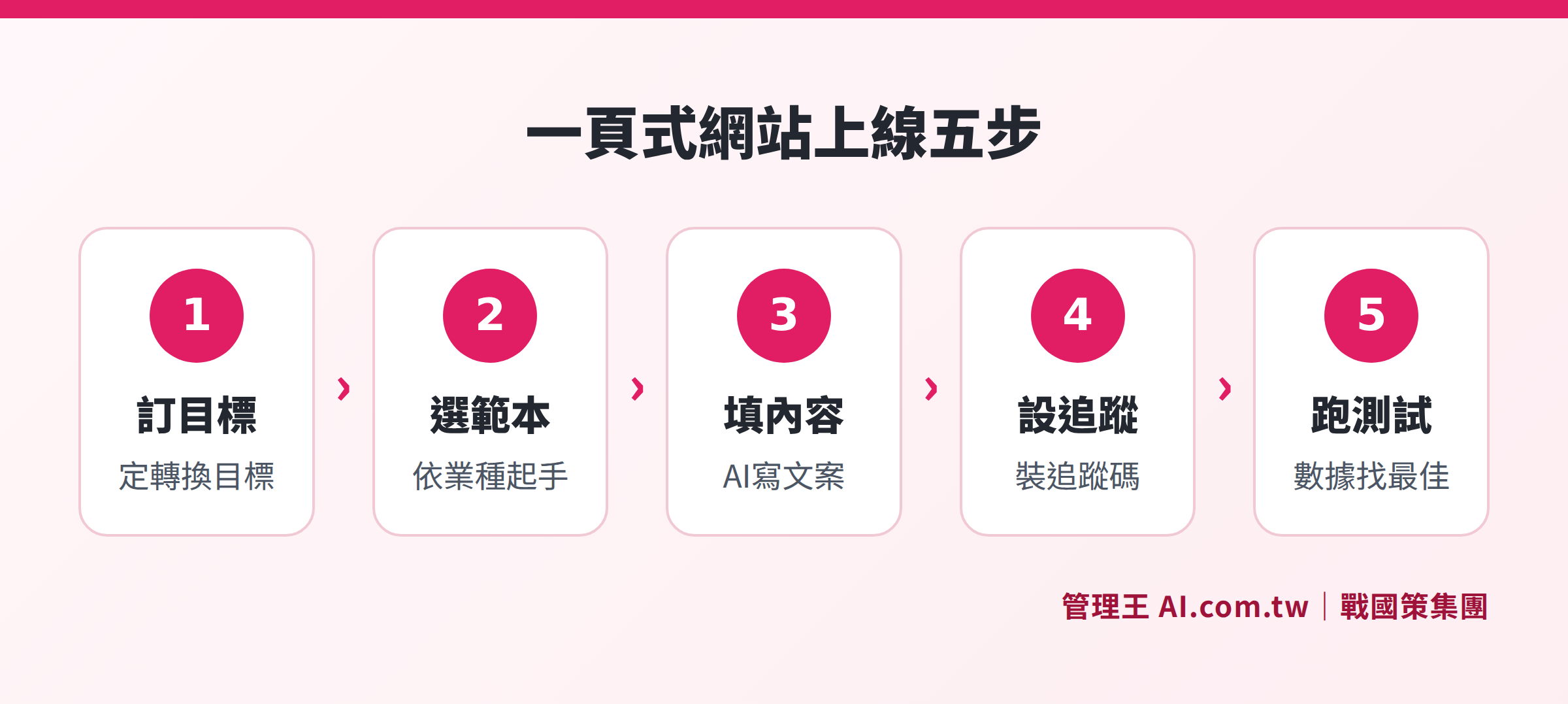
Flowchart illustrating the five key steps from defining objectives to launching A/B testing
Common Landing Page Mistakes Made by Small and Medium-Sized Enterprises in Taiwan
Based on actual observations, small and medium-sized enterprises most commonly make the following six mistakes on Landing Pages, each directly harming the conversion rate:
- Using the website homepage as a Landing Page: The website homepage has more than 10 links, greatly increasing the chances of visitors being distracted and leaving, thus wasting advertising budget. Solution: Pair each ad combination with a dedicated Landing Page for consistent messaging.
- Main headline focuses on features rather than benefits: "Supports 50 integrations" is less compelling than "No need for engineers; connect to LINE Official Account in 30 minutes", which makes visitors immediately see what they can gain.
- Neglecting mobile optimization: With over 70% of traffic coming from mobile, if the desktop version is fine but the mobile layout is broken, that means wasted advertising budget. Always browse the page on mobile before launching.
- Requesting too much information in forms: A "fill it out later" mindset significantly lowers form submission rates. Only ask for name and phone number in the first phase; collect other information during follow-up by sales.
- Having no social proof: First-time visitors know nothing about you; seeing zero testimonials or case studies offers no incentive to fill out data. At least three named testimonials combined with figures are better.
- Not following up after launch: A Landing Page is a tool that requires continuous A/B testing and iteration, not a "publish and be done" situation. After setting up tracking, return every week to check data and test new versions.
Create Landing Pages with 管理王 AI.com.tw
The Landing Page creation tool from 管理王 AI.com.tw is specifically designed for small and medium-sized enterprises in Taiwan, providing a drag-and-drop platform for one-page sales pages to meet the needs of marketing teams without designers or engineers.
Main features and operation methods:
- Start with templates: The system provides over 50 industry templates (e-commerce, courses, fitness, dining, real estate, consulting, etc.). After selecting a template, drag and modify blocks directly; add main visuals, lists of selling points, customer testimonials, FAQs, and CTA forms as needed. Marketers without a design background can go live in 30 minutes.
- Automatic adaptation for mobile devices: All pages are responsive and automatically adapt to mobile and tablet, eliminating the need to create two separate versions, ensuring that visitors on mobile experience a complete view and easily clickable buttons.
- Forms linked directly to CRM: When visitors fill out the form, data automatically enters the CRM system as a lead for follow-up, creating a seamless process from ad click to sales engagement without manual export and assignment, so hot leads don’t get lost in transfer.
- AI copywriting and A/B testing: Input the product name, and AI automatically generates copy and selling points with professional, friendly, and lively styles. Built-in A/B testing traffic splits allow marketers to use data to find the most converting version.
- One-click tracking setup: One-click installation of Google Analytics 4 and Facebook Pixel supports custom domain binding, automatic SSL encryption, and editing of SEO meta tags and social sharing OG images, catering to both paid and organic traffic.
- Real-time feedback on advertising: Conversion rates from Landing Pages are fed back in real-time to advertising management, allowing Google and Facebook's algorithms to continuously optimize delivery efficiency.
管理王 uses a subscription model, with a free plan available for permanent use, and an economical plan starting at NT$5,000/month, including all 100+ functions like Landing Page, CRM, and social scheduling, without needing separate integration fees. Compared to foreign tools like HubSpot Marketing Hub, which charges thousands of NT dollars monthly and lacks LINE integration, 管理王 is more cost-effective for Taiwan's small and medium-sized enterprises. For complete pricing, see service plans.
Combining other functions of the marketing system yields even greater benefits: social scheduling management allows you to attract traffic to your Landing Page simultaneously across multiple platforms like FB, IG, LINE, and Threads, expanding reach; marketing automation automatically kicks off follow-up sequences after visitors fill out forms, preventing hot leads from going cold; and AI-SEO tools help optimize the page structure of Landing Pages to capture organic search rankings, allowing advertising budgets to sustainably attract organic traffic.
Try the Landing Page Creation Tool for Free
管理王 consultants assist you in launching your first high-conversion Landing Page in 30 minutes, with forms linked directly to CRM and one-click tracking installation, free forever.
Free consultation hotline: 0800-003-191
LINE Official Account: @119m
Official website: app.AI.com.tw
Free trial: Apply for 管理王 now
Frequently Asked Questions
What’s the difference between a Landing Page and a website homepage?
The website homepage serves as the main entrance for the brand, containing navigation bars and multiple page links, aimed at providing visitors with a comprehensive understanding of the company. A Landing Page is a dedicated destination for ads, removing all distracting links and retaining only one CTA, specifically designed to enhance conversion rates. The purposes of the two are different and cannot replace each other—the ad traffic must lead to a dedicated Landing Page.
Can I create a Landing Page without a designer or engineer?
Yes. Modern Landing Page tools (like 管理王) provide drag-and-drop template editors; after selecting an industry template, you just need to input content to go live. The AI copy assistant can also automatically generate main headlines and selling points, allowing general marketers or store managers to publish their first page within half an hour without needing engineer assistance.
Is it necessary to have a separate domain for a Landing Page?
Not necessarily. You can use a sub-path (yoursite.com/offer) or sub-domain (offer.yoursite.com); the key is that the SSL certificate is valid and the URL is clear and memorable. For short-term event pages, using the platform's default domain is sufficient. However, for long-term use, it’s recommended to bind a custom domain to strengthen brand trust and reduce visitor doubts.
How can I tell if my Landing Page conversion rate is good?
The industry's overall median is around 6% to 7%; a conversion rate over 10% is considered high performance. There are significant differences across industries; B2B lead generation pages typically outperform e-commerce product pages. Most importantly, continually conduct A/B testing, comparing your own pre- and post-data, rather than merely comparing against industry averages—the previous version is your best benchmark.
How do I drive traffic to my Landing Page once it's created?
A Landing Page itself will not automatically generate traffic; you must couple it with traffic sources: Google Search Ads (for precise keywords), Facebook/Instagram Ads (for interest audiences), LINE pushes (for retargeting existing members), newsletters (promoting to subscribed users), and social media posts (for organic reach). It’s advisable to initially use paid ads to quickly validate the page’s conversion rate and, once performance stabilizes, implement organic traffic strategies. Since visitor intent varies by traffic source, it’s suggested to create corresponding versions of the Landing Page for each major source, making the messaging more relevant to achieve higher conversion rates.
Data Sources
- Landing Page Marketing System Function Introduction, 管理王 AI.com.tw (Retrieved October 2026)
- Landing Page Conversion Rate Benchmarks 2026, involve.me (Retrieved 2026)
- The Anatomy of a Landing Page, Unbounce (Retrieved 2026)
- Taiwan E-commerce Conversion Rate Optimization & Benchmarks 2026, Branch8 (Retrieved 2026)