How to Create a Membership Points System? A Complete Guide for Merchants to Implement Electronic Points|Points System Recommendations

The membership points system allows physical stores in the dining, retail, beauty, and other industries to cultivate each consumer into a repeat customer through electronic points, a tier system (bronze, silver, gold, diamond), and precise RFM segmentation. This article provides a complete explanation of the advantages of electronic points, core functions, RFM application methods, a six-step implementation process, and compliance points regarding personal data protection laws, recommending suitable points system solutions for small and medium enterprises in Taiwan.
The membership points system is a tool that allows physical stores to cultivate each consumer from a "stranger" into a "regular customer" through a digital points mechanism. The approach is that customers earn points when their spending reaches a certain amount, which can be redeemed for discounts or products after accumulating points, paired with a tiered system (bronze, silver, gold, diamond) that increases rewards, forming a positive cycle of "spending→earning points→redeeming→spending again." Compared to one-time discount events, the points system continuously creates motivation for customer return, making it a common retention strategy among restaurant, retail, beauty, and tutoring shop owners in Taiwan. This article explains the definition of the points system, function comparisons, RFM analysis application, implementation process, and provides the most complete operational guide for physical stores on how to go online in one day using 管理王 AI.com.tw.
What is a Membership Points System? Comparison of Electronic Points vs Paper Points
Although traditional paper points cards are low-cost, they have fundamental issues such as loss of cards, counterfeit stamps, and inability to track behavior. More importantly, paper points cannot inform you "how often this customer visits" or "which customers are about to churn," leading marketing to always rely on intuition. The electronic points system brings the points process to mobile phones, so consumers do not need to carry a card, and stores do not need to print cards, allowing all consumer behavior to be recorded in real-time in the cloud, becoming the data basis for future marketing segmentation.
Table: Comparison Between Paper Points and Electronic Points Systems
| Comparison Item | Paper Points Card | Electronic Points System |
|---|---|---|
| Risk of Loss | Invalid if customer loses it | Cloud storage, no worry about loss |
| Counterfeit Prevention | Easily copied or stamped | System verification, cannot be forged |
| Data Collection | Only knows "points are collected" | Records all spending amounts, frequency, and items |
| Marketing Reach | Only relies on the card itself | Can actively push birthday gifts or exclusive offers |
| Multi-store Management | Each store operates independently | Unified management by headquarters, usable across stores |
| Implementation Cost | Printing costs but no monthly fee | Free plans can be used permanently |
The electronic points system has another advantage that paper cannot achieve: after integrating the official LINE account, customers can directly check points and receive notifications on LINE without needing to download another app, greatly reducing the operational threshold for consumers.
In a Nutshell
The core value of the electronic points system is that "each purchase leaves data," allowing stores to upgrade from recognizing regular customers by memory to using data to manage every member precisely.
Five Core Functions of the Electronic Points System
Before implementation, make sure the system has the following five functions; lacking any of these may require additional integration or development later.
1. Electronic Membership Card and Points Accumulation
Consumers join the membership by scanning a QR code or reporting their phone number, and points are automatically awarded for spending a specific amount. The system should support customizable point award rules (e.g., 1 point for every 100 dollars spent, double points for certain products, additional rewards for referring friends), as well as point expiration settings, allowing the points mechanism to flexibly respond to different marketing goals.
2. Membership Tier System
Multi-tier designs such as bronze, silver, gold, and diamond allow customers with different spending power to enjoy differentiated benefits (e.g., gold cardholders enjoy priority reservations, diamond cardholders receive double points on their birthday), driving moderate spenders to actively level up. Birthday gifts and anniversary rewards are automatically issued, allowing systematic rewards to continuously maintain emotional connections with customers.
3. Points Redemption and Coupon Integration
Accumulated points can be redeemed for products, discounts, or coupons. The design of redemption thresholds is critical: if the threshold is too high, customers feel it's out of reach, while if too low, it compresses profits. Generally, it is recommended that customers should visit 3 to 5 times to redeem a tangible reward.
4. RFM Precise Segmentation
Built-in RFM analysis (Recency, Frequency, Monetary) automatically segments members into groups such as VIPs, potential customers, at-risk customers, and inactive customers, allowing marketing resources to be targeted effectively. Detailed explanations are in the next section.
5. Push Notifications and Marketing Automation
Specific groups can receive tailored events, for instance, automatically sending return offers to "regular customers who haven't bought in 3 months" or birthday gifts to "VIPs during their birthday month." Combined with marketing automation systems, after setting trigger conditions, it can operate without manual input, allowing a single marketer to manage personalized communication with thousands of members.
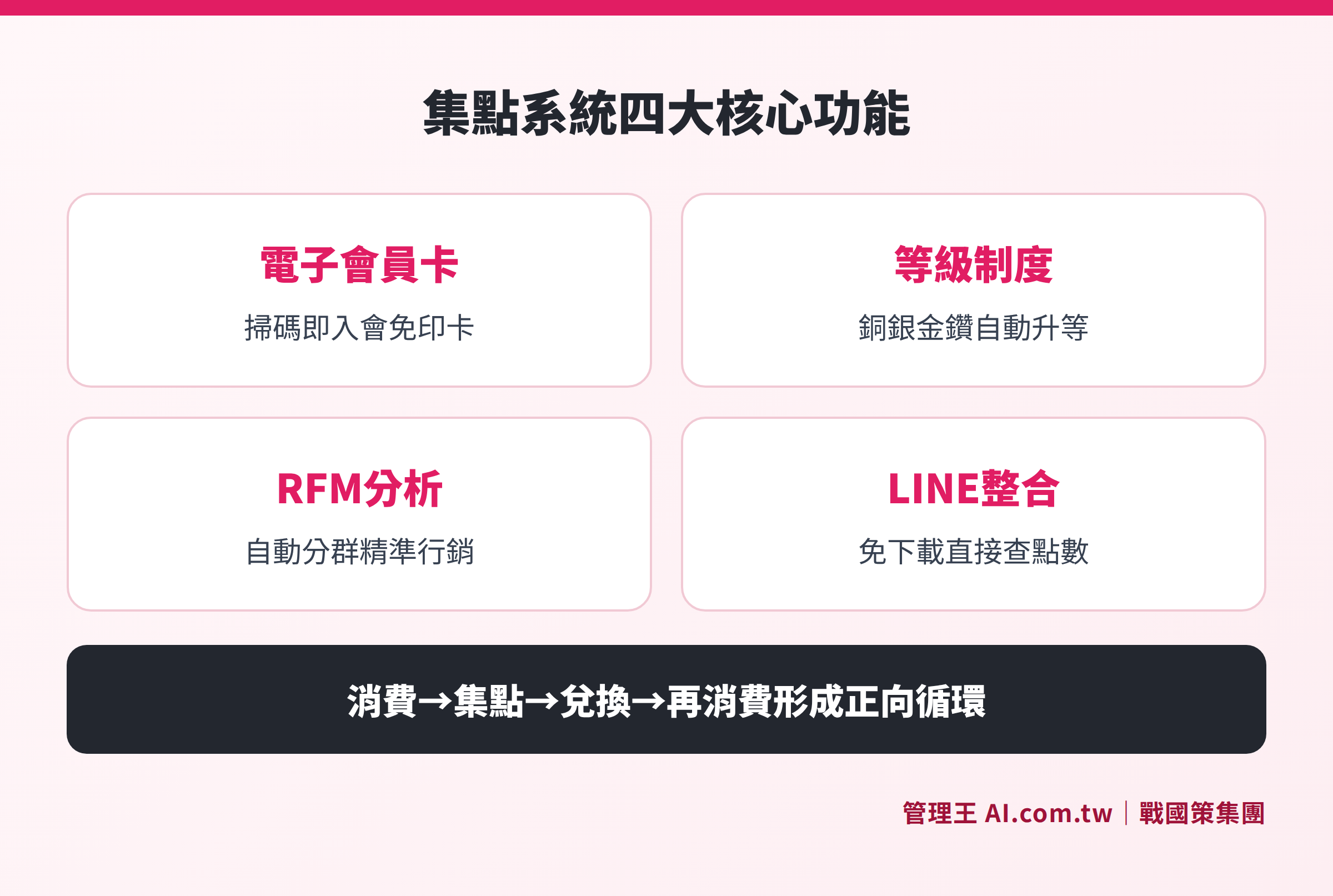
The electronic points system covers five major functional modules: electronic membership cards, tier systems, points redemption, RFM segmentation, and marketing push.
RFM Analysis: Use Data to Identify VIPs and At-risk Customers
RFM is an acronym for three letters: Recency (how long ago the last purchase was), Frequency (how many times a purchase was made in a specific period), and Monetary (total spending amount). These three dimensions combine to divide all members into groups with vastly different behaviors, allowing for targeted marketing actions.
Table: Four Key Member Groups in RFM and Corresponding Marketing Strategies
| Group | RFM Characteristics | Marketing Strategy |
|---|---|---|
| Important Value Customers (VIP) | R Recent, F High, M High | Promote exclusive VIP events, priority access to new products |
| Potential Growth Customers | R Recent, F Medium, M Medium | Encourage upgrades, limited-time double points promotions |
| At-risk Regular Customers | R Distant, F High, M High | Proactively push "we haven't seen you in a while" high-value offers |
| Inactive Customers | R Distant, F Low, M Low | Send re-engagement offers or stop investing resources |
Proactively reactivating at-risk regular customers is one of the highest ROI applications of the points system, as this group once liked your store but has not been reminded in a while.
Three Key Principles for Designing Points Rules
Good points rules facilitate customers' achievements while allowing stores to maintain profit; poor rules either make customers feel unreachable or give away gross profit. The following three design principles help you find the sweet spot:
Principle One: Redemption Threshold Corresponding to Visit Frequency
In the food service industry, it is recommended that customers visit 4 to 6 times to earn the first reward, so the points process feels progressive. The retail industry, which has a longer spending interval, may have slightly higher thresholds but should ideally be achievable within 3 months. If customers feel the rewards are years away, the points system becomes meaningless, regardless of how high the membership sign-up rate is.
Principle Two: Redemption Items Should Be Sensible but Cost-Effective
Redemption items do not have to be expensive but should give customers the feeling of value. Efficient redemption items include: drink upgrades, discounts on specific products, free snacks, or next purchase discount coupons. Avoid using unsold inventory as redemption items, which can make customers feel neglected and harm their trust. Utilizing Coupon Center allows for flexible settings of various redemption options.
Principle Three: Point Validity Period and Expiration Notifications
While having permanently valid points sounds friendly, it leads to endless accumulation, making financial forecasting difficult. It is recommended to set point expiration dates and proactively push notifications 30 days before expiration to remind customers to redeem. This encourages repurchases while controlling point liabilities. The validity period design varies by industry; frequent restaurants can set it to 3 to 6 months, while retail can suggest over 12 months.
Which Industries Are Suitable for Implementing Points Systems?
The points system is suitable for any industry where "repeat customers are the core source of income". Here are the most common application scenarios in Taiwan:
- Restaurant Industry: Customers accumulate points with each meal, integrating with the online ordering system for a seamless points accumulation experience without interrupting the checkout process.
- Retail Industry: Clothing and lifestyle stores can integrate with the POS system for automatic points accumulation without manual operation.
- Beauty Industry: Nail, hair, massage services requiring appointments, where points accumulation complements periodic repurchasing effectively.
- Tutoring Industry: Skill classes and language schools encouraging course renewals through points, providing referral rewards to boost enrollment.
- Gyms: Attendance check-ins earn points, reinforcing visit habits.
Different industries not only have different expiration designs, but the triggers for points accumulation also differ. In food service, points are typically added instantly at checkout; in beauty services, points can be activated upon appointment completion or check-in; in tutoring, they accumulate automatically when payment is made or attendance is recorded. Design the most natural points accumulation trigger based on your service process to make the membership feel seamless and hassle-free for customers. Always refer to the latest announcements from regulatory authorities.
Six Steps to Introduce an Electronic Points System
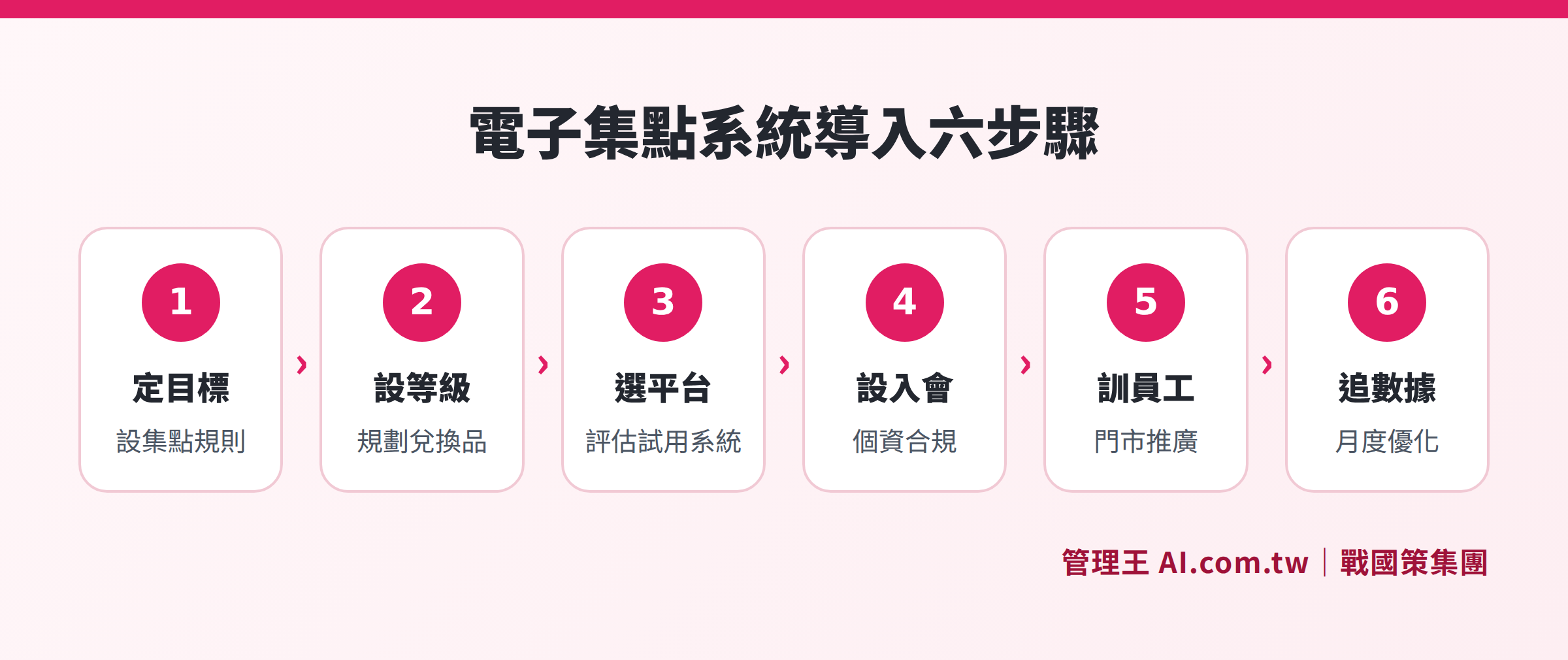
A complete diagram of the six implementation steps from setting points rules to official online launch.
Step One: Define Points Objectives and Rules
First, clarify what you want customers to do: increase visit frequency, raise average transaction value, or boost word-of-mouth recommendations? Different goals will lead to different points rule designs. For example, to enhance visit frequency, you might set up a rule of "fixed points per purchase"; to increase average transaction value, you might set a rule of "double points for spending over 500 dollars."
Step Two: Design Tier Systems and Redemption Items
Decide on the number of tiers, upgrade thresholds, and exclusive benefits for each tier, as well as redemption items. Redemption items should ideally be options that are highly perceived value but low cost, such as free drink upgrades or service add-on discounts.
Step Three: Select Technical Platform
Evaluate whether the system supports LINE integration (which has a high usage rate among Taiwanese consumers), whether it has RFM analysis capabilities, whether it can integrate with existing POS or CRM systems, and whether there is a free plan to try.
Step Four: Design Enrollment Process and Personal Data Notification
According to Taiwan's Personal Data Protection Act, before collecting member data, you must inform the parties involved of the collection purpose, data category, usage methods, and how members can inquire about, modify, or delete their data. It is recommended to include a consent checkbox on the enrollment page, and it should not be pre-checked. This article is general information and does not constitute legal advice; actual compliance should follow the latest announcements from regulatory authorities.
Step Five: Staff Training and Education
Store personnel are the frontline promoters of the points system. Key training points include how to naturally guide customers to join (e.g., “You can accumulate points for a purchase of 100 dollars; would you like to join?”), the SOP for points accumulation, and handling exceptions (such as points not being awarded or customers forgetting their phones). It's suggested to give staff practice opportunities after training to ensure they are prepared for the opening day.
Step Six: Go Live and Data Tracking
After officially launching, track the following four core indicators monthly: new member numbers, active member rates (percentage of members who made a purchase within the last 30 days), points redemption rates, and repurchase rates driven by points activities. It is advisable to review points rules every quarter; if the redemption rate is too low, it may indicate that thresholds are too high or that redemption items are lacking appeal, requiring immediate adjustments to avoid the points system becoming merely a formality.
Six Assessment Indicators for Choosing a Points System
There are many options for points systems on the market, ranging from free LINE card systems to monthly subscription SaaS, with significant functional disparities. The following six indicators can help you quickly gauge:
- LINE Integration: Since Taiwanese consumers use LINE daily, a points system that does not support LINE will face significantly increased promotion difficulties, as consumers are unwilling to download a dedicated app.
- Automated RFM Segmentation: Manual analysis is time-consuming and labor-intensive; built-in automated segmentation is essential for practical use to avoid marketing activities relying solely on intuition rather than data.
- Native Integration with POS/CRM: Prevent annoying issues of having points data and sales data belong to two different systems that require manual reconciliation; native integration allows for real-time points accumulation following purchases.
- Compliance with Personal Data Protection Laws: Confirm that the system provides consent record fields, interfaces for data inquiries and modifications, as well as encryption transmission and secure storage mechanisms to reduce the risk of data breaches.
- Cross-store Management: Businesses with multiple branches should confirm that the system can manage points across stores uniformly while differentiating the membership behavior data for each store.
- Free Plans and Implementation Costs: Some systems offer permanently free plans for you to try before deciding, significantly reducing implementation risk; while assessing, also be wary of hidden costs such as SMS push fees or additional member fees.
How to Use 管理王
管理王 AI.com.tw membership points system is a complete loyalty solution designed for Taiwan’s physical stores, with the fastest online setup in one day. Here’s the actual workflow:
Electronic Membership Card Setup: Set up points rules (proportional spending, specific product bonuses), tier thresholds, birthday gifts, and referral rewards in the backend. After completion, a QR code is generated, which consumers can scan to join without needing to download an app.
LINE Integration: Once linked with the official LINE account, members automatically receive points notifications, check points, and receive store push notifications on LINE, reducing customer operation thresholds and ensuring that each push reaches regular customers securely on their phones.
RFM Dashboard: The system automatically calculates each member's RFM score, displaying the number of VIPs and at-risk customers in a visual dashboard. Offers can be sent with just one click to specific groups without needing to manually sort through Excel.
Integrating CRM Customer Management: Points accumulation behavior records are naturally integrated with CRM customer data. Sales or store managers can view consumption records, service history, and communication remarks on the same screen, making member management not just about awarding points but also about building long-term relationships.
Reward System: 管理王 also has an employee reward system, which, in conjunction with membership points, can design an internal incentive mechanism for "employee referrals to join," motivating store staff to actively promote points accumulation.
The 管理王 free plan can be used permanently, suitable for newly established stores to trial the points logic and confirm customer feedback before upgrading. Paid plans (starting from NT$5,000/month) unlock more AI automatic analysis, advanced push notifications, and unlimited membership features. For stores that already have an existing system, 管理王 also provides REST API integration, allowing points data to flow into existing sales or CRM processes. For a complete comparison of plans, please see the service plan page.
Want to Keep Your Regular Customers Coming Back? Try the Points System for Free
Consultants will assist in setting points rules, tier systems, and RFM segmentation. The free plan can be used permanently and goes live within a day.
Free consultation hotline: 0800-003-191
Official LINE account: @119m
Official website: app.AI.com.tw
Free trial: Apply for 管理王 now
Frequently Asked Questions
How much does it cost to implement a membership points system?
The cost varies by platform. 管理王 AI.com.tw offers a free plan that can be used permanently, covering basic points functions. Advanced functions (advanced RFM analysis, bulk push notifications, AI recommendations) are available starting from NT$5,000/month; see the service plan page for differences. The cost of outsourcing to develop an APP typically exceeds several hundred thousand dollars, with ongoing maintenance costs calculated separately.
Does the points system have to be integrated with LINE?
Not necessarily, but the usage rate of LINE among Taiwanese consumers is extremely high, and integrating with the official LINE account significantly lowers the customer usage threshold, with push notification reach much higher than Email. If your customer base is predominantly over 40 years old, LINE integration is particularly important. For younger customers, Instagram or app push notifications can also be supplemental.
What personal data regulations should I be aware of when collecting member data with the points system?
According to Taiwan's Personal Data Protection Act, before collecting member data, you must inform the parties involved of the collection purpose, data categories, and the rights of the parties to inquire about, modify, or delete their data, and obtain consent. Do not collect data beyond operational purposes, such as collecting ID numbers unnecessarily. It is advisable to use a platform that complies with personal data protection regulations and regularly review the system's cybersecurity measures. This article is general information and does not constitute legal advice; actual compliance should follow the latest announcements from regulatory authorities.
Are small shops or single stores suitable for implementing a points system?
Very much so. One of the biggest advantages of the electronic points system is that it removes the previous barrier of outsourcing app development for hundreds of thousands. Now there are free or low-monthly-cost plans that allow even single stores with 1 to 3 employees to complete setup in a day, making membership not just the privilege of large chain brands.
How can the points system integrate with existing POS systems?
The ease of integration depends on the platform. 管理王's points system is naturally integrated with the POS system, avoiding the need for additional setup; during checkout, the system automatically records the spending amount and adds points in real-time without requiring manual input from cashiers, allowing for a seamless experience for both customers and employees.