What is a Production Management System? Integrating BOM, MRP, Work Orders, and Quality Control|Recommended Production Management Systems

A production management system integrates BOM, MRP, work orders, and quality control, enabling manufacturing plants to fully digitize the process from order receipt to shipment. This article explains the functionalities of each module, key considerations for small and medium-sized manufacturers in Taiwan when purchasing, and how to practically operate 管理王 AI.com.tw.
A production management system is a core tool for the manufacturing sector that integrates BOM (Bill of Materials), MRP (Material Requirements Planning), work orders, and quality control inspections, allowing factories to digitize and trace every step from order receipt to shipment. In simple terms, it addresses three longstanding issues: “discovering material shortages only after production starts,” “nobody knows the status of work orders,” and “quality issues cannot be traced back to their source.” For small and medium-sized manufacturers, implementing a production management system is not just about increasing efficiency but is a key transformation from relying on “master craftsmen's memory” to “system management.” This article targets small and medium manufacturers in Taiwan and explains each functional aspect and purchase key factors of the four modules: BOM, MRP, work orders, and quality control, introducing the practical operations of 管理王 AI.com.tw’s manufacturing system.
What is a Production Management System? Understand Core Functions at a Glance
A Production Management System (Manufacturing Management System) is a software platform that assists the manufacturing sector in planning, executing, and tracking production activities. Its core tasks include: creating product bills of materials (BOM), planning raw material procurement based on order requirements (MRP), issuing and tracking work orders, recording quality control inspection results, and storing finished products.
The pain points of traditional factories are that each of the above steps operates independently: Engineers use personal Excel sheets for BOMs, procurement relies on phone calls to check inventory, work order progress is reported verbally by craftsmen, and quality control records are handwritten and retained. If an error occurs in any step, all subsequent processes will be adversely affected.
A production management system integrates these processes into the same database, achieving:
- Automatic calculation of material requirements with one-click procurement orders
- Real-time updates of work order progress for managers to check anytime
- Statistics on quality control defect rates to swiftly identify problematic batches
- Automatic replenishment of finished goods inventory upon completion, avoiding repetitive data entry for shipments
Understand in One Sentence
The production management system allows factories to upgrade from “relying on craftsmen's memory” to “system management,” integrating all four key aspects: BOM, MRP, work orders, and quality control.
Table: Comparison of Traditional Manual Practices and Production Management System Functions
| Process | Traditional Practice | Production Management System |
|---|---|---|
| BOM | Engineers' personal Excel sheets, difficult to manage versions | Systematically maintained, multi-level expansion with automatic calculations |
| Material Planning | Procurement based on experience estimates, frequent material shortages | MRP automatically calculates material shortages based on work orders and inventory |
| Work Orders | Paper-based issuance, progress reported verbally | Online work orders with real-time tracking of each station's progress |
| Quality Control | Handwritten records, difficult to trace later | Online input of inspection results, complete traceability of batch numbers |
| Finished Goods Storage | Warehouse staff manually update Excel | Automatic increase in finished goods inventory upon completion of work orders |
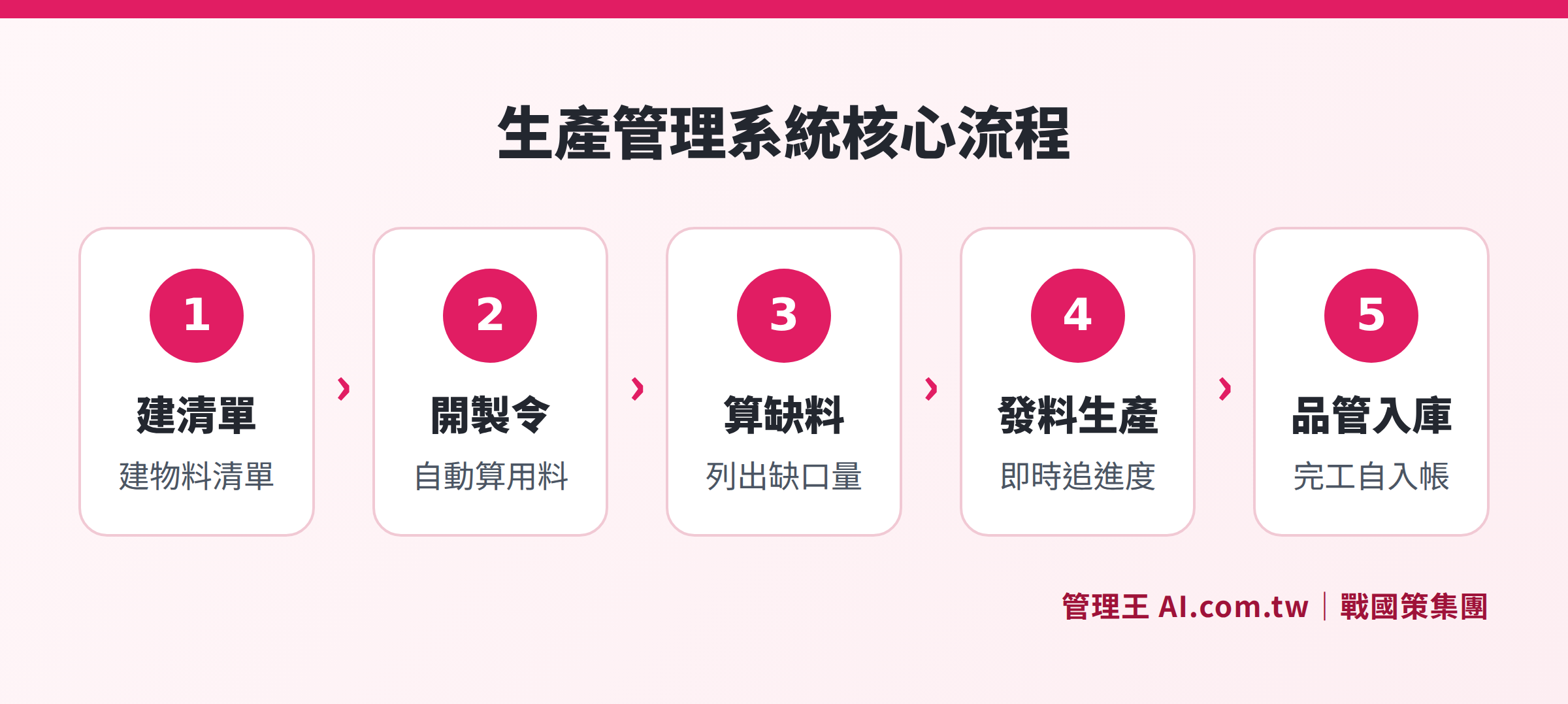
The five key steps of the production management system from order receipt to completion: Establish BOM → MRP calculates material shortages → Issue work orders → Quality control inspection → Finished goods storage
BOM: The Digital Blueprint of the Manufacturing Sector
BOM (Bill of Materials) is a list that records all the raw materials, components, semi-finished products, and their quantities and hierarchical relationships required for a finished product. It forms the data foundation of the entire production management system. Without an accurate BOM, MRP cannot calculate correct material requirements, and work orders cannot issue precise material allocations.
Structure and Types of BOM
BOM is categorized into two main types based on usage scenarios:
Engineering BOM (EBOM): Defined by the R&D or engineering department, describing the functional composition of the product with a focus on design specifications and technical relationships.
Manufacturing BOM (MBOM): Defined by the production unit, arranged according to actual processing and assembly logic, serving as the list used on the production floor.
Most manufacturers maintain both types of BOM, updating the MBOM whenever the EBOM changes to ensure design and production consistency.
Key Fields in BOM
A complete BOM should at least include the following fields:
- Item Number: A unique identifier to prevent confusion of similar items
- Item Name and Specifications: Including material, size, model, and other descriptions
- Level: Indicates the hierarchical position of finished products, subcomponents, and raw materials
- Quantity (Qty): The number of components required to produce one parent item
- Shrinkage Rate: The reasonable waste ratio during processing, affecting actual procurement needs
- Unit: Measurement units such as pieces, kilograms, meters, rolls, etc.
Shrinkage rate is a field that is easily overlooked in Taiwan's manufacturing sector. If a part has a shrinkage rate of 5%, producing 100 finished products actually requires preparing 105 items. MRP must incorporate this factor into calculations to prevent shortages due to slight waste.
Multi-Level BOM Expansion
Complex products often have a BOM structure spanning three to five levels. For example, a machine:
- First level: Finished product (complete machine)
- Second level: Major components (body, electrical control box, drive system)
- Third level: Subcomponents (motor, sensors, screw sets)
- Fourth level: Raw materials (steel plates, copper wires, oil seals)
The system can automatically expand multi-level BOMs, calculating the required materials at each level when producing N finished products, eliminating the need for engineers to perform manual calculations.
MRP: The Key to Precise Procurement from Shortages
MRP (Material Requirements Planning) is a logical system calculation based on order demands, BOM structure, and existing inventory, automatically estimating “what to procure, how much to procure, and the latest order placement time.”
Three Input Sources for MRP
The calculation for MRP requires three pieces of information:
- Main Production Schedule (MPS): Currently unfinished work orders representing confirmed production demand
- BOM: A list of materials and quantities needed for each product
- Inventory Data: Current inventory levels of items and purchase quantities in transit
Four-Step Calculation Logic for MRP
The process for executing MRP in the system is as follows:
- Read all unfinished work orders to acquire demand quantities for each finished product
- Expand raw materials and components (including shrinkage rates) needed for each work order using BOM
- Cross-reference existing inventory with in-transit purchase quantities to calculate net shortages
- Generate “suggested purchase quantities” and “recommended order dates” based on each item's lead time
Core Issues Addressed by MRP
Small and medium manufacturers in Taiwan often encounter two extremes: One is material shortages, discovering insufficient raw materials after accepting orders; the other is over-purchasing, leading to a warehouse full of excess inventory tying up cash flow. MRP enables precise calculations of net requirements, allowing procurement volumes to perfectly match production demands, balancing the goals of not experiencing shortages and not over-purchasing.
Table: Procurement Decision Comparison With and Without MRP System
| Comparison Aspect | Without MRP (Manual Estimation) | With MRP (System Calculation) |
|---|---|---|
| Risk of Material Shortages | High, relying on personal experience, easy to overlook | Low, the system automatically lists each item's shortages |
| Risk of Over-Purchasing | High, tendency to purchase more just in case | Low, calculates precise procurement volumes based on net requirements |
| Data Sources | Dispersed across departments, requires meetings to reconcile | Single system, real-time synchronization |
| Lead Time Management | Manually calculated, prone to errors | The system automatically calculates the latest order date |
| Concurrent Calculation of Multiple Items | Difficult, too many items to calculate manually | Instant results, supports hundreds of items |
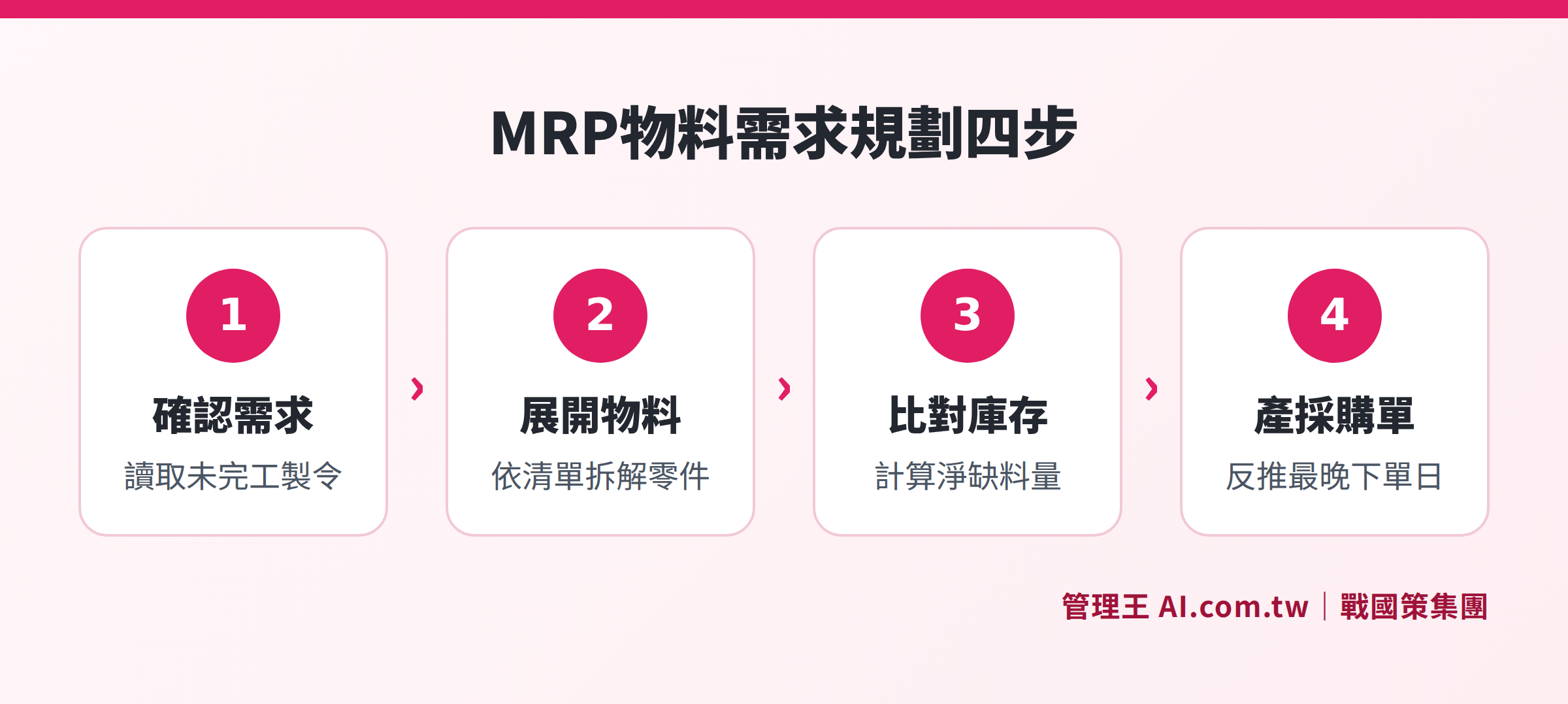
Four-step MRP calculation process: Expanding BOM from work order requirements, subtracting existing inventory to derive net material shortages, then generating purchase suggestions based on lead times
Work Orders: Tracking Progress from Start to Finish
A work order (also known as a manufacturing order) is an official document that initiates a batch production task, recording the production items, quantities, scheduled completion dates, and driving subsequent actions such as material issuance, progress reporting, and finished goods storage.
Key Processes of Work Orders
- Create Work Order: Establish work orders based on customer orders or production plans, and the system automatically inputs materials needed from BOM calculations
- One-Click Material Issuance: Warehouse personnel issue materials based on the system-generated material list, after which the system deducts raw material inventory
- Production Progress Reporting: Each workstation reports completed quantities and hours on the system, allowing managers to see the progress percentage in real time
- Quality Control Sampling: After completion, quality control personnel fill in inspection results in the system, immediately marking any defects
- Finished Goods Storage: After passing quality control, the system automatically adds the finished products to inventory, initiating subsequent shipping processes
Parallel Management of Multiple Work Orders
Manufacturing plants usually run ten to dozens of work orders simultaneously, each at different stages of progress. The system provides a work order dashboard view, allowing production management personnel to see at a glance which orders are nearing deadlines, which workstations are stuck, and which orders should be prioritized, eliminating the need for phone calls to check progress.
Quality Control System: Ensuring Quality from Incoming Materials to Shipment
Quality management is one of the core competitive strengths of the manufacturing industry, but traditional handwritten quality control forms make it hard to statistically analyze defect rates and trace problematic batches. The production management system digitizes quality control results, turning each inspection record into analyzable data.
Three Quality Control Checkpoints
A complete quality control process covers three key points:
Incoming Material Inspection (IQC): Inspection performed before raw materials are stored, returning defective products to suppliers to prevent poor materials from entering the production line.
In-Process Inspection (IPQC): Sampling during the production process to discover issues early, reducing the need for rework later.
Outgoing Shipment Inspection (OQC): The final verification before finished products are shipped, ensuring the products delivered to customers meet specifications.
Batch Number Traceability: The Foundation of Recall Capability
Each batch of raw materials is registered with a batch number when received. Work orders record which order used which batch of materials. If a supplier notifies about defects in a batch of materials, the system can identify all work orders that used that batch in seconds, along with the corresponding finished products delivered to customers, making the recall process shift from “impossible to start” to “precise targeting.”
How Does the Production Management System Integrate with ERP, Procurement, and Inventory?
If the production management system operates as an isolated production module, data still needs to be manually transferred across systems, greatly diminishing the effectiveness. The key to unlocking true value lies in its native integration with ERP, procurement, inventory, and accounting.
Integration Framework Explained
- Integration with ERP System: When customer orders enter the ERP, it automatically triggers production planning without the sales team having to manually notify production management.
- Integration with Procurement System: After MRP calculates material shortages, the system directly generates purchase orders and enters the procurement approval process, eliminating the need for procurement personnel to manually cross-check.
- Integration with Inventory Management: Material issuance deducts raw inventory, and completion replenishes finished goods inventory, with data updated in real-time, so warehouse and sales personnel see the same inventory data.
- Integration with Accounting System: Material consumption, labor costs, and manufacturing expenses are automatically mapped to accounting accounts, streamlining end-of-month cost settlements without reconciliation.
- Integration with Vendor Management: Suppliers' historical on-time delivery rates and quality pass rates are linked directly to procurement decisions, enabling the selection of the most reliable suppliers.
This complete module integration requires data to be entered once, with all backend calculations automatically linked, making it the most effective way for small and medium manufacturers to break free from the manual data transfer across multiple systems.
Five Key Considerations for Taiwanese Small and Medium Manufacturers When Choosing a Production Management System
When small and medium manufacturers in Taiwan consider purchasing a production management system, it is recommended to evaluate from the following five aspects:
1. Multi-Level BOM Expansion Capability
Can it support expansion of BOMs with three or more levels, and can shrinkage rates be set individually at the item level? The flexibility of the BOM directly determines the accuracy of MRP calculations.
2. Native Integration with Procurement, Inventory, and Accounting
Can a one-click conversion to purchase orders be done once MRP outputs material shortages? Can inventory be automatically updated upon completion? If manual data transfers are needed, the system's effectiveness will be greatly reduced.
3. Mobile Device Friendliness
Factory operators may not be sitting in front of computers; does the system support mobile or tablet operations for work order reporting and quality control entries? This significantly affects on-site personnel's acceptance of the system.
4. Localized Support in Taiwan
Can the system interface be in Traditional Chinese? Can customer service respond in Chinese in real-time? Is data stored in Taiwan? These are basic conditions that Taiwanese companies must confirm.
5. Trial and Free Plans
With limited resources, can small and medium manufacturers first validate the system's compatibility with their processes using a free plan before deciding to upgrade? This is key to reducing implementation risk.
Check 管理王 pricing plans to compare the functional differences of various plans.
How to Operate with 管理王 AI.com.tw? Practical Operations of the Production Management System
The 管理王 Production Management System covers items and inventory, BOM (supporting multi-level expansion and shrinkage rate settings), automatically calculates materials required for work orders, issues materials with one click, calculates material shortages and suggested purchase quantities based on unfinished work orders, and manages finished goods storage and quality control inspection records.
The actual operation process is as follows:
- Create Item Master Data: Set up item data for all raw materials, components, semi-finished products, and finished products in the system, defining units and costs.
- Create BOM: Set multi-level BOMs for each finished product, filling in the quantities and shrinkage rates for each sub-component.
- Issue Work Orders: Choose finished products and quantities based on orders, with the system automatically expanding BOMs to calculate the needed materials.
- Execute MRP: The system reads all unfinished work orders, cross-references inventory, and lists the quantity of shortages and suggested purchase amounts, producing purchase orders with one click for approval.
- Material Issuing and Work Order Tracking: Warehouse staff issue materials according to the system list, and production personnel report completion progress online.
- Quality Control Logging: Quality control personnel fill in inspection results in the system, recording batch numbers and anomalies.
- Finished Goods Storage: Once passed quality control, the system automatically adds finished products to inventory, initiating the shipping process.
管理王 offers a free plan for permanent use, enabling manufacturers to set up an account directly and start familiarizing themselves with the system from establishing BOMs without the need for credit card binding. If advanced AI automation features or more user accounts are needed, upgrades are available to Economy, Business, or Enterprise plans as needed.
For consultant assistance, the 戰國策 Group serves over 30,000 companies, providing free system consultations and evaluations, with customized development priced transparently at NT$1,000/hour.
Free Trial of the Production Management System, Starting with BOM Setup
Consultants offer free consultations to assist small and medium manufacturers in Taiwan with BOM, MRP, and work order process planning, with free plans available for permanent use.
Free consultation hotline: 0800-003-191
LINE Official Account: @119m
Official Website: app.AI.com.tw
Free Trial: Apply for 管理王 now
Frequently Asked Questions
What is the difference between a Production Management System and ERP?
ERP (Enterprise Resource Planning) is a management platform that covers the entire enterprise, while a production management system is typically one of the manufacturing modules of an ERP. For manufacturers, choosing an ERP system and enabling its manufacturing module ensures better data interoperability and reduces the cost of transferring data across systems. 管理王's ERP system includes an integrated manufacturing module where procurement, inventory, accounting, and production data are combined into one system.
How complex does a BOM need to be to require system management?
If a product has more than two layers of material structure or if over five SKUs are produced concurrently, manual Excel sheets can easily lead to version confusion and calculation errors. Particularly, multi-level BOM expansion (more than three levels) combined with shrinkage rate calculations are not only time-consuming but also prone to errors, making this one of the most valuable scenarios for a production management system.
Is it necessary to strictly follow the procurement suggestions outputted by MRP?
The suggested quantities from MRP are based on the system calculations of BOM, inventory, and work orders, providing a high level of accuracy. However, procurement personnel can still make manual adjustments based on market conditions, suppliers' minimum order quantities (MOQ), or soon-to-expire inventory. The system provides suggestions, but the final decision must be confirmed by personnel before submission of purchase orders.
How to handle non-conforming quality control products?
After quality control personnel have marked defects in the system, the batch is set as “quarantined,” preventing non-conforming products from entering normal inventory. Subsequent actions can include returning items to suppliers, disposing of them, or sorting for reuse, with each outcome recorded in the system to fully maintain the quality traceability chain.
What size of factory is a Production Management System suitable for?
Even small processing plants with fewer than ten employees can benefit from using a production management system if they have BOM structures and multiple types of raw materials, as the benefits exceed those of manual Excel sheets. 管理王's free plan supports up to 10 members, allowing small and medium manufacturers to start with the free plan and assess compatibility before considering an upgrade based on their scale needs. See 管理王 quotation system and pricing plans for details.
Data Sources
- What is MRP? Analyzing the Five Major Advantages of Material Requirements Planning — Hua Zhi Information Development
- Material Requirements Planning — Wikipedia — Chinese Wikipedia
- 管理王 Production Management System Functionality Page — 管理王 AI.com.tw (Checked October 2026)
- 管理王 ERP System Functionality Page — 管理王 AI.com.tw (Checked October 2026)