What is Marketing Automation? Implementation Processes and Case Studies for Small and Medium Enterprises | Recommended Marketing Automation Tools

Marketing automation allows systems to automatically execute tasks such as sending emails, push notifications, and nurturing leads 24/7, enabling small teams in SMEs to achieve reach equivalent to larger teams. This article covers definitions, functionalities, implementation steps, and selection criteria for tools.
Marketing automation refers to a technology that uses software to automatically complete repetitive marketing tasks. The core includes four elements: visual workflow design, multi-channel message triggers, audience nurturing, and performance tracking. In simple terms, it transforms tasks that relied on manual operations—such as sending emails, scheduling posts, and following up—into actions triggered automatically by conditions—when customers perform specific behaviors, the system immediately executes corresponding marketing actions without manual intervention. Common benefits for SMEs in Taiwan include a significant increase in reach, freeing marketing personnel from repetitive tasks, and continuous optimization of conversion rates through A/B testing. This article thoroughly explains the definition, functionality, implementation steps, tool selection criteria, and real-world application scenarios for marketing automation, serving as a comprehensive guide for SME owners and marketing managers.
What is Marketing Automation? Definition and Operating Principles
The concept of marketing automation originates from "trigger-based" logic: rules are pre-set that say “when a customer does A, the system executes B,” with the system continuously monitoring customer behaviors in the background and automatically executing marketing actions once the conditions are met.
A typical marketing automation process generally follows these steps:
- Trigger Point: The customer completes a specific action (e.g., new member registration, adding to cart without checkout, not purchasing within 30 days)
- Condition Assessment: The system determines which process to follow based on customer tags, segmentation, or historical behavior
- Executing Actions: Automatically sending emails, LINE push notifications, SMS, or app notifications
- Wait and Observe: Waiting for a preset time window to confirm customer response
- Next Steps Branching: Respondent goes through the VIP process; non-respondents go through a reminder process
This logic can extend infinitely to form a complete "Customer Journey" map. Compared to traditional marketing with manual scheduling, the primary advantage of marketing automation lies in its ability to operate continuously 24/7, allowing every customer to receive personalized communication in a timely manner.
In a nutshell
Marketing automation enables a team of two to achieve the outreach of a ten-person team, focusing on converting “manual repetitive tasks” into “condition-triggered processes.”
Table: Core Differences Between Traditional Marketing and Marketing Automation
| Comparison Aspect | Traditional Marketing | Marketing Automation |
|---|---|---|
| Execution Method | Manual operation | System-triggered automatic execution |
| Timing of Outreach | Fixed scheduling, not immediate | Triggered immediately after customer behavior occurs |
| Degree of Personalization | Bulk sending, difficult to segment | Segmented by tags, precise personalization |
| Scalability | Labor increases linearly | Processes can be replicated, low marginal costs |
| Performance Tracking | Disperse monitoring across channels | Unified dashboard for cross-channel attribution |
| Labor Demand | Requires dedicated personnel daily | Runs automatically after processes are set |
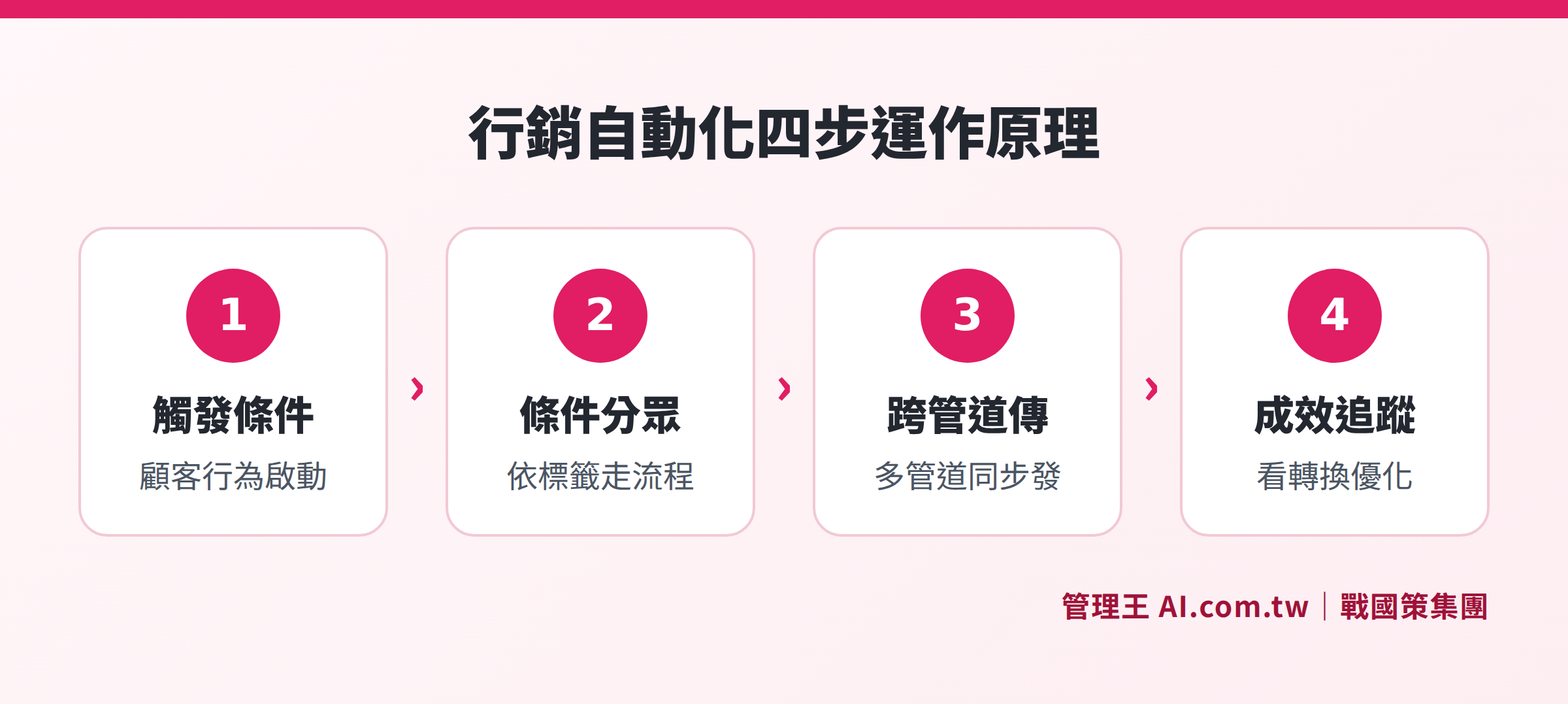
The five-step automated process from trigger conditions to multi-channel execution illustrates how the customer journey progresses autonomously within the system
Six Core Functions of Marketing Automation
Modern marketing automation tools typically encompass the following six functional modules, which SMEs can reference when evaluating tools:
1. Visual Workflow Editor
A drag-and-drop “trigger → condition assessment → action → wait → next step” block design creates the customer journey, allowing marketers to visualize their campaign ideas directly into automated flow charts without needing to write code. This is a key feature that enables marketing automation to be effectively utilized by marketing personnel.
2. Rich Trigger Condition Settings
Mainstream tools come with over 20 built-in trigger scenarios, including: new member registration, abandoned cart, not purchasing for a specific number of days, birthday on the day, clicking specific buttons, browsing specific pages, and reaching spending thresholds. The richer the trigger conditions, the higher the precision of the marketing process.
3. Cross-channel Setup at Once
Email, LINE, SMS, and app push notifications can be set in the same workflow, with the system executing them simultaneously. This is especially important for SMEs in Taiwan—customers predominantly use LINE, but traditional enterprises still have substantial email databases that need to be managed under one system.
4. A/B Testing for Automatic Optimization
The same trigger action can test two versions (e.g., emails with different subject lines), and the system automatically compares performance and expands the better-performing version for larger distribution, allowing data to replace intuition and continuously enhance open and conversion rates.
5. Drip Campaign for Audience Nurturing
New members automatically receive emails with different themes based on a time series (D1, D3, D7, D14, D30), using conditional branching to guide highly interactive customers through VIP processes, and lower-interaction customers through educational content paths, achieving true segmented communication and avoiding the problem of “everyone receiving the same bulk email.”
6. Performance Reports and Remarketing Funnel
Present conversion rates at each step of the process, clearly showing where customers drop off. Remarketing funnels can be designed for groups such as “clicked but did not purchase” and “purchased but did not repurchase,” forming a continuously optimizing closed loop.
Why Do Small and Medium Enterprises in Taiwan Need Marketing Automation?
According to a research report by Grand View Research, the marketing automation market in the Asia-Pacific region is projected to reach $1.407 billion by 2024, and it is expected to expand at a compound annual growth rate (CAGR) of 18.5% between 2025 and 2030, making it the fastest-growing region globally. The Taiwanese market benefits from the acceleration of digital transformation in e-commerce, food service, and other industries, increasing the adoption rate of marketing automation among businesses.
For SMEs in Taiwan, marketing automation addresses several long-term pain points:
- High Labor Costs: Marketing personnel spend significant time on manual tasks such as sending emails, scheduling posts, and copying/pasting, unable to focus on strategy.
- Data Isolation Across Channels: FB ads, LINE OA, and EDM are viewed separately in different backends, making it difficult to ascertain overall ROI.
- Inconsistent Customer Experience: The same customer receives repetitive or contradictory messages across different channels.
- Inability to Scale Activities: Reliance on manual operations limits the number of campaigns that can run simultaneously, making it challenging to run several tests at once.
According to Omnisend's 2025 Email Marketing Benchmark Report, automated triggered emails, while only accounting for 1.8% of total sends, contribute to 31% of email orders, demonstrating that the high accuracy of automation leads to conversion benefits far exceeding those of bulk sending. Data from Taiwan's newsletter platform Newsleopard also shows that welcome emails have an open rate as high as 91.4%, far exceeding the approximate 21% of regular bulk sends, precisely because of the "timely precision"—automatically sent when customers just complete registration, at their peak favorability towards the brand.
Four Steps for SMEs to Implement Marketing Automation
Marketing automation doesn’t launch instantly after system installation; it requires a planned, phased establishment. Here are four steps suitable for SMEs in Taiwan:
Step 1: Inventory Existing Marketing Processes and Identify Automation Opportunities
First, list the currently “weekly/monthly tasks that must be done but are highly repetitive,” such as manually sending promotional emails weekly, reminding inactive customers each month, and notifying VIP lists every time a new product is released. These scenarios are prime candidates for replacement by marketing automation.
Step 2: Define Key Nodes in the Customer Journey
Map out the complete journey from “first contact with the brand” to “becoming a repeat customer,” marking each key node (landing page visits, membership sign-ups, first purchase, second purchase, dormancy, etc.) and the most appropriate message content at each node.
Step 3: Set Up the First Batch of Core Processes and Test
Start with the most impactful processes: typically the “new member welcome series” and “abandoned cart reminders.” After setting these up, observe open rates, click rates, and conversion rates over a period of 2 to 4 weeks, then gradually optimize the processes.
Step 4: Analyze Data to Continuously Optimize and Gradually Expand Processes
Use A/B testing to compare the performance of different subject lines, sending times, and CTA button texts, fix the best-performing versions, and then extend to the next scenario (e.g., introduce birthday discount processes, VIP upgrade processes). The core competitive advantage of marketing automation lies in "continuous optimization,” not in one-time setup.
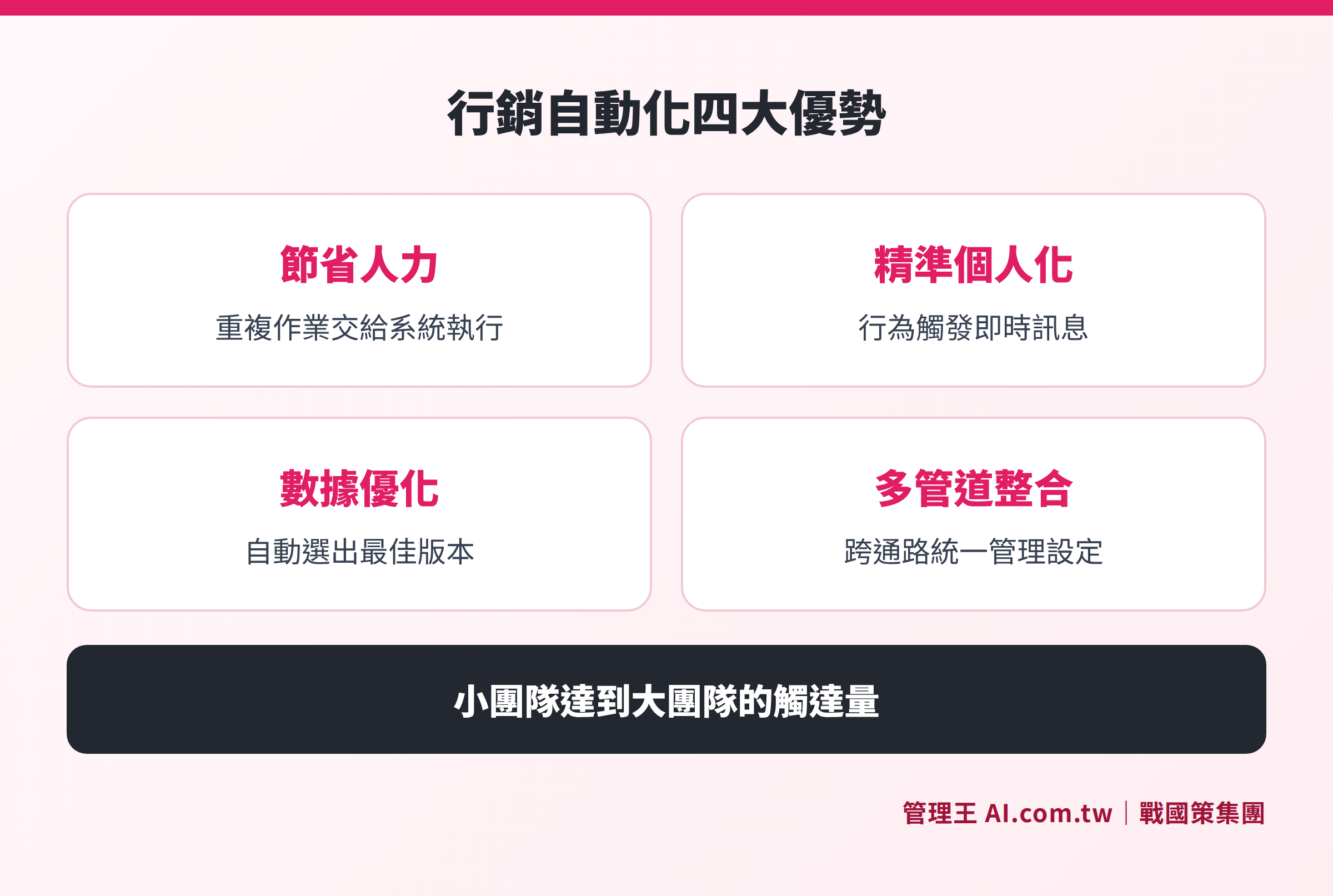
The four introduction phases from process inventory, journey design, establishing core automation to data optimization
Five Evaluation Criteria for Selecting Marketing Automation Tools
The Taiwanese market has numerous marketing automation tools, ranging from international SaaS (HubSpot, Klaviyo, Mailchimp) to local integrated platforms (管理王, various EDM tools). When choosing, SMEs are advised to reference the following five standards:
1. Support for Major Platforms in Taiwan
Taiwan consumers commonly use LINE for communication, B2B clients still heavily use Email, and e-commerce customers receive app push notifications. When selecting a tool, verify if LINE OA push notifications, Email, and SMS can be managed under the same system rather than having separate channel setups and data views.
2. Variety of Trigger Conditions and Process Logic
The richer the trigger conditions, the more precise the marketing process. Confirm that the tool supports scenarios such as abandoned carts, page visit durations, member cumulative spending, birthdays/anniversaries, and RFM segmentation triggers.
3. Ability to Integrate with Other Business Systems
The greatest value of marketing automation lies in "data circulation"—customer labels from the CRM, purchase records from the ERP, and tickets from the customer service system should all be readable and usable in the marketing process. If a tool is designed as an island with additional API connection costs, it may increase costs and maintenance difficulties.
4. AI Copy Generation Capability (Traditional Chinese)
Every email and push notification in the automation process requires copy. If the tool has built-in AI copy generation optimized for the Taiwanese Traditional Chinese context (rather than machine-translated English prompts), it can significantly reduce labor costs for content creation.
5. Subscription Costs and Hidden Fees
When evaluating the total cost of ownership (TCO), include the tool's base cost, monthly sending volume costs, API connection fees, and training expenses. The basic plan of international tools (like HubSpot Marketing Hub) can exceed tens of thousands of TWD per month, which may not be cost-effective for Taiwanese SMEs.
Table: Evaluation Matrix for Selecting Marketing Automation Tools
| Evaluation Aspect | Importance Level | Suggested Verification Method |
|---|---|---|
| LINE OA Integration | High (Essential in Taiwan) | Request a demo from the vendor for actual LINE push notification process |
| Number of Trigger Conditions | High | Check if it includes abandoned carts, RFM, and birthday triggers |
| Cross-system Data Integration | High | Confirm if it can read CRM/ERP data |
| Traditional Chinese AI Copy | Medium | Test the generated results for linguistic feel and accuracy |
| Total Subscription Fees | High | Calculate the monthly fee cap including sending volume |
| Customer Service and Training | Medium | Confirm if there is Chinese-speaking customer service and on-site training |
Common Use Cases for Marketing Automation
E-commerce Brands
The most commonly used marketing automation process for e-commerce is the “abandoned cart reminder.” When customers add items to their cart and do not check out, an email reminder is automatically sent 1 hour later, followed by a second email with a discount code 24 hours later if they still haven't purchased, and a final LINE push notification reminder after 3 days. Additionally, “new product launch notifications,” “repurchase reminders (30/60/90 days after last purchase),” and “birthday coupon” are also common automation processes in e-commerce.
Chain Restaurants and Retail
The biggest challenge for chain brands is marketing coordination across multiple locations. Marketing automation allows headquarters to uniformly set activity schedules and automatically push notifications to each store's LINE OA and POS systems, enabling real-time monitoring of each store's campaign performance and eliminating the workload of manually notifying each location. Automatically notifying members once they reach redemption thresholds is also an effective way to increase return rates. You can connect to the member point accumulation feature to further understand point and level management.
B2B Service Industry
In B2B, marketing automation focuses on “Lead Nurturing.” New leads who download a white paper or fill out inquiry forms enter a sequence of 5 to 7 emails, sharing product education content, customer cases, and comparison analyses, gradually guiding them into a business follow-up process when they are ready to purchase. Coupled with the CRM system to track read records, account managers can identify which leads clicked on which content, prioritizing follow-ups for the most engaged leads.
How to Implement Marketing Automation with 管理王
The marketing automation feature of 管理王 AI.com.tw centers around visual flowcharts, allowing marketers to construct customer journeys in a drag-and-drop editor without coding. Here are a few common operational methods:
Setting Up New Member Welcome Sequence: Access the “Marketing Automation” module → Add a process → Select the trigger condition “New member registration completed” → Add “Send Email” node (insert welcome email content) → Add “Wait 3 days” node → Add “Send LINE push notification” node (share usage guide) → Save and activate.
Abandoned Cart Reminder: Select the trigger condition “Adding to cart and not checking out after 1 hour” → Sequentially set up email, LINE, and SMS reminder nodes with different messaging and discount codes → Once activated, the system monitors automatically for 24 hours.
The biggest difference compared to similar tools is that 管理王’s marketing automation integrates natively with CRM, accounting, and customer service from day one, allowing customer spending records from the CRM and historical tickets from the customer service system to serve directly as triggers or sources for personalization in marketing processes, without additional connection fees.
All plans include a free plan that can be used indefinitely, with advanced features like Drip Campaign, A/B testing, and multi-channel integration fully unlocked during the trial period. Features such as social media scheduling management, ad management, newsletter system, and Landing Page are all contained within the same system for unified cross-channel marketing performance review without switching between multiple backends. If development of potential leads identified through intent detection in FB groups is needed, the AI Automated Sea Patrol can also be integrated for use.
Let Marketing Automation Work for You with Free Consultant Planning Assistance
Share your marketing pain points with us, and our consultants will help you design the first automated process, from welcome emails to abandoned cart reminders and Drip Campaigns—all in one go.
Free consultation hotline: 0800-003-191
LINE Official Account: @119m
Official website: app.AI.com.tw
Free trial: Apply for 管理王 now
Frequently Asked Questions
What size of company is suitable for marketing automation?
There are no scale thresholds for marketing automation; even micro e-commerce or service businesses with 2 to 3 people can start with the basic “new member welcome email” and “abandoned cart reminders,” handling tasks previously requiring a dedicated marketing person manually on a daily basis with minimal staff. The key is to identify 1 to 2 of the most repetitive marketing tasks, automate them, and then gradually expand the processes.
What is the difference between marketing automation and EDM tools?
Traditional EDM tools (email sending tools) primarily send “bulk emails to the whole list,” representing a single channel, single action. Marketing automation sends “the right message through the right channel at the right time based on customer behavior,” covering multiple channels such as email, LINE, SMS, app push notifications, and features conditional branching, A/B testing, and Drip Campaigns, among others. The biggest difference lies in the level of personalization and multi-channel integration capability.
How long does it take to see the effects of marketing automation?
Typically, preliminary data for open rates and click rates can be observed within 2 to 4 weeks after activation; processes like abandoned cart reminders often show significant effects within a few days. Overall ROI generally manifests within 1 to 3 months, depending on the maturity of existing processes and traffic scale. Starting with the most critical 1 to 2 processes is more effective in yielding quantifiable results than setting up all processes at once.
Is technical personnel required to set up marketing automation?
Modern marketing automation tools designed with a visual editor can be operated by marketing personnel or the business owner themselves, without the need for engineers or technical staff. Choosing local tools that provide traditional Chinese interfaces, Chinese customer service, and onboarding training can further lower the entry threshold. 管理王 offers a 0800 customer service hotline and remote onboarding training for business and flagship plan users.
What is the approximate cost of implementing marketing automation?
Costs vary significantly based on tool choice and company size. International tools like HubSpot Marketing Hub start with monthly fees of over NT$20,000; local integrated platforms start with free options, while 管理王’s economy plan is NT$5,000/month, business plan NT$10,000/month, and flagship plan NT$19,900/month. When evaluating, it is recommended to consider sending volume fees, connection fees, and training costs to ensure they fit into the overall budget.
Data Sources
- Grand View Research — Asia Pacific Marketing Automation Market Size & Outlook, 2024–2030 (Market size and CAGR of 18.5% for the Asia-Pacific region)
- Email Vendor Selection — 39+ Marketing Automation Statistics 2025 (Omnisend 2025 benchmark report: automated emails account for 1.8% of sending volume but contribute 31% of orders)
- Newsleopard — Complete Guide to Email Marketing Automation 2026 (Data on welcome email open rates from Taiwan's newsletter platform)
- 管理王 AI.com.tw — Marketing Automation Feature Page (Function introduction and plan description, query on November 2026)