How to Write Useful Meeting Minutes? From Format and Templates to AI Auto-Organization | Meeting Minutes Software Recommendations

This article comprehensively explains how to write effective meeting minutes, covering the definition, regulatory requirements (Company Law Article 183, Rules of Procedure for Board Meetings of Public Companies), standard format fields, three scenario templates, five useful writing tips, and AI auto-organization techniques. It also introduces how 管理王 AI Meeting Minutes automatically generates transcripts, summaries, and action items.
Meeting minutes (Minutes of Meeting) are formal documents that comprehensively record the time, location, attendees, discussion items, decisions, and action items of a meeting. A good set of meeting minutes is not just about "transcribing what was said" but ensuring that those who were absent can grasp the overall picture in five minutes, that attendees clearly understand their subsequent tasks, and that the organization has a basis for future reference and tracking. According to the Rules of Procedure for Board Meetings of Public Companies, board meeting minutes must record statutory items and be sent to all directors and supervisors within 20 days after the meeting; while general companies do not have a rigid format, compliant meeting records are still the cornerstone of corporate governance. This article covers every aspect of meeting minutes from format, templates, and writing techniques to how to use AI for auto-organization.
What are Meeting Minutes? How Do They Differ from Memos?
Meeting minutes (Meeting Minutes) are written records of a formal or semi-formal meeting, serving the dual purpose of verification and tracking: verification allows the organization to audit decisions in the future, while tracking ensures that every action item has an assigned person and a due date.
A memo (Memo) is a notification or proposal initiated by an individual or department that does not necessarily stem from a meeting discussion. The key distinction lies in that meeting minutes must accurately reflect collective discussions and decisions, without personal opinions inserted.
In a nutshell
Meeting Minutes = Decisions + Responsible Persons + Deadlines, all three are essential; having these ensures that the meeting has truly concluded.
Table: Comparison of Meeting Minutes vs. Memos
| Item | Meeting Minutes | Memo |
|---|---|---|
| Source | Collective discussion | Unidirectional notice from an individual or department |
| Essential elements | Attendees, decisions, action items | Subject, body, signature |
| Legal validity | Certain contexts have statutory requirements (board meetings, shareholder meetings) | Typically no direct legal validity |
| Retention period | For the duration of the company (some categories over 5 years) | As per company policy |
| Main purpose | Decision verification, task tracking | Notification, proposal, confirmation |
What Fields Should a Standard Meeting Minutes Include?
According to general business practices and Article 16 of the Rules of Procedure for Board Meetings of Public Companies, complete meeting minutes should include the following fields:
Basic Information
- Meeting name (e.g., 2026 Q3 Business Review Meeting)
- Meeting time (date + start and end time)
- Location or link for online meeting
- Host's name
Attendance
- Number of expected attendees vs. actual attendees
- Attendee list (name + title)
- List of absentees or those on leave
- Observers (non-decision-makers)
- Recorder's name
Agenda Content
- Titles of each agenda item
- Summary of discussions (key points, not verbatim)
- Decision outcomes (approved/revised/denied/referred to committee)
- Voting results (if applicable)
- Objections or reserved opinions
Action Items
- Responsible person
- Description of to-do items
- Completion deadline
Conclusion
- Adjournment time
- Signatures of the host and recorder (or electronic seal)
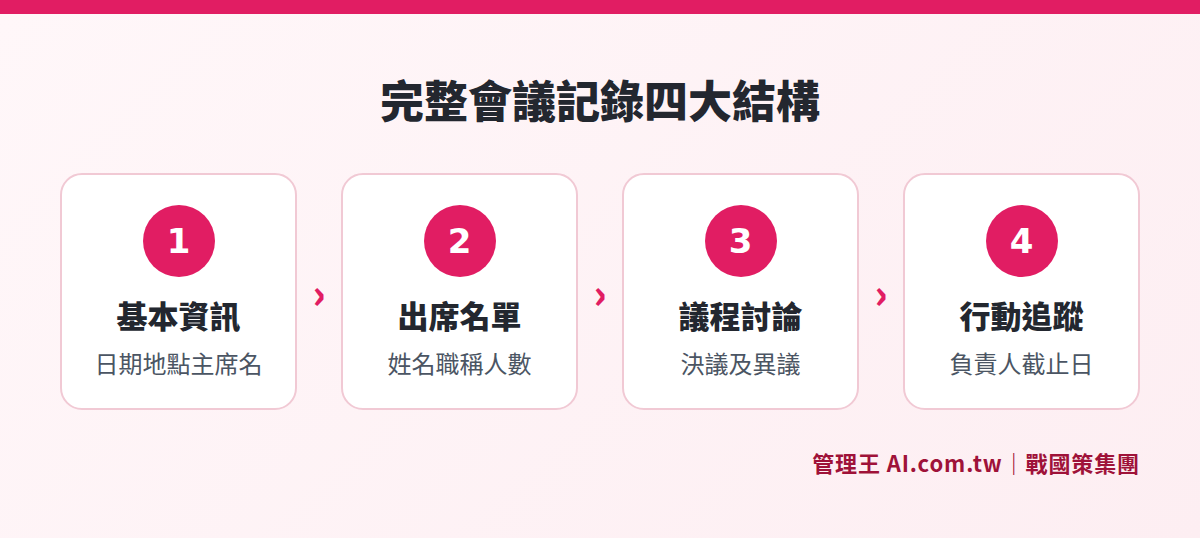
The five-step structure from basic information, attendance, agenda discussions to action items
What Are the Legal Requirements for Meeting Minutes?
In Taiwan, not all meetings have a unified legal format, but certain categories have specific regulations:
Board Meeting Minutes (Public Companies)
According to Rules of Procedure for Board Meetings of Public Companies (National Regulations Database) Article 16:
- The minutes should state: meeting number, date, location, chairperson's name, number of attendees, recorder, discussion situation of each agenda item, and decision methods
- The minutes should be signed or stamped by the chairperson and recorder
- Must be delivered to all directors and supervisors within 20 days after the meeting
- Audio or video recordings must be kept for at least 5 years (if litigation is ongoing, until the conclusion of the litigation)
Shareholders Meeting Minutes
According to Company Law Article 183, the minutes of a shareholders meeting for a joint-stock company must state:
- Essentials of the proceedings and their decisions
- Signature or seal of the chairman
- Delivered to all shareholders within 20 days from the date of the meeting
- Kept for at least 5 years, extended until the litigation is concluded if applicable
General Company Meetings
General business or departmental meetings do not have unified legal regulations, but good corporate governance practices suggest following the aforementioned spirit to ensure that "decisions are traceable and responsibilities are attributed."
Table: Summary of Legal Requirements for Different Types of Meetings
| Meeting Type | Applicable Regulations | Delivery Deadline | Retention Period |
|---|---|---|---|
| Board Meeting (Public) | Rules of Procedure for Board Meetings of Public Companies | 20 days | Audio/Video for 5 years or more |
| Shareholders Meeting (Joint-Stock Company) | Company Law Article 183 | 20 days | 5 years or more |
| Important Subsidiaries or Committees | Company bylaws or self-determined norms | According to the bylaws | According to the bylaws |
| General Business Meeting | No mandatory regulations | Suggested as soon as possible | Suggested for at least 3 years |
Formats and Templates for Meeting Minutes: Three Common Scenarios
Scenario 1: Regular Business Meeting (Weekly)
Simplified version, focusing on "action items":
```
Meeting Name: Weekly Business Meeting
Date: 2026/10/22 (Wednesday) 14:00–15:00
Host: Business Supervisor Zhang ○○
Attendance: All members of Business Division 1 (8 people in total)
[Report Items]
- 12 new clients acquired this week, 5 successfully converted
- Total Pipeline Amount NT$2,800,000
[Decision Items]
- Resolution: From next week, daily business reports must be filled out
→ Responsible Person: All sales staff / Deadline: Daily by 18:00
[To-Do Tracking]
| To-Do Item | Responsible Person | Deadline |
|---|---|---|
| Organize Q4 major client visit list | Li ○○ | 10/25 |
| Send new program quotations | Wang ○○ | 10/24 |
Adjournment: 15:02
Recorder: Assistant Chen ○○
```
Scenario 2: Board Meeting Minutes (Legal Format)
Must include all legal elements; it is recommended to use legal language, written by legal or secretarial departments, scanned for storage after signatures by the chairperson and recorder. Board meeting minutes, in addition to the basic information of general meetings, also require special notes:
- Each director's stance on each agenda item (in favor, opposed, abstained)
- Whether interested directors avoided voting
- If independent directors have objections or reserved opinions, their opinions should be recorded verbatim
- When approving written resolutions, the written agreement of each director
- If involving significant information, it must be announced within 2 business days as required
Usually, the chairperson's office or legal department designates a specific person to take minutes, and establish a standardized template to ensure compliance with regulatory authority requirements. The original minutes and related materials should be treated with just as much importance as the company's financial statements, creating complete physical and electronic backups.
Scenario 3: Cross-Departmental Project Meeting
Focus on "responsibility attribution" and "decision basis" across units, and it is recommended to record each resolution's objections or reserved opinions to avoid ambiguity in responsibility later.
The unique challenge of cross-departmental meetings is that different departments may have varying understandings of the same resolution, and disputes like "sales say they informed, administration says they didn’t hear" are common. Therefore, meeting minutes for cross-departmental meetings should pay special attention to:
- Clearly writing each action item's responsible department and responsible person's name, rather than just listing the department
- If there are items executed jointly across departments, clearly distinguish each party's respective responsibilities
- If resolutions involve budget or resource allocation, note the names of those who approved it and the scope of their authority
- At the start of the next meeting, the first agenda item should be “Tracking Action Items from Last Meeting”
Scenario 4: Online Video Conference
Online meetings through Zoom, Google Meet, Teams, etc., have become mainstream. There are a few special points to note when recording online meetings:
- The recording link and access permissions should be included in the meeting minutes (set an expiration date to avoid indefinite public access)
- Verify each participant's "join time" and "leave time" to confirm attendance
- Results from online voting or raised hands can be screenshots attached to the resolution as an attachment
- Important information or links presented in the chatroom should be extracted into formal records
How to Write Meeting Minutes Efficiently? Five Practical Tips
- Prepare a template in advance: Pre-fill the meeting name, agenda titles, and attendance list, only supplement the discussion content during the meeting instead of starting from a blank slate.
- Record to-do items in the format of “Decision + Responsible Person + Deadline”: Avoid vague phrasing like “everyone discussed and thought it could be considered”; every to-do must have a name and date.
- Note the main points of discussions instead of transcribing verbatim: Transcribing takes time and effort, and readers usually only need the "positions discussed" and "final decisions."
- Issue within 24 hours: Beyond 24 hours, details start to blur; beyond a week, action items lose their timeliness.
- Assign one “responsible person” per resolution: Even if multiple people are executing, there must be one primary responsible individual to avoid a "thought someone else was handling it" responsibility vacuum.
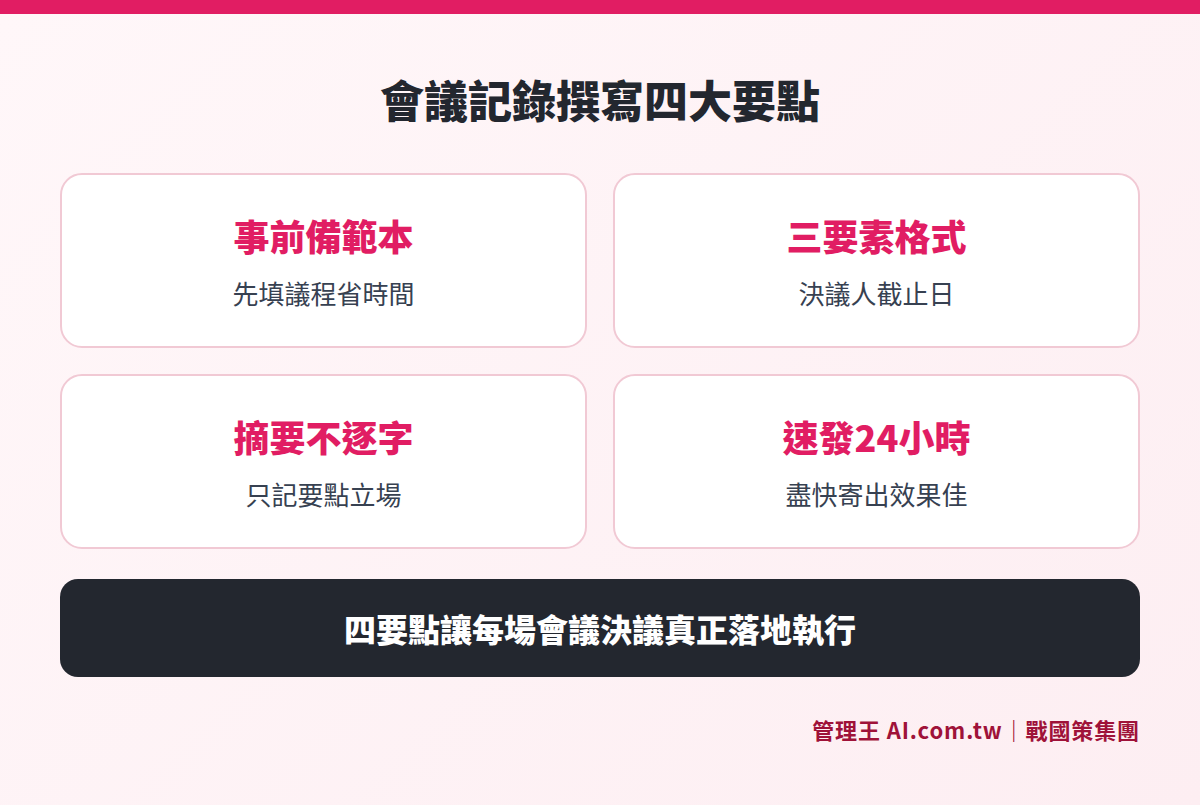
The four main writing points from preparation, record format, summarization principles to sending deadlines
How Does AI Automatically Organize Meeting Minutes?
The pain points of traditional manual recording are evident: the recorder is distracted by typing and cannot participate in discussions; organizing transcripts is time-consuming; action items scatter across various paragraphs, making them easy to overlook. AI meeting minute tools solve these issues through the following techniques:
Automatic Speech Recognition (ASR)
This technology converts meeting recordings into transcripts in real-time, supporting mixed languages and multiple speakers, with error rates continuously decreasing as models improve. Current mainstream tools support direct uploads or real-time streams from Zoom, Google Meet, and Teams.
Speaker Diarization
This separates the voice features of different speakers and automatically labels "Speaker A, Speaker B," then matches them against the attendance list for actual names, saving manual annotation time.
AI Summarization and Action Item Extraction
Using large language models (like GPT-4, Claude) to automatically extract discussion highlights, decision items, and detect patterns such as “Responsible Person + Task + Deadline,” generating a structured action item list.
Automatic Notifications and Task Integration
After the meeting ends, the minutes are automatically sent to all attendees and absentees, and the to-do items directly enter the task management system without manual transcription.
Full-Text Search and Knowledge Accumulation
AI systems index transcripts and summaries from each meeting, allowing searchability of all past resolutions and discussions. The conclusions from a discussion three months ago or specific demands made by a client at that time can be retrieved swiftly without combing through old emails or recorded audio; just search for keywords. This upgrades meeting minutes from a "one-time document" to a collective knowledge asset of the enterprise.
Recommended Steps for Implementing AI Meeting Minutes
When starting to implement AI meeting minutes, it is advised to begin with the following steps: first, select a regular meeting (such as a weekly or monthly meeting) as a pilot to familiarize members with the process of uploading audio or initiating real-time recognition; second, establish a workflow of “AI first draft + manual confirmation,” with the original recorder responsible for reviewing AI summaries and adding details; finally, gradually expand to other types of meetings while nurturing consensus on the action item format among staff (for example, agreeing to use the format “Responsible Person: XXX; Deadline: YYYY/MM/DD; Item: XXX”), making AI extraction more accurate.
How to Use 管理王 AI Meeting Minutes
管理王 AI Meeting Minutes integrates the aforementioned AI technologies into the daily workflows of enterprises, with specific operations as follows:
Audio Upload or Real-Time Streaming: Supports uploading MP3, WAV, M4A files, and can also import directly from mobile phones, Zoom, Google Meet. Real-time recognition supports Mandarin, English, and Japanese simultaneously, eliminating the need for post-meeting translations in international conferences.
Speaker Diarization Mapping to Real Names: The system automatically distinguishes speakers based on their voice characteristics, mapping them to real names from the participant list at the click of a button, clearly displaying "Manager Zhang said, Director Li said" in the meeting minutes.
AI Key Highlights + Action Items: After the meeting concludes, AI automatically extracts core topics, decisions, and identifies “who is responsible, what to do, due date,” making the to-do list visible to the responsible person the next time they log into the task management system.
Automatic Emailing and CRM Linking: Meeting minutes are automatically sent to all participants, and client meetings are linked with CRM customer profiles, allowing you to quickly find previously discussed terms after three months through full-text search.
Integration with AI Knowledge Base: Important resolutions can be stored in the enterprise AI knowledge base with one click, allowing employees to ask “What was the resolution on the XX project last time?” and receive instant responses without digging through old emails.
管理王 provides consulting support during the implementation, and the free plan can be used permanently, making it suitable for teams looking to test the effects of AI meeting minutes. Check plan pricing or directly try it for free.
Other AI tools and functions, AI smart reply, and AI command center all operate on one platform, with meeting room bookings also managed through the meeting room booking system, eliminating the need to switch between multiple apps.
Selecting Meeting Minutes Tools: Traditional vs. AI-Assisted
When selecting meeting minutes tools, enterprises typically face three choices: purely manual recording, dedicated transcription apps, or integrated AI enterprise systems.
| Comparison Item | Purely Manual | Transcription App (Standalone) | Integrated AI System |
|---|---|---|---|
| Transcriptions | Requires manual listening | Automatically generated | Automatically generated |
| Action Item Tracking | Manual transcription | Sometimes needs to be exported | Automatically enters task system |
| CRM Linking | None | None or requires API | Native integration |
| Multilingual Recognition | Depends on personal capability | Partial support | Mandarin, English, Japanese simultaneously |
| Data Storage Location | Local or personal cloud | Overseas servers | Taiwan data center |
| System Integration Cost | High (requires manual) | Medium (requires API) | Low (native) |
| Suitable Scale | 5 people or less | 10–30 people | 10–500 people |
Let AI Help Automatically Organize Meeting Minutes
管理王 consultants assist you in evaluating AI meeting minute implementation solutions with real-time transcripts and automatic tracking of action items, with a free plan permanently available.
Free consultation hotline: 0800-003-191
LINE Official Account: @119m
Official website: app.AI.com.tw
Free trial: Apply for Management Wang now
Frequently Asked Questions
Do Meeting Minutes Need to Be Signed?
Generally, there are no mandatory requirements for signing minutes of general company business meetings; however, board meeting minutes of public companies and shareholder meeting minutes of joint-stock companies must be signed or stamped by the chairperson and recorder as legally mandated. Electronic meeting minutes, complying with the Electronic Signature Law, are legally equivalent to paper signatures.
How Long Should Meeting Minutes Be Kept?
The minutes of shareholders meetings and board meetings of joint-stock companies must be retained for at least 5 years per company law regulations; retention is extended until litigation concludes if applicable. The audio and video records of board meetings of public companies must also be kept for at least 5 years. While there are no legal requirements for general business meeting minutes, it is advisable to retain them for 3 to 5 years based on business significance for future audits.
What’s the Difference Between Meeting Minutes and Meeting Summaries?
“Meeting minutes” (Minutes) are a more formal and complete document, containing legal elements, attendee signatures, and serving as verified records. “Meeting summaries” are informal brief overviews that typically only list decisions and action items, suitable for internal quick circulation. In formal occasions (like board meetings and shareholders meetings), meeting minutes should be used; for regular business meetings, summaries can be chosen as needed, but it is still advisable to include the three key elements: “Decisions + Responsible Persons + Deadlines.”
Are AI-generated Meeting Summaries Accurate? Are There Legal Risks?
AI summaries are based on speech recognition and large language models, and their accuracy is influenced by recording quality, accents, and speech speed; sometimes numbers or names discussed need manual verification. AI-generated records are not equivalent to legally mandated minutes, and formal occasions still require manual review and signature confirmation by the chairperson. The 管理王 system marks confidence levels for all AI responses, and it is recommended for employees to verify before saving.
Can Small Companies Without IT Departments Use AI Meeting Minutes?
Yes. The 管理王 free plan is available permanently, registration takes 30 seconds, and it can be operated within an hour without IT personnel setup. Uploading after recording on mobile or importing recordings from Zoom or Google Meet can all be completed within the interface. For implementation issues, business-level plans and above include remote training, and you can also consult directly at hotline 0800-003-191.
Data Sources
- Rules of Procedure for Board Meetings of Public Companies — National Regulations Database (Financial Supervisory Commission, legally periodically amended)
- Company Law — National Regulations Database (Ministry of Justice, Article 183 regarding shareholder meeting minutes)
- 管理王 AI.com.tw — AI Meeting Minutes Features Page (戰國策 Group, checked October 2026)
The content related to Company Law and procedural regulations mentioned in this article serves as general information and does not constitute legal advice; actual regulations should be based on the latest announcements from the regulatory authorities.