How Much Does an MES System Cost? Comparing Cloud and On-Premises Solutions | Recommended Production Management Systems
Monthly fees for cloud-based MES systems start from a few thousand TWD, while on-premises implementations cost between 800,000 to over 5 million TWD; this article organizes the cost structure, hidden costs, and government subsidies to help manufacturers clearly calculate the total cost of ownership (TCO) for the first five years before making a selection.
The cost of an MES system (Manufacturing Execution System) can vary more than tenfold depending on the deployment method. Cloud subscription plans start from a few thousand TWD per month, suitable for small and medium-sized manufacturers to quickly implement; on-premises solutions require an initial investment ranging from 800,000 to over 5 million TWD, offering more flexibility but heavier maintenance burdens. This article organizes the cost structures, hidden costs, government subsidy information, and common pricing traps encountered during selection to help manufacturers clearly calculate the total cost of ownership before signing contracts.
What is an MES System? Why Is There Such a Big Cost Difference?
MES (Manufacturing Execution System) is the core system that connects the ERP planning layer and the production site, responsible for managing production orders, BOM (Bill of Materials), process tracking, quality inspections, and finished goods inventory, among other aspects.
The fundamental reasons for the large cost differences are three:
- Deployment Model: Cloud SaaS subscription vs. on-premises self-built servers, resulting in completely different initial cost structures
- Customization Level: Standard modules vs. highly customized integrations, with each additional requirement raising costs
- Integration Complexity: The labor hours required for connecting to ERP, equipment IoT, and quality inspection instruments often account for 40-60% of total costs
According to practices in the Taiwanese market, consulting fees can often be 2 to 3 times the software licensing fees, and server and maintenance costs may double, resulting in a total cost of ownership (TCO) that can reach 200% to 300% of the initial licensing fee.
In a nutshell
The cost of MES is not just about licensing fees; consulting, implementation, equipment integration, and maintenance support are the hidden large costs, and the actual three-year cost is often over 1.5 times the quoted price.
Cloud MES Cost Structure
The advantage of cloud-based MES (SaaS subscription) is its low initial investment and fast go-live speed, making it suitable for small and medium-sized manufacturers ranging from 10 to 100 employees, as well as factories beginning their digital transformation and still unsure about their specific needs.
Table: Typical Cost Components of Cloud MES
| Cost Item | Description | Estimated Range (TWD) |
|---|---|---|
| Software Subscription Fee | Charged based on number of users or modules, payable monthly or annually | Thousands to tens of thousands TWD/month |
| Implementation Setup Fee | Initial data import, process settings, training | 50,000 to 300,000 (one-time) |
| Equipment Integration Fee | IoT sensors, machine networking modules | Subject to quantity of equipment |
| Custom Development Fee | Additional processes, special reports | Charged based on development hours |
Hidden risks of cloud MES include:
- Pressure to Upgrade Plans: Forced to upgrade to higher plans after increased usage, leading to substantial monthly fee increases
- Data Sovereignty Concerns: Data stored in the provider’s data center, requiring special confirmation for data transfer after contract termination
- Customization Limitations: SaaS standard functions cannot change underlying logic, making it difficult to meet special process demands
When selecting a cloud MES vendor, it is advisable to confirm two specific points: First, whether all production records and BOM data can be fully exported after contract termination; second, the SLA guarantees and compensation mechanisms if services are interrupted, as these directly affect the enterprise’s data sovereignty and operational continuity. Also, be cautious of "minimum contract duration" clauses hidden behind annual payment discounts to avoid incurring high penalties in the future if needing to change providers.
On-Premises MES Cost Structure
On-premises deployment is suitable for medium to large manufacturers with complex production processes, high confidentiality requirements, or existing IT infrastructure. The initial investment is higher, but long-term controllability is stronger.
Table: Typical Cost Ranges for On-Premises MES (Taiwan Market)
| Scale | System Range | Estimated Implementation Costs |
|---|---|---|
| Small Factory (Single Production Line) | Lightweight MES, including implementation services | 800,000 to 1,500,000 TWD |
| Medium-Sized Manufacturer (Multiple Lines + Quality Control) | Multiple line integration including quality tracking | 3,000,000 to 5,000,000 TWD |
| International Major Manufacturers (SAP ME, Siemens) | Full functionality for large enterprises | From 5,000,000 TWD |
Additional costs for on-premises deployments include:
- Servers and Data Center: Self-built or rented IDC, yearly maintenance costs vary by scale from 100,000 to over 500,000 TWD
- IT Personnel: Requires dedicated IT maintenance staff or outsourced vendor support
- Version Upgrade Fees: System version upgrades often require separate fees for upgrade services
According to practical research from Taiwanese consulting firms, hidden costs for on-premises MES will increase total expenses by 25% to 50% within three years; therefore, it is recommended to reserve this proportion as a buffer beyond the initial quote.
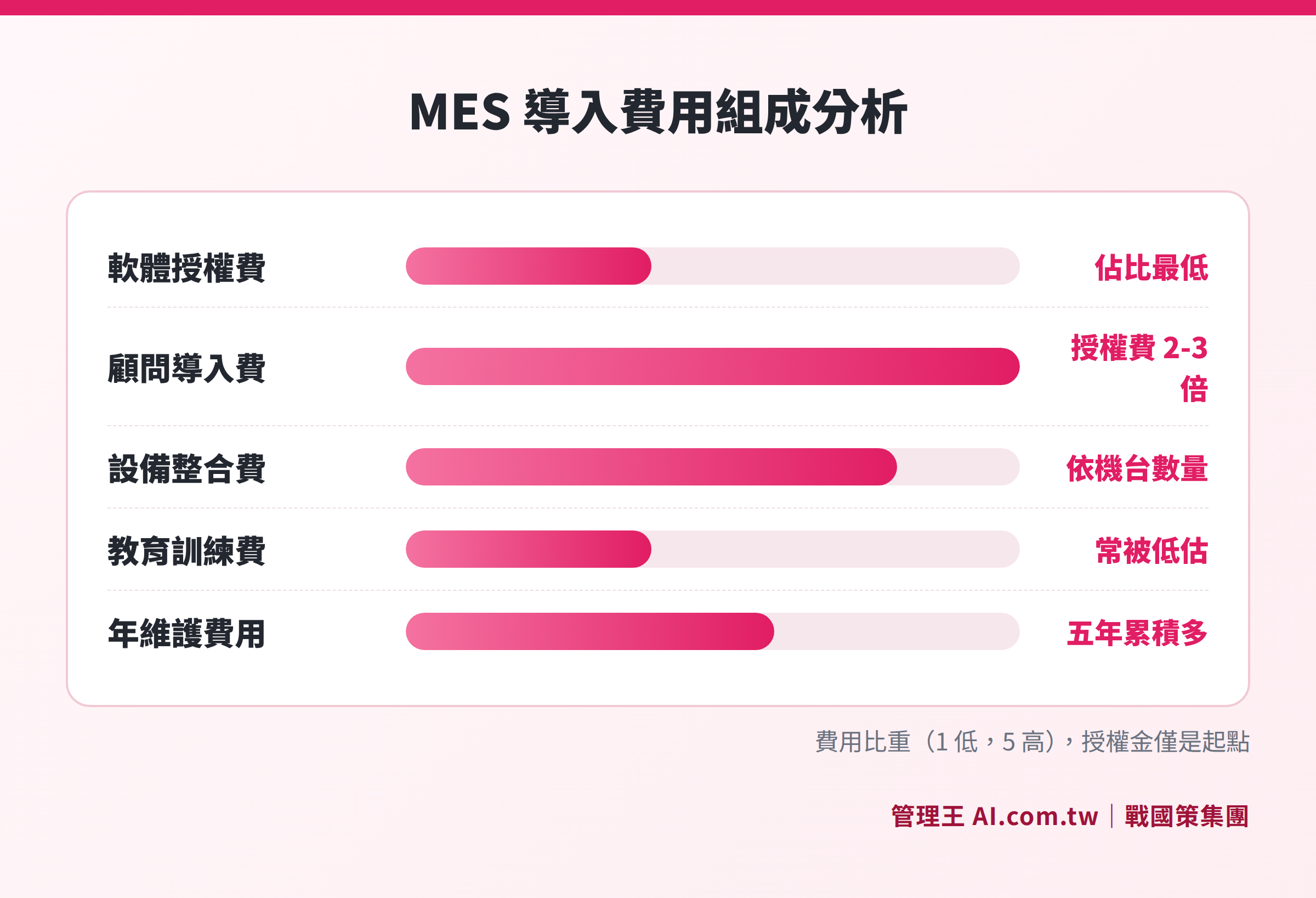
Comparison of cloud MES and on-premises MES across three dimensions: initial investment, maintenance costs, and customization flexibility
Government Subsidies: What Resources Are Available for Implementing MES?
The Taiwanese government actively promotes smart manufacturing, and manufacturers can apply for various subsidies when implementing MES, effectively reducing out-of-pocket costs.
Main subsidy channels include:
- Low-Carbon and Smart Upgrade Subsidies: Promoted by the Industrial Development Bureau of the Ministry of Economic Affairs, SMEs in manufacturing with over 10 employees can apply for subsidies of up to 50% of project costs
- Smart Machinery Industry Promotion Program: Provides consulting and subsidy matching for machine connectivity and MES integration
- Tax Incentives under Industry Innovation Acts: Eligible intelligent equipment investment can enjoy corporate income tax deductions of 5% of the investment amount (maximum 3% over three years)
Points to note when applying for subsidies:
- Subsidy applications usually need to be completed before implementation, and retrospective applications are not allowed
- It is advisable to first find a government-approved consulting firm for evaluation; many consulting firms offer free matching and guidance
- The subsidy amounts and eligibility criteria are adjusted annually, subject to the latest announcements from the competent authority
In practice, many manufacturers report that the subsidy application documents are cumbersome and require consulting assistance, so it is recommended to engage with guidance organizations early to confirm application schedules and required documents, avoiding missing the application window. Some local governments also offer digitalization subsidy programs that can be applied simultaneously with central subsidies to maximize subsidy benefits and effectively lower self-funding ratios.
Cloud vs On-Premises: How to Choose Based on Five Key Dimensions?
The following five dimensions help manufacturers make decisions:
Table: Selection Decision Matrix
| Decision Dimension | Recommend Choosing Cloud | Recommend Choosing On-Premises |
|---|---|---|
| Initial Budget | Limited, want to go live quickly | Ample, accept longer implementation periods |
| Customization Needs | Primarily standard processes | High customization for complex process logic |
| IT Personnel | No dedicated IT team | Has IT department or outsourced support |
| Data Sovereignty | General commercial data | Involves high confidentiality or regulatory compliance needs |
| Scale Outlook | Small and medium-sized, needs flexibility | Large or group, demands system stability |
Generally, it is recommended for small and medium-sized manufacturers with fewer than 50 employees to prioritize cloud solutions due to their low startup costs and manageable risks. For factories with over 100 employees and complex processes, on-premises solutions may not necessarily be higher in total long-term costs, and there is greater room for customization.
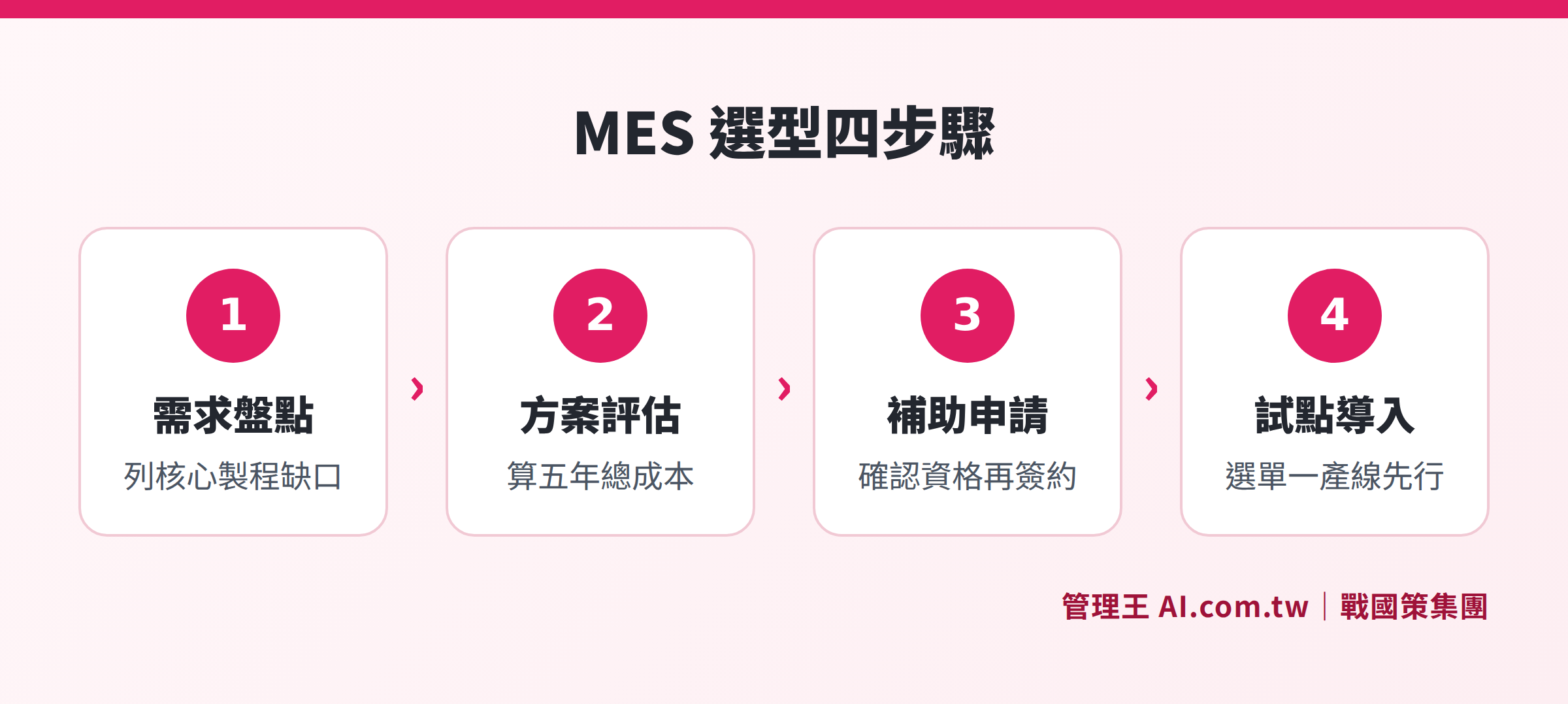
Complete decision-making steps for manufacturers evaluating MES systems from demand inventory to solution selection
Pricing Traps: The 5 Aspects Most Easily Underestimated
Many factories find that the actual implementation costs far exceed the budget after receiving MES quotes, with common reasons including:
- Integration Labor Hours Not Included: Costs for IoT networking of machines and sensor installation are often additional, with integration fees for each piece of equipment ranging from 10,000 to 50,000 TWD
- Insufficient Training Costs: Standard quotes often include only 1 to 2 days of training, but it actually takes 2 to 4 weeks to stabilize production line usage
- System Integration Costs Underreported: The labor hours for integration with existing ERP or WMS are hard to estimate accurately at first; it is advisable to request written estimates of the labor hours for each interface
- Annual Maintenance Fees Overlooked: Annual maintenance costs are usually 15% to 20% of software licensing fees, cumulative over five years should not be underestimated
- Upgrade Fees Not Disclosed: Major upgrades for on-premises solutions every 2 to 3 years often incur separate upgrade service fees
Recommendation: Request vendors to provide a "five-year TCO spreadsheet" covering licensing fees, implementation costs, integration fees, training fees, maintenance fees, and upgrade fees, and then compare horizontally with other solutions.
How to Use Management Wang’s Manufacturing System?
Management Wang AI.com.tw Manufacturing System operates on a cloud subscription model, replacing high on-premises implementation costs with transparent monthly fees, allowing small and medium-sized manufacturers to quickly go live with core MES functions.
Operational methods include:
- BOM (Bill of Materials): Supports multi-level unfolding and loss rate settings, allowing the creation of product structure trees directly within the system without Excel maintenance
- Production Order: Automatically calculates material requirements with one click, and material issuance is completed directly in the system without paper circulation
- MRP Material Shortage Calculation: Automatically calculates shortage lists based on unfinished production orders and suggests purchase quantities, directly integrating with Procurement System
- Finished Goods Inventory + Quality Inspection: Automatically updates the Inventory System after completion, with quality records saved in sync
Transparent public pricing for solutions: The free plan can be used indefinitely, suitable for manufacturers just starting their digital transformation to test the waters; the economical plan is NT$5,000/month and the business plan is NT$10,000/month, providing more comprehensive AI functions and member limits, with all AI functionalities included at no extra charge.
Native integration with ERP Systems and Accounting Systems means data is interoperable within the same system without additional integration fees. If standard functionalities cannot meet special process needs, customization can be strengthened with transparent billing at NT$1,000/hour, and assessments from consultants are provided free of charge before confirming written hours to begin work, making the cost structure far clearer and more predictable than traditional on-premises MES quotes. 戰國策 Group has served over 30,000 enterprises, with local support from the Taiwan team and direct access to 0800 customer service.
For more production management knowledge, refer to: What is a Production Management System? Integrating BOM, MRP, Work Orders to Quality Control | Recommended Production Management Systems
Free Calculation of Your MES Implementation Costs
Management Wang consultants assist in inventorying demands, comparing cloud and on-premises solutions, and providing transparent five-year TCO calculations, with free implementation consultations available without any contract binding.
Free consultation hotline: 0800-003-191
LINE official account: @119m
Official website: app.AI.com.tw
Free trial: Apply for Management Wang now
Frequently Asked Questions
Do you have to spend a lot of money to implement an MES system?
Not necessarily. The monthly fee for cloud SaaS MES solutions can start from a few thousand TWD, suitable for small and medium-sized manufacturers to initiate digitalization with low risk. The high costs of on-premises deployments mainly arise from custom development and equipment integration; if the production processes are highly standardized, using cloud solutions can significantly reduce initial costs.
Which is cheaper in the long run, cloud MES or on-premises MES?
It depends on the scale of the factory and the duration of use. Cloud solutions have low initial costs, but long-term accumulated monthly fees may exceed the total costs of on-premises solutions, typically using 5 to 7 years as a threshold. On-premises solutions have higher initial costs but offer strong long-term controllability, making them suitable for large factories with IT personnel planning for long-term use. Small and medium enterprises are advised to clarify their five-year TCO before making a decision.
Does the Taiwanese government subsidize MES implementation costs?
Yes. The Ministry of Economic Affairs’ Industrial Development Bureau’s "Low Carbon and Smart Upgrade Subsidies" offers up to 50% of project costs for SMEs in manufacturing with over 10 employees; the Industry Innovation Ordinance also provides corporate income tax deductions for intelligence equipment investments. It is recommended to confirm eligibility before signing contracts for implementation, as subsidies must be applied for prior to implementation. Specific eligibility and amounts are based on the latest announcements from the competent authority.
What are the differences between MES and ERP? How are costs calculated separately?
ERP (Enterprise Resource Planning) manages business processes such as order, finance, procurement, and inventory, while MES focuses on the execution of production orders, tracking working hours, and recording quality control on the production floor. The two are complementary: ERP handles planning, while MES manages execution. Traditionally, costs are calculated separately and integrated later, which often incurs additional integration fees; using an integrated system with native integration (like Management Wang) can eliminate these integration costs.
How long does it take to recoup the investment in MES implementation?
According to practical data from MES providers in Taiwan, general manufacturing plants can recoup their investment costs within 1 to 3 years after stabilizing the system based on reduced manual entry errors, enhanced production visibility, and shortened scheduling operation times. The speed of recovery is highly related to the original level of digitalization, system utilization rates, and willingness to improve management.
Sources
- Footmark MES | What is the Cost of Implementing MES? Analysis of MES System Costs and ROI (consulted in 2026)
- Zhanxin Information | What is MES System? Comprehensive Analysis of Architecture, Functions, and Costs (consulted in 2026)
- Hengyuan Digital Technology | AI Automation Costs for Small and Medium-Sized Factories in Taiwan 2026 (consulted in 2026)
- Executive Yuan National Development Council | Accelerating the Promotion of Smart Machinery Industry — Making Taiwan an "Asian High-end Manufacturing Center" (consulted in 2026)
This article is for general information and does not constitute legal or tax advice; actual subsidy eligibility, amounts, and application procedures are subject to the latest announcements from the competent authority.