How to Choose an Email Newsletter Platform? 6 Key Features Small and Medium Enterprises Care About|Email Newsletter System Recommendations

Analyzing six key features for choosing an email newsletter platform: subscriber list segmentation, automated trigger scenarios, SPF/DKIM/DMARC delivery rate guarantees, open and click rate tracking, drag-and-drop templates, and AI subject optimization and best sending time prediction. Includes a comparison table of mainstream platform costs and compliance with Taiwan’s Personal Data Protection Act.
An email newsletter platform is a marketing tool for businesses to reach each subscriber directly without being limited by social media algorithms. Compared to the declining natural reach on Facebook and Instagram, nearly all emails reach the subscriber's inbox, making it a low-cost core channel for small and medium enterprises to maintain customer relationships and increase repurchase rates. The six critical features for selecting an email newsletter platform are: subscriber list management and segmentation, automated scenario-triggered sending, delivery rate guarantees (SPF/DKIM/DMARC three-layer verification), open rate and click rate tracking, professional templates and mobile display, as well as AI subject optimization. In terms of costs, international tools start at about NT$400 per month, while local integrated plans typically exceed NT$5,000 per month, with differences in integration depth and localized services.
Why Do Small and Medium Enterprises Need an Email Newsletter Platform?
Many small and medium enterprises’ first marketing tools are LINE official accounts or Facebook communities. Although these channels can quickly establish a reach, adjustments to algorithms and platform policy changes directly affect reach, and businesses do not have complete control over subscriber lists. If platform rules change or accounts are restricted, accumulated fans become difficult to transition.
Email newsletters are different: the subscriber list is a business's own asset. Once subscribers join, emails can continue to be sent regardless of platform updates. With marketing automation, the right message can be sent to the right person at the right time, yielding a return on investment (ROI) much higher than relying solely on advertising.
According to email marketing research, the average open rate for automated trigger emails (such as welcome emails and cart abandonment reminders) is about 30%, significantly higher than the approximately 20% for typical marketing emails, highlighting the importance of "the right timing" in email newsletter marketing.
Key Takeaway
The email newsletter list is an asset owned by the business, unaffected by algorithms, and the open rates for automated emails are about 50% higher than standard marketing emails.
6 Key Features Small and Medium Enterprises Care About
Before choosing an email newsletter platform, it’s recommended to evaluate the following six essential features to ensure each meets your needs, preventing the selection of a cheaper option that lacks key functionalities.
Table: Overview of 6 Core Features of Email Newsletter Platforms
| Feature | Description | Importance for SMEs |
|---|---|---|
| Subscriber List Management | Segmentation, tagging, blacklist, CSV import | High: A precise list ensures reaching the right people |
| Automated Triggering | Welcome emails, birthday greetings, cart abandonment reminders | High: Saves labor and automatically increases conversion rates |
| Delivery Rate Guarantee | SPF/DKIM/DMARC three-layer verification | High: Ending up in spam is equivalent to wasted effort |
| Performance Data Tracking | Open rate, click rate, bounce rate | Medium-High: Continuous optimization relies on data |
| Template Design | Drag-and-drop editing, mobile preview | Medium: Lowers design barriers |
| AI Subject Optimization | Subject suggestions, A/B testing, best timing | Medium: Effectively increases open rates |
The following six sections will explain the purchase focus of each feature.
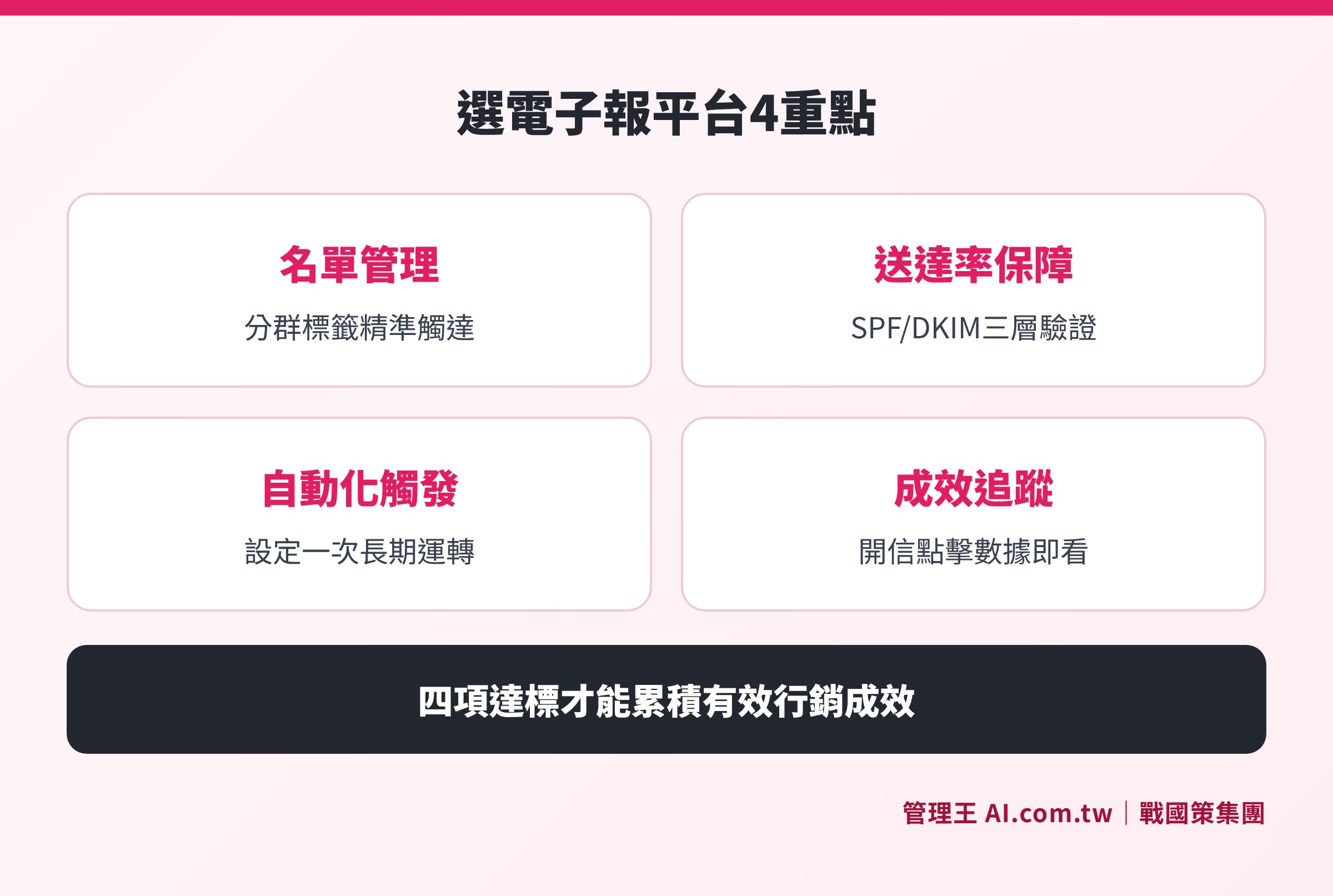
Core purchase indicators for list management, delivery rate guarantee, automated triggering, and performance tracking all in one view
Feature 1: Subscriber List Management and Segmentation Tags
List management is the foundation of all email newsletter functionalities. If the list is not clear, no matter how good the content is, it will be sent to the wrong people, leading to naturally low open and conversion rates.
Key Evaluation Items:
- Segmentation Criteria: Can dynamic segmentation be established across multiple dimensions such as profession, region, purchasing behavior, engagement, etc.?
- Tagging Mechanism: Can each subscriber be assigned multiple custom tags (for example, "VIP customer" or "attended an event")?
- Blacklist Management: Do unsubscribes, invalid email addresses, and complaint addresses automatically move into a blacklist to avoid damaging sending reputation?
- CSV Import: Can existing lists be uploaded in bulk? Does it support field mapping?
- Compliance with Personal Data Protection Laws: According to Article 20 of Taiwan’s Personal Data Protection Act, non-public entities using personal data for marketing must proactively inform the involved parties and provide free opt-out means, ceasing marketing use immediately upon receiving an opt-out request. The platform should support opt-out record retention.
A good list management tool should allow you to clearly know "who this email is being sent to and why", rather than sending it to everyone indiscriminately.
Feature 2: Automated Triggering for Sending Scenarios
Manual mass sending is something everyone can do, but what saves time and effort is the "set it once, run it automatically" automation scenarios. Common automation scenarios include:
- Welcome Email Series: Automatically sends the first email, followed by guidance emails on the third and seventh days after a new subscriber joins
- Birthday Greetings: Automatically sends personalized discounts based on the subscriber's birthday
- Cart Abandonment Reminders: Automatically sends reminder emails after a certain time if items are left in the shopping cart
- Repurchase Promotion: Automatically sends reminders for replenishment or cross-selling suggestions after a purchase
When purchasing, pay attention to the flexibility of triggering conditions: platforms that only support fixed-time triggers have limited scenarios; those that support behavior triggers (such as "clicked a certain link" or "opened but did not make a purchase") can design an entire customer journey automation.
Moreover, it's crucial to confirm whether an unsubscribe link is automatically included in accordance with regulations. According to Taiwan’s Personal Data Protection Act, every marketing email must provide a clear way to unsubscribe, and sending must stop immediately upon receiving an unsubscribe request.
Feature 3: Delivery Rate Guarantee (SPF/DKIM/DMARC Three-Layer Verification)
Delivery rate is the most easily overlooked yet impactful indicator in email newsletter marketing. No matter how good the content is, if it ends up in the spam folder, the conversion rate is zero.
Three-layer verification technologies are explained as follows:
Table: Explanation of the Three-Layer Email Verification Mechanism
| Technology | Full Name | Function Explanation |
|---|---|---|
| SPF | Sender Policy Framework | Specifies which IPs are authorized to send emails on behalf of your domain in DNS settings |
| DKIM | DomainKeys Identified Mail | Adds a digital signature to each email, verifying its content has not been altered |
| DMARC | Domain-based Message Authentication, Reporting & Conformance | Instructs receiving servers on how to handle emails that fail verification and reports anomalies |
Starting in 2024, Google and Yahoo will require senders sending more than 5,000 emails daily to complete SPF and DKIM settings and establish DMARC records; Microsoft (Outlook, Hotmail) has similar regulations. Even if the daily sending volume is below this threshold, completing the three-layer verification can significantly reduce the chances of ending up in spam, protecting the long-term reputation of the sending domain.
When choosing a platform, confirm whether it provides self-service or guided three-layer verification setup tools and can continuously monitor the reputation score of the sending email account, proactively notifying of any anomalies.
Feature 4: Open Rate and Performance Data Tracking
Often, marketing efforts yield no results simply because data is not tracked, hindering improvements. A good email newsletter platform should provide the following complete metrics:
- Delivery Rate: The actual delivery ratio (excluding bounced emails)
- Open Rate: The percentage of emails opened after being received
- Click Rate (CTR): The percentage of emails where links were clicked
- Bounce Rate: Divided into "hard bounces" (invalid email addresses) and "soft bounces" (temporarily full mailboxes)
- Unsubscribe Rate: The percentage of emails where the unsubscribe link was clicked
- UTM Tracking: Automatically adds UTM parameters to links for Google Analytics tracking of complete behavior post-entry
Marketers can reference industry benchmarks to measure their performance. According to email marketing research, the average open rate across industries hovers around 19% to 20%, while automated trigger emails (like welcome emails and cart abandonment reminders) average about 30%. Industry discrepancies are significant, with B2B services typically outperforming retail e-commerce. Importantly, it's essential to compare data after each sending to continuously optimize, rather than interpreting single figures in isolation.
Feature 5: Professional Templates and Mobile Display
Most people now check emails on their mobile phones, and if the email displays poorly on mobile, even with high open rates, the conversion rates will be impacted. When selecting a platform, verify:
- Template Quantity and Categorization: Do they offer categorized templates for holidays, new product launches, promotions, tutorials, announcements, etc.?
- Drag-and-Drop Editor: Can you format directly in the preview interface without coding, adjusting images, text, and buttons?
- Mobile Preview: Can you switch between desktop, mobile, and tablet preview modes in real-time during design?
- Image and Video Support: Do they support embedding images, video thumbnails, or GIFs?
- Traditional Chinese Font Compatibility: Some international tools have issues rendering traditional Chinese fonts; it’s advisable to verify display results through test emails.
Feature 6: AI Subject Optimization and Best Sending Time
The subject line is the most critical factor determining open rates. A/B testing different subject lines, having AI recommend high open rate subject options, and predicting the best sending times based on historical data are functions that are standard in international platforms, though Taiwan's local platforms vary considerably.
Purchase Focus:
- A/B Subject Testing: Can you set testing ratios (for example, 20% testing and 80% sending the winning version)?
- AI Subject Suggestions: Can multiple subject options be generated automatically based on email content?
- Best Timing Prediction: Does it recommend sending times based on subscribers' historical open behaviors, instead of a fixed time every Tuesday morning?
- Personalized Sending Times: Advanced feature that sends emails in batches based on each subscriber’s personal email opening habits.
Using AI subject recommendations alongside A/B testing can enhance open rates for the same group of recipients without adding extra budget, making it one of the most cost-effective optimization methods for marketing personnel in small and medium enterprises.
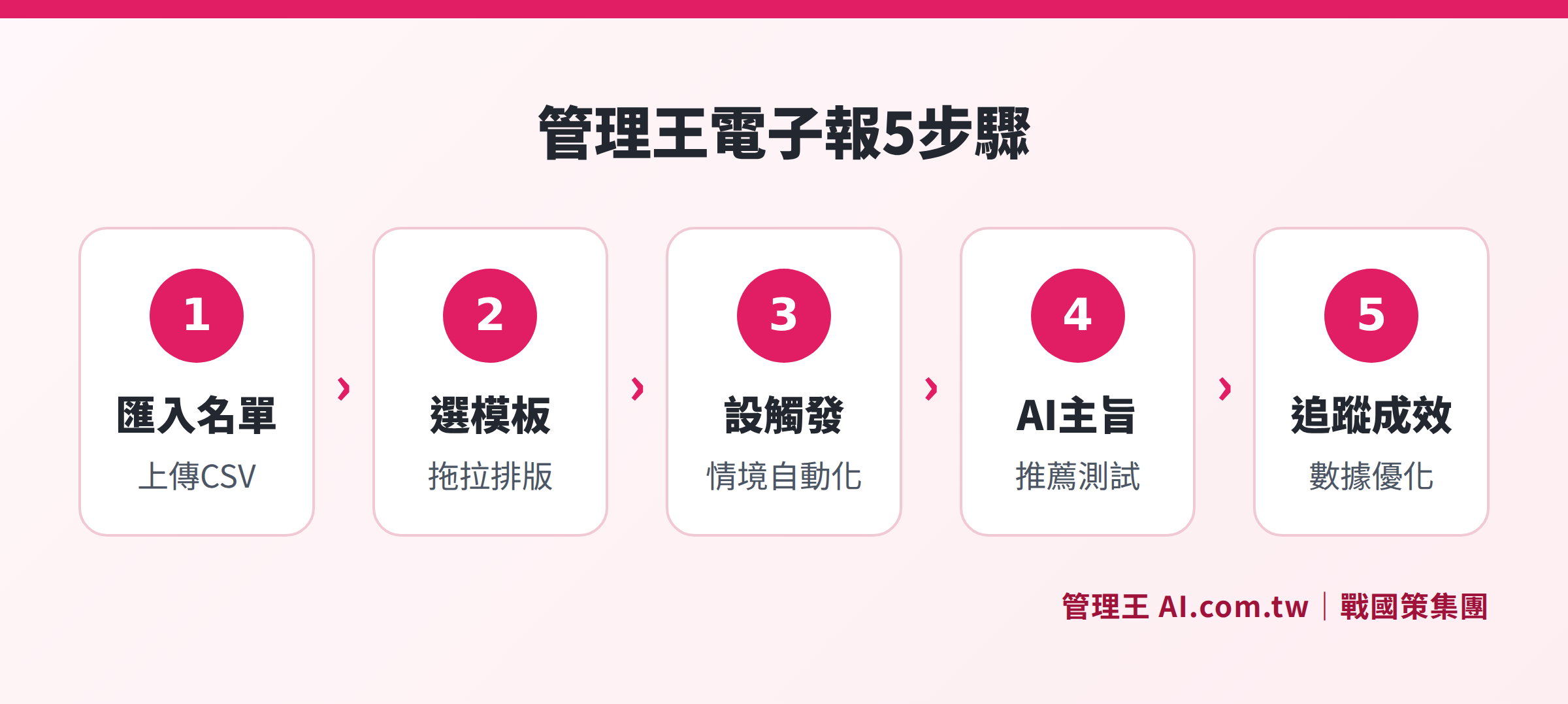
Steps from importing lists, selecting templates, setting trigger conditions, to AI optimizing subjects and tracking performance
Email Newsletter Platform Cost Comparison
The common email newsletter platforms in the Taiwan market are mainly categorized into international SaaS tools, local Taiwan tools, and integrated business systems. The following is compiled based on publicly available information on each platform's official website (as of November 2026):
Table: Comparison of Mainstream Email Newsletter Platforms’ Costs and Features
| Platform | Free Plan | Starting Paid Fee (Approximate NT$) | Main Features |
|---|---|---|---|
| Mailchimp | Yes (with limitations) | Starting at approx. NT$400/month | Rich integration ecosystem, complete AI features |
| MailerLite | Yes (1,000 subscribers) | Starting at approx. NT$320/month | User-friendly, digital product sales |
| ActiveCampaign | No (14-day trial) | Starting at approx. NT$480/month | High delivery rates, built-in CRM |
| Newsleopard | No | Starting at NT$600/month | Local Taiwan tool, priced per email sent |
| 管理王 AI.com.tw | Yes (perma-free) | Starting at NT$5,000/month | Integrates with CRM, accounting, and personnel, using AWS SES for sending |
Note: The monthly fees for international tools are estimated based on the exchange rate at the time of inquiry; actual costs may vary with exchange rate changes. The above table only includes basic plans. It is advisable to verify the latest pricing on each platform's official website before purchasing.
While cost is not the only consideration for small and medium enterprises when selecting a platform, if the email newsletter list needs to integrate with CRM customer data, order data, or LINE notifications, using a separate email newsletter tool would require additional integration costs and maintenance; although integrated platforms come with a higher monthly fee, they eliminate connection costs, meaning the total cost of ownership (TCO) may not necessarily be more expensive.
How to Use 管理王 Email Newsletter System
The 管理王 AI.com.tw's email newsletter system utilizes AWS SES for sending, automatically completes SPF, DKIM, and DMARC domain verification, providing fundamental technical assurance of delivery rates. The platform offers over 20 categorized templates, along with AI subject optimization and A/B testing features, enabling small and medium enterprises to run email newsletters without needing dedicated marketing personnel.
Specific Operational Steps:
- Import Subscriber List: Supports bulk CSV imports, including opt-out record fields, complying with Taiwan’s Personal Data Protection Act requirements.
- Select Template: Offers over 20 categorized templates (for holidays, new products, promotions, tutorials, announcements), using a drag-and-drop editor to modify content and complete layout within ten minutes.
- Set Automated Triggering: Conditions for welcome emails, birthday greetings, and cart abandonment reminders can be set once and will run automatically over time.
- AI Optimize Subject Lines: Input email content, and AI recommends multiple subject options; supports A/B testing and best sending time prediction.
- Track Performance: After each sending, check delivery rate, open rate, click rate, and bounce rate, adjusting the next strategy according to data.
Email newsletter functions are interconnected with 管理王's CRM system, marketing automation, social scheduling, and Landing Page, all within the same account. CRM customer data can be used directly for segmentation without needing additional API or integration costs.
The free plan can be used permanently; AI features provide one-time quota; for further understanding of each plan, refer to 管理王 service plans. For a more complete explanation on selecting email newsletter tools, refer to How to Choose an Email Newsletter System? Understanding Lists, Templates, and Open Rate Tracking.
The 戰國策 Group serves over 30,000 enterprises, and the design of the email newsletter system is based on genuine feedback from small and medium enterprises in Taiwan. With a traditional Chinese interface and compliance with local regulations, consulting services are available from Monday to Friday, 09:00–18:00.
Try the 管理王 Email Newsletter System
Free plan is permanently available, featuring AI subject optimization, automated triggering, and delivery rate guarantees; one account integrates CRM and marketing.
Free consultation hotline: 0800-003-191
LINE Official Account: @119m
Official Website: app.AI.com.tw
Free trial: Apply for 管理王 now
FAQ
Do I have to set up SPF/DKIM for the email newsletter platform?
It is strongly recommended to set it up. Starting in 2024, Google and Yahoo will mandate SPF and DKIM verification for senders sending over 5,000 emails daily, and DMARC records must be established. Even if the daily sending volume is below this threshold, completing the three-layer verification can significantly reduce the chances of entering spam and protect the long-term reputation of the sending domain. Choose platforms that offer automated three-layer verification setup features to lower technical operation barriers.
What is a normal open rate?
According to email marketing research data, the average open rate across industries is about 19% to 20%; automated trigger emails (such as welcome emails and cart abandonment reminders) average around 30%. Industry differences are significant, with B2B services usually higher than retail e-commerce. It is advised to use your past sending historical data as a baseline and continuously optimize subject lines, sending times, and content after each sending, rather than contrasting with industry averages in isolation.
Can I use the free version of 管理王 Email Newsletter System?
Yes. The 管理王 free plan can be used permanently, including basic email newsletter system functions, with AI features offering a one-time point quota. If higher AI usage or more team members are needed, you can upgrade to the economic plan (NT$5,000/month, limit of 30 users, 1,000 AI points/month) or higher plans. For detailed comparison of plans, see 管理王 service plan page.
Can subscriber lists be migrated from other platforms?
Most email newsletter platforms support CSV format imports, with some offering consulting assistance for free migration from tools like Mailchimp, HubSpot, ConvertKit, etc. Prior to migration, check if the subscribers’ opt-in records are maintained to comply with the disclosure obligation under Article 20 of Taiwan's Personal Data Protection Act. 管理王’s CSV import supports opt-out record fields to ensure compliance.
Are email newsletters suitable for B2B or B2C?
Both are applicable, but the operational focuses differ. B2C email newsletters primarily emphasize promotions, holiday events, and repurchase reminders, focusing on visual templates and sending timing optimization; B2B newsletters tend to emphasize content knowledge, case sharing, and development email sequences, focusing on personalization and integration depth with CRM. The 管理王 email newsletter system supports both scenarios, allowing CRM customer data to be used directly for segmentation, and B2B follow-up emails can be set up with the CRM system for automated tracking.
Data Sources
- Gmail Bulk Sender Guidelines: Google Support – Email sender guidelines
- Email Marketing Open Rate Benchmarks: Brevo – Email Marketing Benchmarks
- Article 20 of Taiwan's Personal Data Protection Act (Marketing Regulations): National Legal Database
- SPF Technical Standards: RFC 7208, Internet Engineering Task Force (IETF)
- DKIM Technical Standards: RFC 6376, Internet Engineering Task Force (IETF)
- DMARC Technical Standards: RFC 7489, Internet Engineering Task Force (IETF)
- 管理王 Email Newsletter System Feature Page: https://app.ai.com.tw/features/newsletter
- 管理王 Service Plans: https://app.ai.com.tw/pricing