How to Choose an Email Newsletter System? Understand Lists, Templates, and Open Rate Tracking at Once|Email Newsletter System Recommendations
An email newsletter system enables businesses to build their own mailing lists, design emails, automate sending, and track open rates, freeing them from the constraints of social media algorithms. This article covers seven key purchasing criteria, three compliance requirements under Taiwan's Personal Data Protection Act, five automation scenarios, and a complete operational process for the Management King email newsletter system, making it suitable for small and medium-sized enterprises in Taiwan.
An email newsletter system (EDM system) is a marketing tool used by businesses to establish subscription lists, design email templates, automate sending, and track open and click rates. Simply put, it allows businesses to reclaim the "power to communicate directly with customers," no longer relying on social media platform algorithms to determine reach. When selecting an email newsletter system, small and medium-sized enterprises in Taiwan need to consider compliance with personal data protection laws (which require a subscription unsubscription mechanism under Article 20), support for Traditional Chinese interfaces, and the ability to integrate with local channels like LINE. This article comprehensively explains all aspects of email newsletter systems, from functional analysis and purchasing criteria to compliance points and practical operations.
What is an Email Newsletter System? Three Core Concepts
An email newsletter system (also known as an EDM system or Email Marketing System) consists of three core modules: List Management, Email Design, and Data Analysis.
List Management: Collects email addresses through subscription forms, supports segmentation (e.g., potential customers, previous customers, VIP members), tagging, and blacklist management. The quality of the list determines the effectiveness of sending emails; a "clean list" is far more important than a "large list."
Email Design: The WYSIWYG editor allows non-designers to layout easily; multi-column layouts, images, buttons, and video links can all be drag-and-dropped into place; the template library (festive promotions, new product launches, birthday greetings, weekly reports, etc.) allows for the rapid completion of repetitive tasks.
Data Analysis: Each sending automatically reports deliverability rates, open rates, click rates, bounce rates, and unsubscribe rates. Some systems support UTM parameters and A/B testing for subject lines, transforming marketing from "feeling-based" to "data-driven."
In a nutshell
An email newsletter system allows businesses to reach every subscriber directly without relying on algorithms, and continuously optimize communication effectiveness through automation and data analysis.
Advanced email newsletter systems also provide automation scenario triggers: automatic welcome emails are sent to new subscribers, birthday discount codes are automatically sent three days before a member's birthday, and reminders are automatically sent after shopping cart abandonment. Set it once, and it will run automatically in the long term, saving significant manpower.
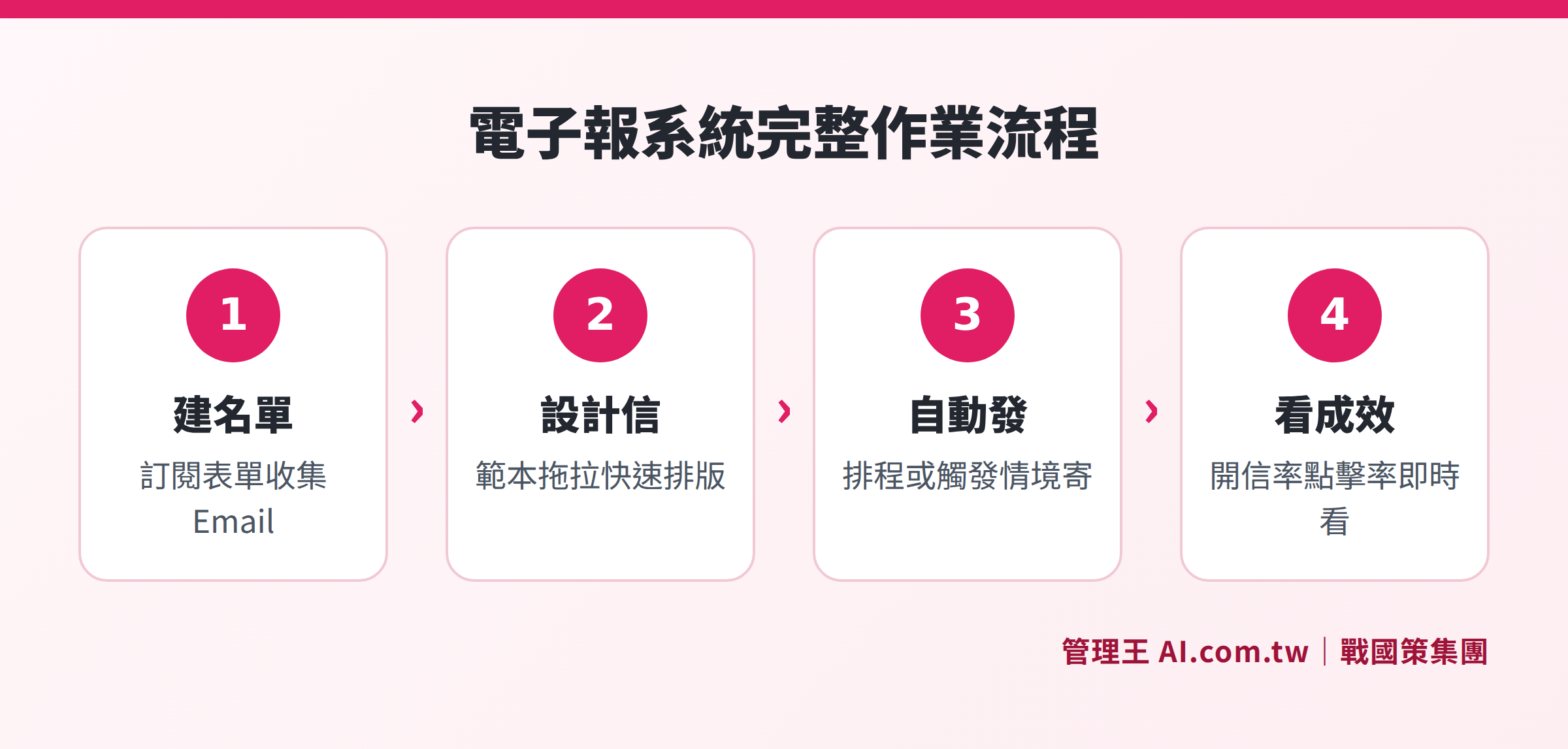
Complete operational flow from list collection to email design and performance tracking
What Metrics Does an Email Newsletter System Have? Industry Open Rate Benchmarks
Before choosing an email newsletter system, it's important to understand the industry's performance benchmark figures to set reasonable goals.
According to the Mailchimp 2024 Email Marketing Benchmark Report, the average metrics for various industries are as follows:
Table: Average Open Rates and Click Rates for Each Industry (Mailchimp 2024)
| Industry Category | Average Open Rate | Average Click Rate | Average Unsubscribe Rate |
|---|---|---|---|
| E-commerce / Retail | 29.8% | 2.3% | 0.19% |
| Food and Beverage | 30.5% | 1.9% | 0.10% |
| Education | 35.6% | 2.7% | 0.12% |
| Business and Financial Services | 31.4% | 2.5% | 0.21% |
| Non-Profit Organizations | 40.1% | 3.2% | 0.10% |
| Overall Average | 32.6% | 2.6% | 0.22% |
Note: Apple Mail Privacy Protection (MPP) automatically pre-loads emails, which may inflate open rate figures. It is recommended to use click rates and conversion rates as more reliable performance metrics.
Key factors affecting open rates include:
- Subject Line: Within 30 characters, including numbers or questions, yields the most significant increase in open rates.
- Sender Name: Using a brand name or a real person's name (e.g., "Wang Daming from 管理王") has a higher open rate than just using a company name.
- Sending Time: High open-rate times for business emails in Taiwan are between 10 AM to 12 PM and 1 PM to 3 PM from Tuesday to Thursday.
- List Cleanliness: Regularly removing long-term inactive "zombie email addresses" helps maintain a healthy deliverability rate.
How to Ensure Compliance for Email Newsletters? Three Core Requirements of Personal Data Protection Law
Taiwan's Personal Data Protection Act has clear regulations regarding email newsletter marketing, and non-compliance may result in civil penalties. The following three points are essential compliance basics that every business must adhere to.
First Point: Obtain Explicit Consent (Opt-in)
According to Article 19 of the Personal Data Protection Act, using personal data for marketing purposes requires obtaining the data subject's explicit consent. Merely relying on purchase records, business card exchanges, or inquiry forms does not equate to obtaining consent for newsletter subscriptions.
Correct Approach: Subscription forms must have independent checkboxes (not pre-checked), clearly stating, "Subscribing means you will receive the XX newsletter," and timestamps with IPs must be recorded for consent.
Second Point: First Email Must Provide an Unsubscribe Mechanism
Article 20, Paragraph 2 of the Personal Data Protection Act states that for marketing purposes, using personal data must provide a free unsubscribe method in the first marketing communication, with costs borne by the business (users cannot be charged for unsubscribing).
Correct Approach: Each email newsletter should include an "Unsubscribe" link at the bottom, which executes immediately upon clicking, without requiring login or form filling.
Third Point: Stop Immediately Upon Receiving Unsubscription Requests
Upon receiving unsubscription requests, businesses must immediately stop using that personal data for marketing and must not delay or send a "confirmation of unsubscription" marketing email.
Violating the Personal Data Protection Act has actual legal judgment cases, with court awards ranging from several thousand to tens of thousands of New Taiwan dollars, and potential fines from regulatory agencies.
> This article is for general information only and does not constitute legal advice; actual regulation compliance should refer to the latest announcements from regulatory agencies.
How to Build an Email Newsletter List? Six Effective Methods
The list is the most core asset of an email newsletter system. A high-quality list with genuinely willing subscribers leads to high open rates and conversions.
Table: Comparison of Six List Building Methods
| Method | Cost | List Quality | Suitable Enterprise Size |
|---|---|---|---|
| Official Website Subscription Form + Content Incentive | Low | High | All Sizes |
| Landing Page Collection | Medium | High | Medium and Above |
| Offline Events Scanning QR Code to Subscribe | Medium | Medium to High | Physical Stores |
| Inviting Subscribers Actively After Purchase | Low | High | E-commerce, Retail |
| Holding Online Raffles / Free Resource Downloads | Medium | Medium | Brand Awareness Building Phase |
| Social Media Ads Leading to Subscription Pages | High | Medium to High | Those with Advertising Budget |
Do not buy lists: Purchased lists do not have consent records, do not comply with personal data protection laws, and have a high proportion of spam emails, severely damaging domain reputation scores. This may lead to regular subscribers' emails being filtered into spam folders.
How to Design Email Newsletter Automation? Five Common Scenarios
Automation is the most time-saving feature of email newsletter systems. The following five scenarios are the most commonly used by small and medium-sized enterprises in Taiwan:
- Welcome Sequence: After a new subscriber joins, day 1 sends brand introduction + new customer discount, day 3 sends hot-selling products, and day 7 sends customer testimonials. The sequence is set once and runs permanently.
- Birthday Greetings + Discount Codes: Personalized greeting emails and exclusive discount codes are automatically sent three days before a member's birthday; repurchase rates are usually better than mass promotional emails.
- Abandoned Cart Reminders: For e-commerce users who add items to the cart but don't check out, reminders are automatically sent one hour later, followed by another email with additional comments or questions 24 hours later to help overcome purchasing barriers.
- Post-Purchase Care + Cross-Selling: After order shipment, automatically send usage instructions and product recommendations to increase average order value and repurchase rates.
- Re-engage Dormant Customers: Subscribers who have not purchased or opened emails for over 180 days automatically enter a "re-engagement sequence" to confirm continued interest; if there is no response, they are automatically removed from the list to maintain list health.
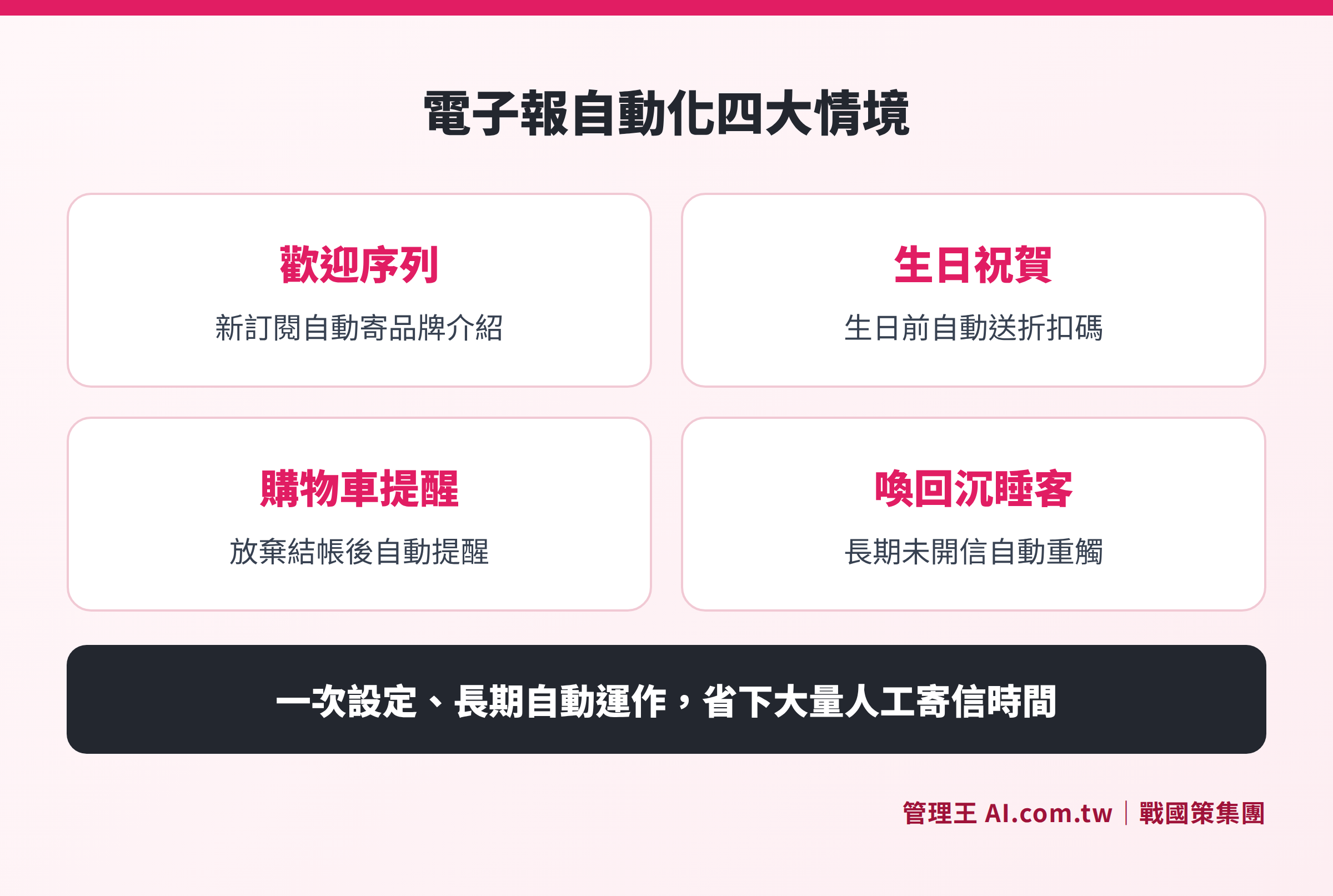
Descriptions of five automation scenarios, including welcome sequences, birthday greetings, and cart reminders
How to Choose an Email Newsletter System? Seven Assessment Criteria
With a plethora of email newsletter tools available in the market, the following seven criteria help Taiwanese companies make the most suitable choice:
1. Does it support local channels in Taiwan?: Foreign tools like Mailchimp and Klaviyo lack integration with LINE official accounts. Since marketing in Taiwan heavily relies on LINE, it's essential to confirm system support.
2. Traditional Chinese Interface and Templates: Ensure that AI content generation is trained for the Taiwanese Traditional Chinese context to avoid Chinese terminology or machine-translated nuances.
3. Compliance Features for Personal Data Protection Act: Must include built-in opt-in records, one-click unsubscription, retention of unsubscription records, and DKIM/DMARC verification settings.
4. Email Sending Cost and Deliverability: The underlying email sending infrastructure (e.g., AWS SES, SendGrid) affects deliverability rates, and the cost can vary widely, necessitating a comparison of costs per thousand emails.
5. Depth of CRM Integration: If the newsletter list is stored separately from the CRM customer data, precise segmentation of the list will be impossible; deeper integration yields better results.
6. Level of Data Tracking Support: Whether it can support UTM tracking, cross-device attribution, and A/B testing is crucial for optimizing strategies based on performance data.
7. Localization of Technical Support: If any issues arise during the usage process, is there a Chinese-speaking customer service available for immediate assistance?
How to Use Management King Email Newsletter System?
Management King's AI.com.tw email newsletter system provides a complete functionality from list building and template design to automated sending, with a free plan available for permanent use. Here’s the operational process:
Step 1 Create Subscription Form: Generate an embedded subscription form in the backend with a single click, fill in brand colors and description text, and copy the code to embed in the official website or blog. New visitors who enter their email are automatically added to the list, and the opt-in timestamp is automatically recorded to comply with personal data protection law requirements.
Step 2 Choose or Customize a Template: Management King provides over 20 categorized templates (for festive promotions, new product launches, educational content, announcements, member exclusives). After selecting a template, modify images, text, and buttons using the drag-and-drop editor, with mobile preview support to confirm layout.
Step 3 AI Subject Suggestions + A/B Testing: Input the email content, and AI will recommend five subject options. A/B testing can be configured (with 20% of each list allocated to observe which version has the higher open rate, then sending that version to the remaining 60% after two hours).
Step 4 Set Sending Schedule: Supports real-time sending or scheduled sending. AI will suggest the best sending times based on historical open rate data, saving adjustment time.
Step 5 View Performance Reports: After sending, deliverability rates, open rates, click rates, and other key indicators update in real time. Clicking on "Most Clicked Links" will directly show the heatmap, optimizing the layout for the next email.
Management King's underlying integration with AWS SES sending mechanism allows costs of less than NT$5 per thousand EDMs, significantly saving costs compared to foreign tools, and the Traditional Chinese interface and localized templates suit the needs of the Taiwanese market. The email newsletter system is natively integrated with Management King's CRM, social scheduling management, advertising management, Landing Page, member points, and coupon center, allowing marketing activities to complete in a closed loop from traffic acquisition to leads nurturing to conversion repurchase, without needing to connect APIs or incurring additional integration costs. Plans range from free to NT$19,900/month flagship version, with flexible options based on needs.
How to Maintain Email Newsletter Deliverability? Technical Settings and List Cleanliness
High deliverability rates are a prerequisite for email newsletter systems to be effective. Regardless of how well-written the text or how targeted the list, if emails end up in the spam folders, it is as if they were never sent. Maintaining deliverability is divided into technical aspects and list management aspects.
Four Technical Settings:
- SPF (Sender Policy Framework): Authorizes which servers can send emails on behalf of your domain in DNS settings to prevent emails from being marked as forged.
- DKIM (DomainKeys Identified Mail): Adds a digital signature in the email headers, allowing the receiving side to verify that the email indeed comes from the claimed domain and has not been altered.
- DMARC (Domain-based Message Authentication, Reporting, and Conformance): Specifies how to handle emails that fail SPF or DKIM verification (whether to quarantine or reject) while sending reports to your domain, allowing you to monitor if someone is impersonating your domain.
- Sending IP Reputation Score: The historical records of the sending IP affect deliverability rates. Choosing an email newsletter system with underlying integration of reputable cloud email services (like AWS SES) can effectively prevent the IP from getting blacklisted.
Three List Management Habits:
- Regularly Remove Hard Bounces: Email addresses that do not exist or have been deactivated should be removed immediately; continued attempts to send will damage the IP's reputation.
- Handle Soft Bounces: Soft bounces occurring three times in a row (mailbox full, temporarily unable to receive) can be moved to an observation list.
- Re-activate or Clear Zombie Subscribers: Subscribers who have not opened emails for over 180 days should receive a confirmation email, and if there is no response, they should be removed to ensure the overall activity level of the list.
The Management King email newsletter system has built-in guidance for automatic SPF/DKIM/DMARC settings and monitors the reputation scores of sending email addresses, minimizing technical thresholds so that marketers without technical backgrounds can complete the setup quickly.
Differences Between Email Newsletter Systems and Social Media Marketing
Many businesses operate both social media and email newsletters; the positioning and advantages of both are clearly different:
Stability of Reach: Social media platform algorithms are constantly adjusting, causing reach rates for the same group of fans to drop from 10% to 2%; emails enter subscribers' mailboxes, making the theoretical reach rate 100% (minus spam filter exclusions).
Ownership of the List: Social media followers belong to the platform; if an account is banned or the platform shuts down, the entire list is lost; email newsletter lists belong to the business and can be exported or migrated to other tools at any time.
Depth of Interaction: Email newsletters are not limited by text length, making them suitable for detailed explanations, instructional content, and long-form case studies; social media posts are more appropriate for short messages and visual impacts.
Conversion Costs: The CTA buttons in email newsletters link directly to purchase pages, minimizing the steps from reading to clicking while remaining in the inbox; social media requires viewing the post, clicking into personal pages, and then finding links, which involve multiple steps.
The best strategy is to complement both: Use social media for attracting new traffic, and then use email newsletters to deepen relationships and drive conversions, with the help of AI automated tools to automatically import social media leads into the CRM list.
Companies already familiar with email newsletter marketing can further explore Landing Page creation and short video marketing to build a more complete digital marketing matrix.
Free Consultation for Email Newsletter Systems
Management King consultants help assess email newsletter system options, covering compliance with personal data protection laws, list building strategies, and automation settings, clarifying needs in 30 minutes.
Free consultation hotline: 0800-003-191
LINE Official Account: @119m
Official Website: app.AI.com.tw
Free Trial: Apply to use Management King now
Frequently Asked Questions
What Size of Business is the Email Newsletter System Suitable For?
The email newsletter system is suitable for all businesses that need to manage customer lists, from solo entrepreneurs to companies with 500 employees. Smaller businesses (under 500 people) can use the free plan to access all core functionalities; larger businesses needing complex automation should opt for advanced paid plans. The core judgment should be: does your business need to regularly communicate promotions, educational content, or announcements with customers? If yes, the email newsletter system can assist.
Can I Use Gmail to Send Bulk Emails?
Gmail personal accounts have a daily sending limit (about 500 emails for regular accounts, 2,000 emails for Google Workspace) and lack tracking features, unsubscription management, and SPF/DKIM settings, making it easy to be marked as spam when sending large volumes. Once a Gmail account is blocked by Google, all business communication will be compromised as well. For formal email newsletter marketing, it’s recommended to use a dedicated email newsletter system.
How to Improve Email Newsletter Open Rates?
The most effective methods, in order, are: (1) Personalizing the subject line (including the subscriber's name or region); (2) Optimizing preview text (Preheader) to supplement unfinished points from the subject line; (3) Using a real person's name as the sender name; (4) Testing sending times (it is suggested to A/B test Tuesday 10 AM vs. Thursday 1 PM); (5) Regularly clearing out zombie email addresses that have not opened for over 180 days to improve overall list health.
What is the Approximate Cost of Email Newsletter Systems?
The Management King email newsletter system operates on a subscription basis: free plan available for permanent use (basic functionalities including one-time AI credits); Economy plan NT$5,000/month (30 people), Business plan NT$10,000/month (60 people), Flagship plan NT$19,900/month (unlimited members). Annual payment offers 14 months at a 12-month rate (pay for 12 months, use for 14). If customized features are needed, transparent pricing is set at NT$1,000/hour. Please refer to the Management King Pricing Page for detailed plans.
Can the Email Newsletter System Integrate with Existing CRM or E-commerce Systems?
Yes. Management King provides REST API and Webhook interfaces, supporting integration with mainstream tools like HubSpot, Salesforce, Mailchimp, Shopify, and more. Local tools in Taiwan (ECPAY, Neweb, electronic invoice systems) also have built-in integrations. If using Management King's own CRM system, native integration requires no extra setup, and customer data is naturally interoperable.
Data Sources
- Personal Data Protection Act (National Regulations Database) — Articles 19 and 20, regulations on consent and unsubscription for email newsletter marketing
- Mailchimp Email Marketing Benchmarks & Statistics — Average open rates and click rates for various industries (2024)
- Management King AI.com.tw Email Newsletter System Features Page — Function introduction, plan descriptions
- Management King AI.com.tw Service Plans and Pricing — Price query date: October 2026
This article is for general information and does not constitute legal advice; personal data protection regulations should refer to the latest announcements from the Ministry of Justice and the Personal Data Protection Commission.